

 登录
登录
二、任务型阅读 “书圣”王羲之
素养:文化意识 难度:中 用时:9分钟
跨学科·历史 Wang Xizhi used to have a job as an officer of the Jin Dynasty. However, he is best known for his unbelievable skills in calligraphy. He was so talented and became the most famous calligrapher of his time. For his brilliant achievements, he is still remembered and respected as the “Sage(圣人) of Calligraphy”. Wang’s uncles and cousins were all famous calligraphers of their time. At seven, Wang began learning calligraphy from a female calligrapher, Wei Shuo.
Wang was such a hard-working student that he tried his best to improve his skills in calligraphy. He kept copying the Wei-style calligraphy for years and learned much from her works. In addition, when coming up with some good ideas, he would write them down at any time.
In 353, Wang invited famous people to gather at the Orchid Pavilion. The guests were asked to write poems while drinking. After collecting all the poems, Wang wrote xingshu-style Preface to the Orchid Pavilion Collection(《兰亭集序》) on his own, describing how happy these men were. Wang’s Preface to the Orchid Pavilion Collection is more popular than his other artworks. His talents in calligraphy were fully shown in this work.
Wang Xizhi set a great example for calligraphers who came after him. His style became the model that many calligraphers followed for centuries. His work, Preface to the Orchid Pavilion Collection, is more than a piece of art. It is a timeless treasure that continues to inspire all who love Chinese culture. Even now, his work is widely studied by students and artists because it symbolizes the Chinese culture.
根据短文内容,回答下列问题
1. What is Wang Xizhi best known for?
2. When did Wang Xizhi begin studying calligraphy under Wei Shuo?
3. How did Wang Xizhi improve his skills in calligraphy? (写出一个答案即可)
4. Among Wang Xizhi’s works, which one is the most popular?
5. 新考法·开放性设问 What do you think of Wang Xizhi? What can you learn from him?
素养:文化意识 难度:中 用时:9分钟
跨学科·历史 Wang Xizhi used to have a job as an officer of the Jin Dynasty. However, he is best known for his unbelievable skills in calligraphy. He was so talented and became the most famous calligrapher of his time. For his brilliant achievements, he is still remembered and respected as the “Sage(圣人) of Calligraphy”. Wang’s uncles and cousins were all famous calligraphers of their time. At seven, Wang began learning calligraphy from a female calligrapher, Wei Shuo.
Wang was such a hard-working student that he tried his best to improve his skills in calligraphy. He kept copying the Wei-style calligraphy for years and learned much from her works. In addition, when coming up with some good ideas, he would write them down at any time.
In 353, Wang invited famous people to gather at the Orchid Pavilion. The guests were asked to write poems while drinking. After collecting all the poems, Wang wrote xingshu-style Preface to the Orchid Pavilion Collection(《兰亭集序》) on his own, describing how happy these men were. Wang’s Preface to the Orchid Pavilion Collection is more popular than his other artworks. His talents in calligraphy were fully shown in this work.
Wang Xizhi set a great example for calligraphers who came after him. His style became the model that many calligraphers followed for centuries. His work, Preface to the Orchid Pavilion Collection, is more than a piece of art. It is a timeless treasure that continues to inspire all who love Chinese culture. Even now, his work is widely studied by students and artists because it symbolizes the Chinese culture.
根据短文内容,回答下列问题
1. What is Wang Xizhi best known for?
His unbelievable skills in calligraphy.
2. When did Wang Xizhi begin studying calligraphy under Wei Shuo?
At seven.
3. How did Wang Xizhi improve his skills in calligraphy? (写出一个答案即可)
He kept copying the Wei-style calligraphy for years./He learned much from Wei Shuo's works./When coming up with some good ideas, he would write them down at any time.
4. Among Wang Xizhi’s works, which one is the most popular?
Preface to the Orchid Pavilion Collection.
5. 新考法·开放性设问 What do you think of Wang Xizhi? What can you learn from him?
He was talented and hard-working. I should work harder and keep practicing in the future.(答案合理即可)
答案
语篇研读
主题和内容
本文主要介绍了书法家王羲之的生平背景、书法学习经历、《兰亭集序》的诞生及其影响等内容。
意义和价值
学生可通过本文了解王羲之的书法成就与《兰亭集序》的文化价值,学习他刻苦练习书法的精神,感受中国书法艺术的魅力。
方式和方法
语篇类型:本文是一篇人物传记,主要介绍了书法家王羲之。引导学生学习人物传记的写作方法。
篇章结构:本文按“生平背景—学习经历—代表作—深远影响”的顺序展开。第一段交代生平背景;第二段描述其书法学习经历,展现他的勤奋与坚持;第三段介绍王羲之代表作《兰亭集序》的相关信息;第四段阐述王羲之及作品的深远影响。
亮点表达:本文借助“such ... that ...”句式、短语“keep doing sth for years”等,彰显王羲之的勤奋与坚持;用短语“set a great example for”点明王羲之对后世书法家的榜样作用。
1. His unbelievable skills in calligraphy.
2. At seven.
3. He kept copying the Wei-style calligraphy for years./He learned much from Wei Shuo's works./When coming up with some good ideas, he would write them down at any time.
4. Preface to the Orchid Pavilion Collection.
5. He was talented and hard-working. I should work harder and keep practicing in the future.(答案合理即可)
主题和内容
本文主要介绍了书法家王羲之的生平背景、书法学习经历、《兰亭集序》的诞生及其影响等内容。
意义和价值
学生可通过本文了解王羲之的书法成就与《兰亭集序》的文化价值,学习他刻苦练习书法的精神,感受中国书法艺术的魅力。
方式和方法
语篇类型:本文是一篇人物传记,主要介绍了书法家王羲之。引导学生学习人物传记的写作方法。
篇章结构:本文按“生平背景—学习经历—代表作—深远影响”的顺序展开。第一段交代生平背景;第二段描述其书法学习经历,展现他的勤奋与坚持;第三段介绍王羲之代表作《兰亭集序》的相关信息;第四段阐述王羲之及作品的深远影响。
亮点表达:本文借助“such ... that ...”句式、短语“keep doing sth for years”等,彰显王羲之的勤奋与坚持;用短语“set a great example for”点明王羲之对后世书法家的榜样作用。
1. His unbelievable skills in calligraphy.
2. At seven.
3. He kept copying the Wei-style calligraphy for years./He learned much from Wei Shuo's works./When coming up with some good ideas, he would write them down at any time.
4. Preface to the Orchid Pavilion Collection.
5. He was talented and hard-working. I should work harder and keep practicing in the future.(答案合理即可)
解析
【分析】做任务型阅读时,先通读全文梳理主旨,再根据每个问题的关键词回原文定位对应语句,提取准确信息;开放性问题需结合原文中王羲之的品质,合理组织语言作答,确保答案符合要求。
【解析】1. 定位原文第一段第二句“However, he is best known for his unbelievable skills in calligraphy.”,直接提取答案。2. 定位原文第一段最后一句“At seven, Wang began learning calligraphy from a female calligrapher, Wei Shuo.”,提取时间信息。3. 定位原文第二段,找到王羲之提高书法技能的方式,任选其一作答即可。4. 定位原文第三段“Wang’s Preface to the Orchid Pavilion Collection is more popular than his other artworks.”,提取最受欢迎的作品。5. 开放性设问,结合原文中王羲之“talented”“hard-working”等品质,组织合理的回答即可。
【答案】
1. His unbelievable skills in calligraphy.
2. At seven.
3. He kept copying the Wei-style calligraphy for years.
4. Preface to the Orchid Pavilion Collection.
5. He was talented and hard-working. I should work harder and keep practicing in the future.
【知识点】任务型阅读、英语阅读理解、中国传统文化
【点评】本题为任务型阅读,围绕中国传统文化人物王羲之展开,既考查学生对文章细节信息的定位与提取能力,又设置开放性问题考查学生的理解与表达能力,引导学生学习王羲之勤奋刻苦的品质,感受中国书法文化的魅力。
【难度系数】0.6
【解析】1. 定位原文第一段第二句“However, he is best known for his unbelievable skills in calligraphy.”,直接提取答案。2. 定位原文第一段最后一句“At seven, Wang began learning calligraphy from a female calligrapher, Wei Shuo.”,提取时间信息。3. 定位原文第二段,找到王羲之提高书法技能的方式,任选其一作答即可。4. 定位原文第三段“Wang’s Preface to the Orchid Pavilion Collection is more popular than his other artworks.”,提取最受欢迎的作品。5. 开放性设问,结合原文中王羲之“talented”“hard-working”等品质,组织合理的回答即可。
【答案】
1. His unbelievable skills in calligraphy.
2. At seven.
3. He kept copying the Wei-style calligraphy for years.
4. Preface to the Orchid Pavilion Collection.
5. He was talented and hard-working. I should work harder and keep practicing in the future.
【知识点】任务型阅读、英语阅读理解、中国传统文化
【点评】本题为任务型阅读,围绕中国传统文化人物王羲之展开,既考查学生对文章细节信息的定位与提取能力,又设置开放性问题考查学生的理解与表达能力,引导学生学习王羲之勤奋刻苦的品质,感受中国书法文化的魅力。
【难度系数】0.6
【语篇解构】阅读文章,补充下面的结构图(每空一词)
background
▲being born into a calligraphers’ family
▲working as an officer
learning experiences
▲studying calligraphy at 1.
▲copying for years and learning from Wei’s works
▲practicing frequently, and recording his 2.
The Introduction to Wang Xizhi
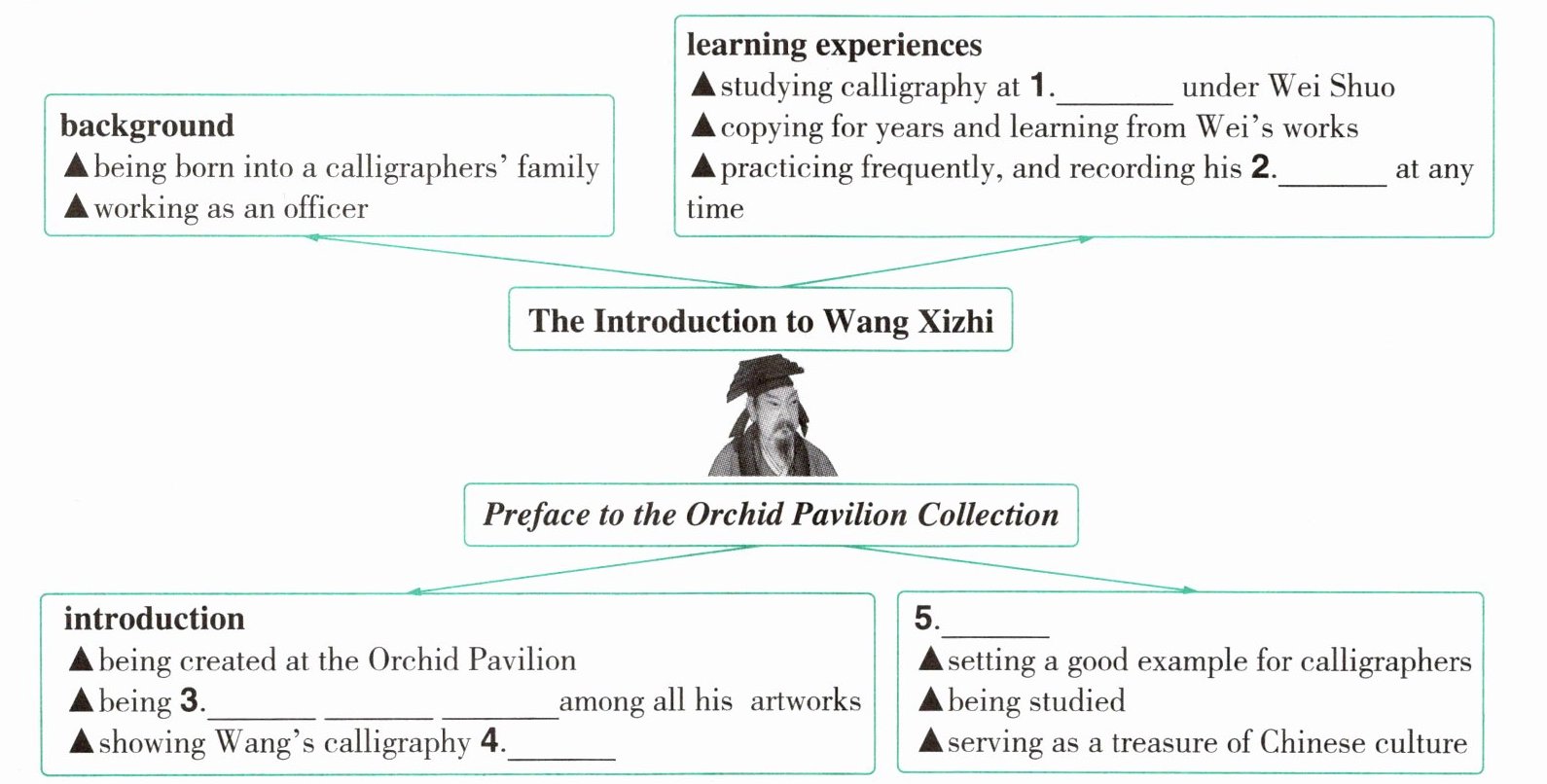
Preface to the Orchid Pavilion Collection
introduction
▲being created at the Orchid Pavilion
▲being 3.
▲showing Wang’s calligraphy 4.
5.
▲setting a good example for calligraphers
▲being studied
▲serving as a treasure of Chinese culture
注:人物传记类语篇研读见答案 P31
background
▲being born into a calligraphers’ family
▲working as an officer
learning experiences
▲studying calligraphy at 1.
seven
under Wei Shuo▲copying for years and learning from Wei’s works
▲practicing frequently, and recording his 2.
inspiration/thoughts/ideas
at any timeThe Introduction to Wang Xizhi
Preface to the Orchid Pavilion Collection
introduction
▲being created at the Orchid Pavilion
▲being 3.
the
most
popular
among all his artworks▲showing Wang’s calligraphy 4.
talents
5.
influence
▲setting a good example for calligraphers
▲being studied
▲serving as a treasure of Chinese culture
注:人物传记类语篇研读见答案 P31
答案
【语篇解构】 1. seven 2. inspiration/thoughts/ideas
3. the most popular 4. talents 5. influence
3. the most popular 4. talents 5. influence
解析
【分析】本题为语篇解构题,需结合王羲之的生平常识及《兰亭集序》的相关信息,根据结构图各模块的提示,逐一分析每个空缺处的内容:1空对应跟随卫夫人学书法的年龄,2空对应练习时记录的内容,3空对应《兰亭集序》在其作品中的地位,4空对应作品展现的书法特质,5空对应《兰亭集序》的作用。
【解析】1. 王羲之七岁时跟随卫夫人学习书法,故填seven;2. 练习书法时需随时记录灵感、想法等,故填inspiration/thoughts/ideas;3. 《兰亭集序》是王羲之最受欢迎的作品,故填the most popular;4. 该作品展现了王羲之的书法才能,故填talents;5. 右侧内容均为《兰亭集序》的影响,故填influence。
【答案】1. seven 2. inspiration/thoughts/ideas 3. the most popular 4. talents 5. influence
【知识点】语篇解构、人物传记阅读、文化常识
【点评】本题以结构图形式考查对人物相关知识及语篇信息的梳理,结合常识与逻辑即可解答,难度适中。
【难度系数】0.6
【解析】1. 王羲之七岁时跟随卫夫人学习书法,故填seven;2. 练习书法时需随时记录灵感、想法等,故填inspiration/thoughts/ideas;3. 《兰亭集序》是王羲之最受欢迎的作品,故填the most popular;4. 该作品展现了王羲之的书法才能,故填talents;5. 右侧内容均为《兰亭集序》的影响,故填influence。
【答案】1. seven 2. inspiration/thoughts/ideas 3. the most popular 4. talents 5. influence
【知识点】语篇解构、人物传记阅读、文化常识
【点评】本题以结构图形式考查对人物相关知识及语篇信息的梳理,结合常识与逻辑即可解答,难度适中。
【难度系数】0.6
