

 登录
Ⅰ. Complete the words according to the phonetic symbols and match the pictures. 根据音标补全单词,并与相应的图片配对。
(
(
(
(
(
(

(
F
)1. /pɔːk/ po
r
k(
D
)2. /blɒg/ blo
g(
C
)3. /nɔːθ/ no
r
th(
B
)4. /ʃɒkt/ sho
cked(
A
)5. /səˈpɔːt/ suppo
r
t(
E
)6. /ˈprɒbləm/ pro
blem答案
1. F, pork
2. D, blog
3. C, north
4. B, shocked
5. A, support
6. E, problem
2. D, blog
3. C, north
4. B, shocked
5. A, support
6. E, problem
解析
【分析】
本题需要根据给出的音标补全单词,再结合单词含义匹配对应图片。解题时,先根据音标和已有字母确定缺失的字母,补全单词;再理解每个单词的意思,对应图片的内容,完成配对。
【解析】
1. 音标/pɔːk/对应单词pork,缺失字母为or,图片F是猪肉,故配对F;
2. 音标/blɒg/对应单词blog,缺失字母为o,图片D是博客页面,故配对D;
3. 音标/nɔːθ/对应单词north,缺失字母为or,图片C是指南针(指向北方),故配对C;
4. 音标/ʃɒkt/对应单词shocked,缺失字母为o,图片B是惊讶的表情,故配对B;
5. 音标/səˈpɔːt/对应单词support,缺失字母为or,图片A是点赞(表示支持),故配对A;
6. 音标/ˈprɒbləm/对应单词problem,缺失字母为o,图片E是困惑的表情(对应问题),故配对E。
【答案】
1. F, pork
2. D, blog
3. C, north
4. B, shocked
5. A, support
6. E, problem
【知识点】
英语单词拼写、音标对应单词、图文匹配
【点评】
本题考查根据音标补全单词并进行图文匹配,需掌握常见单词的音标和词义,结合图片内容完成配对,难度适中。
【难度系数】
0.6
Ⅱ. Complete the sentences with the proper form of the words and expression in the box. 用方框中所给单词或短语的适当形式完成句子。
celebrate plastic pollution waste throw away
1. Buying too many clothes is a
2. Try not to use
3. Cars, buses and trains can cause much air
4. This year, Sally
5. Don’t
celebrate plastic pollution waste throw away
1. Buying too many clothes is a
waste
of money.2. Try not to use
plastic
bags when we go shopping.3. Cars, buses and trains can cause much air
pollution
.4. This year, Sally
is going to / will celebrate
the festival in a green way.5. Don’t
throw away
food, because you can share it with others.答案
1. waste
2. plastic
3. pollution
4. is going to / will celebrate
5. throw away
2. plastic
3. pollution
4. is going to / will celebrate
5. throw away
解析
【分析】
本题要求用方框内单词或短语的适当形式完成句子,解题思路为:先理解每个句子的句意,再结合句子的语法结构(如词性、时态、固定搭配、句子成分),从方框中匹配合适的词汇并调整形式,确保符合句子逻辑和语法要求。
【解析】
1. 句意:买太多衣服是浪费钱。不定冠词a后需接名词,方框中waste作名词意为“浪费”,符合语境,故填waste。
2. 句意:购物时尽量不用塑料袋。修饰名词bags需用形容词,plastic作形容词意为“塑料的”,符合搭配,故填plastic。
3. 句意:汽车、公交和火车会造成大量空气污染。air pollution是固定搭配,意为“空气污染”,方框中pollution为名词,符合要求,故填pollution。
4. 句意:今年,Sally将用绿色方式庆祝这个节日。句子缺谓语,时间状语this year表将来,方框中celebrate的将来形式will celebrate或is going to celebrate均符合,故填will celebrate / is going to celebrate。
5. 句意:不要扔掉食物,因为你可以和别人分享。祈使句否定形式Don’t后接动词原形,方框中throw away是动词短语,意为“扔掉”,符合语境,故填throw away。
【答案】
1. waste
2. plastic
3. pollution
4. will celebrate / is going to celebrate
5. throw away
【知识点】
单词适当形式填空,名词、形容词用法,动词时态
【点评】
本题为基础词汇运用题,侧重考查学生对核心词汇的词性、词义及基本语法的掌握,难度适中,是英语学习的基础题型。
【难度系数】
0.6
Ⅲ. Read and complete the tasks. 阅读并完成任务。
Lingling: Henry, do you know the Qingming Festival?
Henry: Yes. It’s a public holiday in China.
Lingling: You’re right. It falls on April 4th, 5th or 6th of each year. And it’s also called the Tomb-sweeping Day.
Henry: The Tomb-sweeping Day? Can you tell me more about it?
Lingling: Sure. On that day, we visit the tombs of our ancestors(祖先) and burn paper money. Also, we put flowers, fruit and food in front of the tombs. These are our ways to remember our ancestors.
Henry: That’s meaningful. Thank you for telling me so much.
Lingling: You’re welcome.
A. Complete the notes. 完成信息记录表。
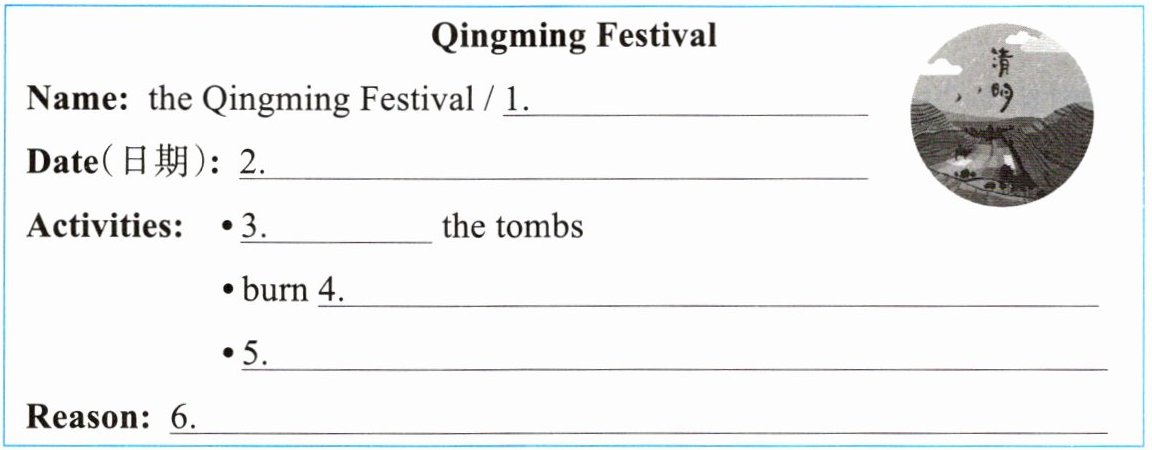
Qingming Festival
Name: the Qingming Festival / 1.
Date(日期): 2.
Activities: • 3. the tombs
• burn 4.
• 5.
Reason: 6.
Lingling: Henry, do you know the Qingming Festival?
Henry: Yes. It’s a public holiday in China.
Lingling: You’re right. It falls on April 4th, 5th or 6th of each year. And it’s also called the Tomb-sweeping Day.
Henry: The Tomb-sweeping Day? Can you tell me more about it?
Lingling: Sure. On that day, we visit the tombs of our ancestors(祖先) and burn paper money. Also, we put flowers, fruit and food in front of the tombs. These are our ways to remember our ancestors.
Henry: That’s meaningful. Thank you for telling me so much.
Lingling: You’re welcome.
A. Complete the notes. 完成信息记录表。
Qingming Festival
Name: the Qingming Festival / 1.
Date(日期): 2.
Activities: • 3. the tombs
• burn 4.
• 5.
Reason: 6.
答案
A.
1. the Tomb-sweeping Day
2. on April 4th, 5th or 6th
3. visit
4. paper money
5. put flowers, fruit and food in front of the tombs
6. to remember our ancestors
1. the Tomb-sweeping Day
2. on April 4th, 5th or 6th
3. visit
4. paper money
5. put flowers, fruit and food in front of the tombs
6. to remember our ancestors
解析
【分析】本题是根据对话内容补全清明节信息表格的题目,解题时需先通读对话,明确每个空格对应的信息类别(名称、日期、活动、原因),再定位对话中相关语句,提取对应内容填入空格即可。
【解析】1. 对话提到清明节也叫Tomb-sweeping Day,对应名称栏;2. 对话说明清明节在每年4月4日、5日或6日,对应日期栏;3. 对话提到人们会“visit the tombs”,对应第一个活动;4. 对话提到“burn paper money”,对应第二个活动;5. 对话还提到“put flowers, fruit and food in front of the tombs”,对应第三个活动;6. 对话说明这些活动是为了“remember our ancestors”,对应原因栏。
【答案】1. the Tomb-sweeping Day;2. on April 4th, 5th or 6th;3. visit;4. paper money;5. put flowers, fruit and food in front of the tombs;6. to remember our ancestors
【知识点】英语阅读填空、节日文化
【点评】本题结合对话考查中国传统节日清明节的相关知识,要求学生从原文中提取关键信息完成表格,侧重信息定位能力,难度适中。
【难度系数】0.7
