

 登录
登录
考向1 实用性文本 以诗歌、海报、地图等新的文本形式来呈现,考查学生在日常生活中应用英语的能力。
[2025 江苏宿迁中考]The following form is a simulated(模拟的)high-speed train schedule from Suqian to six cities.
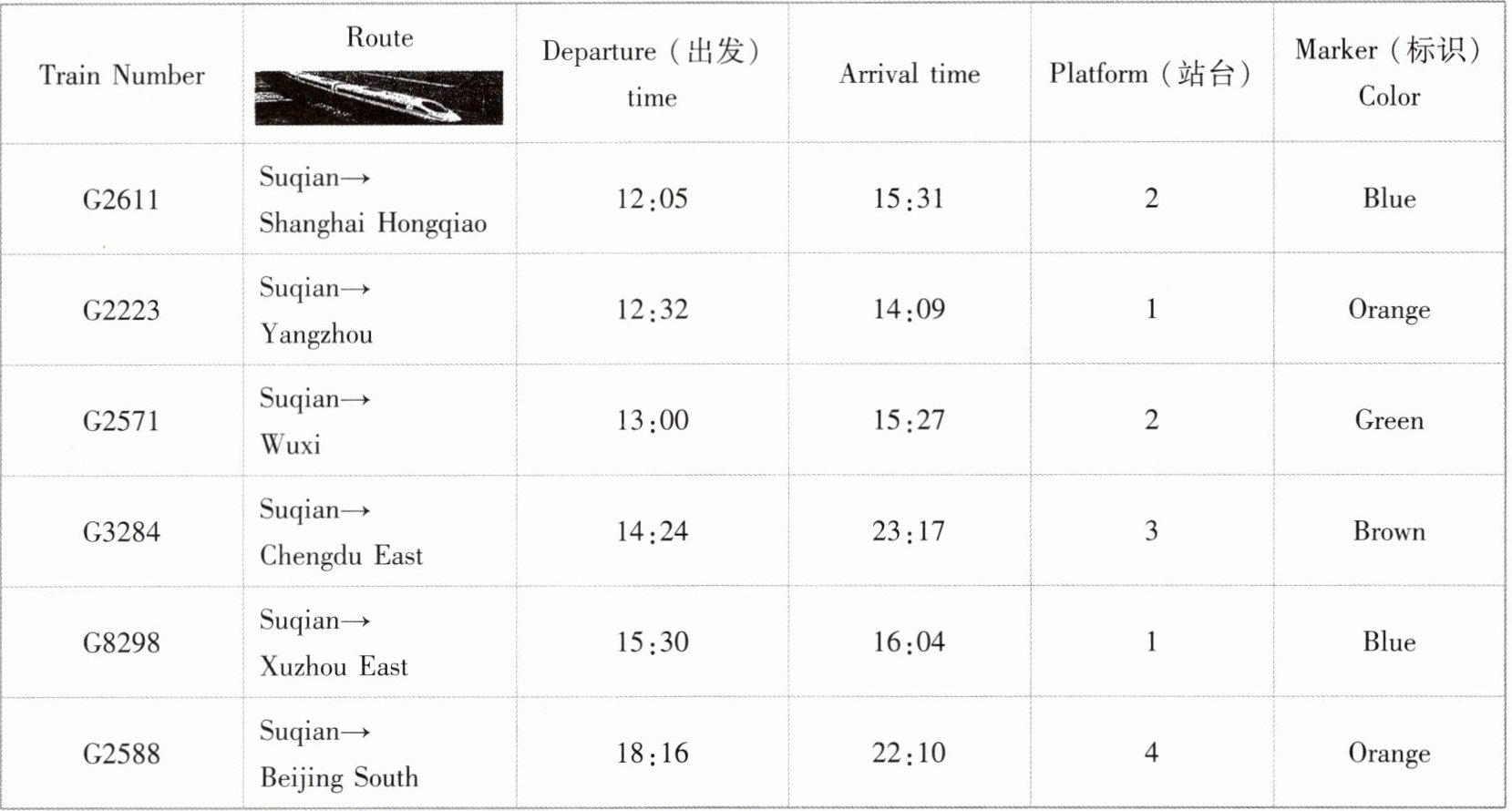
(
A. G2223.
B. G2611.
C. G2588.
D. G3284.
(
A. Brown.
B. Blue.
C. Green.
D. Orange.
(
A. 206 minutes.
B. 147 minutes.
C. 97 minutes.
D. 34 minutes.
[2025 江苏宿迁中考]The following form is a simulated(模拟的)high-speed train schedule from Suqian to six cities.
(
B
)1. Which of the following high-speed trains is from Suqian to Shanghai Hongqiao?A. G2223.
B. G2611.
C. G2588.
D. G3284.
(
C
)2. What marker color should you follow on Platform 2 if your train number is G2571?A. Brown.
B. Blue.
C. Green.
D. Orange.
(
D
)3. How long does it take from Suqian to Xuzhou East by G8298 train?A. 206 minutes.
B. 147 minutes.
C. 97 minutes.
D. 34 minutes.
答案
1. B 细节理解题。根据表格中 G2611 对应的“Suqian→Shanghai Hongqiao”可知,从宿迁到上海虹桥的高铁是 G2611。故选 B 项。
2. C 细节理解题。根据表格中 G2571 对应的 Green 可知,如果车次是 G2571,在 2 号站台应跟随的标识颜色是绿色。故选 C 项。
3. D 细节理解题。根据表格中 G8298 对应的“Suqian → Xuzhou East”及 15:30 和 16:04 可知,G8298 次列车 15:30 从宿迁出发,16:04 到达徐州东,总共花费 34 分钟。故选 D 项。
2. C 细节理解题。根据表格中 G2571 对应的 Green 可知,如果车次是 G2571,在 2 号站台应跟随的标识颜色是绿色。故选 C 项。
3. D 细节理解题。根据表格中 G8298 对应的“Suqian → Xuzhou East”及 15:30 和 16:04 可知,G8298 次列车 15:30 从宿迁出发,16:04 到达徐州东,总共花费 34 分钟。故选 D 项。
解析
【分析】本题为实用性文本阅读中的细节理解题,需根据题目问题,在表格中精准定位对应行与列的信息,逐一匹配答案即可。第1题需找宿迁到上海虹桥的车次,第2题需找G2571车次对应的标识颜色,第3题需计算G8298次列车的行驶时长,均通过表格信息直接提取或简单计算得出。
【解析】1. 定位表格中“Route”列,Suqian→Shanghai Hongqiao对应的车次为G2611,因此选B。2. 定位表格中“Train Number”为G2571的行,其“Marker Color”列的值为Green,因此选C。3. G8298次列车出发时间为15:30,到达时间为16:04,行驶时长为16时04分 -15时30分=34分钟,因此选D。
【答案】1.B 2.C 3.D
【知识点】细节理解题、信息定位、时间计算
【点评】本题是中考常见的表格信息类阅读题,侧重考查学生快速提取和处理表格信息的能力,题目难度较低,只要仔细对应表格内容即可正确解答。
【难度系数】0.8
【解析】1. 定位表格中“Route”列,Suqian→Shanghai Hongqiao对应的车次为G2611,因此选B。2. 定位表格中“Train Number”为G2571的行,其“Marker Color”列的值为Green,因此选C。3. G8298次列车出发时间为15:30,到达时间为16:04,行驶时长为16时04分 -15时30分=34分钟,因此选D。
【答案】1.B 2.C 3.D
【知识点】细节理解题、信息定位、时间计算
【点评】本题是中考常见的表格信息类阅读题,侧重考查学生快速提取和处理表格信息的能力,题目难度较低,只要仔细对应表格内容即可正确解答。
【难度系数】0.8
考向2 跨学科综合 实现了英语与其他学科的结合,考查学生对不同学科的知识融会贯通的能力。
[2025 江苏盐城中考]What do you think will happen if you draw a picture with crayons and cover up that picture with paint? Now follow the steps below to find out the answer.
What you need
crayons of different colours
drawing paper
blue poster paint
中考新考向备训
a small bowl
a cup filled with water
a paintbrush
How to do it
Step 1
Think about a scene under the sea with different-coloured fish and sea plants. And then draw the fish and sea plants with your crayons. The more colours you use, the better your picture will be.
Step 2
Pour a little blue paint into the bowl. Add a bit of water and stir (搅拌) to make your paint a little thinner.
Step 3
Dip your brush into the blue paint in the bowl. Cover your whole picture with the blue paint. What happens? You have sea plants and animals living in a blue sea!
Why it happens
Your crayons are made of wax (蜡). Wax resists, or stays away from the paint. That's why it does not cover the picture. So your sea plants and fish are still there.
(
A. A paintbrush.
B. Different crayons.
C. A small bowl.
D. Some blue paint.
(

(
A. Paper.
B. Water.
C. The bowl.
D. The paint.
[2025 江苏盐城中考]What do you think will happen if you draw a picture with crayons and cover up that picture with paint? Now follow the steps below to find out the answer.
What you need
crayons of different colours
drawing paper
blue poster paint
中考新考向备训
a small bowl
a cup filled with water
a paintbrush
How to do it
Step 1
Think about a scene under the sea with different-coloured fish and sea plants. And then draw the fish and sea plants with your crayons. The more colours you use, the better your picture will be.
Step 2
Pour a little blue paint into the bowl. Add a bit of water and stir (搅拌) to make your paint a little thinner.
Step 3
Dip your brush into the blue paint in the bowl. Cover your whole picture with the blue paint. What happens? You have sea plants and animals living in a blue sea!
Why it happens
Your crayons are made of wax (蜡). Wax resists, or stays away from the paint. That's why it does not cover the picture. So your sea plants and fish are still there.
(
B
)1. Which tool is needed for Step 1?A. A paintbrush.
B. Different crayons.
C. A small bowl.
D. Some blue paint.
(
C
)2. 新考法 图示理解 Which picture shows what you do in Step 2?(
D
)3. What does the underlined word "it" in the last part mean?A. Paper.
B. Water.
C. The bowl.
D. The paint.
答案
1. B 细节理解题。根据 Step 1 下面的“And then draw the fish and sea plants with your crayons.”可知,需要用到的是不同颜色的蜡笔。故选 B 项。
2. C 细节理解题。根据 Step 2 下的内容可知,第二步是“将蓝色颜料和水倒入碗中并搅拌”,选项 C 符合题意。故选 C 项。
3. D 词义猜测题。根据“Your crayons are made of wax. Wax resists, or stays away from the paint. That's why it does not cover the picture.”可知,颜料因为被蜡排斥而无法覆盖蜡笔画的内容,因此 it 指代的是 the paint。故选 D 项。
2. C 细节理解题。根据 Step 2 下的内容可知,第二步是“将蓝色颜料和水倒入碗中并搅拌”,选项 C 符合题意。故选 C 项。
3. D 词义猜测题。根据“Your crayons are made of wax. Wax resists, or stays away from the paint. That's why it does not cover the picture.”可知,颜料因为被蜡排斥而无法覆盖蜡笔画的内容,因此 it 指代的是 the paint。故选 D 项。
解析
【分析】
本题为跨学科英语阅读理解题,包含细节理解题、图示理解题和词义猜测题。解题时需先通读原文,针对每个问题定位对应原文内容,逐一分析选项:第1题定位Step1的工具要求;第2题匹配Step2的操作与图示;第3题分析代词指代的逻辑关系。
【解析】
1. 第1题:根据Step1中“And then draw the fish and sea plants with your crayons.”可知,Step1需要用到不同颜色的蜡笔,对应选项B。
2. 第2题:Step2的操作是“将少量蓝色颜料倒入碗中,加一点水并搅拌”,观察图示,A为准备实验装置、B为对着画、C为向碗中倒液体并搅拌、D为查看画,符合Step2操作的是选项C。
3. 第3题:最后一段提到“Wax resists, or stays away from the paint. That's why it does not cover the picture.”,逻辑为蜡排斥颜料,所以颜料无法覆盖画,因此it指代the paint,对应选项D。
【答案】
1.B 2.C 3.D
【知识点】
英语阅读理解、细节理解题、词义猜测题
【点评】
本题结合跨学科内容,考查学生的信息定位能力与逻辑分析能力,需准确提取原文信息并理解图示、代词的含义,整体难度适中。
【难度系数】
0.6
本题为跨学科英语阅读理解题,包含细节理解题、图示理解题和词义猜测题。解题时需先通读原文,针对每个问题定位对应原文内容,逐一分析选项:第1题定位Step1的工具要求;第2题匹配Step2的操作与图示;第3题分析代词指代的逻辑关系。
【解析】
1. 第1题:根据Step1中“And then draw the fish and sea plants with your crayons.”可知,Step1需要用到不同颜色的蜡笔,对应选项B。
2. 第2题:Step2的操作是“将少量蓝色颜料倒入碗中,加一点水并搅拌”,观察图示,A为准备实验装置、B为对着画、C为向碗中倒液体并搅拌、D为查看画,符合Step2操作的是选项C。
3. 第3题:最后一段提到“Wax resists, or stays away from the paint. That's why it does not cover the picture.”,逻辑为蜡排斥颜料,所以颜料无法覆盖画,因此it指代the paint,对应选项D。
【答案】
1.B 2.C 3.D
【知识点】
英语阅读理解、细节理解题、词义猜测题
【点评】
本题结合跨学科内容,考查学生的信息定位能力与逻辑分析能力,需准确提取原文信息并理解图示、代词的含义,整体难度适中。
【难度系数】
0.6
