

 登录
七、[跨学科] 阅读理解 主题:人与自然——自然生态 学科素养:思维品质 词数:约160 建议用时:6分钟
Do a science experiment to see how rain forms. You will need: a glass jar (罐), hot water, a plate and ice cubes (冰块).
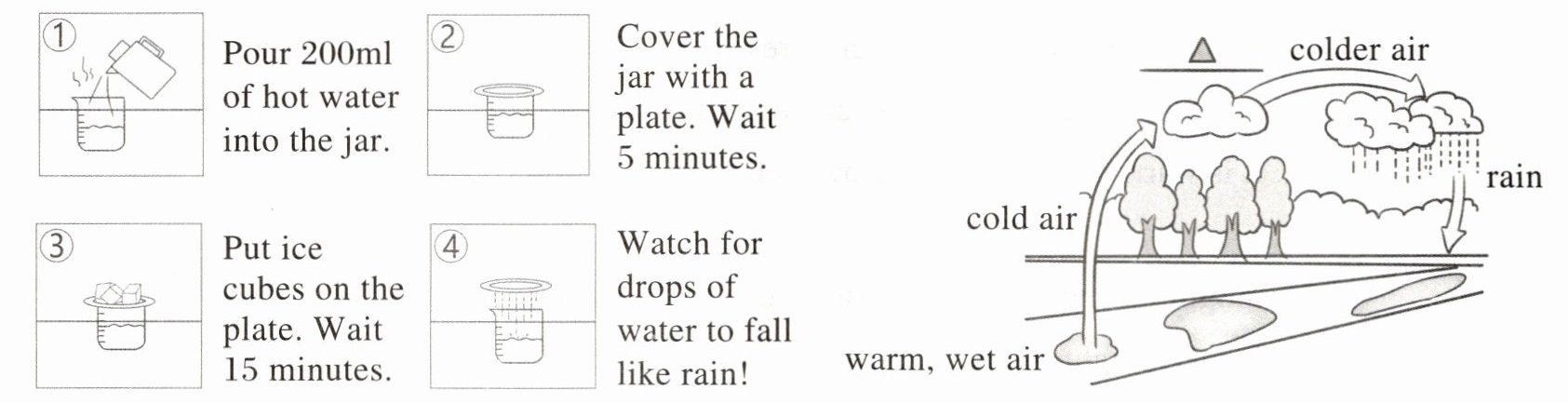
What happens in the jar?
Hot water makes warm, wet air called steam (水蒸气). Steam rises up to the cold plate. The cold air near the plate changes the steam into water. Then, heavy drops of water fall.
What happens in the sky?
The sun heats the water. The warm, wet air rises up into the sky. If the warm, wet air meets the cold air, rain clouds will form. When the clouds have enough water, the drops fall onto the ground as rain.
(
A. Ice cubes → A plate → A jar, hot water.
B. A jar, hot water → Ice cubes → A plate.
C. A jar, hot water → A plate → Ice cubes.
D. Ice cubes → A jar, hot water → A plate.
(
A. About five minutes.
B. About ten minutes.
C. About fifteen minutes.
D. About twenty minutes.
(
A. the melting ice cubes
B. the warm, wet air
C. the rain clouds
D. the cold air
(
A. wet air
B. hot wind
C. rain clouds
D. water drops
(
A. The history class.
B. The chemistry class.
C. The maths class.
D. The physics class.
Do a science experiment to see how rain forms. You will need: a glass jar (罐), hot water, a plate and ice cubes (冰块).
What happens in the jar?
Hot water makes warm, wet air called steam (水蒸气). Steam rises up to the cold plate. The cold air near the plate changes the steam into water. Then, heavy drops of water fall.
What happens in the sky?
The sun heats the water. The warm, wet air rises up into the sky. If the warm, wet air meets the cold air, rain clouds will form. When the clouds have enough water, the drops fall onto the ground as rain.
(
C
) 1. Which of the following is the right order of using the objects in the experiment?A. Ice cubes → A plate → A jar, hot water.
B. A jar, hot water → Ice cubes → A plate.
C. A jar, hot water → A plate → Ice cubes.
D. Ice cubes → A jar, hot water → A plate.
(
D
) 2. How long does it take to see raindrops in this experiment?A. About five minutes.
B. About ten minutes.
C. About fifteen minutes.
D. About twenty minutes.
(
B
) 3. From the passage we can know the drops of water in the experiment come from .A. the melting ice cubes
B. the warm, wet air
C. the rain clouds
D. the cold air
(
C
) 4. 新考法·内容还原 Which of the following should be put into “ ▲ ”?A. wet air
B. hot wind
C. rain clouds
D. water drops
(
D
) 5. In which class will you probably do this experiment?A. The history class.
B. The chemistry class.
C. The maths class.
D. The physics class.
答案
【主旨大意】本文主要介绍了人工造雨实验,并解释了雨水形成的原理。
1. C 【点拨】细节理解题。根据“Pour 200ml of hot water into the jar.”,“Cover the jar with a plate. Wait 5 minutes.”,“Put ice cubes on the plate. Wait 15 minutes.” 和“Watch for drops of water to fall like rain!”可知,实验时,先往罐子里倒入200毫升热水;用一个盘子盖住罐子,等待5分钟;把冰块放在盘子上,再等15分钟;然后就可以观察到水滴像雨一样落下。故选C。
2. D 【点拨】细节理解题。根据“Cover the jar with a plate. Wait 5 minutes.” 和“Put ice cubes on the plate. Wait 15 minutes.”可知,实验观察到雨滴需等待约20分钟。故选D。
3. B 【点拨】细节理解题。根据“Hot water makes warm, wet...Then, heavy drops of water fall.”可知,热水会产生温暖潮湿的空气,即水蒸气;水蒸气上升至冰冷的盘子;盘子附近的冷空气使水蒸气变成水;然后沉甸甸的水滴就落下来了。也就是说,水滴是由温暖潮湿的空气产生的。故选B。
4. C 【点拨】推理判断题。根据“If the warm, wet air meets the cold air, rain clouds will form.”可知,如果温暖潮湿的空气遇到冷空气,就会形成“雨云”。故选C。
5. D 【点拨】推理判断题。本文主要介绍了人工造雨实验,并解释了雨水形成的物理过程,可以推断会在物理课上做这个实验。故选D。
解析
【分析】本题为跨学科阅读理解题,围绕人工造雨实验及雨水形成原理设置5道不同考点的题目。解题时需先通读全文与实验步骤,针对每道题的考点(细节理解、推理判断)定位原文对应信息,逐一分析选项,排除错误选项后得出正确答案。
【解析】1. 第1题考查实验步骤顺序:根据实验步骤①“倒热水入罐”、②“用盘子盖罐子”、③“放冰块在盘子上”,可知顺序为“罐子+热水→盘子→冰块”,对应选项C。2. 第2题考查实验等待时间:根据“Wait 5 minutes”(盖盘子后等待5分钟)和“Wait 15 minutes”(放冰块后等待15分钟),总时长约20分钟,故选D。3. 第3题考查水滴来源:根据文中“Hot water makes warm, wet air called steam...changes the steam into water”,可知水滴来自温暖潮湿的空气,选B。4. 第4题考查内容还原:根据原文“warm, wet air meets the cold air, rain clouds will form”,可知▲处应填雨云,选C。5. 第5题考查课程判断:实验涉及水蒸气液化的物理过程,属于物理学科内容,会在物理课做,选D。
【答案】1.C 2.D 3.B 4.C 5.D
【知识点】阅读理解、细节理解、推理判断
【点评】本题结合科学实验与自然生态知识,以跨学科形式考查学生的信息定位和逻辑推理能力,贴近生活实际,有助于学生理解雨水形成的物理原理。
【难度系数】0.6
