

 登录
登录
22. (10分)如图,四边形ABCD是矩形,AD=12,E,F,G,H分别为矩形四条边的中点,连接EF,FG,GH,EH,FH,EG,I为EG与FH的交点,FJ=IJ,连接EJ并延长交FG于点K,EL平分∠FEJ,∠ELI=45°.
(1)如图1,判断四边形EFGH的形状,并证明;
(2)如图2,求∠EKG的大小;
(3)如图2,直接写出EK的长度,EK=

(1)如图1,判断四边形EFGH的形状,并证明;
(2)如图2,求∠EKG的大小;
(3)如图2,直接写出EK的长度,EK=
$4\sqrt{3}$
.答案
22.【点拨】本题考查矩形的性质、菱形的性质和判定、中点四边形、勾股定理、三角形中位线定理等知识.
【解析】(1)四边形EFGH是菱形.
证明:如题图1,连接AC,BD.
$\because$ 四边形ABCD是矩形,$\therefore BD=AC$.
$\because E,F,G,H$分别为矩形四条边的中点,
$\therefore EF,GH$分别$△ ABD$,$△ BCD$的中位线,
$\therefore EF// BD$且$EF=\frac{1}{2}BD$,$GH// BD$且$GH=\frac{1}{2}BD$,
$\therefore EF// GH$,$EF=GH$,$\therefore$ 四边形EFGH是平行四边形.
同理可得$FG=\frac{1}{2}AC$.$\therefore FG=EF$,$\therefore$ 四边形EFGH是菱形.
(2)设$∠ FEL=α$,$∠ JEI=β$.
$\because EL$平分$∠ FEJ$,$\therefore ∠ FEL=∠ KEL=α$.
$\because$ 四边形EFGH是菱形,$\therefore EG⊥ FH$,$\therefore ∠ FIE=90°$.
$\because ∠ ELI=45°$,$\therefore ∠ LEI=α+β=45°$.
$\because FE=FG$,$\therefore ∠ FEG=∠ FGE=45°+α$.
在$△ EKG$中,$∠ EKG=180°-∠ EGK-∠ GEK=180°-45°-α-β=90°$.
(3)如题图2,过点I作$IN⊥ FG$于点N.
设$KJ=a$,$FK=b$.
$\because ∠ EKG=∠ GNI=90°$,$\therefore EK// IN$.
$\because FJ=IJ$,$EI=IG$,$\therefore FK=KN=NG=b$,
$\therefore KJ$是$△ FNI$的中位线,$NI$是$△ EKG$的中位线,
$\therefore KJ=\frac{1}{2}NI$,$NI=\frac{1}{2}EK$,$\therefore NI=2a$,$EK=4a$.
$\because AD=12$,$\therefore FI=6$.
在$\mathrm{Rt}△ FNI$中,由勾股定理得,$(2a)^2+(2b)^2=6^2$,
$\therefore a^2+b^2=9$,$\therefore a^2=9-b^2$.
$\because S_{△ FIG}=\frac{1}{2}· FI· IG=\frac{1}{2}· FG· IN$,
$\therefore FI· IG=FG· IN$,$\therefore 6IG=3b·2a$,$\therefore IG=ab$.
在$\mathrm{Rt}△ ING$中,$IG^2=4a^2+b^2$,$\therefore a^2b^2=4a^2+b^2$,
$\therefore b^2(9-b^2)=4(9-b^2)+b^2$,$\therefore b^2=6$,$\therefore a^2=3$.
$\because a>0$,$\therefore a=\sqrt{3}$,$\therefore EK=4a=4\sqrt{3}$.故答案为$4\sqrt{3}$.
【解析】(1)四边形EFGH是菱形.
证明:如题图1,连接AC,BD.
$\because$ 四边形ABCD是矩形,$\therefore BD=AC$.
$\because E,F,G,H$分别为矩形四条边的中点,
$\therefore EF,GH$分别$△ ABD$,$△ BCD$的中位线,
$\therefore EF// BD$且$EF=\frac{1}{2}BD$,$GH// BD$且$GH=\frac{1}{2}BD$,
$\therefore EF// GH$,$EF=GH$,$\therefore$ 四边形EFGH是平行四边形.
同理可得$FG=\frac{1}{2}AC$.$\therefore FG=EF$,$\therefore$ 四边形EFGH是菱形.
(2)设$∠ FEL=α$,$∠ JEI=β$.
$\because EL$平分$∠ FEJ$,$\therefore ∠ FEL=∠ KEL=α$.
$\because$ 四边形EFGH是菱形,$\therefore EG⊥ FH$,$\therefore ∠ FIE=90°$.
$\because ∠ ELI=45°$,$\therefore ∠ LEI=α+β=45°$.
$\because FE=FG$,$\therefore ∠ FEG=∠ FGE=45°+α$.
在$△ EKG$中,$∠ EKG=180°-∠ EGK-∠ GEK=180°-45°-α-β=90°$.
(3)如题图2,过点I作$IN⊥ FG$于点N.
设$KJ=a$,$FK=b$.
$\because ∠ EKG=∠ GNI=90°$,$\therefore EK// IN$.
$\because FJ=IJ$,$EI=IG$,$\therefore FK=KN=NG=b$,
$\therefore KJ$是$△ FNI$的中位线,$NI$是$△ EKG$的中位线,
$\therefore KJ=\frac{1}{2}NI$,$NI=\frac{1}{2}EK$,$\therefore NI=2a$,$EK=4a$.
$\because AD=12$,$\therefore FI=6$.
在$\mathrm{Rt}△ FNI$中,由勾股定理得,$(2a)^2+(2b)^2=6^2$,
$\therefore a^2+b^2=9$,$\therefore a^2=9-b^2$.
$\because S_{△ FIG}=\frac{1}{2}· FI· IG=\frac{1}{2}· FG· IN$,
$\therefore FI· IG=FG· IN$,$\therefore 6IG=3b·2a$,$\therefore IG=ab$.
在$\mathrm{Rt}△ ING$中,$IG^2=4a^2+b^2$,$\therefore a^2b^2=4a^2+b^2$,
$\therefore b^2(9-b^2)=4(9-b^2)+b^2$,$\therefore b^2=6$,$\therefore a^2=3$.
$\because a>0$,$\therefore a=\sqrt{3}$,$\therefore EK=4a=4\sqrt{3}$.故答案为$4\sqrt{3}$.
解析
【分析】
(1) 要判断四边形EFGH的形状,先连接矩形的对角线AC、BD,利用三角形中位线定理得到各中点连线与对角线的关系,结合矩形对角线相等的性质,先证四边形EFGH是平行四边形,再证邻边相等,从而判定为菱形;
(2) 通过设角的度数,利用角平分线、菱形对角线垂直的性质,结合三角形内角和定理推导∠EKG的度数;
(3) 作辅助线构造中位线,结合勾股定理和三角形面积法,建立线段关系求解EK的长度。
【解析】
(1) 四边形EFGH是菱形,证明如下:
连接AC、BD,
∵ 四边形ABCD是矩形,
∴ BD=AC。
∵ E、F、G、H分别为矩形四条边的中点,
∴ EF是△ABD的中位线,GH是△BCD的中位线,
∴ EF//BD,EF=$\frac{1}{2}$BD;GH//BD,GH=$\frac{1}{2}$BD,
∴ EF//GH,EF=GH,故四边形EFGH是平行四边形。
同理,FG是△ABC的中位线,FG=$\frac{1}{2}$AC,
∵ BD=AC,
∴ EF=FG,
∴ 平行四边形EFGH是菱形。
(2) 设∠FEL=α,∠JEI=β,
∵ EL平分∠FEJ,
∴ ∠FEL=∠KEL=α,
∵ 四边形EFGH是菱形,
∴ EG⊥FH,即∠FIE=90°,
∵ ∠ELI=45°,在△ELI中,∠LEI=α+β=180°-90°-45°=45°,
又
∵ FE=FG,菱形中∠EGK=45°,
在△EKG中,∠EKG=180°-∠EGK-∠GEK=180°-45°-(α+β)=180°-45°-45°=90°。
(3) 过点I作IN⊥FG于点N,
设KJ=a,FK=b,
∵ ∠EKG=∠GNI=90°,
∴ EK//IN,
∵ FJ=IJ,EI=IG,
∴ FK=KN=NG=b,
∴ KJ是△FNI的中位线,NI是△EKG的中位线,
∴ KJ=$\frac{1}{2}$NI,NI=$\frac{1}{2}$EK,故NI=2a,EK=4a,
∵ AD=12,
∴ FI=6,
在Rt△FNI中,由勾股定理得:(2a)²+(2b)²=6²,即a²+b²=9,
由S△FIG得:FI·IG=FG·IN,即6IG=2b·2a,得IG=$\frac{2ab}{3}$,
在Rt△ING中,IG²=IN²+NG²,即($\frac{2ab}{3}$)²=(2a)²+b²,
结合a²+b²=9,解得a²=3,a=$\sqrt{3}$,故EK=4a=4$\sqrt{3}$。
【答案】4$\sqrt{3}$
【知识点】矩形性质、菱形判定与性质、三角形中位线定理、勾股定理
【点评】本题综合考查矩形、菱形的性质与判定,结合三角形中位线、勾股定理等知识,需逐步分析角度和线段关系,逻辑推导要求较高,是一道综合性较强的几何题。
【难度系数】0.5
(1) 要判断四边形EFGH的形状,先连接矩形的对角线AC、BD,利用三角形中位线定理得到各中点连线与对角线的关系,结合矩形对角线相等的性质,先证四边形EFGH是平行四边形,再证邻边相等,从而判定为菱形;
(2) 通过设角的度数,利用角平分线、菱形对角线垂直的性质,结合三角形内角和定理推导∠EKG的度数;
(3) 作辅助线构造中位线,结合勾股定理和三角形面积法,建立线段关系求解EK的长度。
【解析】
(1) 四边形EFGH是菱形,证明如下:
连接AC、BD,
∵ 四边形ABCD是矩形,
∴ BD=AC。
∵ E、F、G、H分别为矩形四条边的中点,
∴ EF是△ABD的中位线,GH是△BCD的中位线,
∴ EF//BD,EF=$\frac{1}{2}$BD;GH//BD,GH=$\frac{1}{2}$BD,
∴ EF//GH,EF=GH,故四边形EFGH是平行四边形。
同理,FG是△ABC的中位线,FG=$\frac{1}{2}$AC,
∵ BD=AC,
∴ EF=FG,
∴ 平行四边形EFGH是菱形。
(2) 设∠FEL=α,∠JEI=β,
∵ EL平分∠FEJ,
∴ ∠FEL=∠KEL=α,
∵ 四边形EFGH是菱形,
∴ EG⊥FH,即∠FIE=90°,
∵ ∠ELI=45°,在△ELI中,∠LEI=α+β=180°-90°-45°=45°,
又
∵ FE=FG,菱形中∠EGK=45°,
在△EKG中,∠EKG=180°-∠EGK-∠GEK=180°-45°-(α+β)=180°-45°-45°=90°。
(3) 过点I作IN⊥FG于点N,
设KJ=a,FK=b,
∵ ∠EKG=∠GNI=90°,
∴ EK//IN,
∵ FJ=IJ,EI=IG,
∴ FK=KN=NG=b,
∴ KJ是△FNI的中位线,NI是△EKG的中位线,
∴ KJ=$\frac{1}{2}$NI,NI=$\frac{1}{2}$EK,故NI=2a,EK=4a,
∵ AD=12,
∴ FI=6,
在Rt△FNI中,由勾股定理得:(2a)²+(2b)²=6²,即a²+b²=9,
由S△FIG得:FI·IG=FG·IN,即6IG=2b·2a,得IG=$\frac{2ab}{3}$,
在Rt△ING中,IG²=IN²+NG²,即($\frac{2ab}{3}$)²=(2a)²+b²,
结合a²+b²=9,解得a²=3,a=$\sqrt{3}$,故EK=4a=4$\sqrt{3}$。
【答案】4$\sqrt{3}$
【知识点】矩形性质、菱形判定与性质、三角形中位线定理、勾股定理
【点评】本题综合考查矩形、菱形的性质与判定,结合三角形中位线、勾股定理等知识,需逐步分析角度和线段关系,逻辑推导要求较高,是一道综合性较强的几何题。
【难度系数】0.5
23. (10分)如图,在正方形ABCD中,∠MAN=45°,连接BD与AM,AN分别交于点E,F.
(1)求证:MN=BM+DN;
(2)若正方形ABCD的边长是$5\sqrt{2}$,BM=DN,求EF的长;
(3)设AB=a,MN=b,则$\frac{b}{a}$的取值范围是

(1)求证:MN=BM+DN;
(2)若正方形ABCD的边长是$5\sqrt{2}$,BM=DN,求EF的长;
(3)设AB=a,MN=b,则$\frac{b}{a}$的取值范围是
$2\sqrt{2}-2≤\frac{b}{a}≤1$
.(直接写出答案)答案
23.【点拨】本题考查全等三角形的判定与性质、正方形的性质,熟练掌握全等三角形的判定与性质是解题的关键.
【解析】(1)证明:如图1,过点A作$AP⊥ AN$交CB的延长线于点P.
$\therefore ∠ PAN=90°$,$\therefore ∠ PAB+∠ BAN=90°$.
$\because$ 四边形ABCD是正方形,
$\therefore AB=AD$,$∠ BAD=∠ ABC=∠ ADN=90°$,
$\therefore ∠ NAD+∠ BAN=90°$,$∠ ABP=∠ ADN=90°$,
$\therefore ∠ PAB=∠ NAD$.
在$△ PAB$和$△ NAD$中,$\begin{cases}∠ PAB=∠ NAD,\\AB=AD,\\∠ ABP=∠ ADN,\end{cases}$
$\therefore △ PAB≌△ NAD(\mathrm{ASA})$,$\therefore AP=AN$,$BP=DN$,$\therefore PM=BM+BP=BM+DN$.
$\because ∠ MAN=45°$,
$\therefore ∠ BAM+∠ NAD=∠ BAD-∠ MAN=90°-45°=45°$,
$\therefore ∠ BAM+∠ PAB=45°$,即$∠ PAM=45°$,
$\therefore ∠ PAM=∠ MAN=45°$.
在$△ PAM$和$△ NAM$中,$\begin{cases}AP=AN,\\∠ PAM=∠ NAM,\\AM=AM,\end{cases}$
$\therefore △ PAM≌△ NAM(\mathrm{SAS})$,$\therefore PM=MN$,$\therefore MN=BM+DN$.
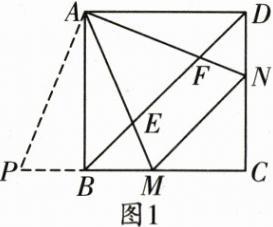
(2)如图2,过点A作$AH⊥ AN$,过点B作$BH⊥ BD$交AH于点H,连接EH.
$\because$ 正方形ABCD的边长为$5\sqrt{2}$,
$\therefore BC=CD=5\sqrt{2}$,$AB=AD$,$∠ ABM=∠ ADN=∠ C=90°$,$∠ ABE=∠ ADF=45°$.
在$\mathrm{Rt}△ BCD$中,$BD=\sqrt{BC^2+CD^2}=10$.
$\because BH⊥ BD$,$\therefore ∠ HBD=90°$,$\therefore ∠ ABH=∠ HBD-∠ ABE=45°$,
$\therefore ∠ ABH=∠ ADF=45°$.
同(1)可证明$∠ HAB=∠ FAD$,$∠ HAE=∠ FAE=45°$.
在$△ ABH$和$△ ADF$中,$\begin{cases}∠ HAB=∠ FAD,\\AB=AD,\\∠ ABH=∠ ADF,\end{cases}$
$\therefore △ ABH≌△ ADF(\mathrm{ASA})$,$\therefore BH=DF$,$AH=AF$.
在$△ AHE$和$△ AFE$中,$\begin{cases}AH=AF,\\∠ HAE=∠ FAE,\\AE=AE,\end{cases}$
$\therefore △ AHE≌△ AFE(\mathrm{SAS})$,$\therefore EH=EF$.
在$\mathrm{Rt}△ BHE$中,由勾股定理得$EH^2=BH^2+BE^2$,$\therefore EF^2=DF^2+BE^2$.
在$△ ABM$和$△ ADN$中,$\begin{cases}AB=AD,\\∠ ABM=∠ ADN=90°,\\BM=DN,\end{cases}$
$\therefore △ ABM≌△ ADN(\mathrm{SAS})$,$\therefore ∠ BAE=∠ DAF$.
在$△ BAE$和$△ DAF$中,$\begin{cases}∠ BAE=∠ DAF,\\AB=AD,\\∠ ABE=∠ ADF,\end{cases}$
$\therefore △ BAE≌△ DAF(\mathrm{ASA})$.
设$BE=DF=t$,$\therefore EF=BD-(BE+DF)=10-2t$,
$\therefore (10-2t)^2=t^2+t^2$,整理得$t^2-20t+50=0$,
解得$t=10-5\sqrt{2}$或$t=10+5\sqrt{2}$(不合题意,舍去),
$\therefore EF=10-2t=10-2×(10-5\sqrt{2})=10\sqrt{2}-10$.
(3)由(1)可知,$MN=BM+DN$.
$\because BM+DN≥2\sqrt{BM· DN}$,当且仅当$BM=DN$时等号成立,此时MN取得最小值,即b最小,$BM=DN=\frac{1}{2}MN=\frac{b}{2}$.
如图3,在CD的延长线上取一点Q,使$DQ=DN=\frac{b}{2}$,在DA上取一点T,使$DT=DN=\frac{b}{2}$,连接TQ,AQ.
由(2)可知,$∠ DAN+∠ BAM=45°$,$∠ DAN=∠ BAM$,$\therefore ∠ DAN=∠ BAM=22.5°$.
在$△ ADQ$和$△ ADN$中,$\begin{cases}DQ=DN,\\∠ ADQ=∠ ADN=90°,\\AD=AD,\end{cases}$
$\therefore △ ADQ≌△ ADN(\mathrm{SAS})$,$\therefore ∠ DAQ=∠ DAN=22.5°$.
$\because DQ=DT=\frac{b}{2}$,$\therefore △ DTQ$是等腰直角三角形,$\therefore ∠ DTQ=45°$.
由勾股定理得,$TQ=\sqrt{DT^2+DQ^2}=\frac{\sqrt{2}b}{2}$.
$\because ∠ TAQ+∠ TQA=∠ DTQ=45°$,$∠ TQA=22.5°$,$\therefore AT=TQ=\frac{\sqrt{2}b}{2}$,
$\therefore AD=AT+TD=\frac{\sqrt{2}b}{2}+\frac{b}{2}=a$,即$a=\frac{(\sqrt{2}+1)b}{2}$,$\therefore \frac{b}{a}=\frac{2}{\sqrt{2}+1}=2\sqrt{2}-2$,即$\frac{b}{a}$的最小值为$2\sqrt{2}-2$.
当点M与点B重合时,点N与点C重合,此时$MN=BC=b=a$,此时MN取最大值,即b最大,$\therefore \frac{b}{a}$的最大值为1,$\therefore \frac{b}{a}$的取值范围是$2\sqrt{2}-2≤\frac{b}{a}≤1$.
故答案为$2\sqrt{2}-2≤\frac{b}{a}≤1$.


解析
【分析】
本题为正方形中的半角模型综合题,核心思路是通过构造全等三角形转化线段关系。第(1)问利用旋转构造全等,将分散的线段BM、DN整合到同一直线,证明MN=BM+DN;第(2)问结合全等三角形与勾股定理,利用BM=DN的条件建立方程求解EF;第(3)问通过基本不等式求MN的最小值,结合极端情况确定最大值,进而得到比值范围。
【解析】
(1) 证明:如图1,过点A作$AP⊥AN$交CB的延长线于点P。
$\therefore ∠PAN=90°$,$\therefore ∠PAB+∠BAN=90°$。
$\because$ 四边形ABCD是正方形,
$\therefore AB=AD$,$∠BAD=∠ABC=∠ADN=90°$,
$\therefore ∠NAD+∠BAN=90°$,$∠ABP=∠ADN=90°$,
$\therefore ∠PAB=∠NAD$。
在$△PAB$和$△NAD$中:
$\begin{cases}∠PAB=∠NAD \\ AB=AD \\ ∠ABP=∠ADN \end{cases}$
$\therefore △PAB≌△NAD(\mathrm{ASA})$,$\therefore AP=AN$,$BP=DN$,
$\therefore PM=BM+BP=BM+DN$。
$\because ∠MAN=45°$,
$\therefore ∠BAM+∠NAD=∠BAD-∠MAN=90°-45°=45°$,
$\therefore ∠BAM+∠PAB=45°$,即$∠PAM=45°$,
$\therefore ∠PAM=∠MAN=45°$。
在$△PAM$和$△NAM$中:
$\begin{cases}AP=AN \\ ∠PAM=∠NAM \\ AM=AM \end{cases}$
$\therefore △PAM≌△NAM(\mathrm{SAS})$,$\therefore PM=MN$,
$\therefore MN=BM+DN$。
(2) 解:如图2,过点A作$AH⊥AN$,过点B作$BH⊥BD$交AH于点H,连接EH。
$\because$ 正方形ABCD边长为$5\sqrt{2}$,
$\therefore BD=\sqrt{(5\sqrt{2})^2+(5\sqrt{2})^2}=10$,$AB=AD$,$∠ABE=∠ADF=45°$。
$\because BH⊥BD$,$\therefore ∠HBD=90°$,$\therefore ∠ABH=45°=∠ADF$。
同(1)可证$∠HAB=∠FAD$,在$△ABH$和$△ADF$中:
$\begin{cases}∠HAB=∠FAD \\ AB=AD \\ ∠ABH=∠ADF \end{cases}$
$\therefore △ABH≌△ADF(\mathrm{ASA})$,$\therefore BH=DF$,$AH=AF$。
在$△AHE$和$△AFE$中:
$\begin{cases}AH=AF \\ ∠HAE=∠FAE=45° \\ AE=AE \end{cases}$
$\therefore △AHE≌△AFE(\mathrm{SAS})$,$\therefore EH=EF$。
在$\mathrm{Rt}△BHE$中,由勾股定理:$EH^2=BH^2+BE^2$,即$EF^2=DF^2+BE^2$。
$\because BM=DN$,$AB=AD$,$∠ABM=∠ADN=90°$,
$\therefore △ABM≌△ADN(\mathrm{SAS})$,$\therefore ∠BAE=∠DAF$。
在$△BAE$和$△DAF$中:
$\begin{cases}∠BAE=∠DAF \\ AB=AD \\ ∠ABE=∠ADF \end{cases}$
$\therefore △BAE≌△DAF(\mathrm{ASA})$,$\therefore BE=DF=t$。
$\because EF=BD-(BE+DF)=10-2t$,代入勾股定理:
$(10-2t)^2=t^2+t^2$,整理得$t^2-20t+50=0$,
解得$t=10-5\sqrt{2}$($t=10+5\sqrt{2}$舍去,不符合线段长度),
$\therefore EF=10-2×(10-5\sqrt{2})=10\sqrt{2}-10$。
(3) 解:由(1)知$MN=BM+DN$,根据基本不等式,$BM+DN≥2\sqrt{BM·DN}$,当且仅当$BM=DN$时等号成立,此时MN最小,即b最小;当点M与B重合、点N与C重合时,MN=BC=a,此时b最大,故$\frac{b}{a}$的最大值为1。结合半角模型性质,MN最小时$\frac{b}{a}=2\sqrt{2}-2$,因此$\frac{b}{a}$的取值范围是$2\sqrt{2}-2≤\frac{b}{a}≤1$。
【答案】
(1) 证明见上述解析;
(2) $10\sqrt{2}-10$;
(3) $2\sqrt{2}-2≤\frac{b}{a}≤1$
【知识点】
正方形性质、全等三角形判定、勾股定理
【点评】
本题是正方形半角模型的典型综合题,构造全等三角形转化线段关系是解题核心,涵盖几何全等、勾股定理、基本不等式等知识点,对逻辑推理能力要求较高,是中考几何压轴题的常见类型。
【难度系数】
0.3
本题为正方形中的半角模型综合题,核心思路是通过构造全等三角形转化线段关系。第(1)问利用旋转构造全等,将分散的线段BM、DN整合到同一直线,证明MN=BM+DN;第(2)问结合全等三角形与勾股定理,利用BM=DN的条件建立方程求解EF;第(3)问通过基本不等式求MN的最小值,结合极端情况确定最大值,进而得到比值范围。
【解析】
(1) 证明:如图1,过点A作$AP⊥AN$交CB的延长线于点P。
$\therefore ∠PAN=90°$,$\therefore ∠PAB+∠BAN=90°$。
$\because$ 四边形ABCD是正方形,
$\therefore AB=AD$,$∠BAD=∠ABC=∠ADN=90°$,
$\therefore ∠NAD+∠BAN=90°$,$∠ABP=∠ADN=90°$,
$\therefore ∠PAB=∠NAD$。
在$△PAB$和$△NAD$中:
$\begin{cases}∠PAB=∠NAD \\ AB=AD \\ ∠ABP=∠ADN \end{cases}$
$\therefore △PAB≌△NAD(\mathrm{ASA})$,$\therefore AP=AN$,$BP=DN$,
$\therefore PM=BM+BP=BM+DN$。
$\because ∠MAN=45°$,
$\therefore ∠BAM+∠NAD=∠BAD-∠MAN=90°-45°=45°$,
$\therefore ∠BAM+∠PAB=45°$,即$∠PAM=45°$,
$\therefore ∠PAM=∠MAN=45°$。
在$△PAM$和$△NAM$中:
$\begin{cases}AP=AN \\ ∠PAM=∠NAM \\ AM=AM \end{cases}$
$\therefore △PAM≌△NAM(\mathrm{SAS})$,$\therefore PM=MN$,
$\therefore MN=BM+DN$。
(2) 解:如图2,过点A作$AH⊥AN$,过点B作$BH⊥BD$交AH于点H,连接EH。
$\because$ 正方形ABCD边长为$5\sqrt{2}$,
$\therefore BD=\sqrt{(5\sqrt{2})^2+(5\sqrt{2})^2}=10$,$AB=AD$,$∠ABE=∠ADF=45°$。
$\because BH⊥BD$,$\therefore ∠HBD=90°$,$\therefore ∠ABH=45°=∠ADF$。
同(1)可证$∠HAB=∠FAD$,在$△ABH$和$△ADF$中:
$\begin{cases}∠HAB=∠FAD \\ AB=AD \\ ∠ABH=∠ADF \end{cases}$
$\therefore △ABH≌△ADF(\mathrm{ASA})$,$\therefore BH=DF$,$AH=AF$。
在$△AHE$和$△AFE$中:
$\begin{cases}AH=AF \\ ∠HAE=∠FAE=45° \\ AE=AE \end{cases}$
$\therefore △AHE≌△AFE(\mathrm{SAS})$,$\therefore EH=EF$。
在$\mathrm{Rt}△BHE$中,由勾股定理:$EH^2=BH^2+BE^2$,即$EF^2=DF^2+BE^2$。
$\because BM=DN$,$AB=AD$,$∠ABM=∠ADN=90°$,
$\therefore △ABM≌△ADN(\mathrm{SAS})$,$\therefore ∠BAE=∠DAF$。
在$△BAE$和$△DAF$中:
$\begin{cases}∠BAE=∠DAF \\ AB=AD \\ ∠ABE=∠ADF \end{cases}$
$\therefore △BAE≌△DAF(\mathrm{ASA})$,$\therefore BE=DF=t$。
$\because EF=BD-(BE+DF)=10-2t$,代入勾股定理:
$(10-2t)^2=t^2+t^2$,整理得$t^2-20t+50=0$,
解得$t=10-5\sqrt{2}$($t=10+5\sqrt{2}$舍去,不符合线段长度),
$\therefore EF=10-2×(10-5\sqrt{2})=10\sqrt{2}-10$。
(3) 解:由(1)知$MN=BM+DN$,根据基本不等式,$BM+DN≥2\sqrt{BM·DN}$,当且仅当$BM=DN$时等号成立,此时MN最小,即b最小;当点M与B重合、点N与C重合时,MN=BC=a,此时b最大,故$\frac{b}{a}$的最大值为1。结合半角模型性质,MN最小时$\frac{b}{a}=2\sqrt{2}-2$,因此$\frac{b}{a}$的取值范围是$2\sqrt{2}-2≤\frac{b}{a}≤1$。
【答案】
(1) 证明见上述解析;
(2) $10\sqrt{2}-10$;
(3) $2\sqrt{2}-2≤\frac{b}{a}≤1$
【知识点】
正方形性质、全等三角形判定、勾股定理
【点评】
本题是正方形半角模型的典型综合题,构造全等三角形转化线段关系是解题核心,涵盖几何全等、勾股定理、基本不等式等知识点,对逻辑推理能力要求较高,是中考几何压轴题的常见类型。
【难度系数】
0.3
