

 登录
登录
一、补全对话
根据对话内容选择恰当的句子填入空白处,使对话通顺、合理、意思完整。
A: Oh no, I forget to bring my English notebook again. Mr. Lee will be angry.
B: It’s okay, Tom. Everyone forgets things sometimes. 1.
A: But this is the third time this week. I’m really bad at remembering things.
B: That doesn’t mean you’re not good. 2.
A: What can I do? I always try to remember, but I just can’t.
B: 3.
A: That’s a good idea. 4.
B: You can set alarms on your phone. For example, “Bring a notebook” at 7 a.m.
A: 5.
B: Small things can make a big difference. You’ll get better.
A. Why not write things down?
B. Don’t worry too much.
C. Maybe you need some help.
D. Oh, right! I have a phone.
E. What else?
根据对话内容选择恰当的句子填入空白处,使对话通顺、合理、意思完整。
A: Oh no, I forget to bring my English notebook again. Mr. Lee will be angry.
B: It’s okay, Tom. Everyone forgets things sometimes. 1.
B
A: But this is the third time this week. I’m really bad at remembering things.
B: That doesn’t mean you’re not good. 2.
C
A: What can I do? I always try to remember, but I just can’t.
B: 3.
A
A small notebook in your bag can help a lot.A: That’s a good idea. 4.
E
B: You can set alarms on your phone. For example, “Bring a notebook” at 7 a.m.
A: 5.
D
I never thought of that.B: Small things can make a big difference. You’ll get better.
A. Why not write things down?
B. Don’t worry too much.
C. Maybe you need some help.
D. Oh, right! I have a phone.
E. What else?
答案
1-5 BCAED
解析
【分析】
本题为补全对话,需结合上下文语境匹配恰当的交际用语。先通读对话理解人物情绪与话题走向,再逐一分析每个空白处的逻辑:1处B需安慰担心的A;2处B需回应A“记性差”的自我否定;3处B需给出解决忘带东西的建议;4处A需询问更多方法;5处A需回应B“设手机闹钟”的建议。
【解析】
1. 第一空:上文A因忘带笔记本担心李老师生气,B需安慰,对应选项B“Don’t worry too much.”(别太担心),符合语境;
2. 第二空:A称自己记性差,B需否定其自我否定并给出方向,对应选项C“Maybe you need some help.”(也许你需要一些帮助),符合逻辑;
3. 第三空:A询问解决办法,B给出“写下来”的建议,对应选项A“Why not write things down?”(为什么不把事情写下来?),匹配后文“小笔记本”的提示;
4. 第四空:A认可建议后,需询问更多方法,对应选项E“What else?”(还有什么?),符合对话延续性;
5. 第五空:B建议设手机闹钟,A回应自己有手机,对应选项D“Oh, right! I have a phone.”(哦,对!我有手机),贴合语境。
【答案】
1-5 BCAED
【知识点】
补全对话、情景交际
【点评】
本题围绕日常学习中忘带物品的话题展开,考查学生对英语日常交际用语的理解与运用,需结合上下文逻辑匹配选项,难度适中。
【难度系数】
0.6
本题为补全对话,需结合上下文语境匹配恰当的交际用语。先通读对话理解人物情绪与话题走向,再逐一分析每个空白处的逻辑:1处B需安慰担心的A;2处B需回应A“记性差”的自我否定;3处B需给出解决忘带东西的建议;4处A需询问更多方法;5处A需回应B“设手机闹钟”的建议。
【解析】
1. 第一空:上文A因忘带笔记本担心李老师生气,B需安慰,对应选项B“Don’t worry too much.”(别太担心),符合语境;
2. 第二空:A称自己记性差,B需否定其自我否定并给出方向,对应选项C“Maybe you need some help.”(也许你需要一些帮助),符合逻辑;
3. 第三空:A询问解决办法,B给出“写下来”的建议,对应选项A“Why not write things down?”(为什么不把事情写下来?),匹配后文“小笔记本”的提示;
4. 第四空:A认可建议后,需询问更多方法,对应选项E“What else?”(还有什么?),符合对话延续性;
5. 第五空:B建议设手机闹钟,A回应自己有手机,对应选项D“Oh, right! I have a phone.”(哦,对!我有手机),贴合语境。
【答案】
1-5 BCAED
【知识点】
补全对话、情景交际
【点评】
本题围绕日常学习中忘带物品的话题展开,考查学生对英语日常交际用语的理解与运用,需结合上下文逻辑匹配选项,难度适中。
【难度系数】
0.6
二、 阅读理解
主题:人与自我——生活与学习 学科素养:语言能力 词数:约240 建议用时:7分钟
① Do you remember your first birthday party or learning to walk? Most people cannot remember anything before the age of three or four. This experience is called “infantile amnesia (婴儿遗忘症)”.
② Scientists once thought babies couldn’t make memories because their brains weren’t ready. They thought a special part of the brain—the memory part didn’t develop fully in young children.
③ However, a new study challenges this idea. In the study, researchers showed babies pictures of faces and things. Later, they showed the babies these pictures again as well as some new photos. If a baby looked longer at the picture showed before, that usually meant the baby knew what it was. Then, the researchers found something important: If the baby’s memory part worked harder when he was seeing a picture, the baby was more likely to remember it later. This means babies may start making memories much younger than we thought.
④ But this raises a big question: If babies can make memories, why can’t we remember being babies? Scientists still aren’t sure.
⑤ One idea suggests baby memories are only short-term. Like quickly forgetting a phone number, these memories are gone as we get older.
⑥ Another idea is that the memories stay in our brains forever, but we lose the way to access them—that is, to find and get them back. As the scientist Nick Turk-Browne, who led the study, says, “The problem isn’t making memories—it’s finding them later.”
(
A. Because babies didn’t see enough pictures.
B. Because their memory parts didn’t develop fully.
C. Because memories just went away quickly.
D. Because scientists didn’t study them carefully.
(
A. One-year-old babies have no brain activities at all.
B. We may still have the memory of our first walk.
C. Researchers showed pictures of animals and things to the babies.
D. Girls usually have better memories than boys.
(新考法·词语运用 Which sentence uses “access” with the same meaning as the underlined word?
A. You need a key to access the School Computer Center.
B. The library gives free Internet access to all students.
C. Reading books helps us access the truth of the world.
D. Every student has access to the teacher’s help after class.
(新考法·篇章结构 Which of the following shows the structure of the passage?
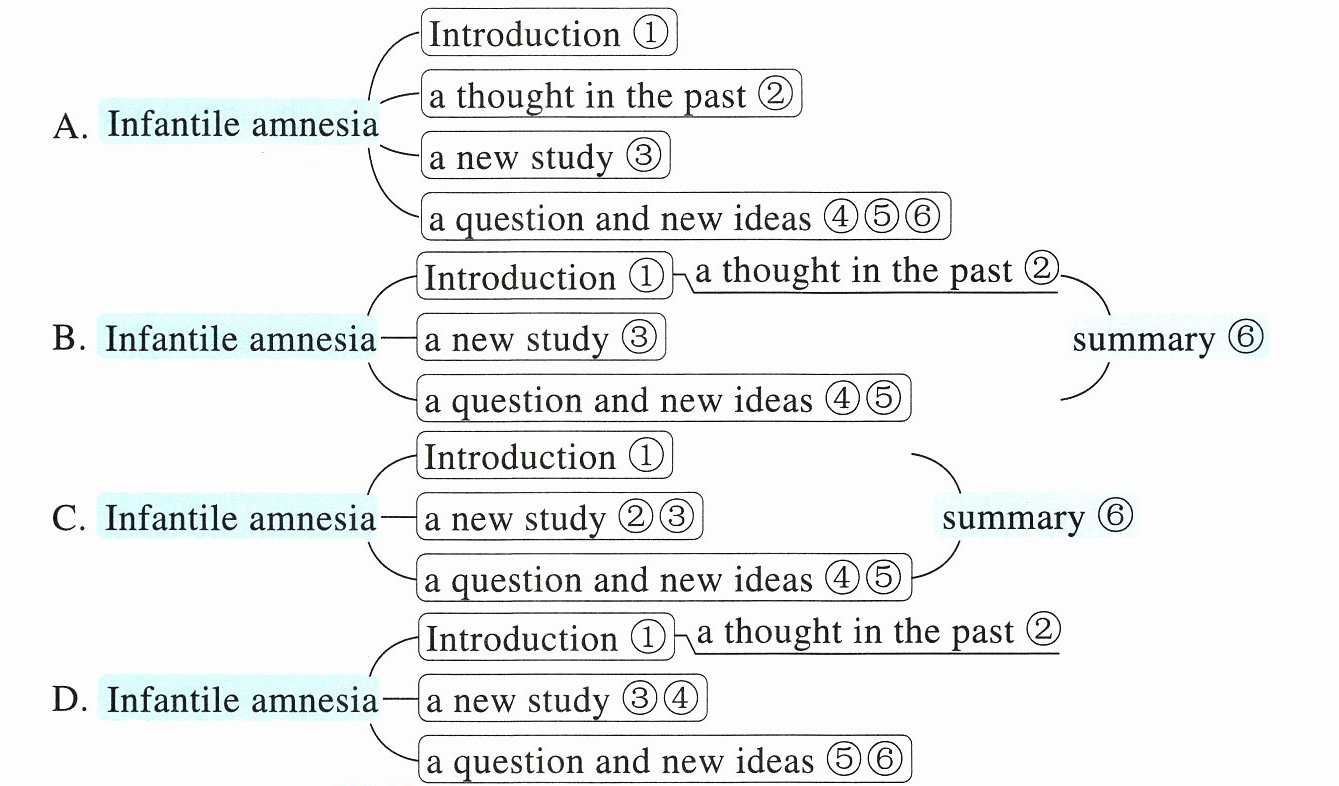
主题:人与自我——生活与学习 学科素养:语言能力 词数:约240 建议用时:7分钟
① Do you remember your first birthday party or learning to walk? Most people cannot remember anything before the age of three or four. This experience is called “infantile amnesia (婴儿遗忘症)”.
② Scientists once thought babies couldn’t make memories because their brains weren’t ready. They thought a special part of the brain—the memory part didn’t develop fully in young children.
③ However, a new study challenges this idea. In the study, researchers showed babies pictures of faces and things. Later, they showed the babies these pictures again as well as some new photos. If a baby looked longer at the picture showed before, that usually meant the baby knew what it was. Then, the researchers found something important: If the baby’s memory part worked harder when he was seeing a picture, the baby was more likely to remember it later. This means babies may start making memories much younger than we thought.
④ But this raises a big question: If babies can make memories, why can’t we remember being babies? Scientists still aren’t sure.
⑤ One idea suggests baby memories are only short-term. Like quickly forgetting a phone number, these memories are gone as we get older.
⑥ Another idea is that the memories stay in our brains forever, but we lose the way to access them—that is, to find and get them back. As the scientist Nick Turk-Browne, who led the study, says, “The problem isn’t making memories—it’s finding them later.”
(
B
)1. According to Paragraph 2, why did the scientists think babies couldn’t make memories?A. Because babies didn’t see enough pictures.
B. Because their memory parts didn’t develop fully.
C. Because memories just went away quickly.
D. Because scientists didn’t study them carefully.
(
B
)2. What can we infer from the new study?A. One-year-old babies have no brain activities at all.
B. We may still have the memory of our first walk.
C. Researchers showed pictures of animals and things to the babies.
D. Girls usually have better memories than boys.
(
C
)3. A. You need a key to access the School Computer Center.
B. The library gives free Internet access to all students.
C. Reading books helps us access the truth of the world.
D. Every student has access to the teacher’s help after class.
(
A
)4. 答案
答案速查 1.B 2.B 3.C 4.A
【主旨大意】本文主要探讨婴儿遗忘症(infantile amnesia)现象。
1. B【点拨】细节理解题。根据“Scientists once thought babies couldn’t make memories... didn’t develop fully in young children.”可知,科学家认为婴儿无法形成记忆的原因是大脑的记忆部位发育不足。
2. B【点拨】推理判断题。根据“This means babies may start making memories much younger than we thought.”以及“the memories stay in our brains forever, but we lose the way to access them—that is, to find and get them back”可推断,我们可能仍保留首次行走的记忆。
3. C【点拨】词义猜测题。画线词为动词形式;根据“the memories stay in our brains forever, but we lose the way to access them—that is, to find and get them back”可知,此处指获取记忆,所以画线部分的含义是“获取”,C选项符合。
4. A【点拨】篇章结构题。通读全文可知,文章第一段提出“婴儿遗忘症”现象;第二段介绍传统理论解释;第三段提出新证据;第四至六段提出核心问题以及两种理论解释。
【主旨大意】本文主要探讨婴儿遗忘症(infantile amnesia)现象。
1. B【点拨】细节理解题。根据“Scientists once thought babies couldn’t make memories... didn’t develop fully in young children.”可知,科学家认为婴儿无法形成记忆的原因是大脑的记忆部位发育不足。
2. B【点拨】推理判断题。根据“This means babies may start making memories much younger than we thought.”以及“the memories stay in our brains forever, but we lose the way to access them—that is, to find and get them back”可推断,我们可能仍保留首次行走的记忆。
3. C【点拨】词义猜测题。画线词为动词形式;根据“the memories stay in our brains forever, but we lose the way to access them—that is, to find and get them back”可知,此处指获取记忆,所以画线部分的含义是“获取”,C选项符合。
4. A【点拨】篇章结构题。通读全文可知,文章第一段提出“婴儿遗忘症”现象;第二段介绍传统理论解释;第三段提出新证据;第四至六段提出核心问题以及两种理论解释。
