

 登录
登录
6. 如图,在平面直角坐标系中,直线 $l_1:y=kx+ b(k≠0)$ 与直线 $l_2:y=x$ 交于点 $A(2,a)$,与$y$ 轴交于点 $B(0,6)$,与 $x$ 轴交于点 $C$.
(1)求直线 $l_1$ 的函数表达式;
(2)在平面直角坐标系中有一点 $P(5,m)$,使得 $S_{△ AOP}=S_{△ AOC}$,请求出点 $P$ 的坐标;
(3)点 $M$ 为直线 $l_1$ 上的动点,过点 $M$ 作 $y$ 轴的平行线,交 $l_2$ 于点 $N$,点 $Q$ 为 $y$ 轴上一动点,且$△ MNQ$ 为等腰直角三角形,请直接写出满足条件的点 $M$ 的坐标.
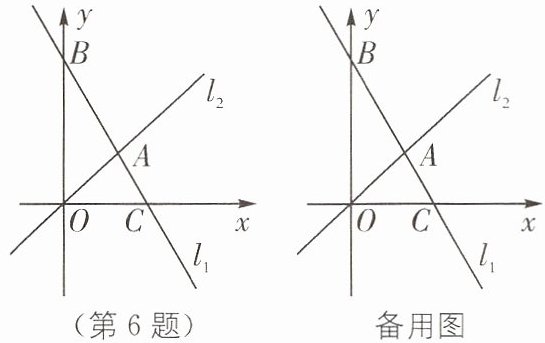
(1)求直线 $l_1$ 的函数表达式;
(2)在平面直角坐标系中有一点 $P(5,m)$,使得 $S_{△ AOP}=S_{△ AOC}$,请求出点 $P$ 的坐标;
(3)点 $M$ 为直线 $l_1$ 上的动点,过点 $M$ 作 $y$ 轴的平行线,交 $l_2$ 于点 $N$,点 $Q$ 为 $y$ 轴上一动点,且$△ MNQ$ 为等腰直角三角形,请直接写出满足条件的点 $M$ 的坐标.
答案
(1)$\because$ 点 $A(2,a)$ 在直线 $l_2:y=x$ 上,
$\therefore a=2$,即 $A(2,2)$。
$\because$ 直线 $l_1:y=kx+b(k≠0)$ 过点 $A(2,2)$,点 $B(0,6)$,
$\therefore\begin{cases}2k+b=2,\\b=6,\end{cases}$ 解得 $\begin{cases}k=-2,\\b=6,\end{cases}$
$\therefore$ 直线 $l_1$ 的函数表达式为 $y=-2x+6$。
(2)$\because S_{△ AOP}=S_{△ AOC}$,
$\therefore$ 当以 $AO$ 为底边时,两三角形等高,
$\therefore$ 设过点 $P$ 且与直线 $AO$ 平行的直线 $l_3$ 为 $y=x+d$。
$y=0$ 时,$0=-2x+6$,$\therefore$ 点 $C$ 坐标为$(3,0)$。
①当直线 $l_3$ 过点 $C(3,0)$ 时,得 $l_3$ 为 $y=x-3$,
当 $x=5$ 时,$m=5-3=2$,$\therefore$ 点 $P$ 的坐标为$(5,2)$;
②点 $C(3,0)$ 关于直线 $OA$ 的对称点为$(0,3)$,
当直线 $l_3$ 过点$(0,3)$ 时,得 $l_3$ 为 $y=x+3$,
当 $x=5$ 时,$m=5+3=8$,$\therefore$ 点 $P$ 的坐标为$(5,8)$。
综上所述,点 $P$ 的坐标为$(5,2)$或$(5,8)$。
(3)设 $M(t,-2t+6)$,则 $N(t,t)$,
$\therefore MN=|-2t+6-t|=|3t-6|$,
①如图(1),若$∠ MQN=90°,MQ=NQ$,
则 $MN=2|x_M|=2|t|$,
$\therefore |3t-6|=2|t|,\therefore t=\dfrac{6}{5}$ 或 $t=6$,
$\therefore M(\dfrac{6}{5},\dfrac{18}{5})$或$(6,-6)$;
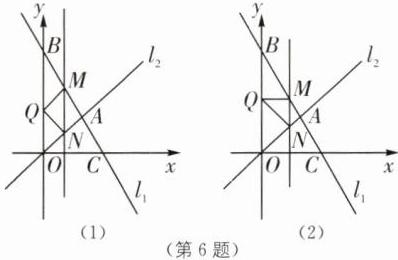
②如图(2),若$∠ QMN=90°$或$∠ QNM=90°$(此种情况图略),则 $MN=|x_M|=|t|,\therefore |3t-6|=|t|$,
$\therefore t=\dfrac{3}{2}$ 或 $t=3$,$\therefore M(\dfrac{3}{2},3)$或$(3,0)$。
综上所述,点 $M$ 的坐标为$(\dfrac{6}{5},\dfrac{18}{5})$或$(6,-6)$或$(\dfrac{3}{2},3)$或$(3,0)$。
7. 如图,在平面直角坐标系$xOy$中,直线$y = -\dfrac{4}{3}x + 4$与$x$轴、$y$轴分别交于点$A$,$B$,点$D$在$y$轴的负半轴上,若将$△ DAB$沿直线$AD$折叠,点$B$恰好落在$x$轴的正半轴上的点$C$处.
(1)求$AB$的长.
(2)求点$C$和点$D$的坐标.
(3)在$y$轴上是否存在一点$P$,使得$S_{△ PAB} = \dfrac{1}{2}S_{△ OCD}$?若存在,直接写出点$P$的坐标;若不存在,请说明理由.
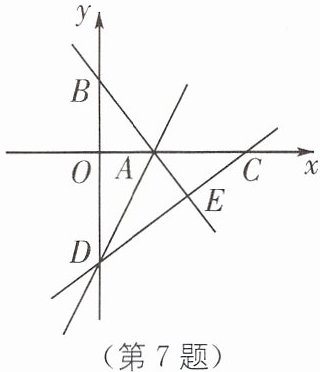
(1)求$AB$的长.
(2)求点$C$和点$D$的坐标.
(3)在$y$轴上是否存在一点$P$,使得$S_{△ PAB} = \dfrac{1}{2}S_{△ OCD}$?若存在,直接写出点$P$的坐标;若不存在,请说明理由.
答案
(1)在 $y=-\dfrac{4}{3}x+4$ 中,令 $x=0$,得 $y=4$,
$\therefore B(0,4)$,即 $OB=4$。
令 $y=0$,得 $0=-\dfrac{4}{3}x+4$,解得 $x=3$,
$\therefore A(3,0)$,即 $OA=3$。
在 $\mathrm{Rt}△ OAB$ 中,$AB=\sqrt{OA^2+OB^2}=5$。
(2)由(1)知,$AB=5$,则由折叠可知,$AC=AB=5$,
$\therefore OC=OA+AC=3+5=8,\therefore C(8,0)$。
设 $OD=m$,则 $CD=DB=m+4$。
在 $\mathrm{Rt}△ OCD$ 中,$DC^2=OD^2+OC^2$,
即 $(m+4)^2=m^2+8^2$,解得 $m=6$,$\therefore D(0,-6)$。
(3)存在,点 $P$ 坐标为$(0,12)$或$(0,-4)$。理由如下:
$\because S_{△ PAB}=\dfrac{1}{2}S_{△ OCD},\therefore S_{△ PAB}=\dfrac{1}{2}×\dfrac{1}{2}×6×8=12$。
$\because$ 点 $P$ 在 $y$ 轴上,$\therefore \dfrac{1}{2}BP· OA=12$,
即 $\dfrac{1}{2}×3BP=12$,解得 $BP=8$。
$\therefore$ 点 $P$ 的坐标为$(0,12)$或$(0,-4)$。
$\therefore B(0,4)$,即 $OB=4$。
令 $y=0$,得 $0=-\dfrac{4}{3}x+4$,解得 $x=3$,
$\therefore A(3,0)$,即 $OA=3$。
在 $\mathrm{Rt}△ OAB$ 中,$AB=\sqrt{OA^2+OB^2}=5$。
(2)由(1)知,$AB=5$,则由折叠可知,$AC=AB=5$,
$\therefore OC=OA+AC=3+5=8,\therefore C(8,0)$。
设 $OD=m$,则 $CD=DB=m+4$。
在 $\mathrm{Rt}△ OCD$ 中,$DC^2=OD^2+OC^2$,
即 $(m+4)^2=m^2+8^2$,解得 $m=6$,$\therefore D(0,-6)$。
(3)存在,点 $P$ 坐标为$(0,12)$或$(0,-4)$。理由如下:
$\because S_{△ PAB}=\dfrac{1}{2}S_{△ OCD},\therefore S_{△ PAB}=\dfrac{1}{2}×\dfrac{1}{2}×6×8=12$。
$\because$ 点 $P$ 在 $y$ 轴上,$\therefore \dfrac{1}{2}BP· OA=12$,
即 $\dfrac{1}{2}×3BP=12$,解得 $BP=8$。
$\therefore$ 点 $P$ 的坐标为$(0,12)$或$(0,-4)$。
8. 如图,直线$l_{1}$的表达式为$y=\dfrac{4}{3}x+4$,与$x$轴、$y$轴分别交于点$A,B$;直线$l_{2}$与$x$轴交于点$C(2,0)$,与$y$轴交于点$D(0,\dfrac{3}{2})$,两直线交于点$P(-\dfrac{6}{5},\dfrac{12}{5})$.
(1)求点$A,B$的坐标及直线$l_{2}$的函数表达式;
(2)求证:$△ AOB≌△ APC$;
(3)若将直线$l_{2}$向右平移$m$个单位,与$x$轴、$y$轴分别交于点$C',D'$,使得以点$A,B,C'$,$D'$为顶点的图形是轴对称图形,求$m$的值.
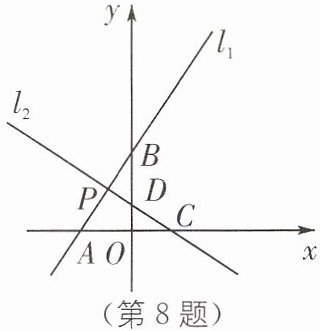
(1)求点$A,B$的坐标及直线$l_{2}$的函数表达式;
(2)求证:$△ AOB≌△ APC$;
(3)若将直线$l_{2}$向右平移$m$个单位,与$x$轴、$y$轴分别交于点$C',D'$,使得以点$A,B,C'$,$D'$为顶点的图形是轴对称图形,求$m$的值.
答案
(1)当 $x=0$ 时,$y=\dfrac{4}{3}x+4=4$,
$\therefore$ 点 $B$ 的坐标为$(0,4)$。
当 $y=0$ 时,有 $\dfrac{4}{3}x+4=0$,解得 $x=-3$,
$\therefore$ 点 $A$ 的坐标为$(-3,0)$。
设直线 $l_2$ 的表达式为 $y=kx+b(k≠0)$,
将 $C(2,0),D(0,\dfrac{3}{2})$ 代入 $y=kx+b$,
得$\begin{cases}2k+b=0,\\b=\dfrac{3}{2},\end{cases}$ 解得 $\begin{cases}k=-\dfrac{3}{4},\\b=\dfrac{3}{2},\end{cases}$
$\therefore$ 直线 $l_2$ 的表达式为 $y=-\dfrac{3}{4}x+\dfrac{3}{2}$。
(2)$\because A(-3,0),C(2,0),B(0,4),P(-\dfrac{6}{5},\dfrac{12}{5})$,
$\therefore AO=3,AC=5,AB=\sqrt{3^2+4^2}=5$,
$AP=\sqrt{[-\dfrac{6}{5}-(-3)]^2+(\dfrac{12}{5}-0)^2}=3$,
$\therefore AO=AP,AB=AC$。
在$△ AOB$ 和$△ APC$ 中,$\begin{cases}AO=AP,\\∠ BAO=∠ CAP,\\AB=AC,\end{cases}$
$\therefore △ AOB≌△ APC(\mathrm{SAS})$。
(3)①如图(1),当点 $B$ 在点 $D'$ 下方时,连接 $BC'$。
$\because$ 平移后直线 $C'D'$ 的表达式为 $y=-\dfrac{3}{4}(x-m)+\dfrac{3}{2}=-\dfrac{3}{4}x+\dfrac{3}{4}m+\dfrac{3}{2}$,$\therefore$ 点 $C'$ 的坐标为$(m+2,0)$,点 $D'$ 的坐标为$(0,\dfrac{3}{4}m+\dfrac{3}{2})$。
由题意,可得以点 $A,B,C',D'$ 为顶点的图形是轴对称图形,当$△ ABC'≌△ D'BC'$时,有 $AB=D'B,AC'=D'C'$。
$\because A(-3,0),B(0,4),\therefore D'B=\dfrac{3}{4}m+\dfrac{3}{2}-4=\dfrac{3}{4}m-\dfrac{5}{2}$,
$AC'=m+2-(-3)=m+5$,
$D'C'=\sqrt{(m+2)^2+(\dfrac{3}{4}m+\dfrac{3}{2})^2}=\dfrac{5}{4}(m+2)$。
$\therefore\begin{cases}\dfrac{3}{4}m-\dfrac{5}{2}=5,\\m+5=\dfrac{5}{4}(m+2),\end{cases}$ 解得 $m=10$。
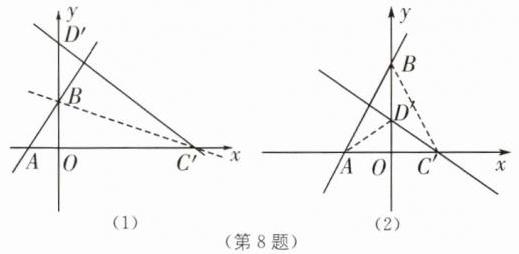
②如图(2),当点 $B$ 在点 $D'$ 上方时,连接 $BC',AD'$。
若$△ AC'D'≌△ BC'D'$,则 $AC'=BC'$,
由①可得 $BC'=\sqrt{(m+2)^2+4^2},AC'=m+5$,
$\therefore m+5=\sqrt{(m+2)^2+4^2}$,
解得 $m=-\dfrac{5}{6}$(不合题意,舍去);
若$△ ABD'≌△ C'BD'$,则 $AB=C'B$,
$\therefore OA=OC'$,即 $3=m+2$,解得 $m=1$。
故以点 $A,B,C',D'$ 为顶点的图形是轴对称图形时,$m$ 的值为 10 或 1。
