

 登录
登录
一、听录音,选出正确的问句或答句。
(
B. Yes, of course.
C. No, I don't.
(
B. Because he helps others.
C. He is cute.
(
B. Did people like the ant?
C. Was the ant tired?
(
B. Does the bee go out late?
C. Was the ant happy or sad?
(
B
)1. A. No, I'm hungry.B. Yes, of course.
C. No, I don't.
(
B
)2. A. He can fly.B. Because he helps others.
C. He is cute.
(
A
)3. A. Does the ant work hard?B. Did people like the ant?
C. Was the ant tired?
(
A
)4. A. Was the ant happy?B. Does the bee go out late?
C. Was the ant happy or sad?
答案
1. B 2. B 3. A 4. A
二、听录音,在表格对应的位置打“√”。
| | Danny | Jill | Ben | Lily |
| --- | --- | --- | --- | --- |
| help tourists find their way | | | | |
| read the newspaper to old people |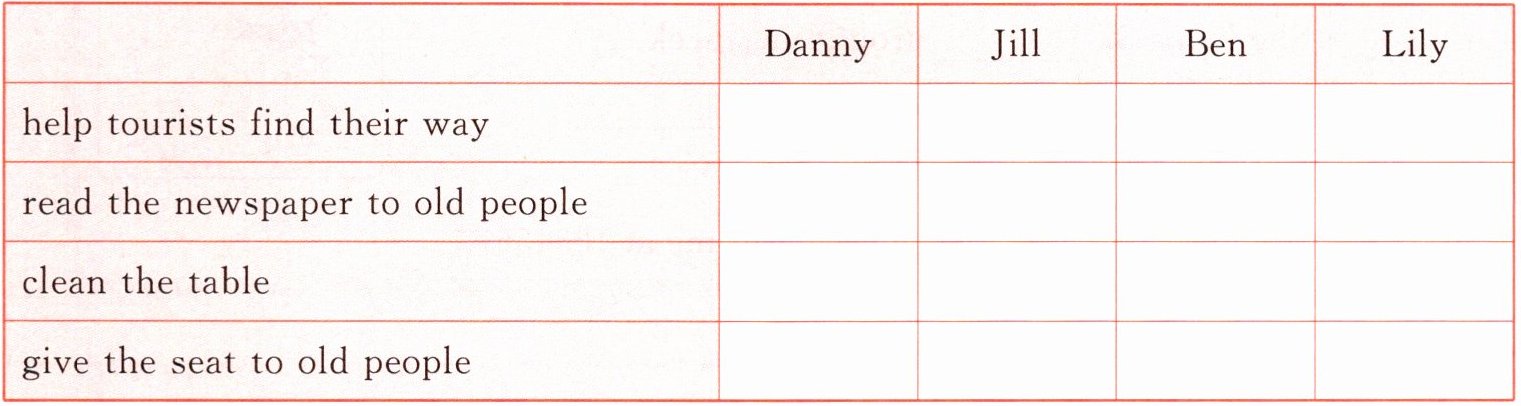 | | | |
| clean the table | | | | |
| give the seat to old people | | | | |
| | Danny | Jill | Ben | Lily |
| --- | --- | --- | --- | --- |
| help tourists find their way | | | | |
| read the newspaper to old people |
| | | || clean the table | | | | |
| give the seat to old people | | | | |
答案
| | Danny | Jill | Ben | Lily |
| --- | --- | --- | --- | --- |
| help tourists find their way | | | | √ |
| read the newspaper to old people | √ | | | |
| clean the table | | √ | | |
| give the seat to old people | | | √ | |
| --- | --- | --- | --- | --- |
| help tourists find their way | | | | √ |
| read the newspaper to old people | √ | | | |
| clean the table | | √ | | |
| give the seat to old people | | | √ | |
三、听录音,补全短文中所缺的单词。
A long time ago, there was a fisherman. The fisherman liked 1.
A long time ago, there was a fisherman. The fisherman liked 1.
helping
others. He worked hard all day. One day he 2. went
out 3. early
in the morning. The fisherman saved a golden fish. But people didn't 4. praise
him for that. Why? Because his wife was greedy(贪婪的) after knowing the fish could do anything for them. She asked for a big house, a big castle, and even to be a queen. At last, they 5. lost
all of those.答案
1. helping 2. went 3. early 4. praise 5. lost
一、选出每组中音节数不同的单词。
(
(
(
(
C
)1. A. neck B. arm C. shoulder (A
)2. A. pear B. banana C. strawberry(
A
)3. A. rabbit B. bee C. pig (C
)4. A. happy B. angry C. sad(
C
)5. A. kitchen B. dinner C. hamburger (C
)6. A. answer B. guitar C. ask答案
1. C 2. A 3. A 4. C 5. C 6. C
解析
【分析】本题要求选出每组中音节数不同的单词,解题关键是明确音节的划分规则:一个单词中元音音素的数量即为音节数,单个元音音素构成一个音节,辅音不单独构成音节。需逐个分析每组单词的音节数,找出与其他两个音节数不同的选项。
【解析】1. A. neck(/nek/)含1个音节;B. arm(/ɑːm/)含1个音节;C. shoulder(/ˈʃəʊldə(r)/)含2个音节,故选C。
2. A. pear(/peə(r)/)含1个音节;B. banana(/bəˈnɑːnə/)含3个音节;C. strawberry(/ˈstrɔːbəri/)含2个音节,故选A。
3. A. rabbit(/ˈræbɪt/)含2个音节;B. bee(/biː/)含1个音节;C. pig(/pɪɡ/)含1个音节,故选A。
4. A. happy(/ˈhæpi/)含2个音节;B. angry(/ˈæŋɡri/)含2个音节;C. sad(/sæd/)含1个音节,故选C。
5. A. kitchen(/ˈkɪtʃɪn/)含2个音节;B. dinner(/ˈdɪnə(r)/)含2个音节;C. hamburger(/ˈhæmbɜːɡə(r)/)含3个音节,故选C。
6. A. answer(/ˈɑːnsə(r)/)含2个音节;B. guitar(/ɡɪˈtɑː(r)/)含2个音节;C. ask(/ɑːsk/)含1个音节,故选C。
【答案】1.C 2.A 3.A 4.C 5.C 6.C
【知识点】英语音节划分、英语单词音节数判断
【点评】本题侧重考查英语单词音节数的识别能力,需掌握音节的基本概念,难度适中,只要能准确划分单词音节即可正确作答。
【难度系数】0.6
【解析】1. A. neck(/nek/)含1个音节;B. arm(/ɑːm/)含1个音节;C. shoulder(/ˈʃəʊldə(r)/)含2个音节,故选C。
2. A. pear(/peə(r)/)含1个音节;B. banana(/bəˈnɑːnə/)含3个音节;C. strawberry(/ˈstrɔːbəri/)含2个音节,故选A。
3. A. rabbit(/ˈræbɪt/)含2个音节;B. bee(/biː/)含1个音节;C. pig(/pɪɡ/)含1个音节,故选A。
4. A. happy(/ˈhæpi/)含2个音节;B. angry(/ˈæŋɡri/)含2个音节;C. sad(/sæd/)含1个音节,故选C。
5. A. kitchen(/ˈkɪtʃɪn/)含2个音节;B. dinner(/ˈdɪnə(r)/)含2个音节;C. hamburger(/ˈhæmbɜːɡə(r)/)含3个音节,故选C。
6. A. answer(/ˈɑːnsə(r)/)含2个音节;B. guitar(/ɡɪˈtɑː(r)/)含2个音节;C. ask(/ɑːsk/)含1个音节,故选C。
【答案】1.C 2.A 3.A 4.C 5.C 6.C
【知识点】英语音节划分、英语单词音节数判断
【点评】本题侧重考查英语单词音节数的识别能力,需掌握音节的基本概念,难度适中,只要能准确划分单词音节即可正确作答。
【难度系数】0.6
二、选择恰当的单词或短语,并用其适当形式填空。
work hard praise ... for ... yourself go ahead go out
1. She
2. You work for
3. —Can I ask you a question? —OK. Please
4. People
5. I also
work hard praise ... for ... yourself go ahead go out
1. She
goes out
early in the morning and comes home late in the evening.2. You work for
yourself
only.3. —Can I ask you a question? —OK. Please
go ahead
.4. People
praise/are praising
her for
her hard work now.5. I also
work hard
all day.答案
1. goes out 2. yourself 3. go ahead 4. praise/are praising, for 5. work hard
解析
【分析】
先通读每个句子理解语境,结合所给短语的含义、用法,注意时态、主谓一致及固定搭配来填空:1. 句子描述日常作息,对应“早出晚归”的短语,需考虑主语的单三形式;2. 考查固定搭配,结合主语确定反身代词;3. 是日常交际用语的固定答语;4. 考查固定搭配及现在的时态;5. 结合语境选合适的动词短语,注意主语的形式。
【解析】
1. 由“comes home late”可知是日常作息,选短语go out,主语she为第三人称单数,一般现在时动词用三单形式,故填goes out;
2. 固定搭配for oneself表示“为自己”,结合主语you,填yourself;
3. 日常交际中请求允许的答语,用固定短语go ahead表示“请讲”,故填go ahead;
4. 固定搭配praise sb for sth表示“因某事表扬某人”,时间状语now可搭配一般现在时praise或现在进行时are praising,后接介词for,故填praise/are praising, for;
5. 描述日常行为,主语I,填动词短语原形work hard,故填work hard。
【答案】
1. goes out 2. yourself 3. go ahead 4. praise/are praising, for 5. work hard
【知识点】
动词短语用法;固定搭配;日常交际用语
【点评】
本题考查常用短语的运用,需结合语境、时态及固定搭配准确选择,注重基础短语的掌握,难度适中。
【难度系数】
0.7
先通读每个句子理解语境,结合所给短语的含义、用法,注意时态、主谓一致及固定搭配来填空:1. 句子描述日常作息,对应“早出晚归”的短语,需考虑主语的单三形式;2. 考查固定搭配,结合主语确定反身代词;3. 是日常交际用语的固定答语;4. 考查固定搭配及现在的时态;5. 结合语境选合适的动词短语,注意主语的形式。
【解析】
1. 由“comes home late”可知是日常作息,选短语go out,主语she为第三人称单数,一般现在时动词用三单形式,故填goes out;
2. 固定搭配for oneself表示“为自己”,结合主语you,填yourself;
3. 日常交际中请求允许的答语,用固定短语go ahead表示“请讲”,故填go ahead;
4. 固定搭配praise sb for sth表示“因某事表扬某人”,时间状语now可搭配一般现在时praise或现在进行时are praising,后接介词for,故填praise/are praising, for;
5. 描述日常行为,主语I,填动词短语原形work hard,故填work hard。
【答案】
1. goes out 2. yourself 3. go ahead 4. praise/are praising, for 5. work hard
【知识点】
动词短语用法;固定搭配;日常交际用语
【点评】
本题考查常用短语的运用,需结合语境、时态及固定搭配准确选择,注重基础短语的掌握,难度适中。
【难度系数】
0.7
