

 登录
登录
6. 如图,抛物线 $ y = x^{2} + bx + c $ 与 $ x $ 轴交于 $ A(-1,0) $,$ B(3,0) $ 两点。
(1)求该抛物线的对称轴以及顶点坐标;
(2)设(1)中的抛物线上有一个动点 $ P $,当点 $ P $ 在该抛物线上滑动到什么位置时,满足 $ S_{\triangle PAB} = 8 $?求出此时点 $ P $ 的坐标。
]
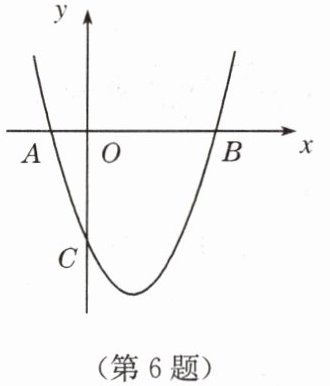
(1)求该抛物线的对称轴以及顶点坐标;
(2)设(1)中的抛物线上有一个动点 $ P $,当点 $ P $ 在该抛物线上滑动到什么位置时,满足 $ S_{\triangle PAB} = 8 $?求出此时点 $ P $ 的坐标。
]
答案
(1)对称轴为直线$x=1$,顶点坐标为$(1,-4)$;(2)$(1+2\sqrt{2},4)$或$(1-2\sqrt{2},4)$或$(1,-4)$.
解析
解:(1)将$A(-1,0)$,$B(3,0)$代入$y=x^{2}+bx+c$,得
$\begin{cases}1 - b + c = 0 \\9 + 3b + c = 0\end{cases}$
解得$\begin{cases}b = -2 \\c = -3\end{cases}$
抛物线解析式为$y=x^{2}-2x-3$
对称轴为直线$x=-\frac{-2}{2×1}=1$
当$x=1$时,$y=1 - 2 - 3=-4$
顶点坐标为$(1,-4)$
(2)$AB=3 - (-1)=4$
设$P(x,y)$,$S_{\triangle PAB}=\frac{1}{2}×4×|y|=8$
则$|y|=4$,$y=\pm4$
当$y=4$时,$x^{2}-2x-3=4$
$x^{2}-2x-7=0$
$x=\frac{2\pm\sqrt{4 + 28}}{2}=1\pm2\sqrt{2}$
当$y=-4$时,$x^{2}-2x-3=-4$
$x^{2}-2x + 1=0$
$(x - 1)^{2}=0$
$x=1$
$P$点坐标为$(1 + 2\sqrt{2},4)$,$(1 - 2\sqrt{2},4)$,$(1,-4)$
$\begin{cases}1 - b + c = 0 \\9 + 3b + c = 0\end{cases}$
解得$\begin{cases}b = -2 \\c = -3\end{cases}$
抛物线解析式为$y=x^{2}-2x-3$
对称轴为直线$x=-\frac{-2}{2×1}=1$
当$x=1$时,$y=1 - 2 - 3=-4$
顶点坐标为$(1,-4)$
(2)$AB=3 - (-1)=4$
设$P(x,y)$,$S_{\triangle PAB}=\frac{1}{2}×4×|y|=8$
则$|y|=4$,$y=\pm4$
当$y=4$时,$x^{2}-2x-3=4$
$x^{2}-2x-7=0$
$x=\frac{2\pm\sqrt{4 + 28}}{2}=1\pm2\sqrt{2}$
当$y=-4$时,$x^{2}-2x-3=-4$
$x^{2}-2x + 1=0$
$(x - 1)^{2}=0$
$x=1$
$P$点坐标为$(1 + 2\sqrt{2},4)$,$(1 - 2\sqrt{2},4)$,$(1,-4)$
如图(1),在平面直角坐标系中,抛物线 $ y = x^{2} + bx + c $ 的顶点为点 $ D $,与 $ y $ 轴交于点 $ C $,与 $ x $ 轴交于点 $ A(-1,0) $,$ B(3,0) $。
(1)求这个二次函数的解析式;
(2)若点 $ P $ 是 $ x $ 轴上一动点,当 $ \triangle PCD $ 的周长最小时,求点 $ P $ 的坐标;
(3)如图(2),若点 $ G(2,m) $ 是该抛物线上一点,点 $ E $ 是直线 $ AG $ 下方抛物线上的一动点,点 $ E $ 到直线 $ AG $ 的距离为 $ d $,求 $ d $ 的最大值。
]
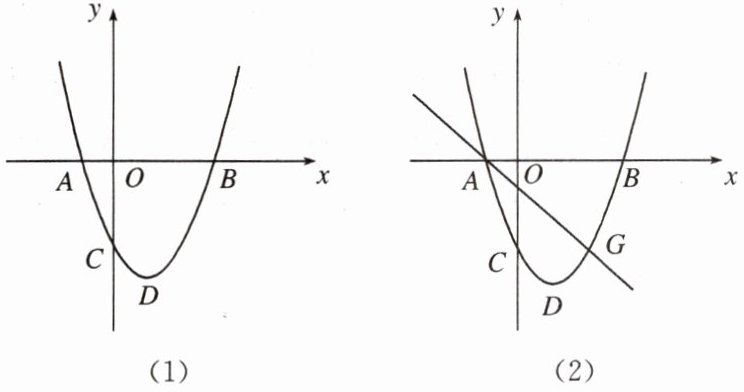
(1)求这个二次函数的解析式;
(2)若点 $ P $ 是 $ x $ 轴上一动点,当 $ \triangle PCD $ 的周长最小时,求点 $ P $ 的坐标;
(3)如图(2),若点 $ G(2,m) $ 是该抛物线上一点,点 $ E $ 是直线 $ AG $ 下方抛物线上的一动点,点 $ E $ 到直线 $ AG $ 的距离为 $ d $,求 $ d $ 的最大值。
]
答案
(1)$y=x^{2}-2x-3$;(2)$\left(\dfrac{3}{7},0\right)$;(3)$\dfrac{9\sqrt{2}}{8}$.
解析
(1)解:将点$A(-1,0)$,$B(3,0)$代入$y=x^{2}+bx+c$,得
$\begin{cases}1 - b + c = 0 \\9 + 3b + c = 0\end{cases}$
解得$\begin{cases}b=-2 \\c=-3\end{cases}$
$\therefore y=x^{2}-2x-3$
(2)解:$y=x^{2}-2x-3=(x-1)^{2}-4$,$\therefore D(1,-4)$
令$x=0$,则$y=-3$,$\therefore C(0,-3)$
作点$C$关于$x$轴的对称点$C'(0,3)$,连接$C'D$交$x$轴于点$P$,此时$\triangle PCD$周长最小
设直线$C'D$的解析式为$y=kx + 3$,将$D(1,-4)$代入,得$k + 3=-4$,$\therefore k=-7$
$\therefore y=-7x + 3$
令$y=0$,则$-7x + 3=0$,$\therefore x=\dfrac{3}{7}$
$\therefore P\left(\dfrac{3}{7},0\right)$
(3)解:将$G(2,m)$代入$y=x^{2}-2x-3$,得$m=4 - 4 - 3=-3$,$\therefore G(2,-3)$
设直线$AG$的解析式为$y=kx + n$,将$A(-1,0)$,$G(2,-3)$代入,得
$\begin{cases}-k + n = 0 \\2k + n=-3\end{cases}$
解得$\begin{cases}k=-1 \\n=-1\end{cases}$
$\therefore y=-x - 1$
设$E(t,t^{2}-2t - 3)(-1 < t < 2)$,过点$E$作$EF \perp AG$于点$F$,$EH // y$轴交$AG$于点$H$,则$H(t,-t - 1)$
$EH=(-t - 1)-(t^{2}-2t - 3)=-t^{2}+t + 2$
$\because$直线$AG$的斜率为$-1$,$\therefore \angle EHF=45^{\circ}$,$\therefore d=EF=EH \cdot \sin45^{\circ}=\dfrac{\sqrt{2}}{2}(-t^{2}+t + 2)$
$d=-\dfrac{\sqrt{2}}{2}\left(t - \dfrac{1}{2}\right)^{2}+\dfrac{9\sqrt{2}}{8}$
$\because -\dfrac{\sqrt{2}}{2} < 0$,$\therefore$当$t=\dfrac{1}{2}$时,$d_{max}=\dfrac{9\sqrt{2}}{8}$
$\begin{cases}1 - b + c = 0 \\9 + 3b + c = 0\end{cases}$
解得$\begin{cases}b=-2 \\c=-3\end{cases}$
$\therefore y=x^{2}-2x-3$
(2)解:$y=x^{2}-2x-3=(x-1)^{2}-4$,$\therefore D(1,-4)$
令$x=0$,则$y=-3$,$\therefore C(0,-3)$
作点$C$关于$x$轴的对称点$C'(0,3)$,连接$C'D$交$x$轴于点$P$,此时$\triangle PCD$周长最小
设直线$C'D$的解析式为$y=kx + 3$,将$D(1,-4)$代入,得$k + 3=-4$,$\therefore k=-7$
$\therefore y=-7x + 3$
令$y=0$,则$-7x + 3=0$,$\therefore x=\dfrac{3}{7}$
$\therefore P\left(\dfrac{3}{7},0\right)$
(3)解:将$G(2,m)$代入$y=x^{2}-2x-3$,得$m=4 - 4 - 3=-3$,$\therefore G(2,-3)$
设直线$AG$的解析式为$y=kx + n$,将$A(-1,0)$,$G(2,-3)$代入,得
$\begin{cases}-k + n = 0 \\2k + n=-3\end{cases}$
解得$\begin{cases}k=-1 \\n=-1\end{cases}$
$\therefore y=-x - 1$
设$E(t,t^{2}-2t - 3)(-1 < t < 2)$,过点$E$作$EF \perp AG$于点$F$,$EH // y$轴交$AG$于点$H$,则$H(t,-t - 1)$
$EH=(-t - 1)-(t^{2}-2t - 3)=-t^{2}+t + 2$
$\because$直线$AG$的斜率为$-1$,$\therefore \angle EHF=45^{\circ}$,$\therefore d=EF=EH \cdot \sin45^{\circ}=\dfrac{\sqrt{2}}{2}(-t^{2}+t + 2)$
$d=-\dfrac{\sqrt{2}}{2}\left(t - \dfrac{1}{2}\right)^{2}+\dfrac{9\sqrt{2}}{8}$
$\because -\dfrac{\sqrt{2}}{2} < 0$,$\therefore$当$t=\dfrac{1}{2}$时,$d_{max}=\dfrac{9\sqrt{2}}{8}$
1. 若二次函数$y = x^{2}+mx的对称轴是直线x = 3$,则关于$x的方程x^{2}+mx = 7$的解为( )
A.$x_{1}= 0$,$x_{2}= 6$
B.$x_{1}= 1$,$x_{2}= 7$
C.$x_{1}= 1$,$x_{2}= -7$
D.$x_{1}= -1$,$x_{2}= 7$
A.$x_{1}= 0$,$x_{2}= 6$
B.$x_{1}= 1$,$x_{2}= 7$
C.$x_{1}= 1$,$x_{2}= -7$
D.$x_{1}= -1$,$x_{2}= 7$
答案
D
解析
对于二次函数$y = x^{2}+mx$,其对称轴公式为$x=-\dfrac{m}{2}$。已知对称轴是直线$x = 3$,则有:
$-\dfrac{m}{2}=3$
解得$m=-6$。
将$m = -6$代入方程$x^{2}+mx=7$,得:
$x^{2}-6x=7$
移项化为标准形式:
$x^{2}-6x - 7=0$
因式分解:
$(x - 7)(x + 1)=0$
解得$x_{1}=7$,$x_{2}=-1$。
D
$-\dfrac{m}{2}=3$
解得$m=-6$。
将$m = -6$代入方程$x^{2}+mx=7$,得:
$x^{2}-6x=7$
移项化为标准形式:
$x^{2}-6x - 7=0$
因式分解:
$(x - 7)(x + 1)=0$
解得$x_{1}=7$,$x_{2}=-1$。
D
2. 抛物线$y = -\frac{1}{2}x^{2}-2x-\frac{3}{2}与x$轴的交点个数是______。
答案
2个
解析
令$y = 0$,则$-\frac{1}{2}x^{2}-2x-\frac{3}{2}=0$,方程两边同乘$-2$得$x^{2}+4x + 3=0$。$\Delta=4^{2}-4×1×3=16 - 12=4>0$,所以抛物线与$x$轴有2个交点。
2个
2个
3. 抛物线$y = a(x - 5)(x + 3)与x$轴的交点坐标为______。
答案
$(5,0),(-3,0)$
