

 登录
登录
18. 小明在学习完“等腰三角形底边上的高线、中线及顶角平分线重合”,继续探索,他猜想“如果三角形的一条角平分线是这个角对边上的中线,那么这个三角形是等腰三角形”并进行了证明.
(1)请根据以上命题和图形写出已知和求证:
已知:
求证:
(2)请证明以上命题.
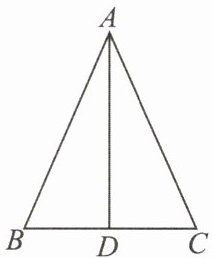
(1)请根据以上命题和图形写出已知和求证:
已知:
如图,在△ABC中,AD平分∠BAC,D为BC的中点
求证:
△ABC是等腰三角形
(2)请证明以上命题.
答案
18. (1) 已知:如图,在$△ ABC$中,$AD$平分$∠ BAC$,$D$为$BC$的中点. 求证:$△ ABC$是等腰三角形.
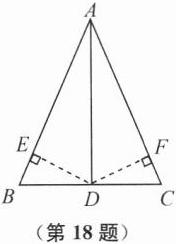
(2) 如图,过点 $D$ 作 $DE ⊥ AB$ 于点 $E$, $DF ⊥ AC$ 于点 $F$,
$\because AD$ 平分 $∠ BAC, DE ⊥ AB, DF ⊥ AC, \therefore DE=DF. \because D$ 是 $BC$ 的中点, $\therefore BD=CD. \because ∠ DEB=∠ DFC=90°$, 在 $\mathrm{Rt}△ BDE$ 和 $\mathrm{Rt}△ CDF$ 中, $\begin{cases} BD=CD, \\ DE=DF, \end{cases}$
$\therefore \mathrm{Rt}△ BDE ≌ \mathrm{Rt}△ CDF (\mathrm{HL}). \therefore ∠ B=∠ C. \therefore AB=AC. \therefore △ ABC$ 是等腰三角形.
19. 如图,$△ ABC$是边长为12 cm的等边三角形,动点M,N同时从A,B两点出发,分别沿AB,BC方向匀速移动.
(1)若点M的运动速度是2 cm/s,点N的运动速度是4 cm/s,当点N到达点C时,M,N两点都停止运动,设运动时间为t(单位:s),当$t=2$时,判断$△ BMN$的形状,并说明理由;
(2)当它们的速度都是2 cm/s,且当点M到达点B时,M,N两点停止运动,设点M的运动时间为t(单位:s),则当t为何值时,$△ BMN$是直角三角形?
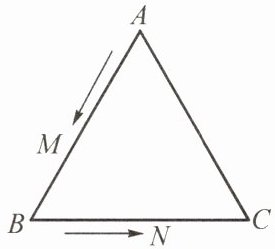
(1)若点M的运动速度是2 cm/s,点N的运动速度是4 cm/s,当点N到达点C时,M,N两点都停止运动,设运动时间为t(单位:s),当$t=2$时,判断$△ BMN$的形状,并说明理由;
(2)当它们的速度都是2 cm/s,且当点M到达点B时,M,N两点停止运动,设点M的运动时间为t(单位:s),则当t为何值时,$△ BMN$是直角三角形?
答案
19. (1) $△ BMN$ 是等边三角形,理由如下:当 $t=2$ 时, $AM=4\ \mathrm{cm}, BN=8\ \mathrm{cm}. \because △ ABC$ 是边长为 $12\ \mathrm{cm}$ 的等边三角形, $\therefore BM=12-4=8(\mathrm{cm}), ∠ B=60°. \therefore BM=BN. \therefore △ BMN$ 是等边三角形.
(2) 在 $△ BMN$ 中, $BM=(12-2t)\ \mathrm{cm}, BN=2t\ \mathrm{cm}$, ① 当 $∠ BNM=90°$ 时, $∠ B=60°$, $\therefore ∠ BMN=30°. \therefore BN=\frac{1}{2} BM. \therefore 2t=\frac{1}{2}(12-2t). \therefore t=2$; ② 当 $∠ BMN=90°$ 时, $∠ B=60°$, $\therefore ∠ BNM=30°. \therefore BM=\frac{1}{2} BN. \therefore 12-2t=\frac{1}{2} × 2t, \therefore t=4$. 综上所述, 当 $t$ 的值为 2 或 4 时, $△ BMN$ 是直角三角形.
(2) 在 $△ BMN$ 中, $BM=(12-2t)\ \mathrm{cm}, BN=2t\ \mathrm{cm}$, ① 当 $∠ BNM=90°$ 时, $∠ B=60°$, $\therefore ∠ BMN=30°. \therefore BN=\frac{1}{2} BM. \therefore 2t=\frac{1}{2}(12-2t). \therefore t=2$; ② 当 $∠ BMN=90°$ 时, $∠ B=60°$, $\therefore ∠ BNM=30°. \therefore BM=\frac{1}{2} BN. \therefore 12-2t=\frac{1}{2} × 2t, \therefore t=4$. 综上所述, 当 $t$ 的值为 2 或 4 时, $△ BMN$ 是直角三角形.
20. 在$△ ABC$中,$AB=AC$,$D$是边$BC$上一点,点$E$在$AD$的右侧,线段$AE=AD$,且$∠ DAE=∠ BAC=α$.
(1)如图①,若$α=60°$,连接$CE$,$DE$,则$∠ ADE$的度数为________;$BD$与$CE$的数量关系是________;
(2)如图②,若$α=90°$,连接$CE$,$BE$,试判断$△ BCE$的形状,并说明理由.

(1)如图①,若$α=60°$,连接$CE$,$DE$,则$∠ ADE$的度数为________;$BD$与$CE$的数量关系是________;
(2)如图②,若$α=90°$,连接$CE$,$BE$,试判断$△ BCE$的形状,并说明理由.
答案
20. (1) $60°$ $BD=CE$
(2) $△ BCE$ 是直角三角形, 理由如下:
$\because ∠ DAE=∠ BAC=90°, \therefore ∠ DAE-∠ CAD=∠ BAC-∠ CAD$, 即 $∠ BAD=∠ CAE$. 在 $△ ABD$ 和 $△ ACE$ 中, $\begin{cases} AB=AC, \\ ∠ BAD=∠ CAE, \\ AD=AE, \end{cases}$$\therefore △ ABD ≌ △ ACE (\mathrm{SAS})$. 由题意知 $△ ABC$ 是等腰直角三角形, $\therefore ∠ ACE=∠ ABD=45°. \therefore ∠ BCE=∠ ACB+∠ ACE=90°. \therefore △ BCE$ 是直角三角形.
(2) $△ BCE$ 是直角三角形, 理由如下:
$\because ∠ DAE=∠ BAC=90°, \therefore ∠ DAE-∠ CAD=∠ BAC-∠ CAD$, 即 $∠ BAD=∠ CAE$. 在 $△ ABD$ 和 $△ ACE$ 中, $\begin{cases} AB=AC, \\ ∠ BAD=∠ CAE, \\ AD=AE, \end{cases}$$\therefore △ ABD ≌ △ ACE (\mathrm{SAS})$. 由题意知 $△ ABC$ 是等腰直角三角形, $\therefore ∠ ACE=∠ ABD=45°. \therefore ∠ BCE=∠ ACB+∠ ACE=90°. \therefore △ BCE$ 是直角三角形.
