

 登录
登录
D 核心素养 社会主义先进文化
In a community in Hangzhou, a group of middle school students started a "Little Librarian" activity. 16.
Last month, the students organised a book donation. 17.
A. Now I can read on my phone.
B. Many students want to join in the activity next month.
C. Every Saturday afternoon, they meet in the community library.
D. But when we help one person, that person may help another.
E. They collected over 150 books and sent them to a school in a village.
In a community in Hangzhou, a group of middle school students started a "Little Librarian" activity. 16.
C
They help younger children choose books and read stories to them. They also teach the elderly how to use e-readers and smartphones.Last month, the students organised a book donation. 17.
E
Zhang Wei, a 14-year-old boy, said, "I feel proud when I see others enjoy reading. A small act of kindness can bring happiness to many people." Grandma Chen, 70, often comes to the library. She said, "These kids taught me how to borrow e-books. 18. A
I feel happy and not lonely anymore. They are like my own grandchildren." The team leader, 15-year-old Wang Fang, said, "We are not doing big things. 19. D
Together, we can make the world a warmer place." The community director said, "These young people set a good example for everyone."A. Now I can read on my phone.
B. Many students want to join in the activity next month.
C. Every Saturday afternoon, they meet in the community library.
D. But when we help one person, that person may help another.
E. They collected over 150 books and sent them to a school in a village.
答案
16. C 第一段开头介绍活动后,需要说明活动的时间和地点。选项C“每周六下午,他们在社区图书馆相聚”承接前文,并引出后文“他们帮助小孩子选书……”,逻辑通顺。
17. E 前一句说“组织了一次图书捐赠”,后文应具体说明捐赠情况。选项E“他们收集了150多本书,寄给了乡村的一所学校”直接描述捐赠细节,符合语境。
18. A 陈奶奶先说了“教我怎么借电子书”,后文应说明结果。选项A“现在我能用手机阅读了”是学会借电子书后的自然结果,且与后文“我感到快乐”连贯。注意选项A不是“借电子书”的重复,而是进一步说明。
19. D 王芳说“我们做的不是什么大事”,后文需要解释虽非大事但仍有意义。选项D“但当我们帮助一个人时,那个人可能会再去帮助另一个人”体现了善举的传递效应,与后文“一起让世界更温暖”完美衔接。
17. E 前一句说“组织了一次图书捐赠”,后文应具体说明捐赠情况。选项E“他们收集了150多本书,寄给了乡村的一所学校”直接描述捐赠细节,符合语境。
18. A 陈奶奶先说了“教我怎么借电子书”,后文应说明结果。选项A“现在我能用手机阅读了”是学会借电子书后的自然结果,且与后文“我感到快乐”连贯。注意选项A不是“借电子书”的重复,而是进一步说明。
19. D 王芳说“我们做的不是什么大事”,后文需要解释虽非大事但仍有意义。选项D“但当我们帮助一个人时,那个人可能会再去帮助另一个人”体现了善举的传递效应,与后文“一起让世界更温暖”完美衔接。
解析
【分析】
本题为英语七选五题型,解题思路是结合上下文的逻辑关系(如事件承接、时间地点说明、因果关联、语义递进等)匹配选项。需先梳理文章脉络:杭州中学生开展“小图书管理员”活动,介绍活动内容、图书捐赠事件、受助者反馈及团队感悟,再逐空分析前后文的衔接需求,对应选项。
【解析】
16. 前文提及启动“小图书管理员”活动,后文是学生的具体活动内容,此处需交代活动的时间与地点,选项C“每周六下午,他们在社区图书馆相聚”承接前文,引出后文具体行为,逻辑通顺。
17. 前文说学生组织了图书捐赠,此处需说明捐赠的具体情况,选项E“他们收集了150多本书,寄给了乡村的一所学校”直接对应捐赠事件,符合语境。
18. 陈奶奶提到被教借电子书,后文说自己快乐不孤单,此处需说明学会借电子书后的结果,选项A“现在我能用手机阅读了”是学会借电子书后的自然结果,与后文连贯。
19. 王芳说“做的不是大事”,后文说一起让世界更温暖,此处需解释小事的意义,选项D“但当我们帮助一个人时,那个人可能会再去帮助另一个人”体现善举的传递,与后文衔接紧密。
【答案】
16.C 17.E 18.A 19.D
【知识点】
英语七选五、语篇逻辑衔接
【点评】
本题围绕中学生公益活动展开,考查学生对语篇上下文逻辑关系的理解,需结合事件发展、人物对话的连贯性解题,难度适中。
【难度系数】
0.5
本题为英语七选五题型,解题思路是结合上下文的逻辑关系(如事件承接、时间地点说明、因果关联、语义递进等)匹配选项。需先梳理文章脉络:杭州中学生开展“小图书管理员”活动,介绍活动内容、图书捐赠事件、受助者反馈及团队感悟,再逐空分析前后文的衔接需求,对应选项。
【解析】
16. 前文提及启动“小图书管理员”活动,后文是学生的具体活动内容,此处需交代活动的时间与地点,选项C“每周六下午,他们在社区图书馆相聚”承接前文,引出后文具体行为,逻辑通顺。
17. 前文说学生组织了图书捐赠,此处需说明捐赠的具体情况,选项E“他们收集了150多本书,寄给了乡村的一所学校”直接对应捐赠事件,符合语境。
18. 陈奶奶提到被教借电子书,后文说自己快乐不孤单,此处需说明学会借电子书后的结果,选项A“现在我能用手机阅读了”是学会借电子书后的自然结果,与后文连贯。
19. 王芳说“做的不是大事”,后文说一起让世界更温暖,此处需解释小事的意义,选项D“但当我们帮助一个人时,那个人可能会再去帮助另一个人”体现善举的传递,与后文衔接紧密。
【答案】
16.C 17.E 18.A 19.D
【知识点】
英语七选五、语篇逻辑衔接
【点评】
本题围绕中学生公益活动展开,考查学生对语篇上下文逻辑关系的理解,需结合事件发展、人物对话的连贯性解题,难度适中。
【难度系数】
0.5
三、补全对话(有一项多余)。(每小题2分,共10分)
[2026南宁期末改编]
A: Hi, Gina. What are you reading now?
B: 1.
A: What's it about?
B: It's about changes in future school life.
A: 2.
B: Sure. For example, there will be smart blackboards.
A: Really? What about the teachers then?
B: 3.
A: Wow! 4.
B: Students might use VR for learning.
A: That's so cool! 5.
B: Me too. I believe it will come true.
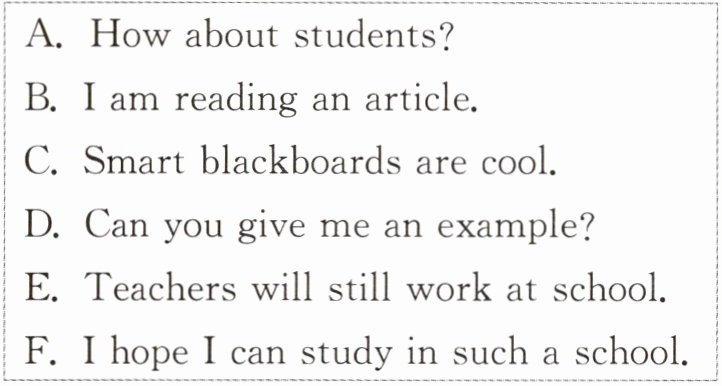
A. How about students?
B. I am reading an article.
C. Smart blackboards are cool.
D. Can you give me an example?
E. Teachers will still work at school.
F. I hope I can study in such a school.
[2026南宁期末改编]
A: Hi, Gina. What are you reading now?
B: 1.
B
A: What's it about?
B: It's about changes in future school life.
A: 2.
D
B: Sure. For example, there will be smart blackboards.
A: Really? What about the teachers then?
B: 3.
E
Robots will help them.A: Wow! 4.
A
B: Students might use VR for learning.
A: That's so cool! 5.
F
B: Me too. I believe it will come true.
A. How about students?
B. I am reading an article.
C. Smart blackboards are cool.
D. Can you give me an example?
E. Teachers will still work at school.
F. I hope I can study in such a school.
答案
1~5. BDEAF
解析
【分析】
本题为补全对话题型,需结合上下文的问答逻辑与语境选择匹配的句子。首先,A询问B正在读什么,答句需说明当前动作;其次,A在得知文章主题后,因下文出现举例内容,故需选择请求举例的句子;接着,A询问老师的情况,答句需对应老师的相关描述;之后,B回答老师情况后提到学生的学习方式,说明A问的是学生的情况;最后,A感叹后,B回应“Me too”,说明A表达了相关愿望,据此逐一匹配选项。
【解析】
1. 上文A问“What are you reading now?”,答句需说明正在做的事,对应选项B(I am reading an article.);
2. B提到文章关于未来学校变化,下文B以“Sure. For example...”回应,说明A是请求举例,对应选项D(Can you give me an example?);
3. A问“What about the teachers then?”,答句需说明老师的情况,对应选项E(Teachers will still work at school.);
4. B回答老师情况后提到学生的学习方式,说明A问的是学生的情况,对应选项A(How about students?);
5. A感叹后,B说“Me too. I believe it will come true.”,说明A表达了愿望,对应选项F(I hope I can study in such a school.)。
【答案】
BDEAF
【知识点】
补全对话、情景交际
【点评】
本题考查日常情景对话的补全,需结合上下文语境与问答逻辑选择合适句子,是初中英语常见题型,难度适中。
【难度系数】
0.3
本题为补全对话题型,需结合上下文的问答逻辑与语境选择匹配的句子。首先,A询问B正在读什么,答句需说明当前动作;其次,A在得知文章主题后,因下文出现举例内容,故需选择请求举例的句子;接着,A询问老师的情况,答句需对应老师的相关描述;之后,B回答老师情况后提到学生的学习方式,说明A问的是学生的情况;最后,A感叹后,B回应“Me too”,说明A表达了相关愿望,据此逐一匹配选项。
【解析】
1. 上文A问“What are you reading now?”,答句需说明正在做的事,对应选项B(I am reading an article.);
2. B提到文章关于未来学校变化,下文B以“Sure. For example...”回应,说明A是请求举例,对应选项D(Can you give me an example?);
3. A问“What about the teachers then?”,答句需说明老师的情况,对应选项E(Teachers will still work at school.);
4. B回答老师情况后提到学生的学习方式,说明A问的是学生的情况,对应选项A(How about students?);
5. A感叹后,B说“Me too. I believe it will come true.”,说明A表达了愿望,对应选项F(I hope I can study in such a school.)。
【答案】
BDEAF
【知识点】
补全对话、情景交际
【点评】
本题考查日常情景对话的补全,需结合上下文语境与问答逻辑选择合适句子,是初中英语常见题型,难度适中。
【难度系数】
0.3
四、核心素养 学习能力 语法填空。(每小题1分,共10分)
When doing his maths homework, Lu Lifei, 14, from Jiangsu came across a problem. He couldn't 1.
Nowadays, many students do homework like Lu. They search for information online, use apps 3.
"It improves students' abilities," said Wang Shiying, 4.
However, this trend(趋势) also brings up 7.
"No matter how difficult the problem is, think about it independently 10.
When doing his maths homework, Lu Lifei, 14, from Jiangsu came across a problem. He couldn't 1.
work
(work) it out. So he 2. took
(take) out his cellphone and searched the internet for the problem. The answers soon appeared on the screen.Nowadays, many students do homework like Lu. They search for information online, use apps 3.
or
discuss problems through social networks."It improves students' abilities," said Wang Shiying, 4.
a
girl from Shanghai. "And it's especially true for new types of homework." Wang's Chinese teacher often asks students to give speeches on great writers. When it comes to Wang's turn, she usually searches online, 5. learns
(learn) about certain stories and makes slides(幻灯片) by herself. Wang said, "I've become good at finding information online and 6. using
(use) Microsoft Office."However, this trend(趋势) also brings up 7.
problems
(problem). Some students just copy the answers online 8. without
thinking. They become lazy. According to Huang Pengxiang, a head teacher from Shanxi, the key is 9. to have
(have) good self-control."No matter how difficult the problem is, think about it independently 10.
first
(one)," Huang said. "Be sure to understand the reasons behind the answers, or you won't make progress."答案
1. work 2. took 3. or 4. a 5. learns
6. using 7. problems 8. without 9. to have 10. first
6. using 7. problems 8. without 9. to have 10. first
解析
【分析】
本题为语法填空题,需结合语境和语法规则逐一分析每个空:1. 情态动词后接动词原形;2. 时态需与前文一致;3. 此处表选择关系;4. 泛指单数可数名词用不定冠词;5. 一般现在时第三人称单数动词形式;6. 介词后接动名词;7. 可数名词泛指多个用复数;8. 结合语境表“没有”的介词;9. 不定式作表语;10. 此处需用序数词表“首先”。
【解析】
1. 情态动词couldn't后必须接动词原形,故填work;
2. 前文用一般过去时(came),此处时态保持一致,take的过去式为took,故填took;
3. 此处表示“使用应用程序或通过社交网络讨论问题”,表选择关系,用连词or,故填or;
4. 此处泛指“一个来自上海的女孩”,girl为可数名词单数,且以辅音音素开头,故用不定冠词a,填a;
5. 主语是第三人称单数she,句子为一般现在时,与searches、makes并列,动词需用第三人称单数形式,learn的第三人称单数是learns,故填learns;
6. be good at是固定搭配,意为“擅长”,介词at后接动名词作宾语,use的动名词为using,故填using;
7. problem是可数名词,此处表泛指多个问题,需用复数形式,故填problems;
8. 结合语境“一些学生只是网上抄答案________思考”,可知是“没有”思考,用介词without,故填without;
9. the key is后接不定式作表语,表具体内容,故填to have;
10. 此处表示“独立思考,首先自己想”,用one的序数词first,意为“首先”,故填first。
【答案】
1. work 2. took 3. or 4. a 5. learns 6. using 7. problems 8. without 9. to have 10. first
【知识点】
基础语法运用、情态动词与时态、非谓语动词
【点评】
本题结合学生日常学习场景,考察基础语法在语境中的实际运用,注重学生对语法规则的灵活掌握,难度适中,符合学习能力类题目的要求。
【难度系数】
0.6
本题为语法填空题,需结合语境和语法规则逐一分析每个空:1. 情态动词后接动词原形;2. 时态需与前文一致;3. 此处表选择关系;4. 泛指单数可数名词用不定冠词;5. 一般现在时第三人称单数动词形式;6. 介词后接动名词;7. 可数名词泛指多个用复数;8. 结合语境表“没有”的介词;9. 不定式作表语;10. 此处需用序数词表“首先”。
【解析】
1. 情态动词couldn't后必须接动词原形,故填work;
2. 前文用一般过去时(came),此处时态保持一致,take的过去式为took,故填took;
3. 此处表示“使用应用程序或通过社交网络讨论问题”,表选择关系,用连词or,故填or;
4. 此处泛指“一个来自上海的女孩”,girl为可数名词单数,且以辅音音素开头,故用不定冠词a,填a;
5. 主语是第三人称单数she,句子为一般现在时,与searches、makes并列,动词需用第三人称单数形式,learn的第三人称单数是learns,故填learns;
6. be good at是固定搭配,意为“擅长”,介词at后接动名词作宾语,use的动名词为using,故填using;
7. problem是可数名词,此处表泛指多个问题,需用复数形式,故填problems;
8. 结合语境“一些学生只是网上抄答案________思考”,可知是“没有”思考,用介词without,故填without;
9. the key is后接不定式作表语,表具体内容,故填to have;
10. 此处表示“独立思考,首先自己想”,用one的序数词first,意为“首先”,故填first。
【答案】
1. work 2. took 3. or 4. a 5. learns 6. using 7. problems 8. without 9. to have 10. first
【知识点】
基础语法运用、情态动词与时态、非谓语动词
【点评】
本题结合学生日常学习场景,考察基础语法在语境中的实际运用,注重学生对语法规则的灵活掌握,难度适中,符合学习能力类题目的要求。
【难度系数】
0.6
