

 登录
登录
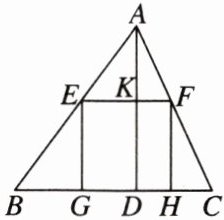
15.如图,一块材料的形状是锐角三角形ABC,边BC长12 cm,BC边上的高AD为10 cm,把它加工成正方形零件,使正方形的一边GH在BC上,其余两个顶点E,F分别在AB,AC上,求这个正方形零件EFHG的边长.
答案
15.【解】$\because$ 四边形EFHG是正方形,$\therefore EF// BC. \therefore △ AEF∽ △ ABC. \because AD⊥ BC,\therefore AK⊥ EF.\therefore \frac{EF}{BC}=\frac{AK}{AD}.$ 易知四边形EGDK是矩形,$\therefore DK=GE.$ 设正方形零件EFHG的边长为$x\ \mathrm{cm},$ 则$EF=GE=x\ \mathrm{cm},\therefore DK=x\ \mathrm{cm}.\therefore AK=(10-x)\ \mathrm{cm}. \therefore \frac{x}{12}=\frac{10-x}{10},$ 解得$x=\frac{60}{11}.$ 因此这个正方形零件EFHG的边长为$\frac{60}{11}\ \mathrm{cm}.$
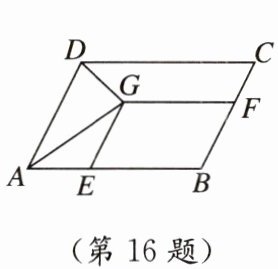
16. 如图,已知平行四边形ABCD的面积为24,以B为位似中心,作平行四边形ABCD的位似图形平行四边形EBFG,位似图形与原图形的相似比为$\frac{2}{3}$,连结AG,DG,则$△ ADG$的面积为
4
.答案
16.4 【点拨】延长EG交CD于点H. $\because$ 四边形ABCD和四边形EBFG是平行四边形,$\therefore AB// CD,AD// BC,BF// EG,\therefore AD// EG.\therefore$ 四边形AEHD是平行四边形. $\therefore S_{△ ADG}=\frac{1}{2}S_{\mathrm{平行四边形}AEHD}.\because$ 平行四边形EBFG与平行四边形ABCD的相似比为$\frac{2}{3}.\therefore BE=\frac{2}{3}AB,\therefore AE=\frac{1}{3}AB.\therefore S_{\mathrm{平行四边形}AEHD}=\frac{1}{3}S_{\mathrm{平行四边形}ABCD}=8.\therefore S_{△ ADG}=\frac{1}{2}S_{\mathrm{平行四边形}AEHD}=\frac{1}{2}× 8=4.$
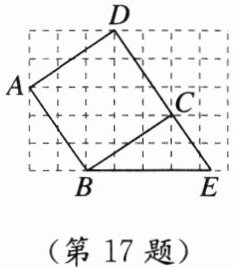
17.如图,四边形ABCD的每个顶点都在边长为1的正方形格点上,延长DC与过点B的水平格线交于点E,则线段BE的长为
$\frac{13}{3}$
.答案
17.$\frac{13}{3}$ 【点拨】过点C作$CF⊥ BE$于点F,则$∠ BFC=∠ CFE=90°.$ 易得四边形ABCD是正方形,$\therefore ∠ BCD=90°.\therefore ∠ BCE=90°.\therefore ∠ BCF+∠ ECF=90°.\because ∠ BFC=90°,\therefore ∠ BCF+∠ CBF=90°.\therefore ∠ ECF=∠ CBF.$ 又$\because ∠ BFC=∠ CFE,\therefore △ BCF∽ △ CEF.\therefore \frac{BC}{CE}=\frac{BF}{CF}.$ 由题图易知$BF=3,CF=2,\therefore BC=\sqrt{13}.\therefore \frac{\sqrt{13}}{CE}=\frac{3}{2}.\therefore CE=\frac{2\sqrt{13}}{3}.\therefore BE=\sqrt{BC^2+CE^2}=\sqrt{(\sqrt{13})^2+(\frac{2\sqrt{13}}{3})^2}=\frac{13}{3}.$
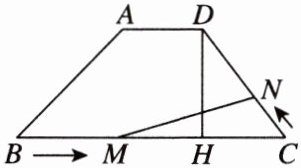
18. 如图,在四边形ABCD中,AD//BC,过点D作DH⊥BC于H.已知AD=3,BC=10,CD=5,DH=4.动点M从B点出发沿线段BC以每秒2个单位长度的速度向终点C运动,动点N同时从C点出发沿线段CD以每秒1个单位长度的速度向终点D运动.设运动时间为t秒.
(1)当MN//AB时,求t的值;
(2)当△CMN是等腰三角形时,求t的值.
(1)当MN//AB时,求t的值;
(2)当△CMN是等腰三角形时,求t的值.
答案
18.【解】(1)如图①,过点D作$DG// AB$交BC于点G.
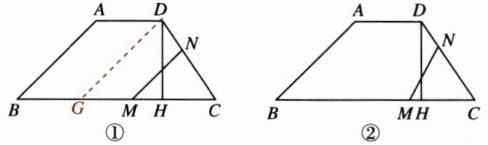 $\because DG// AB,AD// BC,\therefore$ 四边形ABGD是平行四边形.$\therefore BG=AD=3.\therefore GC=10-3=7.$ 由题意得,当M,N运动$t(0≤ t≤ 5)$秒后,$CN=t,CM=10-2t. \because AB// DG,MN// AB,\therefore DG// MN. \therefore △ MNC∽ △ GDC.\therefore \frac{CN}{CD}=\frac{CM}{CG},$ 即$\frac{t}{5}=\frac{10-2t}{7},$ 解得$t=\frac{50}{17}.$ 即当$MN// AB$时,$t=\frac{50}{17}.$
(2)由题意得,当M,N运动$t(0≤ t≤ 5)$秒后,$CN=t,CM=10-2t.$
第一种情况:当$NC=MC$时,如图②,$t=10-2t,$ 解得$t=\frac{10}{3};$
第二种情况:当$MN=NC$时,如图③,过点N作$NE⊥ MC$于点E,
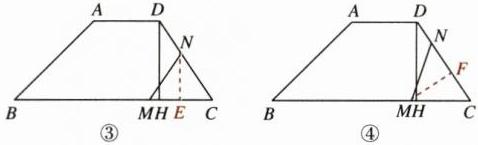 则$CE=ME=\frac{1}{2}CM=5-t.\because CD=5,DH=4,\therefore CH=\sqrt{CD^2-DH^2}=3. \because ∠ C=∠ C,∠ DHC=∠ NEC=90°,\therefore △ NEC∽ △ DHC.\therefore \frac{NC}{DC}=\frac{EC}{HC},$ 即$\frac{t}{5}=\frac{5-t}{3},$ 解得$t=\frac{25}{8};$
第三种情况:当$MN=MC$时,如图④,过点M作$MF⊥ CN$于点F,则$FC=\frac{1}{2}NC=\frac{1}{2}t,$ 同理可得,$CH=3. \because ∠ C=∠ C,∠ MFC=∠ DHC=90°,\therefore △ MFC∽ △ DHC.\therefore \frac{FC}{HC}=\frac{MC}{DC},$ 即$\frac{\frac{1}{2}t}{3}=\frac{10-2t}{5},$ 解得$t=\frac{60}{17}.$
综上所述,当$△ CMN$为等腰三角形时,$t=\frac{10}{3}$或$t=\frac{25}{8}$或$t=\frac{60}{17}.$
