

 登录
登录
(55分 60分钟)
大单元主题情境
本单元以“庆祝”为核心线索,既聚焦了我国家喻户晓的传统节日,探寻了民族文化底蕴与节日氛围,又串联了全球共通的节庆主题,展现了不同文化背景下的节日特色与价值内核。
情境1 “腊八,腊八,过了腊八就是年”——这句耳熟能详的民间俗语,是不是也藏着你的家乡记忆?作为春节的“前奏”,腊八节一到,年味儿便悄悄蔓延开来。下面就让我们一同探寻腊八节的由来,解锁它承载的传统习俗吧!
任务一 [2026江苏盐城期末改编]完形填空(10分)
The Laba Festival is a traditional Chinese festival celebrated on the eighth day of the twelfth month of the Chinese lunar calendar. “La” 1 the 12th lunar month, and “ba” means eight.
In the past, the Laba Festival was a chance for people to give sacrifices to their 2, and to pray(祈祷)to heaven and earth for a good harvest and good luck. It marks the start of the Spring Festival. 3 the Laba Festival, Lunar New Year is coming soon. Many years later, it has developed into eating Laba Porridge—a kind of porridge that 4 different types of rice, beans and dried nuts. Laba porridge is the most 5 meal in the festival.
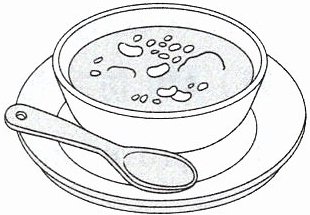
Laba Porridge
According to the most famous 6, the founding emperor of the Ming Dynasty, Zhu Yuanzhang, used to work for a rich man. One day, one cow’s leg was broken because of his carelessness. The rich man was so 7 that he locked Zhu in a small room and didn’t allow others to give food to him. After some time, in a corner of the room, Zhu found a rat 8 which had plenty of stolen red beans, rice, red dates(红枣)and other things. Then he made these things into porridge, which let him not 9 hunger. The emperor Zhu Yuanzhang named the 10 “Laba Porridge” because that day was the eighth day of the twelfth lunar month.
(
(
(
(
(
(
(
(
(
(
情境2 新年新气象,二月二是春节后的第一个节日,在这个节日里也有很多传承下来的习俗,让我们一起去看看吧。
任务二 阅读理解A(10分)
The Longtaitou Festival is one of the traditional Chinese festivals. It is often celebrated after the Spring Festival and the Lantern Festival. Let’s take a look!
| Festival | Longtaitou |
| --- | --- |
| Time | • On the second day of the second lunar month.
• On March 11th, 2024.
• On March 1st, 2025. |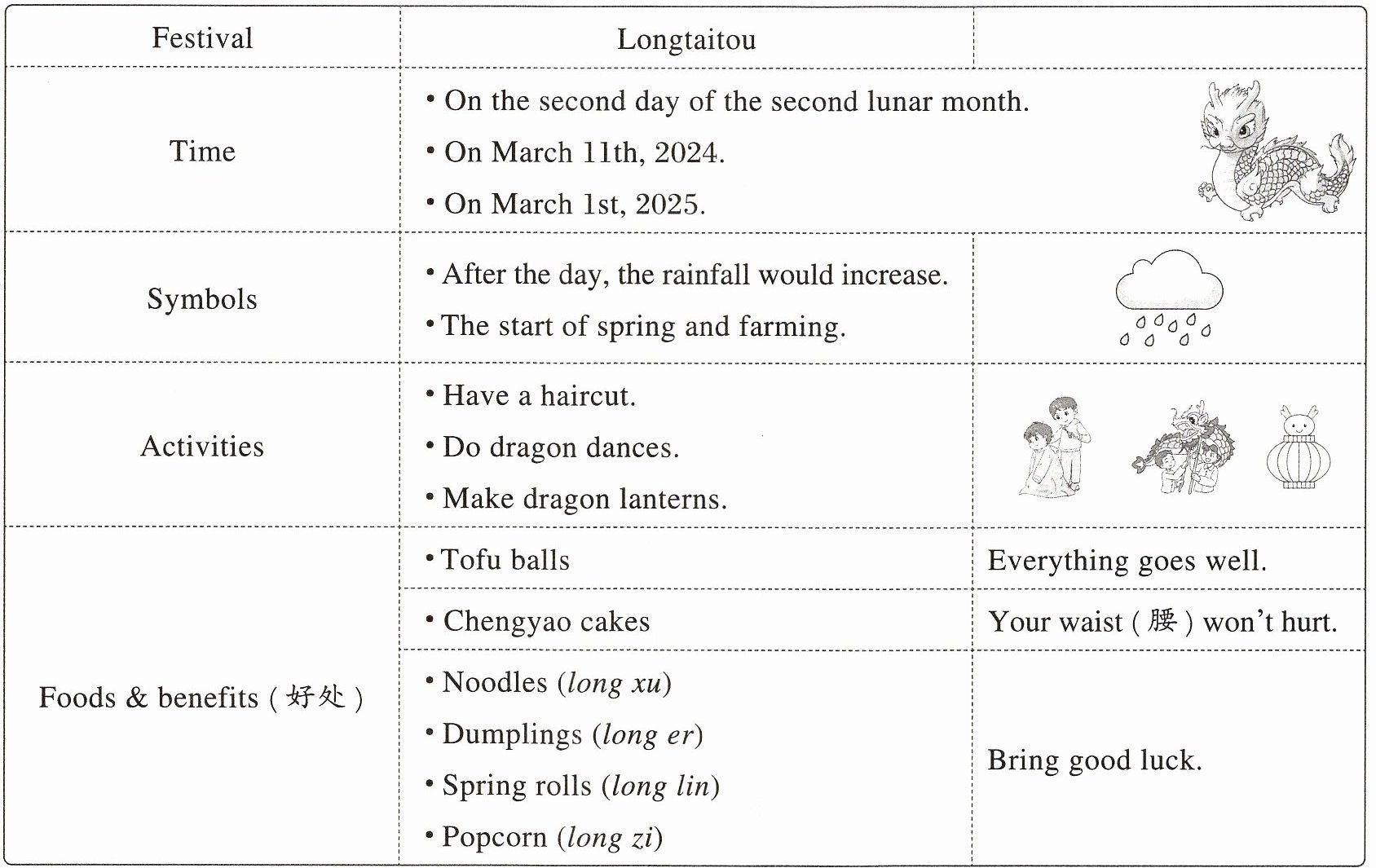 |
|
| Symbols | • After the day, the rainfall would increase.
• The start of spring and farming. | |
| Activities | • Have a haircut.
• Do dragon dances
• Make dragon lanterns. | |
| Foods & benefits(好处) | • Tofu balls
• Chengyao cakes
• Noodles (long xu)
• Dumplings (long er)
• Spring rolls (long lin)
• Popcorn (long zi) | Everything goes well.
Your waist(腰)won’t hurt.
Bring good luck. |
(
A. On the second day of March. B. On March 1st in 2024.
C. On the second day of the second lunar month. D. On March 11th in 2025.
(

(
① Dumplings. ② Spring rolls. ③ Chengyao cakes. ④ Popcorn.
A. ①②③ B. ②③④ C. ①②④ D. ①③④
(
A. After the Longtaitou Festival, there will be more rainy days.
B. People can’t have a haircut after the Longtaitou Festival.
C. During the Longtaitou Festival, people dislike dancing.
D. According to the solar calendar, the time of the Longtaitou Festival is the same every year.
(
A. Famous People. B. The Culture Window. C. The Movie World. D. TV Programs.
大单元主题情境
本单元以“庆祝”为核心线索,既聚焦了我国家喻户晓的传统节日,探寻了民族文化底蕴与节日氛围,又串联了全球共通的节庆主题,展现了不同文化背景下的节日特色与价值内核。
情境1 “腊八,腊八,过了腊八就是年”——这句耳熟能详的民间俗语,是不是也藏着你的家乡记忆?作为春节的“前奏”,腊八节一到,年味儿便悄悄蔓延开来。下面就让我们一同探寻腊八节的由来,解锁它承载的传统习俗吧!
任务一 [2026江苏盐城期末改编]完形填空(10分)
The Laba Festival is a traditional Chinese festival celebrated on the eighth day of the twelfth month of the Chinese lunar calendar. “La” 1 the 12th lunar month, and “ba” means eight.
In the past, the Laba Festival was a chance for people to give sacrifices to their 2, and to pray(祈祷)to heaven and earth for a good harvest and good luck. It marks the start of the Spring Festival. 3 the Laba Festival, Lunar New Year is coming soon. Many years later, it has developed into eating Laba Porridge—a kind of porridge that 4 different types of rice, beans and dried nuts. Laba porridge is the most 5 meal in the festival.
Laba Porridge
According to the most famous 6, the founding emperor of the Ming Dynasty, Zhu Yuanzhang, used to work for a rich man. One day, one cow’s leg was broken because of his carelessness. The rich man was so 7 that he locked Zhu in a small room and didn’t allow others to give food to him. After some time, in a corner of the room, Zhu found a rat 8 which had plenty of stolen red beans, rice, red dates(红枣)and other things. Then he made these things into porridge, which let him not 9 hunger. The emperor Zhu Yuanzhang named the 10 “Laba Porridge” because that day was the eighth day of the twelfth lunar month.
(
D
)1. A. drives B. accepts C. wonders D. means(
C
)2. A. friends B. family C. ancestors D. neighbors(
A
)3. A. After B. Before C. Until D. While(
D
)4. A. interests B. invites C. introduces D. includes(
A
)5. A. popular B. simple C. true D. useful(
B
)6. A. news B. story C. poem D. diary(
D
)7. A. bored B. cheerful C. sad D. angry(
A
)8. A. hole B. door C. chair D. picture(
C
)9. A. put up B. find out C. die of D. get off(
C
)10. A. honey B. meat C. porridge D. soup情境2 新年新气象,二月二是春节后的第一个节日,在这个节日里也有很多传承下来的习俗,让我们一起去看看吧。
任务二 阅读理解A(10分)
The Longtaitou Festival is one of the traditional Chinese festivals. It is often celebrated after the Spring Festival and the Lantern Festival. Let’s take a look!
| Festival | Longtaitou |
| --- | --- |
| Time | • On the second day of the second lunar month.
• On March 11th, 2024.
• On March 1st, 2025. |
|| Symbols | • After the day, the rainfall would increase.
• The start of spring and farming. | |
| Activities | • Have a haircut.
• Do dragon dances
• Make dragon lanterns. | |
| Foods & benefits(好处) | • Tofu balls
• Chengyao cakes
• Noodles (long xu)
• Dumplings (long er)
• Spring rolls (long lin)
• Popcorn (long zi) | Everything goes well.
Your waist(腰)won’t hurt.
Bring good luck. |
(
C
)11. When is the Longtaitou Festival?A. On the second day of March. B. On March 1st in 2024.
C. On the second day of the second lunar month. D. On March 11th in 2025.
(
A
)12. [新考法·图文转换] What should farmers do after the festival?(
C
)13. [新考法·信息组合] Which of the following foods can bring good luck according to the passage?① Dumplings. ② Spring rolls. ③ Chengyao cakes. ④ Popcorn.
A. ①②③ B. ②③④ C. ①②④ D. ①③④
(
A
)14. What can you know according to the passage?A. After the Longtaitou Festival, there will be more rainy days.
B. People can’t have a haircut after the Longtaitou Festival.
C. During the Longtaitou Festival, people dislike dancing.
D. According to the solar calendar, the time of the Longtaitou Festival is the same every year.
(
B
)15. In which part of a magazine can you read the text?A. Famous People. B. The Culture Window. C. The Movie World. D. TV Programs.
答案
任务一 答案速查 1.D 2.C 3.A 4.D 5.A 6.B 7.D 8.A 9.C 10.C
【主旨大意】本文介绍了中国传统节日腊八节的由来、习俗及相关的传说故事。
1. D【点拨】根据“and ‘ba’ means eight”可知,此处应介绍“La”的含义。
2. C【点拨】根据“give sacrifices to their... and to pray(祈祷)to heaven and earth for a good harvest and good luck”可知是供奉祖先。
3. A【点拨】根据常识可知,农历新年在腊八节之后。
4. D【点拨】根据“different types of rice, beans and dried nuts”和常识可知,腊八粥中包括大米和豆类等。
5. A【点拨】根据“it has developed into eating Laba Porridge”可知,腊八粥很受欢迎。
6. B【点拨】根据“the founding emperor of the Ming Dynasty, Zhu Yuanzhang, used to work for a rich man”可知,朱元璋为富人打工是一个传说故事。
7. D【点拨】根据“he locked Zhu in a small room and didn’t allow others to give food to him”可知,因为生气,所以惩罚了朱元璋。
8. A【点拨】根据“which had plenty of stolen red beans, rice, red dates(红枣)and other things”可知,老鼠洞中储存了这些东西。
9. C【点拨】根据“hunger”可知,长时间挨饿会死人。
10. C【点拨】根据“Then he made these things into porridge”和“Laba Porridge”可知,朱元璋把自己熬成的粥命名为腊八粥。
任务二 答案速查 11.C 12.A 13.C 14.A 15.B
【主旨大意】本文主要讲述了中国的传统节日——二月二龙抬头。
11. C【点拨】细节理解题。根据“Time”中的“On the second day of the second lunar month.”可知,龙抬头节日在农历二月初二。
12. A【点拨】推理判断题。根据“Symbols”中的“The start of spring and farming.”可知,龙抬头是春天和农耕的开始,所以农民们应该在节日之后开始春耕。选项A所示是农耕。
13. C【点拨】细节理解题。根据“Chengyao cakes”对应的“Your waist(腰)won’t hurt.”可知,没有提到“撑腰糕”能带来好运,排除③。
14. A【点拨】细节理解题。根据“After the day, the rainfall would increase.”可知,过了龙抬头,下雨天就多了。
15. B【点拨】推理判断题。文章主要介绍了龙抬头节日的时间、象征、活动、食物和好处等相关文化知识,所以我们能在杂志的文化窗口部分读到这篇文章。
【主旨大意】本文介绍了中国传统节日腊八节的由来、习俗及相关的传说故事。
1. D【点拨】根据“and ‘ba’ means eight”可知,此处应介绍“La”的含义。
2. C【点拨】根据“give sacrifices to their... and to pray(祈祷)to heaven and earth for a good harvest and good luck”可知是供奉祖先。
3. A【点拨】根据常识可知,农历新年在腊八节之后。
4. D【点拨】根据“different types of rice, beans and dried nuts”和常识可知,腊八粥中包括大米和豆类等。
5. A【点拨】根据“it has developed into eating Laba Porridge”可知,腊八粥很受欢迎。
6. B【点拨】根据“the founding emperor of the Ming Dynasty, Zhu Yuanzhang, used to work for a rich man”可知,朱元璋为富人打工是一个传说故事。
7. D【点拨】根据“he locked Zhu in a small room and didn’t allow others to give food to him”可知,因为生气,所以惩罚了朱元璋。
8. A【点拨】根据“which had plenty of stolen red beans, rice, red dates(红枣)and other things”可知,老鼠洞中储存了这些东西。
9. C【点拨】根据“hunger”可知,长时间挨饿会死人。
10. C【点拨】根据“Then he made these things into porridge”和“Laba Porridge”可知,朱元璋把自己熬成的粥命名为腊八粥。
任务二 答案速查 11.C 12.A 13.C 14.A 15.B
【主旨大意】本文主要讲述了中国的传统节日——二月二龙抬头。
11. C【点拨】细节理解题。根据“Time”中的“On the second day of the second lunar month.”可知,龙抬头节日在农历二月初二。
12. A【点拨】推理判断题。根据“Symbols”中的“The start of spring and farming.”可知,龙抬头是春天和农耕的开始,所以农民们应该在节日之后开始春耕。选项A所示是农耕。
13. C【点拨】细节理解题。根据“Chengyao cakes”对应的“Your waist(腰)won’t hurt.”可知,没有提到“撑腰糕”能带来好运,排除③。
14. A【点拨】细节理解题。根据“After the day, the rainfall would increase.”可知,过了龙抬头,下雨天就多了。
15. B【点拨】推理判断题。文章主要介绍了龙抬头节日的时间、象征、活动、食物和好处等相关文化知识,所以我们能在杂志的文化窗口部分读到这篇文章。
解析
【分析】
本题是英语学科的完形填空和阅读理解,围绕“庆祝”主题的中国传统节日(腊八节、龙抬头)展开。解题思路:1. 做完形填空时,先通读全文把握腊八节的主旨,再结合上下文语境、词汇含义及固定搭配逐一分析选项;2. 做阅读理解时,先快速浏览表格或语篇明确龙抬头的相关信息,再根据题干关键词定位原文细节,推理判断题需结合原文象征意义等内容,最后核对选项得出答案。
【解析】
任务一(完形填空):
1. 根据后文“and ‘ba’ means eight”,此处应解释“La”的含义,故选D(means)。
2. 腊八节过去是供奉祖先、祈求丰收的节日,故选C(ancestors)。
3. 腊八节是春节前奏,春节在腊八之后,故选A(After)。
4. 腊八粥包含多种米、豆等食材,故选D(includes)。
5. 腊八粥是节日最受欢迎的食物,故选A(popular)。
6. 朱元璋的相关内容是民间传说,故选B(story)。
7. 富人因朱元璋打碎牛腿而生气,将其关起来不给食物,故选D(angry)。
8. 老鼠在洞中储存偷来的食材,故选A(hole)。
9. 粥让他免于饿死,故选C(die of)。
10. 他把熬的粥命名为腊八粥,故选C(porridge)。
任务二(阅读理解A):
11. 根据表格Time部分“On the second day of the second lunar month”,确定龙抬头时间,故选C。
12. 龙抬头是春天和农耕的开始,农民节后需春耕,对应农耕类插图,故选A。
13. 撑腰糕对应好处是腰不疼,并非带来好运,排除③,故选C(①②④)。
14. 根据Symbols部分“After the day, the rainfall would increase”,确定选项A正确。
15. 文章介绍节日文化,应在杂志的文化窗口板块,故选B。
【答案】
任务一:1.D 2.C 3.A 4.D 5.A 6.B 7.D 8.A 9.C 10.C
任务二:11.C 12.A 13.C 14.A 15.B
【知识点】
英语完形填空、英语阅读理解、中国传统节日文化
【点评】
本题以“庆祝”为核心主题,结合中国传统节日的英语语篇,考查学生的词汇运用、语篇理解及文化常识,符合期末学业评价要求,注重语言能力与文化意识的融合。
【难度系数】
0.7
本题是英语学科的完形填空和阅读理解,围绕“庆祝”主题的中国传统节日(腊八节、龙抬头)展开。解题思路:1. 做完形填空时,先通读全文把握腊八节的主旨,再结合上下文语境、词汇含义及固定搭配逐一分析选项;2. 做阅读理解时,先快速浏览表格或语篇明确龙抬头的相关信息,再根据题干关键词定位原文细节,推理判断题需结合原文象征意义等内容,最后核对选项得出答案。
【解析】
任务一(完形填空):
1. 根据后文“and ‘ba’ means eight”,此处应解释“La”的含义,故选D(means)。
2. 腊八节过去是供奉祖先、祈求丰收的节日,故选C(ancestors)。
3. 腊八节是春节前奏,春节在腊八之后,故选A(After)。
4. 腊八粥包含多种米、豆等食材,故选D(includes)。
5. 腊八粥是节日最受欢迎的食物,故选A(popular)。
6. 朱元璋的相关内容是民间传说,故选B(story)。
7. 富人因朱元璋打碎牛腿而生气,将其关起来不给食物,故选D(angry)。
8. 老鼠在洞中储存偷来的食材,故选A(hole)。
9. 粥让他免于饿死,故选C(die of)。
10. 他把熬的粥命名为腊八粥,故选C(porridge)。
任务二(阅读理解A):
11. 根据表格Time部分“On the second day of the second lunar month”,确定龙抬头时间,故选C。
12. 龙抬头是春天和农耕的开始,农民节后需春耕,对应农耕类插图,故选A。
13. 撑腰糕对应好处是腰不疼,并非带来好运,排除③,故选C(①②④)。
14. 根据Symbols部分“After the day, the rainfall would increase”,确定选项A正确。
15. 文章介绍节日文化,应在杂志的文化窗口板块,故选B。
【答案】
任务一:1.D 2.C 3.A 4.D 5.A 6.B 7.D 8.A 9.C 10.C
任务二:11.C 12.A 13.C 14.A 15.B
【知识点】
英语完形填空、英语阅读理解、中国传统节日文化
【点评】
本题以“庆祝”为核心主题,结合中国传统节日的英语语篇,考查学生的词汇运用、语篇理解及文化常识,符合期末学业评价要求,注重语言能力与文化意识的融合。
【难度系数】
0.7
