

 登录
登录
C(2025·慈溪)
The East Zhejiang Canal(运河), also known as the Zhedong Canal, is part of the Grand Canal of China. Running from the Qiantang River in Hangzhou to the city of Ningbo, the Zhedong Canal played an important role in transport(运输) and trade for centuries. Before modern roads and railways, waterways were one of the most important ways to transport goods.
Built over 2,000 years ago, the canal was used to transport goods like rice, silk, and tea in ancient China. Even today, some parts of the canal are still in use, mostly for tourism(旅游). Along the canal, there are old towns and bridges. Tourists can see traditional houses, walk along the ancient paths, and take boat rides on the canal.
Today, the Zhejiang government is working to protect the canal. They clean the water and repair old buildings. The scenery along the canal is becoming more and more beautiful, especially in spring and autumn.
The Zhedong Canal is not just a waterway—it is a symbol of ancient Chinese people's wisdom and smart engineering.
(
A.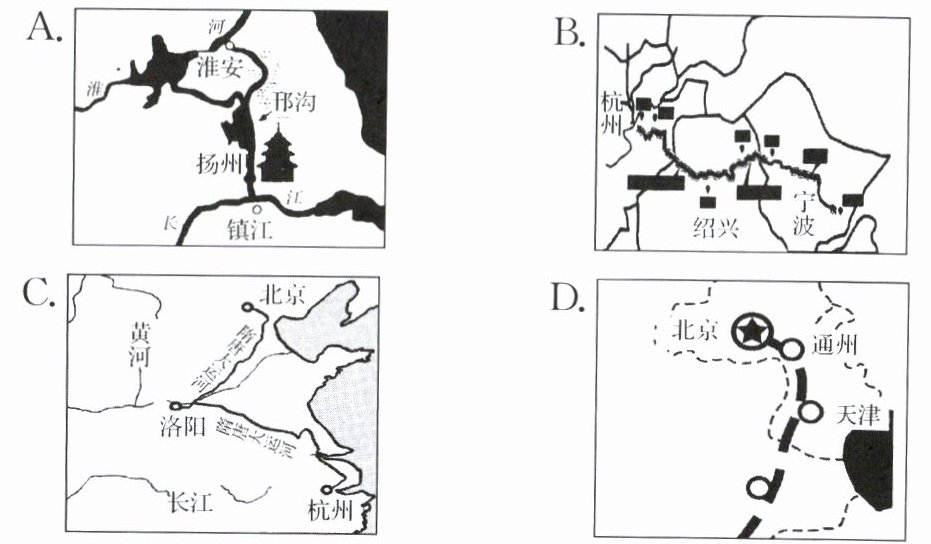 B.
B.
C. D.
(
A. 珠宝 B. 武器 C. 游客 D. 货物
(
A. About three thousand years.
B. Exactly four thousand years.
C. Less than one thousand years.
D. More than two thousand years.
(
A. Tourism. B. Transport.
C. Education. D. Research.
The East Zhejiang Canal(运河), also known as the Zhedong Canal, is part of the Grand Canal of China. Running from the Qiantang River in Hangzhou to the city of Ningbo, the Zhedong Canal played an important role in transport(运输) and trade for centuries. Before modern roads and railways, waterways were one of the most important ways to transport goods.
Built over 2,000 years ago, the canal was used to transport goods like rice, silk, and tea in ancient China. Even today, some parts of the canal are still in use, mostly for tourism(旅游). Along the canal, there are old towns and bridges. Tourists can see traditional houses, walk along the ancient paths, and take boat rides on the canal.
Today, the Zhejiang government is working to protect the canal. They clean the water and repair old buildings. The scenery along the canal is becoming more and more beautiful, especially in spring and autumn.
The Zhedong Canal is not just a waterway—it is a symbol of ancient Chinese people's wisdom and smart engineering.
(
B
)23. Which of the following is the right map for the Zhedong Canal?A.
B.C. D.
(
D
)24. The underlined word "goods" (in Para. 1) means "货物
" in Chinese.A. 珠宝 B. 武器 C. 游客 D. 货物
(
D
)25. How old is the Zhedong Canal?A. About three thousand years.
B. Exactly four thousand years.
C. Less than one thousand years.
D. More than two thousand years.
(
A
)26. What is the Zhedong Canal mainly used for today?A. Tourism. B. Transport.
C. Education. D. Research.
答案
23.B 24.D 25.D 26.A
解析
【分析】
本题为阅读理解题,需结合文本内容和图文信息逐一分析各小题:
1. 第23题需匹配浙东运河的地图:根据文本,浙东运河从杭州延伸至宁波,对比四幅图,只有B图包含杭州、绍兴、宁波,符合浙东运河走向;A图涉及扬州、镇江等,C图是隋唐大运河,D图是北京天津区域,均不符合。
2. 第24题是词义猜测题:结合语境“运输goods”,且后文提到古代运输大米、丝绸等物品,可知goods意为“货物”。
3. 第25题是细节理解题:文本明确提到浙东运河“Built over 2,000 years ago”,即超过2000年历史。
4. 第26题是细节理解题:文本指出如今浙东运河“mostly for tourism”,即主要用于旅游。
【解析】
23. 浙东运河的走向是从杭州到宁波,观察选项地图:A图涉及淮安、扬州等区域,不符合;B图包含杭州、绍兴、宁波,匹配浙东运河的位置;C图是隋唐大运河(以洛阳、北京为中心),不符合;D图是北京、天津区域,不符合。故选B。
24. 第一段提到水路是运输goods的重要方式,第二段说明古代运输大米、丝绸等物品,这些都属于货物,因此goods的含义是“货物”。故选D。
25. 第二段第一句明确说明“Built over 2,000 years ago”,即浙东运河的历史超过2000年。故选D。
26. 第二段提到“Even today, some parts of the canal are still in use, mostly for tourism”,可知如今浙东运河主要用于旅游。故选A。
【答案】
23.B 24.D 25.D 26.A
【知识点】
阅读理解、词义猜测、细节理解
【点评】
本题围绕浙东运河展开,结合图文信息考查学生的信息提取、词义猜测及图文匹配能力,题型基础,难度适中。
【难度系数】
0.6
本题为阅读理解题,需结合文本内容和图文信息逐一分析各小题:
1. 第23题需匹配浙东运河的地图:根据文本,浙东运河从杭州延伸至宁波,对比四幅图,只有B图包含杭州、绍兴、宁波,符合浙东运河走向;A图涉及扬州、镇江等,C图是隋唐大运河,D图是北京天津区域,均不符合。
2. 第24题是词义猜测题:结合语境“运输goods”,且后文提到古代运输大米、丝绸等物品,可知goods意为“货物”。
3. 第25题是细节理解题:文本明确提到浙东运河“Built over 2,000 years ago”,即超过2000年历史。
4. 第26题是细节理解题:文本指出如今浙东运河“mostly for tourism”,即主要用于旅游。
【解析】
23. 浙东运河的走向是从杭州到宁波,观察选项地图:A图涉及淮安、扬州等区域,不符合;B图包含杭州、绍兴、宁波,匹配浙东运河的位置;C图是隋唐大运河(以洛阳、北京为中心),不符合;D图是北京、天津区域,不符合。故选B。
24. 第一段提到水路是运输goods的重要方式,第二段说明古代运输大米、丝绸等物品,这些都属于货物,因此goods的含义是“货物”。故选D。
25. 第二段第一句明确说明“Built over 2,000 years ago”,即浙东运河的历史超过2000年。故选D。
26. 第二段提到“Even today, some parts of the canal are still in use, mostly for tourism”,可知如今浙东运河主要用于旅游。故选A。
【答案】
23.B 24.D 25.D 26.A
【知识点】
阅读理解、词义猜测、细节理解
【点评】
本题围绕浙东运河展开,结合图文信息考查学生的信息提取、词义猜测及图文匹配能力,题型基础,难度适中。
【难度系数】
0.6
