

 登录
登录
【例】(江苏省初中数学竞赛)如图,在平面直角坐标系中,多边形 $ABCDEFGH$ 是正八边形,点$A$ 的坐标为$(1,0)$,点 $B$ 的坐标为$(0,1)$,则点 $E$的坐标为.
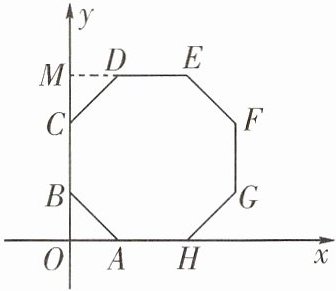
解析: 如图, 延长 $ED$ 交 $y$ 轴于点 $M$. 由题意可知, 点 $E$ 的横坐标与点 $H$ 的横坐标相等, 点 $E$的纵坐标与点 $M$ 的纵坐标相等.
$\because A(1,0), B(0,1),$
$\therefore OA=OB=1,$
$\therefore AB=AH=BC=CD=\sqrt{2}.$
又多边形 $ABCDEFGH$ 是正八边形,
$\therefore ∠ DCM=45°.$
在 $\mathrm{Rt}△ MCD$ 中, 易求得 $MC=1$,
$\therefore OM=2+\sqrt{2}\,,\therefore E(1+\sqrt{2}\,,2+\sqrt{2}).$
答案: $(1+\sqrt{2}\,,2+\sqrt{2})$
解析: 如图, 延长 $ED$ 交 $y$ 轴于点 $M$. 由题意可知, 点 $E$ 的横坐标与点 $H$ 的横坐标相等, 点 $E$的纵坐标与点 $M$ 的纵坐标相等.
$\because A(1,0), B(0,1),$
$\therefore OA=OB=1,$
$\therefore AB=AH=BC=CD=\sqrt{2}.$
又多边形 $ABCDEFGH$ 是正八边形,
$\therefore ∠ DCM=45°.$
在 $\mathrm{Rt}△ MCD$ 中, 易求得 $MC=1$,
$\therefore OM=2+\sqrt{2}\,,\therefore E(1+\sqrt{2}\,,2+\sqrt{2}).$
答案: $(1+\sqrt{2}\,,2+\sqrt{2})$
答案
解:
延长ED交y轴于点M。
∵ A(1,0),B(0,1),
∴ OA=1,OB=1。
在Rt△AOB中,由勾股定理得AB=√(OA²+OB²)=√(1²+1²)=√2。
∵ 多边形ABCDEFGH是正八边形,
∴ 各边长度相等,即AB=BC=CD=DE=AH=√2,正八边形的每个内角为135°。
∵ 点B、C都在y轴上,BC=√2,
∴ OC=OB + BC=1 + √2。
∵ ∠BCD=135°,∠BCM=180°,
∴ ∠DCM=180°-135°=45°。
又∵ ∠CMD=90°,
∴ △MCD是等腰直角三角形,
∴ MC² + MD² = CD²,且MC=MD,代入CD=√2,得2MC²=2,解得MC=MD=1。
∴ OM=OC + MC=1+√2 +1=2+√2。
∵ DE//x轴,MD=1,DE=√2,
∴ 点E的横坐标为MD + DE=1+√2,点E的纵坐标与点M的纵坐标相等,为2+√2。
∴ 点E的坐标为$(1+\sqrt{2},2+\sqrt{2})$。
延长ED交y轴于点M。
∵ A(1,0),B(0,1),
∴ OA=1,OB=1。
在Rt△AOB中,由勾股定理得AB=√(OA²+OB²)=√(1²+1²)=√2。
∵ 多边形ABCDEFGH是正八边形,
∴ 各边长度相等,即AB=BC=CD=DE=AH=√2,正八边形的每个内角为135°。
∵ 点B、C都在y轴上,BC=√2,
∴ OC=OB + BC=1 + √2。
∵ ∠BCD=135°,∠BCM=180°,
∴ ∠DCM=180°-135°=45°。
又∵ ∠CMD=90°,
∴ △MCD是等腰直角三角形,
∴ MC² + MD² = CD²,且MC=MD,代入CD=√2,得2MC²=2,解得MC=MD=1。
∴ OM=OC + MC=1+√2 +1=2+√2。
∵ DE//x轴,MD=1,DE=√2,
∴ 点E的横坐标为MD + DE=1+√2,点E的纵坐标与点M的纵坐标相等,为2+√2。
∴ 点E的坐标为$(1+\sqrt{2},2+\sqrt{2})$。
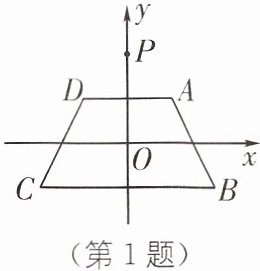
1.(全国初中数学竞赛)如图,在平面直角坐标系$xOy$中,等腰梯形$ABCD$的顶点坐标分别为$A(1,1),B(2,-1),C(-2,-1),D(-1,1).$将$y$轴上一点$P(0,2)$绕点$A$旋转$180°$得点$P_1$,点$P_1$绕点$B$旋转$180°$得点$P_2$,点$P_2$绕点$C$旋转$180°$得点$P_3$,点$P_3$绕点$D$旋转$180°$得点$P_4,\dots,$重复操作依次得到点$P_1,$$P_2,\dots,$则点$P_{2\,024}$的坐标是(
A.$(2\,022,2)$
B.$(2\,022,-2)$
C.$(2\,024,2)$
D.$(0,2)$
C
).A.$(2\,022,2)$
B.$(2\,022,-2)$
C.$(2\,024,2)$
D.$(0,2)$
答案
1.C
2.[全国初中数学竞赛(广东中山)预赛]在平面直角坐标系内,点$A(n,1-n)$一定不在(
A.第一象限
B.第二象限
C.第三象限
D.第四象限
C
).A.第一象限
B.第二象限
C.第三象限
D.第四象限
答案
2.C
3. [全国初中数学竞赛(海南赛区)初赛]已知点$P$在平面直角坐标系中的坐标为$(0,1)$,$O$为坐标原点,$∠ QPO=150°$,且点$P$到点$Q$的距离为2,则点$Q$的坐标为
(1,1+√3)或(-1,1+√3)
.答案
3.$(1,1+\sqrt{3})$或$(-1,1+\sqrt{3})$
4.(第二十届“希望杯”全国数学邀请赛)记有序的有理数对 $x,y$ 为 $(x,y).$ 若 $xy>0,|x|y-x=0$且$|x|+|y|=3,$则满足以上条件的有理数对$(x,y)$是
(2,1)
或(-2,-1)
.答案
4.$(2,1)$ $(-2,-1)$
[解析]$\because xy>0$,
$\therefore x>0,y>0$或$x<0,y<0$.
①当$x>0,y>0$时,$\because |x|y-x=0$,
$\therefore xy-x=0,\therefore x(y-1)=0$,
$\therefore x=0$(舍去)或$y-1=0,\therefore y=1$.
$\because |x|+|y|=3,\therefore |x|+1=3$,
$\therefore |x|=2,\therefore x=-2$(舍去)或$x=2$,
$\therefore$有理数对$(x,y)$是$(2,1)$;
②当$x<0,y<0$时,$\because |x|y-x=0$,
$\therefore -xy-x=0,\therefore -x(y+1)=0$,
$\therefore x=0$(舍去)或$y+1=0,\therefore y=-1$.
$\because |x|+|y|=3,\therefore |x|+1=3$,
$\therefore |x|=2,\therefore x=-2$或$x=2$(舍去),
$\therefore$有理数对$(x,y)$是$(-2,-1)$.
故满足条件的有理数对$(x,y)$是$(2,1)$或$(-2,-1)$.
[解析]$\because xy>0$,
$\therefore x>0,y>0$或$x<0,y<0$.
①当$x>0,y>0$时,$\because |x|y-x=0$,
$\therefore xy-x=0,\therefore x(y-1)=0$,
$\therefore x=0$(舍去)或$y-1=0,\therefore y=1$.
$\because |x|+|y|=3,\therefore |x|+1=3$,
$\therefore |x|=2,\therefore x=-2$(舍去)或$x=2$,
$\therefore$有理数对$(x,y)$是$(2,1)$;
②当$x<0,y<0$时,$\because |x|y-x=0$,
$\therefore -xy-x=0,\therefore -x(y+1)=0$,
$\therefore x=0$(舍去)或$y+1=0,\therefore y=-1$.
$\because |x|+|y|=3,\therefore |x|+1=3$,
$\therefore |x|=2,\therefore x=-2$或$x=2$(舍去),
$\therefore$有理数对$(x,y)$是$(-2,-1)$.
故满足条件的有理数对$(x,y)$是$(2,1)$或$(-2,-1)$.
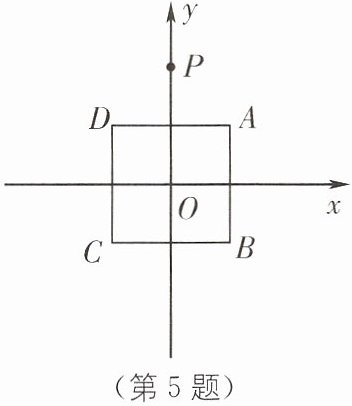
5. [全国初中数学竞赛(湖南赛区)复赛]如图,在平面直角坐标系$xOy$中,正方形$ABCD$的中心为坐标原点,顶点$A$的坐标为$(1,1)$,$y$轴上一点$P(0,2)$绕点$A$旋转$180°$得到点$P_1$,点$P_1$绕点$B$旋转$180°$得到点$P_2$,点$P_2$绕点$C$旋转$180°$得点$P_3$,点$P_3$绕点$D$旋转$180°$得点$P_4$,$···$,重复操作依次得到点$P_1,P_2,P_3,···$.求:
(1)点$P_1,P_2,P_3$的坐标;
(2)点$P_{2024}$的坐标.
(1)点$P_1,P_2,P_3$的坐标;
(2)点$P_{2024}$的坐标.
答案
5.(1)$P_1(2,0),P_2(0,-2),P_3(-2,0)$.
(2)重复操作依次可得$P_4=P_8=P,P_5=P_9=P_1,P_6=P_{10}=P_2,P_7=P_{11}=P_3$.
$\because 2\ 024=4×506,\therefore P_{2\ 024}=P_4.\therefore P_{2\ 024}(0,2)$.
(2)重复操作依次可得$P_4=P_8=P,P_5=P_9=P_1,P_6=P_{10}=P_2,P_7=P_{11}=P_3$.
$\because 2\ 024=4×506,\therefore P_{2\ 024}=P_4.\therefore P_{2\ 024}(0,2)$.
