

 登录
一、读一读,根据语境选择正确的答案。
(
A. Please B. Should C. Don’t
(
A. should B. need C. shouldn’t
(
A. Don’t B. Please C. Should
(
A. and B. but C. because
(
A. will to have B. is going to have C. are going to have
(
C
) 1. Candies and chocolate are not good for us. eat too much.A. Please B. Should C. Don’t
(
C
) 2. You eat your food too fast.A. should B. need C. shouldn’t
(
A
) 3. throw away the milk box. I want to recycle it.A. Don’t B. Please C. Should
(
C
) 4. I’m happy I have a new friend.A. and B. but C. because
(
B
) 5. Our school a football match.A. will to have B. is going to have C. are going to have
答案
1. C
2. C
3. A
4. C
5. B
解析:1. 句意为“糖果和巧克力对我们有害。________吃太多。”“Don’t+动词原形(+其他).”表示“不要做某事。”
2. 由常识可知句意为“你不应该吃太快。”should意为“应该”,need意为“需要”,shouldn’t意为“不应该”。
3. 由第二句“我想循环利用它。”可猜测第一句意为“不要扔掉那个牛奶盒子。”
4. 句意为“我很高兴________我有一个新朋友。”后句是前句的原因,故用because。
5. 句意为“我们学校将会举行一场足球比赛。”一般将来时的构成为“be going to +动词原形”或“will+动词原形”。句子的主语our school是第三人称单数,故be动词用is。
解析
【分析】
逐题梳理解题思路:1. 结合语境“糖果和巧克力对我们有害”,需用祈使句否定形式表达“不要吃太多”,对应结构Don’t+动词原形;2. 根据常识,此处需表“不应该吃太快”,辨析情态动词should、need、shouldn’t的含义;3. 由后句“我想回收牛奶盒”可知,前句需表“不要扔”,用祈使句否定形式;4. 前半句“我开心”的原因是“有新朋友”,需用引导原因的连词;5. 考查一般将来时结构,结合主语的单复数确定be动词形式,匹配结构be going to+动词原形。
【解析】
1. 句意为“糖果和巧克力对我们有害。________吃太多。”“Don’t+动词原形”构成祈使句的否定形式,表“不要做某事”,符合语境,故选C。
2. 句意为“你________吃你的食物太快。”结合常识可知此处表否定含义,should意为“应该”,need意为“需要”,shouldn’t意为“不应该”,shouldn’t符合语境,故选C。
3. 句意为“______扔掉那个牛奶盒子。我想回收它。”根据后句“我想回收它”可知前句表否定含义,祈使句否定形式用Don’t,故选A。
4. 句意为“我很高兴________我有一个新朋友。”后半句是前半句“高兴”的原因,because引导原因状语从句,符合逻辑,故选C。
5. 句意为“我们学校将会举行一场足球比赛。”一般将来时的构成为“be going to+动词原形”或“will+动词原形”,主语our school是第三人称单数,be动词用is,故用is going to have,选B。
【答案】1.C 2.C 3.A 4.C 5.B
【知识点】祈使句、情态动词、一般将来时
【点评】本题考查小学英语核心基础语法,涵盖祈使句、情态动词、一般将来时的用法,语境贴近生活,侧重基础应用,是学生需熟练掌握的知识点。
【难度系数】0.7
二、看图,给图片选择相应的句子。
1. ()
2. 图1?不,重新看,第一排的5个图:
1. ()
2. ()
3. ()
4. ()
5. ()
A. We can recycle food waste for animals.
B. People will drive a flying car.
C. Friends are happy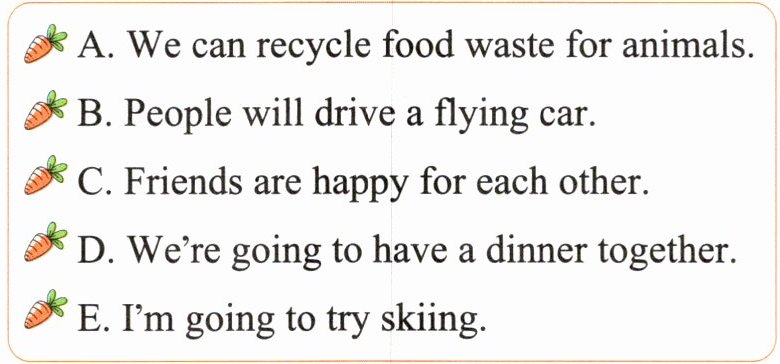 for each other.
D. We're going to have a dinner together.
E. I'm going to try skiing.
哦,不对,正确的是:
二、看图,给图片选择相应的句子。
1. ()
2. ()
3. ()
4. ()
5. ()
A. We can recycle food waste for animals.
B. People will drive a flying car.
C. Friends are happyfor each other.
D. We're going to have a dinner together.
E. I'm going to try skiing.
对,这样,因为只有第3个图有红框标图1,C选项里有红框标图2,所以替换成和。其他的图没有红框标注,所以直接是1、2、4、5的图,括号留空。二、看图,给图片选择相应的句子。
1. ()
2. ()
3. ()
4. ()
5. ()
A. We can recycle food waste for animals.
B. People will drive a flying car.
C. Friends are happyfor each other.
D. We're going to have a dinner together.
E. I'm going to try skiing.
1.
()2. 图1?不,重新看,第一排的5个图:
1. ()
2. ()
3. ()
4. ()
5. ()
A. We can recycle food waste for animals.
B. People will drive a flying car.
C. Friends are happy
for each other.D. We're going to have a dinner together.
E. I'm going to try skiing.
哦,不对,正确的是:
二、看图,给图片选择相应的句子。
1. ()
2. ()
3. ()
4. ()
5. ()
A. We can recycle food waste for animals.
B. People will drive a flying car.
C. Friends are happyfor each other.
D. We're going to have a dinner together.
E. I'm going to try skiing.
对,这样,因为只有第3个图有红框标图1,C选项里有红框标图2,所以替换成和。其他的图没有红框标注,所以直接是1、2、4、5的图,括号留空。二、看图,给图片选择相应的句子。
1. ()
2. ()
3. ()
4. ()
5. ()
A. We can recycle food waste for animals.
B. People will drive a flying car.
C. Friends are happyfor each other.
D. We're going to have a dinner together.
E. I'm going to try skiing.
答案
1. C
2. E
3. A
4. D
5. B
2. E
3. A
4. D
5. B
解析
【分析】解题思路:先逐一理解A-E五个选项句子的含义,再对应1-5号图片的具体场景,将匹配的选项填入对应括号。步骤:1. 分析每个选项的语义;2. 匹配图片对应的场景;3. 确定每个编号对应的正确选项。
【解析】各选项语义:A.我们可以回收厨余垃圾给动物;B.人们将驾驶飞行汽车;C.朋友们彼此开心;D.我们要一起吃晚餐;E.我要尝试滑雪。对应图片场景:1号图对应朋友开心的场景,匹配C;2号图对应滑雪场景,匹配E;3号图对应回收厨余场景,匹配A;4号图对应聚餐场景,匹配D;5号图对应飞行汽车场景,匹配B。
【答案】1. C
2. E
3. A
4. D
5. B
【知识点】英语情景匹配;看图选句
【点评】本题为英语基础类看图匹配题,需准确衔接句子语义与图片场景,难度适中,适合巩固英语日常表达。
【难度系数】0.6
【解析】各选项语义:A.我们可以回收厨余垃圾给动物;B.人们将驾驶飞行汽车;C.朋友们彼此开心;D.我们要一起吃晚餐;E.我要尝试滑雪。对应图片场景:1号图对应朋友开心的场景,匹配C;2号图对应滑雪场景,匹配E;3号图对应回收厨余场景,匹配A;4号图对应聚餐场景,匹配D;5号图对应飞行汽车场景,匹配B。
【答案】1. C
2. E
3. A
4. D
5. B
【知识点】英语情景匹配;看图选句
【点评】本题为英语基础类看图匹配题,需准确衔接句子语义与图片场景,难度适中,适合巩固英语日常表达。
【难度系数】0.6
三、按要求完成下列句子。
1. throw don't box that away (.)(连词成句)
2. have vegetables should some you (.)(连词成句)
3. going the to have are test we tomorrow (.)(连词成句)
4. People will eat 3-D printed food.(对画线部分提问)
5. I'm going to make meat mooncakes for the tigers.(对画线部分提问)
1. throw don't box that away (.)(连词成句)
Don’t throw away that box./Don’t throw that box away.
2. have vegetables should some you (.)(连词成句)
You should have some vegetables.
3. going the to have are test we tomorrow (.)(连词成句)
We are going to have the test tomorrow./Tomorrow we are going to have the test.
4. People will eat 3-D printed food.(对画线部分提问)
What food will people eat?
5. I'm going to make meat mooncakes for the tigers.(对画线部分提问)
What are you going to do?
答案
1. Don’t throw away that box./Don’t throw that box away.
2. You should have some vegetables.
3. We are going to have the test tomorrow./Tomorrow we are going to have the test.
4. What food will people eat?
5. What are you going to do?
2. You should have some vegetables.
3. We are going to have the test tomorrow./Tomorrow we are going to have the test.
4. What food will people eat?
5. What are you going to do?
解析
【分析】
本题分为连词成句和划线提问两类题型:1-3题需根据标点(句号)判断句式,结合核心词汇、固定搭配调整语序;4-5题需先确定划线部分的内容类型,选择对应特殊疑问词,再将原句转为一般疑问句语序,注意人称变化。
【解析】
1. 该句为否定祈使句,结构为“Don’t + 动词短语”,固定搭配“throw away”,宾语为“that box”,可连成:Don’t throw away that box.(或Don’t throw that box away);
2. 主语为“you”,情态动词“should”后接动词原形“have”,宾语为“some vegetables”,连成:You should have some vegetables;
3. 主语为“we”,“be going to”表将来,宾语为“the test”,时间状语“tomorrow”可放句末或句首,连成:We are going to have the test tomorrow.(或Tomorrow we are going to have the test);
4. 划线部分是“3-D printed food”(事物),用特殊疑问词“what”,原句为一般将来时,将助动词“will”提前,连成:What food will people eat?;
5. 划线部分是动作,用“what...do”提问,原句为“be going to”结构,将be动词“are”提前,主语“I”变“you”,连成:What are you going to do?
【答案】
1. Don’t throw away that box./Don’t throw that box away.
2. You should have some vegetables.
3. We are going to have the test tomorrow./Tomorrow we are going to have the test.
4. What food will people eat?
5. What are you going to do?
【知识点】
连词成句、特殊疑问句构成、祈使句
【点评】
本题考查英语基础句型运用,涵盖连词成句和特殊疑问句转换,是初中英语核心基础题型,需掌握基本句型结构与特殊疑问词用法,难度较低。
【难度系数】
0.8
