

 登录
一、完形填空 让国旗在月球上“飘扬”
素养:思维品质 难度:中 用时:7分钟
[2026 泉州惠安县一模改编]Chang'e 7 is set to launch (发射) in the second half of 2026. It will carry a very special national flag (国旗) — one designed by a group of primary school
The idea started in the science club of Lushan International Experimental Primary School. During one of their meetings, a student named Deng Haoxuan
His question led to a lively discussion. Deng then thought of magnets (磁铁) and how they push away from each other. Maybe the
Not giving up, they
The students didn't stop there. They wanted to make sure their idea would
“It’s
1. A. parents B. students
C. teachers D. scientists
2. A. raised B. answered
C. invented D. finished
3. A. cloud B. snow C. wind D. rain
4. A. different B. related C. similar D. same
5. A. rising B. flying C. falling D. waving
6. A. kept up with B. came up with
C. ended up with D. teamed up with
7. A. heat B. light
C. sound D. electricity
8. A. work B. matter C. change D. happen
9. A. suddenly B. quickly C. finally D. easily
10. A. amazing B. relaxing
C. boring D. tiring
素养:思维品质 难度:中 用时:7分钟
[2026 泉州惠安县一模改编]Chang'e 7 is set to launch (发射) in the second half of 2026. It will carry a very special national flag (国旗) — one designed by a group of primary school
B
1 from Hunan.The idea started in the science club of Lushan International Experimental Primary School. During one of their meetings, a student named Deng Haoxuan
A
2 an interesting question: “There’s no C
3 on the moon, so how can we make the flag wave?”His question led to a lively discussion. Deng then thought of magnets (磁铁) and how they push away from each other. Maybe the
D
4 idea could help the flag move. However, when the team tried using real magnets, they found them too heavy. The flag kept C
5.Not giving up, they
B
6 another idea. They connected thin wires (导线) to the flag. When D
7 passed through the wires, a magnetic field (磁场) was created. This made the flag move just as if it were flying in the wind.The students didn't stop there. They wanted to make sure their idea would
A
8 in space. After months of testing and making small changes, they C
9 found the perfect way to place the wires.“It’s
A
10 that our idea actually worked,” Deng said excitedly. “Soon, the five-star red flag will fly on the moon!”1. A. parents B. students
C. teachers D. scientists
2. A. raised B. answered
C. invented D. finished
3. A. cloud B. snow C. wind D. rain
4. A. different B. related C. similar D. same
5. A. rising B. flying C. falling D. waving
6. A. kept up with B. came up with
C. ended up with D. teamed up with
7. A. heat B. light
C. sound D. electricity
8. A. work B. matter C. change D. happen
9. A. suddenly B. quickly C. finally D. easily
10. A. amazing B. relaxing
C. boring D. tiring
答案
【解题导语】 本文讲述了湖南庐山国际实验小学的学生们为嫦娥七号登月任务设计特殊国旗的故事,他们通过创新思路解决了使国旗在月球无风环境中飘扬的难题。
1. B 根据第二段中的“a student named Deng Haoxuan”和倒数第二段中的“The students didn't stop there”可知答案为B。
2. A 根据下文内容可知,此处是说邓昊轩提出了一个问题,A项“提出,提起”符合语境。
3. C 根据空后的“so how can we make the flag wave?”及选项可知,wind“风”符合语境。第四段中的“This made the flag move just as if it were flying in the wind”也是提示。
4. D 根据上文中的“Deng then thought of magnets(磁铁) and how they push away from each other”和下文中的“the team tried using real magnets”可知,灵感来源和解决方法都是磁铁的磁力,故选D。
5. C 根据上文中的“However, when the team tried using real magnets, they found them too heavy”可知,他们失败了,没有让旗帜飘扬起来,故选C。
6. B keep up with“跟上,持续了解”;come up with“想出,提出”;end up with“以……收场”;team up with“与……组队,与……协作”,其宾语通常是人。根据空后的“another idea”可知应选B。
7. D 根据上文中的“They connected thin wires(导线) to the flag”可知,此处是说当电流通过导线时,会产生一个磁场,故选D。
8. A 根据最后一段中的“our idea actually worked”可知,此处是说他们想要确保自己的想法能在太空中行得通,故选A。
9. C 根据空前的“After months of testing and making small changes”及选项可知,此处是说他们终于找到了布置导线的最佳方法,应选C。
10. A 根据空后的“Deng said excitedly. ‘Soon, the five-star red flag will fly on the moon!’”可知,邓昊轩对他们的成功感到兴奋,A项“令人惊喜的”符合语境。
解析
【分析】
做完形填空时,首先需通读全文把握主旨(本文讲述湖南小学生为嫦娥七号设计月球国旗的创新故事),再逐题结合上下文线索、词汇词义辨析、固定搭配推导答案,避免主观臆断,每道题都要找到对应的语境提示。
【解析】
1. 选B:根据下文提到的“a student named Deng Haoxuan”和倒数第二段的“The students”,可知是小学生,故选B。
2. 选A:此处指邓昊轩提出一个问题,raise有“提出”之意,符合语境,故选A。
3. 选C:根据后文“so how can we make the flag wave?”及“as if it were flying in the wind”,可知月球没有风,故选C。
4. 选D:根据上文提到的磁铁特性,此处指和磁铁相关的同样思路,故选D。
5. 选C:因为磁铁太重,导致旗帜掉落,故选C。
6. 选B:come up with表示“想出(主意)”,符合“想出另一个想法”的语境,故选B。
7. 选D:连接导线后,电流通过导线会产生磁场,故选D。
8. 选A:此处指确保想法在太空可行,work表示“运转、起作用”,符合语境,故选A。
9. 选C:经过数月测试和调整,终于找到最佳方法,finally表示“终于”,故选C。
10. 选A:根据邓昊轩兴奋的表述,可知成功的想法很令人惊喜,amazing符合语境,故选A。
【答案】
B A C D C B D A C A
【知识点】
完形填空解题法、词汇辨析、上下文语境理解
【点评】
本文围绕小学生创新设计月球国旗的故事展开,难度中等,解题时需紧扣上下文线索,结合词汇含义及固定搭配分析,注重语篇理解能力的考查。
【难度系数】
0.5
二、阅读理解 人工智能的现在与未来
素养:思维品质 难度:难 用时:8分钟
[2025 西安经开区模拟改编]You may have a house robot that can do housework for you. But is it so smart? See Aurora, a headless dog-sized robot used to keep birds and other animals away at an Alaskan airport. Watch another 1.8-meter-tall legless robot called EveR6, waving its arms to guide musicians through a performance.
Those robots above require artificial intelligence (AI). AI is a computer system (系统) that can understand languages, make decisions and solve problems. AI can be taught skills using a process called machine learning.
▲. For example, when you watch TV, AI is watching you. It'll know what your favorite is and suggest similar ones. In hospitals, AI is very good at suggesting treatments and can even invent new medicines. In cities, AI is used to watch out for cars that make black smoke. It works together with the police and transportation teams to stop them and keep the air clean.
Some people worry that AI will take away a large number of jobs and also fear that AI could develop out of our control and bring danger to humans. However, AI is expected to be a more powerful production tool that will help humans achieve more in less time. Humans imagine AI might even find a way to solve the problems of our energy needs completely. Anyway, there is still a long journey for humans and AI.
1. 新考法·图文转换题 In which pictures can we see Aurora and EveR6?
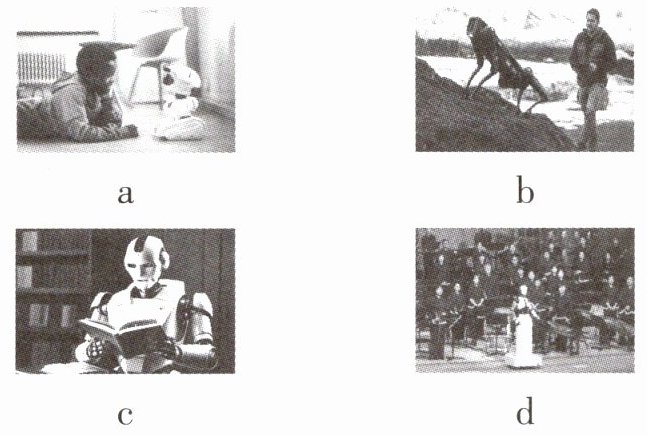
A. a, c B. b, d C. b, c D. a, d
2. 新考法·创新性设问 What BIG question does Paragraph 2 answer?
A. What is AI?
B. Why are AI robots made?
C. Where is AI used?
D. How many AI robots are mentioned?
3. 新考法·信息还原题 Which of the following can be put in ▲?
A. AI will be developed rapidly
B. Humans depend too much on AI
C. Humans wonder if AI could think
D. AI has become part of daily life
4. In the future, AI is expected to be able to
A. suggest TV programs
B. cut down food waste
C. invent new medicines
D. help produce enough energy
5. 新考法·推断文章后续 What would the author write about after the last paragraph?
A. The end of AI.
B. The history of AI.
C. The way to get along with AI.
D. The skill of making AI robots.
素养:思维品质 难度:难 用时:8分钟
[2025 西安经开区模拟改编]You may have a house robot that can do housework for you. But is it so smart? See Aurora, a headless dog-sized robot used to keep birds and other animals away at an Alaskan airport. Watch another 1.8-meter-tall legless robot called EveR6, waving its arms to guide musicians through a performance.
Those robots above require artificial intelligence (AI). AI is a computer system (系统) that can understand languages, make decisions and solve problems. AI can be taught skills using a process called machine learning.
▲. For example, when you watch TV, AI is watching you. It'll know what your favorite is and suggest similar ones. In hospitals, AI is very good at suggesting treatments and can even invent new medicines. In cities, AI is used to watch out for cars that make black smoke. It works together with the police and transportation teams to stop them and keep the air clean.
Some people worry that AI will take away a large number of jobs and also fear that AI could develop out of our control and bring danger to humans. However, AI is expected to be a more powerful production tool that will help humans achieve more in less time. Humans imagine AI might even find a way to solve the problems of our energy needs completely. Anyway, there is still a long journey for humans and AI.
1. 新考法·图文转换题 In which pictures can we see Aurora and EveR6?
A. a, c B. b, d C. b, c D. a, d
2. 新考法·创新性设问 What BIG question does Paragraph 2 answer?
A. What is AI?
B. Why are AI robots made?
C. Where is AI used?
D. How many AI robots are mentioned?
3. 新考法·信息还原题 Which of the following can be put in ▲?
A. AI will be developed rapidly
B. Humans depend too much on AI
C. Humans wonder if AI could think
D. AI has become part of daily life
4. In the future, AI is expected to be able to
D
.A. suggest TV programs
B. cut down food waste
C. invent new medicines
D. help produce enough energy
5. 新考法·推断文章后续 What would the author write about after the last paragraph?
A. The end of AI.
B. The history of AI.
C. The way to get along with AI.
D. The skill of making AI robots.
答案
【解题导语】 本文主要介绍了人工智能的相关信息。
1. B 图文转换题。
解题图式
Step 1 分析题干
In which pictures can we see Aurora and EveR6?
题眼
Step 2 定位关键句,确定答案
定位到第一段中的“See Aurora, a headless dog-sized robot”及“Watch another 1.8-meter-tall legless robot called EveR6, waving its arms to guide musicians through a performance”。
对应b
对应d
故选B。
2. A 段落大意题。通读第二段内容可知,本段主要介绍了人工智能是什么以及它的学习方式。故A项符合题意。
3. D 信息还原题。第三段中列举的例子是人工智能在生活中各个领域的应用,故D项“人工智能已经成为日常生活的一部分”符合语境。
4. D 细节理解题。根据最后一段中的“Humans imagine AI might even find a way to solve the problems of our energy needs completely”可知,人类认为人工智能甚至可以找到方法彻底解决能源需求的问题,即人们期望未来人工智能可以帮助生产足够的能源。故选D。
5. C 推断文章后续。最后一段介绍了人工智能可能会给人们带来的问题,但是人们期望人工智能会成为更有用的人类助手,再结合文章结尾处的“there is still a long journey for humans and AI”可推知,接下来作者可能会探讨人类与人工智能相处的方式。故选C。
解析
【分析】
本题是围绕人工智能展开的英语阅读理解题,包含5道不同类型的题目,解题思路如下:
1. 第1题(图文转换题):需定位原文中Aurora和EveR6的特征描述,匹配对应的图片,选出正确选项。
2. 第2题(段落大意题):通读第二段内容,明确该段核心是解释人工智能的定义,对应问题的答案。
3. 第3题(信息还原题):分析第三段列举的AI在生活各领域的应用实例,匹配符合语境的句子。
4. 第4题(细节理解题):定位最后一段中关于未来AI期望的描述,选出对应选项。
5. 第5题(推断文章后续题):结合最后一段的内容和结尾句的逻辑,推断作者接下来会写的内容。
【解析】
1. 第1题:定位原文第一段,Aurora是“headless dog-sized robot”,对应图b;EveR6是“1.8-meter-tall legless robot... waving its arms to guide musicians”,对应图d,因此选B。
2. 第2题:第二段主要介绍AI是能理解语言、做决策、解决问题的计算机系统,核心是回答“What is AI?”,故选A。
3. 第3题:第三段列举了AI在看电视推荐、医院治疗、城市环保等日常生活中的应用,说明AI已成为日常生活的一部分,故选D。
4. 第4题:根据最后一段“Humans imagine AI might even find a way to solve the problems of our energy needs completely”,可知未来AI有望解决能源需求问题,对应选项D。
5. 第5题:最后一段提到人们对AI的担忧和期望,结尾指出人类与AI还有很长的路,因此接下来会探讨人类与AI的相处方式,故选C。
【答案】
1.B 2.A 3.D 4.D 5.C
【知识点】
英语阅读理解、段落大意、细节理解
【点评】
本题围绕人工智能主题,设置了图文转换、段落大意、信息还原、细节理解、推断后续等多种题型,考查学生的信息定位、语境分析和逻辑推断能力,需要学生结合原文细节和语境进行综合判断。
【难度系数】
0.4
