登录
登录
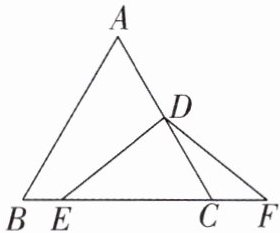
1. 如图,$△ ABC$为等边三角形,$D$为$AC$上一点,$E,F$分别为$BC$及其延长线上一点,$AD=BE+CF$,求证:$DE=DF$.
答案
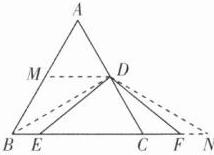
作 $DM// BC$,延长 $CF$ 至点$N$, 使得 $FN = BE$, 连接 $DB, DN$.
$\because △ ABC$ 是等边三角形, $\therefore △ AMD$也是等边三角形. $\because AD = BE+CF$,
$\therefore AD=DM=CN, BM=CD, ∠ BMD= ∠ DCN = 120°, \therefore △ MDB≌ △ CND$
(SAS), $\therefore DB = DN, \therefore ∠ DBE= ∠ DNF. \because BE = FN, \therefore △ DBE≌ △ DNF(SAS), \therefore DE=DF.$
2. 已知$△ ABC$为等边三角形,$D$为射线$CB$上一点,$E$为射线$AC$上一点,$AD=DE$.
(1)如图①,当点$D$为线段$BC$的中点,点$E$在$AC$的延长线上时,求证:$AE=AB+BD$.
(2)如图②,当点$D$为线段$BC$上任意一点,点$E$在$AC$的延长线上时,(1)的结论是否成立? 若成立,请证明;若不成立,请说明理由.
(3)如图③,当点$D$在$CB$的延长线上,点$E$在线段$AC$上时,$BD$,$AB$,$AE$之间又有何数量关系?请说明理由.
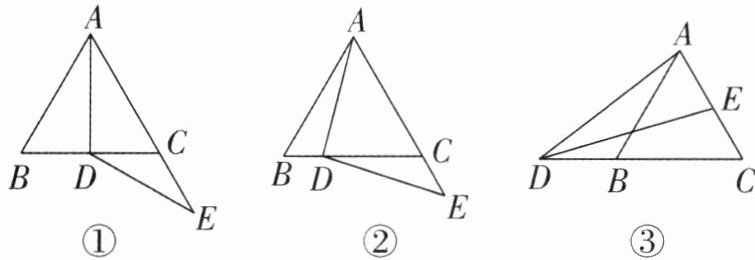
(1)如图①,当点$D$为线段$BC$的中点,点$E$在$AC$的延长线上时,求证:$AE=AB+BD$.
(2)如图②,当点$D$为线段$BC$上任意一点,点$E$在$AC$的延长线上时,(1)的结论是否成立? 若成立,请证明;若不成立,请说明理由.
(3)如图③,当点$D$在$CB$的延长线上,点$E$在线段$AC$上时,$BD$,$AB$,$AE$之间又有何数量关系?请说明理由.
答案
(1)$\because △ ABC$ 是等边三角形, $\therefore AB = AC, ∠ BAC = ∠ B = ∠ ACB=60°. \because$ 点 $D$ 为线段 $BC$ 的中点, $\therefore BD = CD, ∠ CAD = \frac{1}{2}∠ BAC=30°. \because AD=DE, \therefore ∠ E = ∠ CAD=30°. \because ∠ ACB = ∠ E+ ∠ CDE, \therefore ∠ CDE = 60° - 30° = 30°, \therefore ∠ CDE = ∠ E, \therefore CD = CE,$
$\therefore AE=AC+CE=AB+CD=AB+BD.$
(2)成立,理由:如图①,过点 $D$ 作 $DH// AC$ 交 $AB$ 于点 $H$,
$\therefore △ BDH$为等边三角形, $\therefore ∠ BHD = 60°, BD = DH = BH. \because AB - BH=BC-BD$,即 $AH=DC. \because AD=DE, \therefore ∠ E = ∠ CAD, \therefore ∠ BAC - ∠ CAD = ∠ ACB - ∠ E$, 即 $∠ BAD = ∠ CDE. \because ∠ BHD = 60°$,
$∠ ACB = 60°, \therefore 180° - ∠ BHD = 180° - ∠ ACB$, 即 $∠ AHD = ∠ DCE$. 在 $△ AHD$ 和 $△ DCE$ 中, $\begin{cases}∠ DAH=∠ EDC,\\AH=DC,\\∠ AHD=∠ DCE,\end{cases}$ $\therefore △ AHD≌ △ DCE(ASA), \therefore DH=CE, \therefore BD=CE, \therefore AE=AC+CE=AB+BD.$
(3)$AB=BD+AE$,理由:如图②,过点 $E$ 作 $EF// BC$ 交 $AB$ 于点 $F$,连接 $DF. \because △ ABC$ 为等边三角形, $\therefore △ AFE$ 是等边三角形,$AF=AE=EF. \because EF// BC, \therefore ∠ EDB = ∠ DEF$. 在 $△ AFD$ 和 $△ EFD$ 中, $\begin{cases}AD=ED,\\DF=DF,\\AF=EF,\end{cases}$ $\therefore △ AFD ≌ △ EFD$ (SSS), $\therefore ∠ ADF= ∠ EDF, ∠ DAF = ∠ DEF. \because ∠ FDB = ∠ EDF+ ∠ EDB, ∠ DFB = ∠ DAF+ ∠ ADF, ∠ EDB = ∠ DEF, \therefore ∠ FDB = ∠ DFB, \therefore BD=FB.$
$\because AB=FB+AF, \therefore AB=BD+AE.$