

 登录
登录
1.如图,$BD⊥ AC$于D,$CE⊥ AB$于E,BD与CE相交于O,则图中线段的比不能表示$\sin A$的式子为(
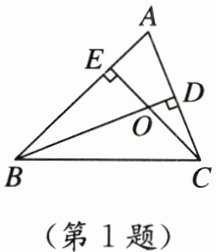
A.$\frac{BD}{AB}$
B.$\frac{CD}{OC}$
C.$\frac{AE}{AD}$
D.$\frac{BE}{OB}$
C
)A.$\frac{BD}{AB}$
B.$\frac{CD}{OC}$
C.$\frac{AE}{AD}$
D.$\frac{BE}{OB}$
答案
1.C
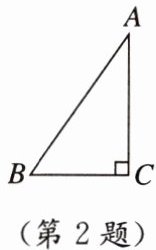
2. 如图,在$△ ABC$中,$∠ C=90°$,$AB=5$,$AC=4$,下列三角函数表示正确的是(
A.$\sin A=\dfrac{4}{5}$
B.$\tan A=\dfrac{4}{3}$
C.$\cos A=\dfrac{4}{5}$
D.$\tan B=\dfrac{3}{4}$
C
)A.$\sin A=\dfrac{4}{5}$
B.$\tan A=\dfrac{4}{3}$
C.$\cos A=\dfrac{4}{5}$
D.$\tan B=\dfrac{3}{4}$
答案
2.C 【点拨】$\because ∠C=90°,AB=5,AC=4, \therefore BC=\sqrt{AB^2-AC^2}=\sqrt{5^2-4^2}=3, \therefore \sin A=\frac{3}{5}$,故选项A错误;$\tan A=\frac{3}{4}$,故选项B错误;$\cos A=\frac{4}{5}$,故选项C正确;$\tan B=\frac{4}{3}$,故选项D错误.故选C.
3. 在$\mathrm{Rt}△ ABC$中,$∠ A$是锐角,$AC=8$,$BC=6$,则$\cos A$的值等于(
A.$\frac{3}{5}$
B.$\frac{\sqrt{7}}{4}$
C.$\frac{4}{5}$或$\frac{\sqrt{7}}{4}$
D.$\frac{4}{5}$或$\frac{2\sqrt{7}}{7}$
C
)A.$\frac{3}{5}$
B.$\frac{\sqrt{7}}{4}$
C.$\frac{4}{5}$或$\frac{\sqrt{7}}{4}$
D.$\frac{4}{5}$或$\frac{2\sqrt{7}}{7}$
答案
3.C 【点拨】存在两种情况:①当AB为斜边,$∠C=90°$时,$\because AC=8,BC=6, \therefore AB=\sqrt{AC^2+BC^2}=\sqrt{8^2+6^2}=10$.$\therefore \cos A=\frac{AC}{AB}=\frac{8}{10}=\frac{4}{5}$;②当AC为斜边,$∠B=90°$时,$\because AC=8,BC=6, \therefore AB=\sqrt{AC^2-BC^2}=\sqrt{8^2-6^2}=2\sqrt{7}$,$\therefore \cos A=\frac{AB}{AC}=\frac{2\sqrt{7}}{8}=\frac{\sqrt{7}}{4}$.综上所述,$\cos A$的值等于$\frac{4}{5}$或$\frac{\sqrt{7}}{4}$.
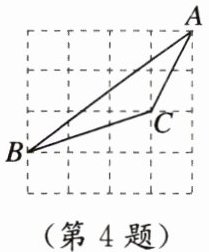
4. 一题多解 如图,在$4×4$的正方形网格中,每个小正方形的边长均为1,每个小正方形的顶点称为格点,$△ ABC$的顶点均在格点上,则$\cos∠ BAC$的值是 (
A.$\frac{\sqrt{5}}{5}$
B.$\frac{\sqrt{10}}{5}$
C.$\frac{2\sqrt{5}}{5}$
D.$\frac{1}{2}$
C
)A.$\frac{\sqrt{5}}{5}$
B.$\frac{\sqrt{10}}{5}$
C.$\frac{2\sqrt{5}}{5}$
D.$\frac{1}{2}$
答案
4.C 【点拨】方法1:延长AC到点D,连结BD,如图.
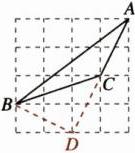 $\because AD^2=20,BD^2=5,AB^2=25, \therefore AD^2+BD^2=AB^2$,$\therefore ∠ADB=90°, \therefore \cos∠BAC=\frac{AD}{AB}=\frac{2\sqrt{5}}{5}$.方法2:过点C作AB的垂线交AB于一点E.$\because$每个小正方形的边长为1,$\therefore AC=\sqrt{5},BC=\sqrt{10},AB=5$.设$AE=x$,则$BE=5-x$.在$\mathrm{Rt}△ACE$中,$EC^2=AC^2-AE^2$,在$\mathrm{Rt}△BCE$中,$EC^2=BC^2-BE^2, \therefore 10-(5-x)^2=5-x^2$,解得$x=2$. $\therefore \cos∠BAC=\frac{AE}{AC}=\frac{2}{\sqrt{5}}=\frac{2\sqrt{5}}{5}$.
5.如图,菱形ABCD的顶点A,B,C在坐标轴上,若点A的坐标为$(0,3)$,$\tan∠ ABO=\sqrt{3}$,则菱形ABCD的周长为
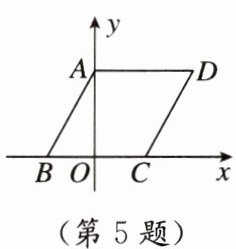
$8\sqrt{3}$
.答案
5.$8\sqrt{3}$
6. 新趋势跨学科 如图,CD是平面镜,光线从点A出发经过CD上的点E反射后照射到点B,若入射角为α(入射角等于反射角),AC⊥CD,BD⊥CD,垂足分别为C,D,且AC=3,BD=6,CD=11,则tan α=
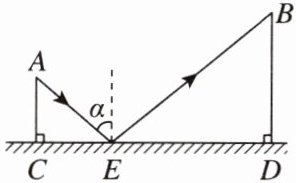
$\frac{11}{9}$
。答案
6.$\frac{11}{9}$ 【点拨】由题易得,$△ACE∽△BDE, \therefore \frac{CE}{DE}=\frac{AC}{BD}$,即$\frac{CE}{DE}=\frac{3}{6}=\frac{1}{2}, \therefore CE=\frac{1}{3}CD=\frac{1}{3}×11=\frac{11}{3}$. $\therefore$易得$\tan α=\tan∠EAC=\frac{CE}{AC}=\frac{11}{9}$.
7.若α为锐角,且$\cosα=\dfrac{1-3m}{2}$,则m的取值范围是
$-\frac{1}{3}<m<\frac{1}{3}$
。答案
7.$-\frac{1}{3}<m<\frac{1}{3}$ 【点拨】$\because 0<\cos α<1, \therefore 0<\frac{1-3m}{2}<1$,解得$-\frac{1}{3}<m<\frac{1}{3}$.
8. 新考法 归纳法 利用特殊直角三角形的三边关系易得
$\sin 30°=\frac{1}{2},\cos 30°=\frac{\sqrt{3}}{2}$,从而可得$\sin^2 30°+\cos^2 30°=\frac{1}{4}+\frac{3}{4}=1$,那么对于任意的锐角$A$,是否都有$\sin^2 A+\cos^2 A=1$呢?
(1)在$\mathrm{Rt}△ ABC$中,$∠ C=90°,∠ A,∠ B,∠ C$的对边分别为$a,b,c$,可得$\sin A=\frac{a}{c},\cos A=\frac{b}{c}$,求证:$\sin^2 A+\cos^2 A=1$.
(2)若$\sin A=\frac{\sqrt{2}}{3}$,利用(1)的结论求$\cos A$的值.
(3)用以上探究的方法你能得出$\sin A,\cos A,\tan A$之间的关系吗?请直接写出答案.
$\sin 30°=\frac{1}{2},\cos 30°=\frac{\sqrt{3}}{2}$,从而可得$\sin^2 30°+\cos^2 30°=\frac{1}{4}+\frac{3}{4}=1$,那么对于任意的锐角$A$,是否都有$\sin^2 A+\cos^2 A=1$呢?
(1)在$\mathrm{Rt}△ ABC$中,$∠ C=90°,∠ A,∠ B,∠ C$的对边分别为$a,b,c$,可得$\sin A=\frac{a}{c},\cos A=\frac{b}{c}$,求证:$\sin^2 A+\cos^2 A=1$.
(2)若$\sin A=\frac{\sqrt{2}}{3}$,利用(1)的结论求$\cos A$的值.
(3)用以上探究的方法你能得出$\sin A,\cos A,\tan A$之间的关系吗?请直接写出答案.
答案
8.(1)【证明】在$\mathrm{Rt}△ABC$中,$∠C=90°, \therefore a^2+b^2=c^2$.又$\because \sin A=\frac{a}{c},\cos A=\frac{b}{c}$,$\therefore \sin^2 A+\cos^2 A=(\frac{a}{c})^2+(\frac{b}{c})^2=\frac{a^2+b^2}{c^2}=1$.
(2)【解】$\because \sin^2 A+\cos^2 A=1,\sin A=\frac{\sqrt{2}}{3}$,$\therefore \cos^2 A=1-(\frac{\sqrt{2}}{3})^2=\frac{7}{9}. \because ∠A$为锐角,$\therefore \cos A=\frac{\sqrt{7}}{3}$.
(3)【解】能,$\sin A=\cos A · \tan A$.
【点拨】在$\mathrm{Rt}△ABC$中,$∠C=90°,∠A,∠B,∠C$的对边分别为$a,b,c$,则$\sin A=\frac{a}{c},\cos A=\frac{b}{c},\tan A=\frac{a}{b}$$\therefore \cos A · \tan A=\frac{b}{c} · \frac{a}{b}=\frac{a}{c}=\sin A$.
(2)【解】$\because \sin^2 A+\cos^2 A=1,\sin A=\frac{\sqrt{2}}{3}$,$\therefore \cos^2 A=1-(\frac{\sqrt{2}}{3})^2=\frac{7}{9}. \because ∠A$为锐角,$\therefore \cos A=\frac{\sqrt{7}}{3}$.
(3)【解】能,$\sin A=\cos A · \tan A$.
【点拨】在$\mathrm{Rt}△ABC$中,$∠C=90°,∠A,∠B,∠C$的对边分别为$a,b,c$,则$\sin A=\frac{a}{c},\cos A=\frac{b}{c},\tan A=\frac{a}{b}$$\therefore \cos A · \tan A=\frac{b}{c} · \frac{a}{b}=\frac{a}{c}=\sin A$.
