

 登录
登录
5. (2024·常州市溧阳月考)It is not easy
A.for; to understand
B.of; to understand
C.for; understanding
D.of; understanding
A
us A
others all the time because we all have different personalities.A.for; to understand
B.of; to understand
C.for; understanding
D.of; understanding
答案
5. A 【解析】“It's+adj.+of/for sb to do sth”是固定句型,其中 of 前的形容词应形容人的品质,for 前的形容词应形容事物的特征。句中形容词“easy”修饰事情,介词应用 for。
解析
【分析】
首先要回忆“It's+adj.+of/for sb to do sth”这个固定句型的用法,核心是区分of和for的适用情况:当形容词描述人的性格品质(如kind、friendly)时用of;当形容词描述事情的性质特征(如easy、difficult)时用for。题目中形容词是easy,它是形容“一直理解别人”这件事的难度,并非形容人的品质,所以介词要用for,同时句型中后面要接不定式to do sth,因此可以确定正确选项。
【解析】
本题考查固定句型“It's+adj.+of/for sb to do sth”的用法:
1. 该句型中,of前的形容词用于描述人的性格、品质(如kind, nice等);for前的形容词用于描述事物的性质、特征(如easy, hard等)。
2. 句中的形容词“easy”是用来描述“一直理解别人”这件事的难度,属于事物的特征,因此介词应用for。
3. 句型要求后面接不定式结构to do sth,所以第二个空填to understand。
综上,正确选项为A。
【答案】
A
【知识点】
固定句型“It's+adj.+of/for sb to do sth”;介词for/of用法辨析
【点评】
本题是初中英语基础题型,重点考查固定句型中介词of和for的区分,需要学生牢记两种介词对应的形容词类型,平时多积累相关词汇,就能轻松应对这类题目。
【难度系数】
0.7
首先要回忆“It's+adj.+of/for sb to do sth”这个固定句型的用法,核心是区分of和for的适用情况:当形容词描述人的性格品质(如kind、friendly)时用of;当形容词描述事情的性质特征(如easy、difficult)时用for。题目中形容词是easy,它是形容“一直理解别人”这件事的难度,并非形容人的品质,所以介词要用for,同时句型中后面要接不定式to do sth,因此可以确定正确选项。
【解析】
本题考查固定句型“It's+adj.+of/for sb to do sth”的用法:
1. 该句型中,of前的形容词用于描述人的性格、品质(如kind, nice等);for前的形容词用于描述事物的性质、特征(如easy, hard等)。
2. 句中的形容词“easy”是用来描述“一直理解别人”这件事的难度,属于事物的特征,因此介词应用for。
3. 句型要求后面接不定式结构to do sth,所以第二个空填to understand。
综上,正确选项为A。
【答案】
A
【知识点】
固定句型“It's+adj.+of/for sb to do sth”;介词for/of用法辨析
【点评】
本题是初中英语基础题型,重点考查固定句型中介词of和for的区分,需要学生牢记两种介词对应的形容词类型,平时多积累相关词汇,就能轻松应对这类题目。
【难度系数】
0.7
四、任务型阅读。
Chinese people started to use hand fans over 2,000 years ago. Then, they were almost the only way to drive the heat away. The Chinese character(汉字) for the word “fan” has the same sound as the character for “kindness”.
The fans came in different shapes and were made of all kinds of materials. Palm(棕榈树) leaf fans were cheap and easy to make. Feather fans showed the owner's high position(地位). Sandalwood(檀香) fans could send out a sweet smell.
Later, hand fans became far more than just something that could cool people down. They developed into works of art, in which round fans and folded fans were the most common.
In the shape of a full moon, the round fans mean union and happiness. They have beautiful embroidery(刺绣) featuring birds and flowers on them, meaning wealth and longevity(长寿). Women, especially those in the palace, liked to use them. Such fans were very popular in the Han dynasty.
Folding fans were first made in the Song dynasty and became popular in the Ming dynasty. They have a history of symbolizing scholarship(象征学问). Men, especially the literati, used *zheshan* because they were usually made of paper and they could paint and write poems on them. It was a way for them to show off their skills or taste in literature, painting and calligraphy.
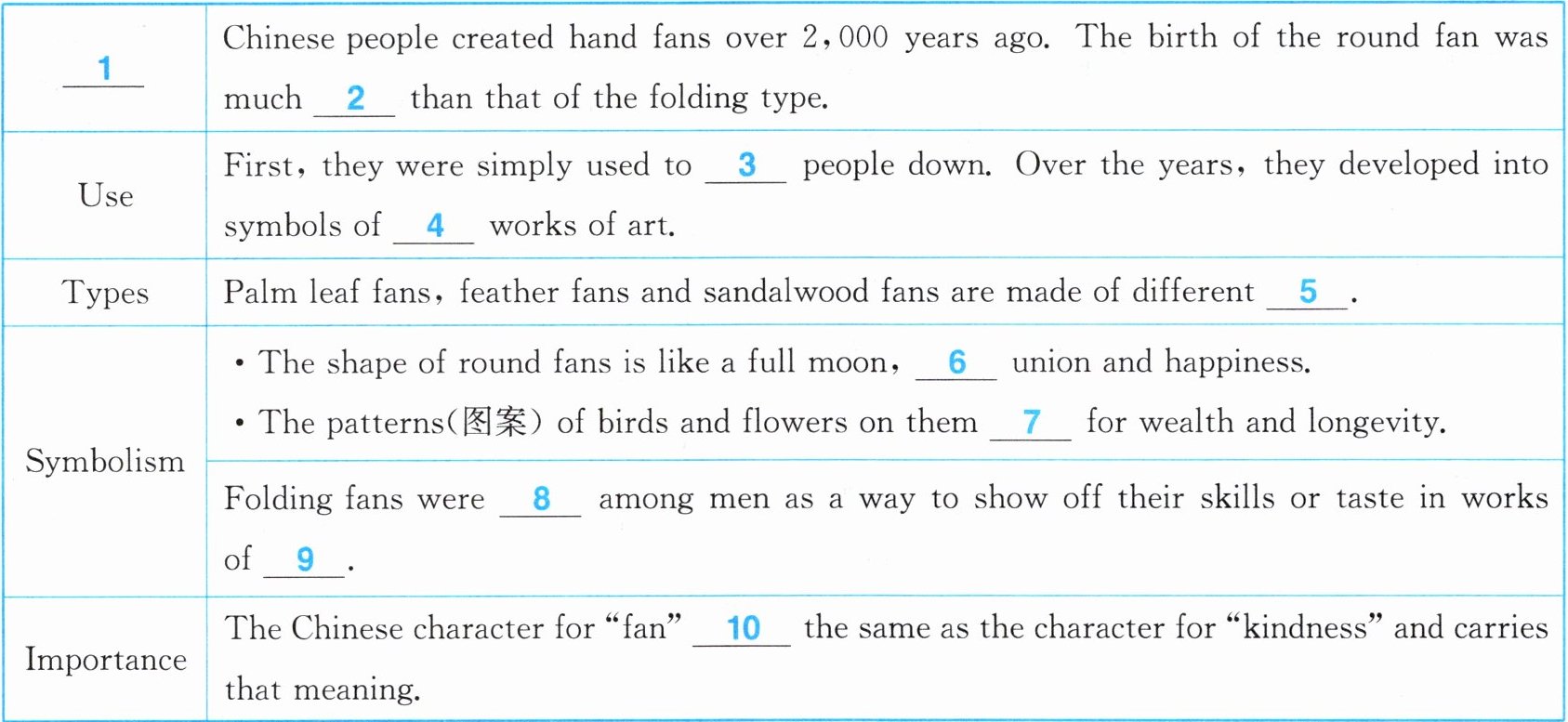
Chinese people started to use hand fans over 2,000 years ago. Then, they were almost the only way to drive the heat away. The Chinese character(汉字) for the word “fan” has the same sound as the character for “kindness”.
The fans came in different shapes and were made of all kinds of materials. Palm(棕榈树) leaf fans were cheap and easy to make. Feather fans showed the owner's high position(地位). Sandalwood(檀香) fans could send out a sweet smell.
Later, hand fans became far more than just something that could cool people down. They developed into works of art, in which round fans and folded fans were the most common.
In the shape of a full moon, the round fans mean union and happiness. They have beautiful embroidery(刺绣) featuring birds and flowers on them, meaning wealth and longevity(长寿). Women, especially those in the palace, liked to use them. Such fans were very popular in the Han dynasty.
Folding fans were first made in the Song dynasty and became popular in the Ming dynasty. They have a history of symbolizing scholarship(象征学问). Men, especially the literati, used *zheshan* because they were usually made of paper and they could paint and write poems on them. It was a way for them to show off their skills or taste in literature, painting and calligraphy.
答案
四
1. History
2. earlier
3. cool
4. different
5. materials
6. meaning
7. stand
8. popular
9. art
10. sounds
1. History
2. earlier
3. cool
4. different
5. materials
6. meaning
7. stand
8. popular
9. art
10. sounds
解析
【分析】
这是一道任务型阅读题,解题思路如下:
1. 首先通读全文,把握文章关于中国手扇的起源、用途、种类、象征意义和文化内涵的整体内容;
2. 对照表格的各个板块,逐个分析空格所在句子的语境,回到原文寻找对应的细节信息;
3. 注意词性变化、固定搭配和语法要求,比如比较级、动词形式、主谓一致等,确保填写的内容符合句子结构和语义。
【解析】
1. 第一栏内容介绍手扇的起源时间以及团扇和折扇的出现先后,属于“历史(History)”范畴,故填History;
2. 根据文章内容,团扇的诞生比折扇早,结合空格后的than,需用early的比较级earlier,much修饰比较级,故填earlier;
3. 原文提到“they were almost the only way to drive the heat away”,也就是用来给人们降温(cool people down),be used to后接动词原形,故填cool;
4. 原文表明手扇发展成了艺术品,结合语境是“不同的(different)”艺术品,故填different;
5. 原文“were made of all kinds of materials”说明不同种类的扇子由不同材料制成,故填materials;
6. 原文“In the shape of a full moon, the round fans mean union and happiness”,此处用现在分词meaning作伴随状语,补充说明团扇形状的象征意义,故填meaning;
7. “stand for”是固定搭配,意为“代表”,对应原文中花鸟图案象征财富和长寿的内容,主语是复数,故填stand;
8. 原文提到折扇在明代流行,且在男性中受欢迎,故填popular;
9. 原文“show off their skills or taste in literature, painting and calligraphy”,这些都属于艺术(art)范畴,故填art;
10. 原文“The Chinese character for the word ‘fan’ has the same sound as the character for ‘kindness’”,主语是第三人称单数,一般现在时,故填sounds。
【答案】
1. History
2. earlier
3. cool
4. different
5. materials
6. meaning
7. stand
8. popular
9. art
10. sounds
【知识点】
任务型阅读技巧、词汇运用、固定搭配
【点评】
本题围绕中国传统手扇展开,考查学生对文章细节信息的抓取能力,同时涉及词性转换、固定搭配等语法知识,既考查语言能力,也渗透了传统文化知识,有助于学生了解中国传统器物的文化内涵。
【难度系数】
0.6
这是一道任务型阅读题,解题思路如下:
1. 首先通读全文,把握文章关于中国手扇的起源、用途、种类、象征意义和文化内涵的整体内容;
2. 对照表格的各个板块,逐个分析空格所在句子的语境,回到原文寻找对应的细节信息;
3. 注意词性变化、固定搭配和语法要求,比如比较级、动词形式、主谓一致等,确保填写的内容符合句子结构和语义。
【解析】
1. 第一栏内容介绍手扇的起源时间以及团扇和折扇的出现先后,属于“历史(History)”范畴,故填History;
2. 根据文章内容,团扇的诞生比折扇早,结合空格后的than,需用early的比较级earlier,much修饰比较级,故填earlier;
3. 原文提到“they were almost the only way to drive the heat away”,也就是用来给人们降温(cool people down),be used to后接动词原形,故填cool;
4. 原文表明手扇发展成了艺术品,结合语境是“不同的(different)”艺术品,故填different;
5. 原文“were made of all kinds of materials”说明不同种类的扇子由不同材料制成,故填materials;
6. 原文“In the shape of a full moon, the round fans mean union and happiness”,此处用现在分词meaning作伴随状语,补充说明团扇形状的象征意义,故填meaning;
7. “stand for”是固定搭配,意为“代表”,对应原文中花鸟图案象征财富和长寿的内容,主语是复数,故填stand;
8. 原文提到折扇在明代流行,且在男性中受欢迎,故填popular;
9. 原文“show off their skills or taste in literature, painting and calligraphy”,这些都属于艺术(art)范畴,故填art;
10. 原文“The Chinese character for the word ‘fan’ has the same sound as the character for ‘kindness’”,主语是第三人称单数,一般现在时,故填sounds。
【答案】
1. History
2. earlier
3. cool
4. different
5. materials
6. meaning
7. stand
8. popular
9. art
10. sounds
【知识点】
任务型阅读技巧、词汇运用、固定搭配
【点评】
本题围绕中国传统手扇展开,考查学生对文章细节信息的抓取能力,同时涉及词性转换、固定搭配等语法知识,既考查语言能力,也渗透了传统文化知识,有助于学生了解中国传统器物的文化内涵。
【难度系数】
0.6
