

 登录
登录
Ⅲ. 阅读理解(18 分)
A
[2025 湖北武汉调研]
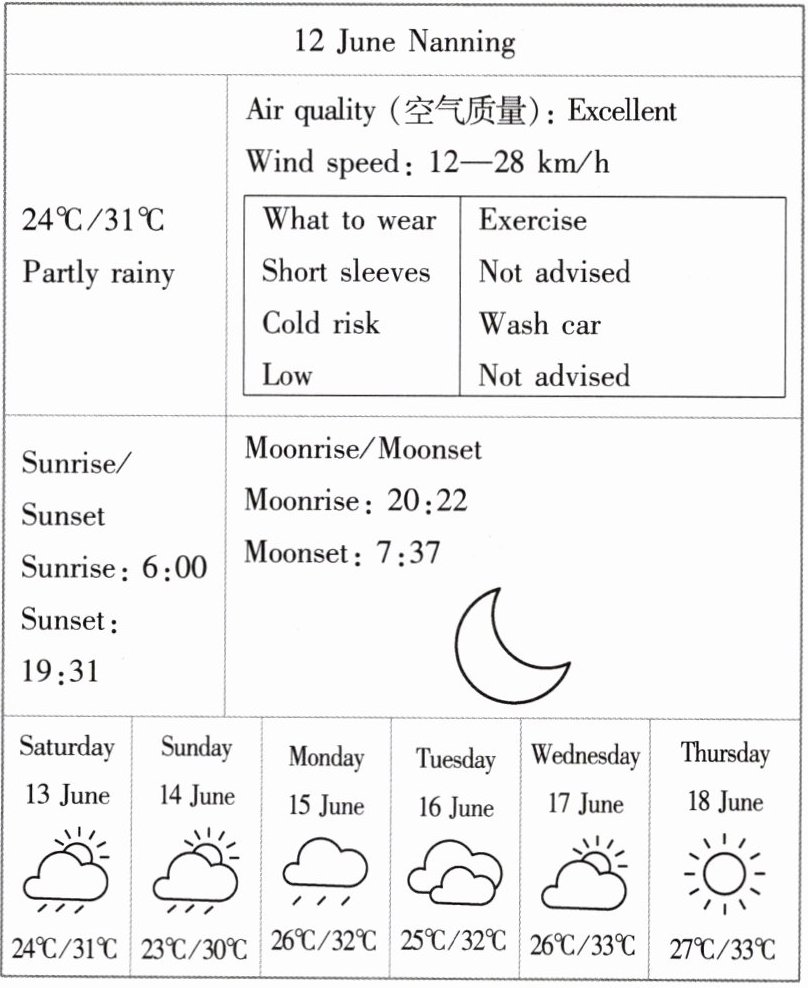
( )26. The moon rises at _______ on 12 June.
A. 5:56
B. 7:37
C. 19:24
D. 20:22
( )27. It will be _______ on Tuesday.
A. sunny
B. rainy
C. cloudy
D. windy
( )28. The lowest (最低的) temperature will be on _______.
A. 12 June
B. 13 June
C. 14 June
D. 15 June
( )29. What can we learn from the report?
A. It shows us the weather in Nanjing.
B. It is not easy to catch a cold on 12 June.
C. It is proper for us to wear a sweater on 12 June.
D. It is a good idea to have a picnic at this weekend.
( )30. 新考法 文章出处 This passage is probably from a _______.
A. storybook
B. novel
C. science book
D. newspaper
A
[2025 湖北武汉调研]
( )26. The moon rises at _______ on 12 June.
A. 5:56
B. 7:37
C. 19:24
D. 20:22
( )27. It will be _______ on Tuesday.
A. sunny
B. rainy
C. cloudy
D. windy
( )28. The lowest (最低的) temperature will be on _______.
A. 12 June
B. 13 June
C. 14 June
D. 15 June
( )29. What can we learn from the report?
A. It shows us the weather in Nanjing.
B. It is not easy to catch a cold on 12 June.
C. It is proper for us to wear a sweater on 12 June.
D. It is a good idea to have a picnic at this weekend.
( )30. 新考法 文章出处 This passage is probably from a _______.
A. storybook
B. novel
C. science book
D. newspaper
答案
阅读A篇·语篇导读 本文介绍了南宁七天的天气情况。
快速对答案 26—30 D C C B D
26. D 细节理解题。根据表格中“Moonrise:20:22”可知,月亮在20:22升起,故选D项。
27. C 细节理解题。根据表格中Tuesday的天气情况可知,那一天多云,故选C项。
28. C 细节理解题。对比每一天的最低气温可知,6月14日的气温最低,故选C项。
29. B 细节理解题。根据表格中6月12日这一天的Cold risk及Low可知,这一天不容易感冒。故选B项。
30. D 推理判断题。通读全文可知,本文介绍了南宁七天的天气情况,可能来自报纸,故选D项。
快速对答案 26—30 D C C B D
26. D 细节理解题。根据表格中“Moonrise:20:22”可知,月亮在20:22升起,故选D项。
27. C 细节理解题。根据表格中Tuesday的天气情况可知,那一天多云,故选C项。
28. C 细节理解题。对比每一天的最低气温可知,6月14日的气温最低,故选C项。
29. B 细节理解题。根据表格中6月12日这一天的Cold risk及Low可知,这一天不容易感冒。故选B项。
30. D 推理判断题。通读全文可知,本文介绍了南宁七天的天气情况,可能来自报纸,故选D项。
解析
【分析】
这是一篇介绍南宁多日天气情况的图表类应用文,解题时优先提取每道题干的核心关键词,直接回到表格对应区域定位查找匹配信息即可:细节题不需要通读全文,带着目标信息检索图表内容就能快速得到答案,推理类题目结合生活常识判断文本的常见发布场景即可。
【解析】
26. 细节理解题:提取题干关键词"moon rises"和"12 June",定位到表格的Moonrise/Moonset板块,明确标注Moonrise: 20:22,因此月亮升起的时间是20:22,选D。
27. 细节理解题:提取题干关键词"Tuesday",定位到表格底部6月16日周二的天气标识,对应多云的天气图标,因此当天天气是多云,选C。
28. 细节理解题:对比所有标注日期的最低气温:12日最低24℃、13日最低24℃、14日最低23℃、15日最低26℃,可知最低气温出现在6月14日,选C。
29. 细节理解题:逐一判断选项:A选项文本介绍的是南宁Nanning的天气,不是南京Nanjing,表述错误;B选项12日的Cold risk标注为Low,说明感冒风险很低,不容易感冒,表述正确;C选项12日建议穿着是短袖,不需要穿毛衣,表述错误;D选项周末周六、周日都有降雨,不适合野餐,表述错误。因此选B。
30. 推理判断题:本文是天气预报内容,这类内容通常会刊登在报纸的生活资讯板块,不可能出自故事书、小说或者科普书籍,因此选D。
【答案】
26—30 D C C B D
【知识点】
应用文阅读,细节信息定位,文本出处判断
【点评】
本题属于典型的图表类应用文阅读,绝大多数题目为直接检索信息的细节题,难度较低,主要考查学生快速从图表中抓取关键信息的能力,解题时注意不要混淆相似地名、看错不同日期的对应数据即可轻松得分。
【难度系数】
0.8
这是一篇介绍南宁多日天气情况的图表类应用文,解题时优先提取每道题干的核心关键词,直接回到表格对应区域定位查找匹配信息即可:细节题不需要通读全文,带着目标信息检索图表内容就能快速得到答案,推理类题目结合生活常识判断文本的常见发布场景即可。
【解析】
26. 细节理解题:提取题干关键词"moon rises"和"12 June",定位到表格的Moonrise/Moonset板块,明确标注Moonrise: 20:22,因此月亮升起的时间是20:22,选D。
27. 细节理解题:提取题干关键词"Tuesday",定位到表格底部6月16日周二的天气标识,对应多云的天气图标,因此当天天气是多云,选C。
28. 细节理解题:对比所有标注日期的最低气温:12日最低24℃、13日最低24℃、14日最低23℃、15日最低26℃,可知最低气温出现在6月14日,选C。
29. 细节理解题:逐一判断选项:A选项文本介绍的是南宁Nanning的天气,不是南京Nanjing,表述错误;B选项12日的Cold risk标注为Low,说明感冒风险很低,不容易感冒,表述正确;C选项12日建议穿着是短袖,不需要穿毛衣,表述错误;D选项周末周六、周日都有降雨,不适合野餐,表述错误。因此选B。
30. 推理判断题:本文是天气预报内容,这类内容通常会刊登在报纸的生活资讯板块,不可能出自故事书、小说或者科普书籍,因此选D。
【答案】
26—30 D C C B D
【知识点】
应用文阅读,细节信息定位,文本出处判断
【点评】
本题属于典型的图表类应用文阅读,绝大多数题目为直接检索信息的细节题,难度较低,主要考查学生快速从图表中抓取关键信息的能力,解题时注意不要混淆相似地名、看错不同日期的对应数据即可轻松得分。
【难度系数】
0.8
B
[2024 河南商丘期末·改编]How do you know about the weather this week? Is it rainy, cloudy, windy, sunny...? Do you know it by listening to the radio, using the internet or watching TV? We can know it by watching some animals too. They can know the change of the weather easily and do something to prepare for the bad weather.
It is easy for bees to know the change of the weather in a short time because they can "talk" to others by dancing and a lot of bees can live very well with each other. But do you know why bees don't go out on rainy days? Because they may get hurt in the rain. So now you may know this saying well, "If bees fly away, fine will be the day."
We can also know the coming of the rain by other animals. It's really interesting, isn't it? Learn more and know more from now on.
(
① listening to the radio ② using the internet ③ watching TV ④ watching animals ⑤ reading a newspaper
A. ①②③④
B. ①②③④⑤
C. ①②③
D. ①②④
(
A. People.
B. Animals.
C. Books.
D. Clouds.
(
A. Bees like to dance in the rain.
B. The writer doesn't like watching TV.
C. If bees are at home and don't go out, rain is coming.
D. The writer doesn't want to learn about the weather.
(
A. We can know the weather by watching animals.
B. Dancing is a special way for bees to talk with each other.
C. We will learn more about bees by watching them carefully.
D. We can't tell the weather by watching what bees are doing.
[2024 河南商丘期末·改编]How do you know about the weather this week? Is it rainy, cloudy, windy, sunny...? Do you know it by listening to the radio, using the internet or watching TV? We can know it by watching some animals too. They can know the change of the weather easily and do something to prepare for the bad weather.
It is easy for bees to know the change of the weather in a short time because they can "talk" to others by dancing and a lot of bees can live very well with each other. But do you know why bees don't go out on rainy days? Because they may get hurt in the rain. So now you may know this saying well, "If bees fly away, fine will be the day."
We can also know the coming of the rain by other animals. It's really interesting, isn't it? Learn more and know more from now on.
(
A
)31. 新考法 选项选择 People can know the weather by ①②③④
according to the passage.① listening to the radio ② using the internet ③ watching TV ④ watching animals ⑤ reading a newspaper
A. ①②③④
B. ①②③④⑤
C. ①②③
D. ①②④
(
B
)32. What does the underlined word "They" in Paragraph 1 refer to?A. People.
B. Animals.
C. Books.
D. Clouds.
(
C
)33. What can we know from the passage?A. Bees like to dance in the rain.
B. The writer doesn't like watching TV.
C. If bees are at home and don't go out, rain is coming.
D. The writer doesn't want to learn about the weather.
(
A
)34. What is this passage mainly about?A. We can know the weather by watching animals.
B. Dancing is a special way for bees to talk with each other.
C. We will learn more about bees by watching them carefully.
D. We can't tell the weather by watching what bees are doing.
答案
阅读B篇·语篇导读 本文介绍了蜜蜂可以预测天气,告诉人们可以观察动物来预测天气。
快速对答案 31—34 A B C A
31. A 细节理解题。根据“Do you know it by listening to the radio, using the internet or watching TV? We can know it by watching some animals too.”可知选A项。
32. B 词义猜测题。根据“We can know it by watching some animals too. They can know the change of the weather easily and do something to prepare for the bad weather.”可知,此处They指代animals。
33. C 细节理解题。根据“But do you know why bees don't go out on rainy days? Because they may get hurt in the rain.”可知,如果蜜蜂待在“家”里不出去,这意味着雨将来临。
34. A 主旨大意题。通读全文可知,本文主要说明了我们可以通过观察动物来预测天气。
快速对答案 31—34 A B C A
31. A 细节理解题。根据“Do you know it by listening to the radio, using the internet or watching TV? We can know it by watching some animals too.”可知选A项。
32. B 词义猜测题。根据“We can know it by watching some animals too. They can know the change of the weather easily and do something to prepare for the bad weather.”可知,此处They指代animals。
33. C 细节理解题。根据“But do you know why bees don't go out on rainy days? Because they may get hurt in the rain.”可知,如果蜜蜂待在“家”里不出去,这意味着雨将来临。
34. A 主旨大意题。通读全文可知,本文主要说明了我们可以通过观察动物来预测天气。
解析
【分析】
这是一篇介绍通过观察动物预判天气的说明文阅读理解,解题时可以按照不同题型的对应思路思考:1. 细节理解题先圈出题干关键词,回到原文定位对应语句,逐一核对选项内容是否和原文表述一致,排除未提及的错误信息;2. 词义猜测题找划线词的前文内容,判断指代的最近的核心名词;3. 主旨大意题不要被局部的举例内容干扰,要结合首尾段的核心论述确定全文主题。
【解析】
31. 细节理解题:定位原文第一段"Do you know it by listening to the radio, using the internet or watching TV? We can know it by watching some animals too.",文中明确提到了听广播、用互联网、看电视、观察动物这4种获知天气的方式,没有提到读报纸,因此①②③④符合要求,选A。
32. 词义猜测题:划线词"They"的前一句刚提到"We can know it by watching some animals too.",后文表述的是“它们能轻易感知天气变化,提前为坏天气做准备”,符合动物的特征,因此They指代的是animals,选B。
33. 细节理解题:逐一核对选项:A选项“蜜蜂喜欢在雨里跳舞”和原文“蜜蜂雨天不外出,怕在雨中受伤”表述矛盾;B选项“作者不喜欢看电视”原文完全没有提及;C选项“如果蜜蜂待在家里不外出,雨就要来了”对应原文"But do you know why bees don't go out on rainy days? Because they may get hurt in the rain."的表述,符合文意;D选项“作者不想了解天气”和最后一段"Learn more and know more from now on."表述矛盾,因此选C。
34. 主旨大意题:全文开篇就引出除了常规方式,还可以通过观察动物获知天气,后续用蜜蜂的例子做具体佐证,核心主题就是我们可以通过观察动物判断天气,其余选项都是局部细节内容,不能概括全文,因此选A。
【答案】
31.A 32.B 33.C 34.A
【知识点】
细节理解,词义猜测,主旨大意
【点评】
本题属于基础难度的生活科普类阅读,覆盖了初中英语阅读最常见的三类考点,学生解题时要注意细节题不要漏看原文给出的全部有效信息,指代题要优先向前文找最近的对应指代对象,主旨题不要被局部的举例内容误导,要抓住全文的核心论述方向。
【难度系数】
0.7
这是一篇介绍通过观察动物预判天气的说明文阅读理解,解题时可以按照不同题型的对应思路思考:1. 细节理解题先圈出题干关键词,回到原文定位对应语句,逐一核对选项内容是否和原文表述一致,排除未提及的错误信息;2. 词义猜测题找划线词的前文内容,判断指代的最近的核心名词;3. 主旨大意题不要被局部的举例内容干扰,要结合首尾段的核心论述确定全文主题。
【解析】
31. 细节理解题:定位原文第一段"Do you know it by listening to the radio, using the internet or watching TV? We can know it by watching some animals too.",文中明确提到了听广播、用互联网、看电视、观察动物这4种获知天气的方式,没有提到读报纸,因此①②③④符合要求,选A。
32. 词义猜测题:划线词"They"的前一句刚提到"We can know it by watching some animals too.",后文表述的是“它们能轻易感知天气变化,提前为坏天气做准备”,符合动物的特征,因此They指代的是animals,选B。
33. 细节理解题:逐一核对选项:A选项“蜜蜂喜欢在雨里跳舞”和原文“蜜蜂雨天不外出,怕在雨中受伤”表述矛盾;B选项“作者不喜欢看电视”原文完全没有提及;C选项“如果蜜蜂待在家里不外出,雨就要来了”对应原文"But do you know why bees don't go out on rainy days? Because they may get hurt in the rain."的表述,符合文意;D选项“作者不想了解天气”和最后一段"Learn more and know more from now on."表述矛盾,因此选C。
34. 主旨大意题:全文开篇就引出除了常规方式,还可以通过观察动物获知天气,后续用蜜蜂的例子做具体佐证,核心主题就是我们可以通过观察动物判断天气,其余选项都是局部细节内容,不能概括全文,因此选A。
【答案】
31.A 32.B 33.C 34.A
【知识点】
细节理解,词义猜测,主旨大意
【点评】
本题属于基础难度的生活科普类阅读,覆盖了初中英语阅读最常见的三类考点,学生解题时要注意细节题不要漏看原文给出的全部有效信息,指代题要优先向前文找最近的对应指代对象,主旨题不要被局部的举例内容误导,要抓住全文的核心论述方向。
【难度系数】
0.7
