

 登录
登录
Ⅰ.根据汉语意思完成句子,每空一词
1.我们应该做什么来保护这些动物?
What should we do
2.他正在面临什么难题?
3.它是世界上最美的地方之一。
It is
4.让我们阻止他们砍伐树木吧。
Let’s stop them
1.我们应该做什么来保护这些动物?
What should we do
to
protect
the animals?2.他正在面临什么难题?
What
problem(s)
is he facing?3.它是世界上最美的地方之一。
It is
one
of
the
most
beautiful places in the world.4.让我们阻止他们砍伐树木吧。
Let’s stop them
cutting
down
trees.答案
Ⅰ.1. to protect 2. What problem(s) 3. one of the most 4. cutting down
解析
【分析】
1. 第1小题:需表达“来保护”作目的状语,英语中常用动词不定式(to+动词原形)表目的,故填to protect。
2. 第2小题:询问“什么难题”,疑问词用What,“难题”对应problem,此处可单复数,故填What problem(s)。
3. 第3小题:“最…之一”的固定结构为one of + the + 形容词最高级 + 可数名词复数,“最美的”是most beautiful,故填one of the most。
4. 第4小题:“阻止某人做某事”的固定搭配是stop sb doing sth,“砍伐”是cut down,需用动名词形式,故填cutting down。
【解析】
1. 第1小题:根据汉语提示“来保护”,此处作目的状语,使用不定式结构to protect,符合英语表达习惯。
2. 第2小题:针对“什么难题”提问,用疑问词What修饰名词problem,problem可使用单数或复数形式,故为What problem(s)。
3. 第3小题:“one of the + 形容词最高级 + 名词复数”是固定句式,用于表示“最……之一”,结合“最美的”,故填one of the most。
4. 第4小题:固定搭配stop sb (from) doing sth中from可省略,“砍伐”是cut down,动名词形式为cutting down,符合搭配要求。
【答案】
1. to protect 2. What problem(s) 3. one of the most 4. cutting down
【知识点】
动词不定式、形容词最高级、固定搭配
【点评】
本题为基础句型填空题,考查核心语法结构与固定短语,是初中英语常见题型,侧重基础知识点的应用,难度较低。
【难度系数】
0.7
1. 第1小题:需表达“来保护”作目的状语,英语中常用动词不定式(to+动词原形)表目的,故填to protect。
2. 第2小题:询问“什么难题”,疑问词用What,“难题”对应problem,此处可单复数,故填What problem(s)。
3. 第3小题:“最…之一”的固定结构为one of + the + 形容词最高级 + 可数名词复数,“最美的”是most beautiful,故填one of the most。
4. 第4小题:“阻止某人做某事”的固定搭配是stop sb doing sth,“砍伐”是cut down,需用动名词形式,故填cutting down。
【解析】
1. 第1小题:根据汉语提示“来保护”,此处作目的状语,使用不定式结构to protect,符合英语表达习惯。
2. 第2小题:针对“什么难题”提问,用疑问词What修饰名词problem,problem可使用单数或复数形式,故为What problem(s)。
3. 第3小题:“one of the + 形容词最高级 + 名词复数”是固定句式,用于表示“最……之一”,结合“最美的”,故填one of the most。
4. 第4小题:固定搭配stop sb (from) doing sth中from可省略,“砍伐”是cut down,动名词形式为cutting down,符合搭配要求。
【答案】
1. to protect 2. What problem(s) 3. one of the most 4. cutting down
【知识点】
动词不定式、形容词最高级、固定搭配
【点评】
本题为基础句型填空题,考查核心语法结构与固定短语,是初中英语常见题型,侧重基础知识点的应用,难度较低。
【难度系数】
0.7
[2025 安徽合肥新站月考改编]
Derrick Downey is from the US. He loves animals a lot, and he makes
Downey
In his free time, Downey makes short videos (视频) for the two to relax. “I
Downey also builds a
What an animal lover!
5.A.languages B.friends C.cards D.pictures
6.A.takes B.sends C.visits D.brings
7.A.calls B.tells C.leaves D.gives
8.A.never B.already C.always D.even
9.A.clever B.scary C.lazy D.quiet
10.A.look after B.take away C.look at D.take back
11.A.find B.use C.watch D.share
12.A.sad B.bored C.happy D.tired
13.A.cake B.jacket C.gift D.house
14.A.fun B.work C.time D.food
Derrick Downey is from the US. He loves animals a lot, and he makes
B
5 with a lovely squirrel (松鼠)! The squirrel comes to Downey’s house often. Sometimes he D
6 his friend here. Downey loves the two and A
7 them Richard and Maxine.Downey
C
8 gives food and water to Richard and Maxine. He likes talking to them, too. “They’re so A
9 and cute. When I ask them ‘Would you like some food?’, they run to me and B
10 the food quickly,” Downey says.In his free time, Downey makes short videos (视频) for the two to relax. “I
D
11 my videos online. People love them very much and call me ‘The Squirrel’s Dad’. I feel so C
12 and I want to keep doing that,” Downey says.Downey also builds a
D
13 for the two. Look at the sofa in the house! Downey wants the two to rest well. We can find a small TV on a small table in the house, too—Downey wants them to have A
14 here.What an animal lover!
5.A.languages B.friends C.cards D.pictures
6.A.takes B.sends C.visits D.brings
7.A.calls B.tells C.leaves D.gives
8.A.never B.already C.always D.even
9.A.clever B.scary C.lazy D.quiet
10.A.look after B.take away C.look at D.take back
11.A.find B.use C.watch D.share
12.A.sad B.bored C.happy D.tired
13.A.cake B.jacket C.gift D.house
14.A.fun B.work C.time D.food
答案
Ⅱ. [语篇解读] 本文讲的是 Derrick Downey 和两只松鼠建立了深厚的友谊的故事。
5. B 考查名词辨析。根据设空处前的“他非常喜欢动物”可知,Downey 和一只可爱的松鼠交朋友。make friends with...意为“和……交朋友”。故选 B。
6. D 考查动词辨析。有时松鼠会带它的朋友来这里。bring 意为“带来”,可表示“把某人或某物从别处带到说话人处”。故选 D。
7. A 考查动词辨析。设空处后的 Richard 和 Maxine 是 Downey 给那两只松鼠起的名字。call 意为“称呼;把……叫做”。故选 A。
8. C 考查副词辨析。上文提到 Downey 很喜欢这两只松鼠,由此可推断,他总是给 Richard 和 Maxine 食物和水,always 符合题意。故选 C。
9. A 考查形容词辨析。根据下文的描述可知,当 Downey 问它们是否想要食物时,它们会跑到 Downey 面前快速拿走食物。由此可推断,松鼠们很聪明。故选 A。
10. B 考查动词短语辨析。松鼠们会快速跑到 Downey 面前拿走食物。take away 拿走,带走。故选 B。
易错警示 take away 意为“拿走;带走”。如果宾语是名词,该名词宾语可以位于 take 和 away 之间,也可以位于 away 之后;如果宾语是代词,该代词宾语只能位于 take 和 away 之间。
Can I take these books away?
= Can I take away these books?
我能把这些书带走吗?
These toys are yours. You can take them away.
这些玩具是你的。你可以把它们拿走。
11. D 考查动词辨析。根据设空处后的“人们很喜欢它们”可推知,Downey 在网上分享了他的视频,share 符合题意。故选 D。
12. C 考查形容词辨析。根据设空处后的“我想继续那样做”可知,Downey 感到很开心,happy 符合题意。故选 C。
13. D 考查名词辨析。根据设空处后的“the sofa in the house”可知,Downey 为两只松鼠建了一个房子,house 符合题意。故选 D。
14. A 考查名词辨析。根据设空处前的“一个小的电视机”可知,Downey 想要它们在这里玩得开心。have fun 意为“玩得开心”。故选 A。
5. B 考查名词辨析。根据设空处前的“他非常喜欢动物”可知,Downey 和一只可爱的松鼠交朋友。make friends with...意为“和……交朋友”。故选 B。
6. D 考查动词辨析。有时松鼠会带它的朋友来这里。bring 意为“带来”,可表示“把某人或某物从别处带到说话人处”。故选 D。
7. A 考查动词辨析。设空处后的 Richard 和 Maxine 是 Downey 给那两只松鼠起的名字。call 意为“称呼;把……叫做”。故选 A。
8. C 考查副词辨析。上文提到 Downey 很喜欢这两只松鼠,由此可推断,他总是给 Richard 和 Maxine 食物和水,always 符合题意。故选 C。
9. A 考查形容词辨析。根据下文的描述可知,当 Downey 问它们是否想要食物时,它们会跑到 Downey 面前快速拿走食物。由此可推断,松鼠们很聪明。故选 A。
10. B 考查动词短语辨析。松鼠们会快速跑到 Downey 面前拿走食物。take away 拿走,带走。故选 B。
易错警示 take away 意为“拿走;带走”。如果宾语是名词,该名词宾语可以位于 take 和 away 之间,也可以位于 away 之后;如果宾语是代词,该代词宾语只能位于 take 和 away 之间。
Can I take these books away?
= Can I take away these books?
我能把这些书带走吗?
These toys are yours. You can take them away.
这些玩具是你的。你可以把它们拿走。
11. D 考查动词辨析。根据设空处后的“人们很喜欢它们”可推知,Downey 在网上分享了他的视频,share 符合题意。故选 D。
12. C 考查形容词辨析。根据设空处后的“我想继续那样做”可知,Downey 感到很开心,happy 符合题意。故选 C。
13. D 考查名词辨析。根据设空处后的“the sofa in the house”可知,Downey 为两只松鼠建了一个房子,house 符合题意。故选 D。
14. A 考查名词辨析。根据设空处前的“一个小的电视机”可知,Downey 想要它们在这里玩得开心。have fun 意为“玩得开心”。故选 A。
解析
【分析】
本题为完形填空,解题思路如下:首先通读全文,把握文章主旨(Derrick Downey与两只松鼠的友好故事);接着逐题分析,结合上下文语境、词义辨析、固定搭配及逻辑关系,排除不符合语境的干扰项,确定正确选项。
【解析】
5. 考查名词辨析。根据前文“他非常喜欢动物”,结合固定搭配“make friends with(和……交朋友)”,可知此处指Downey和松鼠交朋友,故选B。
6. 考查动词辨析。此处表示松鼠会带它的朋友来到Downey家,bring意为“带来”,符合语境,故选D。
7. 考查动词辨析。此处指Downey给两只松鼠起名为Richard和Maxine,call意为“称呼;把……叫做”,符合语境,故选A。
8. 考查副词辨析。根据上文“Downey很喜欢这两只松鼠”,可知他总是给松鼠食物和水,always符合逻辑,故选C。
9. 考查形容词辨析。根据下文松鼠听到“想吃食物吗”就跑过来的表现,可知松鼠很聪明,clever符合语境,故选A。
10. 考查动词短语辨析。此处指松鼠快速拿走食物,take away意为“拿走”,符合语境,故选B。
11. 考查动词辨析。根据后文“人们很喜欢它们”,可知Downey把视频分享到网上,share意为“分享”,故选D。
12. 考查形容词辨析。根据后文“想继续做这件事”,可知Downey感到很开心,happy符合语境,故选C。
13. 考查名词辨析。根据后文“房子里的沙发”,可知Downey为松鼠建了一个房子,house符合语境,故选D。
14. 考查名词辨析。结合前文提到的小电视,可知此处是固定搭配“have fun(玩得开心)”,指让松鼠在这里玩得愉快,故选A。
【答案】
5.B 6.D 7.A 8.C 9.A 10.B 11.D 12.C 13.D 14.A
【知识点】
名词辨析、动词辨析、形容词辨析、副词辨析、固定搭配
【点评】
本题围绕人与动物的友好故事展开,是典型的完形填空题型,侧重考查词汇在具体语境中的运用,需要学生具备语篇理解能力及词义辨析能力,整体难度适中。
【难度系数】
0.6
本题为完形填空,解题思路如下:首先通读全文,把握文章主旨(Derrick Downey与两只松鼠的友好故事);接着逐题分析,结合上下文语境、词义辨析、固定搭配及逻辑关系,排除不符合语境的干扰项,确定正确选项。
【解析】
5. 考查名词辨析。根据前文“他非常喜欢动物”,结合固定搭配“make friends with(和……交朋友)”,可知此处指Downey和松鼠交朋友,故选B。
6. 考查动词辨析。此处表示松鼠会带它的朋友来到Downey家,bring意为“带来”,符合语境,故选D。
7. 考查动词辨析。此处指Downey给两只松鼠起名为Richard和Maxine,call意为“称呼;把……叫做”,符合语境,故选A。
8. 考查副词辨析。根据上文“Downey很喜欢这两只松鼠”,可知他总是给松鼠食物和水,always符合逻辑,故选C。
9. 考查形容词辨析。根据下文松鼠听到“想吃食物吗”就跑过来的表现,可知松鼠很聪明,clever符合语境,故选A。
10. 考查动词短语辨析。此处指松鼠快速拿走食物,take away意为“拿走”,符合语境,故选B。
11. 考查动词辨析。根据后文“人们很喜欢它们”,可知Downey把视频分享到网上,share意为“分享”,故选D。
12. 考查形容词辨析。根据后文“想继续做这件事”,可知Downey感到很开心,happy符合语境,故选C。
13. 考查名词辨析。根据后文“房子里的沙发”,可知Downey为松鼠建了一个房子,house符合语境,故选D。
14. 考查名词辨析。结合前文提到的小电视,可知此处是固定搭配“have fun(玩得开心)”,指让松鼠在这里玩得愉快,故选A。
【答案】
5.B 6.D 7.A 8.C 9.A 10.B 11.D 12.C 13.D 14.A
【知识点】
名词辨析、动词辨析、形容词辨析、副词辨析、固定搭配
【点评】
本题围绕人与动物的友好故事展开,是典型的完形填空题型,侧重考查词汇在具体语境中的运用,需要学生具备语篇理解能力及词义辨析能力,整体难度适中。
【难度系数】
0.6
[2025 江西南昌中学教育集团期中改编]
“Tu-whit tu-whoo, tu-whit tu-whoo!” What’s that sound coming from the forest at night? It’s the cry of an owl (猫头鹰), of course! The owl is different from all other birds in so many ways.
During the day, the owl sits in a tree sleeping or at least trying to snooze, because sometimes it’s hard to close the eyes with all the sounds coming from little birds and other animals in the forest! The owl gets food only at night. When evening comes, the animals all get to a safe place. The owl opens its big and round eyes. Any little animal around had better be careful!
The owl usually eats small animals like mice, but it also eats birds if it can get! The owl uses its great hearing to find its food, and then it turns its head from side to side, using its eyes to follow the animal. Finally, it flies down to get the animal. The owl has special and soft feathers (羽毛), so it can fly without making any sound. The owl is such a good hunter (猎手) that it can even catch a fly in the air!
▲ But when you get too close to its home, it will make a sound to keep you away. The female owl is a great mother. A mother owl will even hurt people if it thinks its babies are in danger!
The owl has no teeth, so it eats an animal without chewing (咀嚼). Later it coughs up pellets. If you find these small pellets of animals, you know you might be near an owl’s home.
15.What does the underlined word “snooze” in Paragraph 2 mean?
A.Sit. B.Sleep. C.Hunt. D.Fly.
16.What can we learn about the owl’s eating habits?
A.It uses its nose to find food.
B.It goes to a safe place at night.
C.It may have birds as its meals.
D.It usually gets food in the daytime.
17.新中考 What’s the missing part “▲” in Paragraph 4?
A.The owl is good at flying.
B.The owl always makes sounds.
C.The owl lives in a big group.
D.The owl is quiet most of the time.
18.新中考 Which of the following shows the structure of the text?
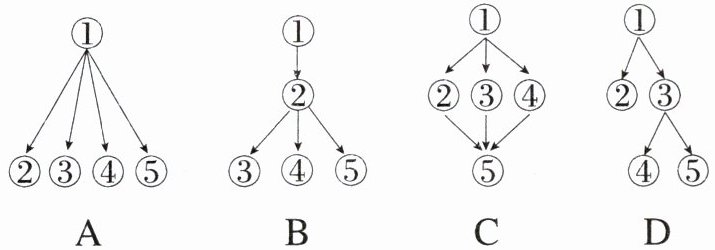
“Tu-whit tu-whoo, tu-whit tu-whoo!” What’s that sound coming from the forest at night? It’s the cry of an owl (猫头鹰), of course! The owl is different from all other birds in so many ways.
During the day, the owl sits in a tree sleeping or at least trying to snooze, because sometimes it’s hard to close the eyes with all the sounds coming from little birds and other animals in the forest! The owl gets food only at night. When evening comes, the animals all get to a safe place. The owl opens its big and round eyes. Any little animal around had better be careful!
The owl usually eats small animals like mice, but it also eats birds if it can get! The owl uses its great hearing to find its food, and then it turns its head from side to side, using its eyes to follow the animal. Finally, it flies down to get the animal. The owl has special and soft feathers (羽毛), so it can fly without making any sound. The owl is such a good hunter (猎手) that it can even catch a fly in the air!
▲ But when you get too close to its home, it will make a sound to keep you away. The female owl is a great mother. A mother owl will even hurt people if it thinks its babies are in danger!
The owl has no teeth, so it eats an animal without chewing (咀嚼). Later it coughs up pellets. If you find these small pellets of animals, you know you might be near an owl’s home.
15.What does the underlined word “snooze” in Paragraph 2 mean?
A.Sit. B.Sleep. C.Hunt. D.Fly.
16.What can we learn about the owl’s eating habits?
A.It uses its nose to find food.
B.It goes to a safe place at night.
C.It may have birds as its meals.
D.It usually gets food in the daytime.
17.新中考 What’s the missing part “▲” in Paragraph 4?
A.The owl is good at flying.
B.The owl always makes sounds.
C.The owl lives in a big group.
D.The owl is quiet most of the time.
18.新中考 Which of the following shows the structure of the text?
答案
Ⅲ. [语篇解读] 本文主要介绍了猫头鹰的一些习性。
15. B 词义猜测题。根据第二段中的“...trying to snooze, because sometimes it's hard to close the eyes with all the sounds coming from little birds and other animals in the forest!”可知,有时森林里的小鸟和其他动物发出的声音会让猫头鹰很难闭上眼睛,由此可推断,即使猫头鹰会因为其他动物发出的声音睡不着,它也会试图小睡一会儿。snooze 意为“小睡;打盹”,和 sleep 意义接近,故选 B。
16. C 细节理解题。根据第三段中的“The owl usually eats small animals like mice, but it also eats birds if it can get!”可知,猫头鹰通常吃老鼠等小动物,但也会捕食鸟类,故选 C。
17. D 信息还原题。根据设空处后的“但是当你过于靠近它家的时候,它会发出声音让你离开”可推断,所缺的句子是“猫头鹰大多数情况下很安静”,故选 D。
18. A 文章结构题。通读全文可知,本文是“总—分”的结构,第一段是总述,引出话题;第二段到第五段主要讲述了猫头鹰的捕食时间、捕食方式以及母性行为等,它们是并列关系,故选 A。
15. B 词义猜测题。根据第二段中的“...trying to snooze, because sometimes it's hard to close the eyes with all the sounds coming from little birds and other animals in the forest!”可知,有时森林里的小鸟和其他动物发出的声音会让猫头鹰很难闭上眼睛,由此可推断,即使猫头鹰会因为其他动物发出的声音睡不着,它也会试图小睡一会儿。snooze 意为“小睡;打盹”,和 sleep 意义接近,故选 B。
16. C 细节理解题。根据第三段中的“The owl usually eats small animals like mice, but it also eats birds if it can get!”可知,猫头鹰通常吃老鼠等小动物,但也会捕食鸟类,故选 C。
17. D 信息还原题。根据设空处后的“但是当你过于靠近它家的时候,它会发出声音让你离开”可推断,所缺的句子是“猫头鹰大多数情况下很安静”,故选 D。
18. A 文章结构题。通读全文可知,本文是“总—分”的结构,第一段是总述,引出话题;第二段到第五段主要讲述了猫头鹰的捕食时间、捕食方式以及母性行为等,它们是并列关系,故选 A。
解析
【分析】
解答本题需先梳理文章各段落内容,明确段落间的逻辑关系:第一段总述猫头鹰与其他鸟类的不同,引出话题;第二段至第五段分别介绍猫头鹰的作息、捕食方式、护家行为、进食特点,这些内容是围绕猫头鹰习性展开的并列分述,属于“总-分”结构,对应总节点指向多个并列分节点的图示。
【解析】
通读全文可知,文章第一段为总起段,引出猫头鹰的话题;第二段到第五段分别从猫头鹰的作息规律、捕食习性、护家行为、进食特点等方面具体说明,各段落内容为并列关系,整体是“总-分”结构。观察四个图示,A选项是总节点①指向四个并列分节点②③④⑤,符合文章结构,故选A。
【答案】
A
【知识点】
文章结构分析、阅读理解
【点评】
本题考查对文章整体结构的把握,需理清段落间的逻辑层次,难度中等。
【难度系数】
0.5
解答本题需先梳理文章各段落内容,明确段落间的逻辑关系:第一段总述猫头鹰与其他鸟类的不同,引出话题;第二段至第五段分别介绍猫头鹰的作息、捕食方式、护家行为、进食特点,这些内容是围绕猫头鹰习性展开的并列分述,属于“总-分”结构,对应总节点指向多个并列分节点的图示。
【解析】
通读全文可知,文章第一段为总起段,引出猫头鹰的话题;第二段到第五段分别从猫头鹰的作息规律、捕食习性、护家行为、进食特点等方面具体说明,各段落内容为并列关系,整体是“总-分”结构。观察四个图示,A选项是总节点①指向四个并列分节点②③④⑤,符合文章结构,故选A。
【答案】
A
【知识点】
文章结构分析、阅读理解
【点评】
本题考查对文章整体结构的把握,需理清段落间的逻辑层次,难度中等。
【难度系数】
0.5
