

 登录
登录
1. 已知$△ ABC$是等腰三角形,$AB=AC$,$∠ BAC=120°$,点$D$为$BC$边上一点,连接$AD$.
(1) 如图①,$AD=AP$,$∠ DAP=120°$,连接$DP$,$BP$.若$∠ DPB=90°$,$DC=2$,求$BD$的长度.
(2) 如图②,将线段$DC$绕点$D$逆时针旋转$60°$到$DE$,连接$BE$,点$O$为线段$BE$的中点,连接$AO$,证明:$AO=\dfrac{1}{2}AD$.
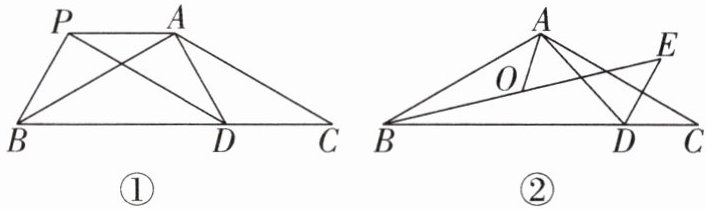
(1) 如图①,$AD=AP$,$∠ DAP=120°$,连接$DP$,$BP$.若$∠ DPB=90°$,$DC=2$,求$BD$的长度.
(2) 如图②,将线段$DC$绕点$D$逆时针旋转$60°$到$DE$,连接$BE$,点$O$为线段$BE$的中点,连接$AO$,证明:$AO=\dfrac{1}{2}AD$.
答案
1.(1) 在$△ ABC$中,$∠ BAC=120°,AB=AC,\therefore ∠ ABC=∠ C=30°.\because AD=AP, ∠ DAP=120°,\therefore ∠ BAP=∠ CAD,\therefore △ ABP≌△ ACD,\therefore BP=DC=2,∠ ABP=∠ C=30°$,在$△ BDP$中,可求得$∠ BDP=30°$,又$∠ DPB=90°,\therefore BD=4$.
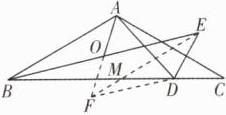
(2) 如图,延长$AO$到点$F$,使$OF=AO$,连接$EF,DF$,$EF$与$BC$交于点$M$,则$AO=\dfrac{1}{2}AF$.$\because$ 点$O$是$BE$的中点,$\therefore BO=OE$.
$\because ∠ AOB=∠ FOE,\therefore △ AOB≌△ FOE(\mathrm{SAS}),\therefore AB=EF=AC$,$∠ ABO=∠ FEO$.$\because ∠ ABO+∠ EBD=30°,\therefore ∠ EMD=∠ EBD+∠ FEO = ∠ EBD + ∠ ABO = 30°$.
$\because ∠ CDE=60°,\therefore ∠ DEM = 30° = ∠ C$,由旋转可知,$CD = DE$.$\because AB = EF = AC$,$\therefore △ DEF ≌ △ DCA(\mathrm{SAS})$,$\therefore ∠ ADC = ∠ EDF$,$AD = DF$,$\therefore ∠ ADF = ∠ CDE = 60°$, $\therefore △ ADF$是等边三角形,$\therefore AF=AD$,即$AO=\dfrac{1}{2}AD$.
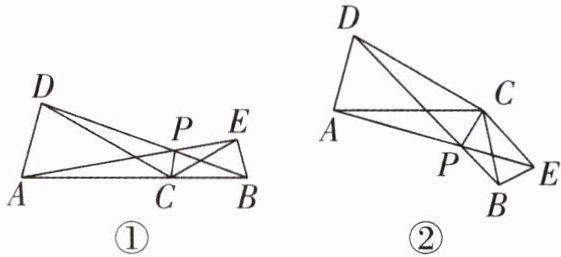
2. 如图①,点 C 在线段 AB 上(点 C 不与点 A,B 重合),分别以 AC,BC 为一腰在 AB 同侧作等腰三角形 ACD 和等腰三角形 BCE,其中 $ CA = CD, CB = CE, ∠ACD = ∠BCE = 30° $,连接 AE,DB 交于点 P.
(1)【观察猜想】:①AE 与 DB 的数量关系是
(2)【数学思考】:将$ △BCE $绕点 C 旋转到如图②所示的位置,其他条件不变,上述猜想①②是否仍然成立?若成立,请给予证明;若不成立,请你写出正确结论再给予证明.
(3)【拓展应用】:在(2)的条件下,求证:$ ∠APC = ∠BPC $.
>> 进一步挑战进阶专题:P37 专题 24,P38 专题 25,P40 专题 27
(1)【观察猜想】:①AE 与 DB 的数量关系是
AE=DB
;②$ ∠APD $的度数为30°
.(2)【数学思考】:将$ △BCE $绕点 C 旋转到如图②所示的位置,其他条件不变,上述猜想①②是否仍然成立?若成立,请给予证明;若不成立,请你写出正确结论再给予证明.
(3)【拓展应用】:在(2)的条件下,求证:$ ∠APC = ∠BPC $.
>> 进一步挑战进阶专题:P37 专题 24,P38 专题 25,P40 专题 27
答案
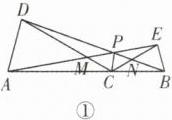
2.(1)①AE=DB ②30° 解析:①如图①,设AE与CD相交于点M,CE与BD相交于点N,$\because ∠ ACD = ∠ BCE$,$\therefore ∠ ACD+∠ DCE= ∠ BCE+∠ DCE$,$\therefore ∠ ACE= ∠ DCB$.在$△ ACE$和$△ DCB$中,
$\begin{cases} CA=CD, \\ ∠ ACE=∠ DCB, \\ CE=CB, \end{cases}$
$\therefore △ ACE ≌ △ DCB (\mathrm{SAS})$.
$\therefore AE=DB$.
②$\because △ ACE≌△ DCB$,$\therefore ∠ CAE = ∠ CDB$.$\because ∠ AMC = ∠ DMP$,$\therefore ∠ APD = ∠ ACD = 30°$.
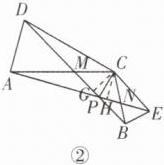
(2)猜想①②仍然成立.证明如下:如图②,$\because ∠ ACD=∠ BCE$,$\therefore ∠ ACD+∠ ACB= ∠ BCE+∠ ACB$,$\therefore ∠ DCB=∠ ACE$.又$\because CA = CD$,$CE = CB$,$\therefore △ ACE≌△ DCB(\mathrm{SAS})$.$\therefore AE = DB$, $∠ CAE=∠ CDB$.$\because ∠ AMP=∠ DMC$,$\therefore ∠ APD=∠ ACD=30°$.
(3)如图②,分别过点 C 作 $CH ⊥ AE$,垂足为 H,作 $CG ⊥ BD$,垂足为 G,$\because △ ACE≌△ DCB$,$\therefore AE=BD$.$\because S_{△ ACE}=S_{△ DCB}$,$\therefore CH=CG$,$\therefore △ CPG≌△ CPH$,$\therefore ∠ DPC=∠ EPC$.$\because ∠ APD=∠ BPE$,$∠ APC=∠ DPC+∠ APD$,$∠ BPC=∠ EPC+∠ BPE$,$\therefore ∠ APC=∠ BPC$.
