

 登录
登录
Ⅱ. 阅读了 Sarah 的一周安排表后,请以“My Week”为题,分享你的一周生活。
My Week
I have a week.
.
My Week
I have a week.
.
答案
示例:
标题横线处填:Happy
正文开头标题横线处填:Happy
第三处横线处填:happy
后续横线内容:From Monday to Friday, I go to school. I have Chinese, English, PE and art at school every day. I love PE lessons, I can play ping-pong with my classmates. On Saturday, I often go to the bookstore with my mother. On Sunday, I usually finish my homework and watch cartoons at home. I have a lot of fun this week.
标题横线处填:Happy
正文开头标题横线处填:Happy
第三处横线处填:happy
后续横线内容:From Monday to Friday, I go to school. I have Chinese, English, PE and art at school every day. I love PE lessons, I can play ping-pong with my classmates. On Saturday, I often go to the bookstore with my mother. On Sunday, I usually finish my homework and watch cartoons at home. I have a lot of fun this week.
解析
【分析】
本题为英语半命题写作题,解题思路如下:首先补全标题与开头的形容词,选择贴合一周生活的正向形容词(如Happy);接着围绕一周生活,分述上学日的校园活动、周末的具体安排,确保内容具体、语句通顺;最后总结一周的感受,使短文结构完整。
【解析】
写作步骤:1. 补全空缺:标题“My ______ Week”填“Happy”,开头“I have a ______ week.”填“happy”;2. 正文内容:先描述周一至周五的校园课程与喜爱的活动,再写周六、周日的休闲或学习安排,最后总结一周的感受,保证语句连贯、符合逻辑。
【答案】
标题横线处填:Happy
正文开头标题横线处填:Happy
第三处横线处填:happy
后续横线内容:From Monday to Friday, I go to school. I have Chinese, English, PE and art at school every day. I love PE lessons, I can play ping-pong with my classmates. On Saturday, I often go to the bookstore with my mother. On Sunday, I usually finish my homework and watch cartoons at home. I have a lot of fun this week.
【知识点】
英语半命题作文写作、英语书面表达
【点评】
本题考查学生的英语书面表达能力,要求围绕“我的一周生活”完成短文,内容贴近学生日常,需补全标题并组织连贯语句,难度适中,能有效考查学生的语言运用能力。
【难度系数】
0.6
本题为英语半命题写作题,解题思路如下:首先补全标题与开头的形容词,选择贴合一周生活的正向形容词(如Happy);接着围绕一周生活,分述上学日的校园活动、周末的具体安排,确保内容具体、语句通顺;最后总结一周的感受,使短文结构完整。
【解析】
写作步骤:1. 补全空缺:标题“My ______ Week”填“Happy”,开头“I have a ______ week.”填“happy”;2. 正文内容:先描述周一至周五的校园课程与喜爱的活动,再写周六、周日的休闲或学习安排,最后总结一周的感受,保证语句连贯、符合逻辑。
【答案】
标题横线处填:Happy
正文开头标题横线处填:Happy
第三处横线处填:happy
后续横线内容:From Monday to Friday, I go to school. I have Chinese, English, PE and art at school every day. I love PE lessons, I can play ping-pong with my classmates. On Saturday, I often go to the bookstore with my mother. On Sunday, I usually finish my homework and watch cartoons at home. I have a lot of fun this week.
【知识点】
英语半命题作文写作、英语书面表达
【点评】
本题考查学生的英语书面表达能力,要求围绕“我的一周生活”完成短文,内容贴近学生日常,需补全标题并组织连贯语句,难度适中,能有效考查学生的语言运用能力。
【难度系数】
0.6
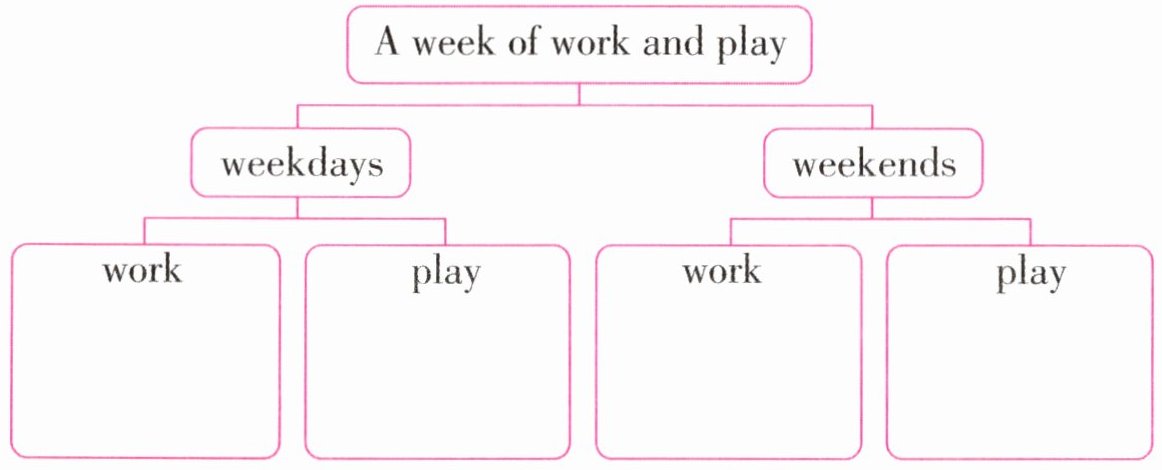
亲爱的同学,本单元我们学习了用英语描述一周的课程与活动,并探索了如何合理规划时间、做到劳逸结合。现在,请运用所学内容,完成下面的思维导图吧!
答案
参考填写内容:
1. weekdays-work:have Chinese, Maths, English lessons; do my homework after school
2. weekdays-play:play ping-pong with classmates; draw pictures in my free time
3. weekends-work:finish weekend homework; have the dancing lesson
4. weekends-play:go to the park with parents; watch cartoons at home
1. weekdays-work:have Chinese, Maths, English lessons; do my homework after school
2. weekdays-play:play ping-pong with classmates; draw pictures in my free time
3. weekends-work:finish weekend homework; have the dancing lesson
4. weekends-play:go to the park with parents; watch cartoons at home
解析
【分析】
首先明确思维导图的结构:主题为“一周的工作与玩乐”,分为工作日(weekdays)和周末(weekends)两大模块,每个模块又细分为“work(学习/任务)”和“play(休闲/活动)”两部分。解题时需结合所学的英语一周活动相关表达,对应各模块填写符合场景的内容:工作日的work对应日常学习任务(课程、作业),play对应工作日课余休闲;周末的work对应周末学习任务(作业、兴趣课),play对应周末休闲活动,确保内容符合逻辑且为所学的英语表达。
【解析】
根据思维导图结构,结合所学知识填写内容:
1. weekdays-work:填写日常学习相关内容,如have Chinese, Maths, English lessons; do my homework after school;
2. weekdays-play:填写工作日课余休闲活动,如play ping-pong with classmates; draw pictures in my free time;
3. weekends-work:填写周末学习任务,如finish weekend homework; have the dancing lesson;
4. weekends-play:填写周末休闲活动,如go to the park with parents; watch cartoons at home。
【答案】
1. weekdays-work:have Chinese, Maths, English lessons; do my homework after school
2. weekdays-play:play ping-pong with classmates; draw pictures in my free time
3. weekends-work:finish weekend homework; have the dancing lesson
4. weekends-play:go to the park with parents; watch cartoons at home
【知识点】
英语一周活动表达、词汇短语运用
【点评】
本题考察对一周活动的英语表达能力,同时引导学生树立劳逸结合的时间规划意识,题目贴近生活,难度适中。
【难度系数】
0.3
首先明确思维导图的结构:主题为“一周的工作与玩乐”,分为工作日(weekdays)和周末(weekends)两大模块,每个模块又细分为“work(学习/任务)”和“play(休闲/活动)”两部分。解题时需结合所学的英语一周活动相关表达,对应各模块填写符合场景的内容:工作日的work对应日常学习任务(课程、作业),play对应工作日课余休闲;周末的work对应周末学习任务(作业、兴趣课),play对应周末休闲活动,确保内容符合逻辑且为所学的英语表达。
【解析】
根据思维导图结构,结合所学知识填写内容:
1. weekdays-work:填写日常学习相关内容,如have Chinese, Maths, English lessons; do my homework after school;
2. weekdays-play:填写工作日课余休闲活动,如play ping-pong with classmates; draw pictures in my free time;
3. weekends-work:填写周末学习任务,如finish weekend homework; have the dancing lesson;
4. weekends-play:填写周末休闲活动,如go to the park with parents; watch cartoons at home。
【答案】
1. weekdays-work:have Chinese, Maths, English lessons; do my homework after school
2. weekdays-play:play ping-pong with classmates; draw pictures in my free time
3. weekends-work:finish weekend homework; have the dancing lesson
4. weekends-play:go to the park with parents; watch cartoons at home
【知识点】
英语一周活动表达、词汇短语运用
【点评】
本题考察对一周活动的英语表达能力,同时引导学生树立劳逸结合的时间规划意识,题目贴近生活,难度适中。
【难度系数】
0.3
我们都知道,劳逸结合是高效学习与快乐生活的关键。其他国家的学生是如何平衡课内学习和课外活动的呢?快来一起探索他们的时间管理小妙招吧!
Work and Play Around the World
How do children balance work and play in other countries(其他国家)?Let's see!
Germany(德国)
In Germany, most kids finish school at lunchtime. They do homework first, then play outside or learn music. Many children walk to school alone and join sports clubs. On weekends, families often ride bikes, visit castles(城堡) or go hiking in the forest.
Japan
In Japan, students usually finish school at around 3 p.m. But for many of them, the learning isn't over! They often join after-school clubs called "bukatsu". They play sports and make friends, learning teamwork(团队协作) through a lot of fun activities.
USA
School times are different. Students are at school from 8:30 a.m. to 3:00 p.m. They have maths, English, science and social studies. After school, kids play sports or join the Scouts(童子军). Weekends are for family, games or church.
任务一:根据短文内容,判断句子正(T)误(F)。
(
(
(
任务二:长时间学习后,你有哪些给大脑“充电”的小妙招?请分享给大家吧!
After studying for a long time, I usually .
I often .
Sometimes I .
Work and Play Around the World
How do children balance work and play in other countries(其他国家)?Let's see!
Germany(德国)
In Germany, most kids finish school at lunchtime. They do homework first, then play outside or learn music. Many children walk to school alone and join sports clubs. On weekends, families often ride bikes, visit castles(城堡) or go hiking in the forest.
Japan
In Japan, students usually finish school at around 3 p.m. But for many of them, the learning isn't over! They often join after-school clubs called "bukatsu". They play sports and make friends, learning teamwork(团队协作) through a lot of fun activities.
USA
School times are different. Students are at school from 8:30 a.m. to 3:00 p.m. They have maths, English, science and social studies. After school, kids play sports or join the Scouts(童子军). Weekends are for family, games or church.
任务一:根据短文内容,判断句子正(T)误(F)。
(
F
)1. In the USA, kids visit castles with their families at the weekend.(
T
)2. Many students in Japan often join clubs after school.(
T
)3. Most students finish school at lunchtime in Germany.任务二:长时间学习后,你有哪些给大脑“充电”的小妙招?请分享给大家吧!
After studying for a long time, I usually .
I often .
Sometimes I .
答案
任务一:1. F 2. T 3. T
解析
【分析】本题为英语阅读理解判断正误题,解题思路是:先明确每个判断句的核心信息,再回到原文对应国家的段落中定位相关内容,将判断句与原文信息逐一比对,信息一致则为正确(T),不一致则为错误(F);任务二为开放性表达题,结合自身实际填写合理的“充电”方式即可。
【解析】任务一:1. 题干描述“美国孩子周末和家人参观城堡”,原文德国部分提到“On weekends, families often ride bikes, visit castles or go hiking in the forest.”,可知参观城堡是德国家庭的周末活动,并非美国,故判断为F;2. 题干描述“日本很多学生放学后加入俱乐部”,原文日本部分提到“They often join after-school clubs called 'bukatsu'.”,与题干一致,故判断为T;3. 题干描述“德国大多数学生午餐时间放学”,原文德国部分提到“In Germany, most kids finish school at lunchtime.”,与题干一致,故判断为T。任务二为开放性试题,示例:After studying for a long time, I usually take a short break and listen to music. I often go for a walk outside. Sometimes I do some light stretching exercises.
【答案】任务一:1.F 2.T 3.T;任务二:take a short break and listen to music;go for a walk outside;do some light stretching exercises
【知识点】英语阅读理解、信息定位、判断正误
【点评】本题以不同国家学生的学习与课外活动为素材,既考查学生的英语阅读信息提取能力,又拓展了学生的国际视野,开放性问题还能锻炼学生的语言表达能力,整体难度适中。
【难度系数】0.6
【解析】任务一:1. 题干描述“美国孩子周末和家人参观城堡”,原文德国部分提到“On weekends, families often ride bikes, visit castles or go hiking in the forest.”,可知参观城堡是德国家庭的周末活动,并非美国,故判断为F;2. 题干描述“日本很多学生放学后加入俱乐部”,原文日本部分提到“They often join after-school clubs called 'bukatsu'.”,与题干一致,故判断为T;3. 题干描述“德国大多数学生午餐时间放学”,原文德国部分提到“In Germany, most kids finish school at lunchtime.”,与题干一致,故判断为T。任务二为开放性试题,示例:After studying for a long time, I usually take a short break and listen to music. I often go for a walk outside. Sometimes I do some light stretching exercises.
【答案】任务一:1.F 2.T 3.T;任务二:take a short break and listen to music;go for a walk outside;do some light stretching exercises
【知识点】英语阅读理解、信息定位、判断正误
【点评】本题以不同国家学生的学习与课外活动为素材,既考查学生的英语阅读信息提取能力,又拓展了学生的国际视野,开放性问题还能锻炼学生的语言表达能力,整体难度适中。
【难度系数】0.6
