

 登录
登录
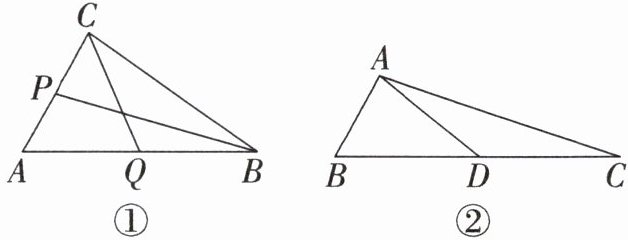
6. (1)理解定义:我们把两个面积相等但不全等的三角形叫作偏等积三角形.
如图①,在$△ ABC$中,$AB=10,AC=6,BC=9.$
①若$Q$是$AB$上一点,$AQ=5$,则$△ CAQ$与$△ CBQ$
②若$P$为$AC$上一点,当$AP$的长为
(2)运用定义:如图②,$D$为$BC$上一点,$△ ABD$与$△ ACD$是偏等积三角形,$AB=4$,$AC=12$,且线段$AD$的长为偶数,则$AD$的长为
(3)拓展加深:
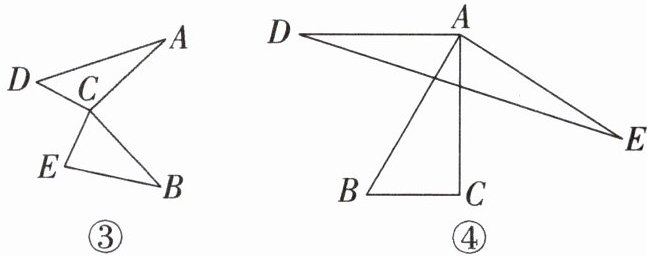
①如图③,$CA=CB,CD=CE,∠ ACB=∠ DCE=90^{\circ }(0^{\circ }<∠ BCE<90^{\circ }).$
求证:$△ ACD$与$△ BCE$是偏等积三角形;
②如图④,$△ ABC$与$△ ADE$是偏等积三角形,$AB=AE,AC=AD$,求证:$∠ BAC+∠ DAE=180^{\circ }.$
如图①,在$△ ABC$中,$AB=10,AC=6,BC=9.$
①若$Q$是$AB$上一点,$AQ=5$,则$△ CAQ$与$△ CBQ$
是
偏等积三角形(填"是"或"不是");②若$P$为$AC$上一点,当$AP$的长为
3
时,$△ ABP$与$△ CBP$是偏等积三角形.(2)运用定义:如图②,$D$为$BC$上一点,$△ ABD$与$△ ACD$是偏等积三角形,$AB=4$,$AC=12$,且线段$AD$的长为偶数,则$AD$的长为
6
.(3)拓展加深:
①如图③,$CA=CB,CD=CE,∠ ACB=∠ DCE=90^{\circ }(0^{\circ }<∠ BCE<90^{\circ }).$
求证:$△ ACD$与$△ BCE$是偏等积三角形;
②如图④,$△ ABC$与$△ ADE$是偏等积三角形,$AB=AE,AC=AD$,求证:$∠ BAC+∠ DAE=180^{\circ }.$
答案
(1) ①是 解析:$\because$ 点 Q 是 AB 上一点,且$AQ=5$,又$\because AB=$$10$,$\therefore AQ=\dfrac{1}{2}AB$,即 Q 为 AB 的中点,$\therefore CQ$为$△ ABC$的中线,$\therefore S_{△ ACQ}=S_{△ BCQ}$.$\because AQ=BQ$,$CQ=CQ$,$AC ≠ BC$,$\therefore △ ACQ$,$△ BCQ$不全等,$\therefore △ CAQ$与$△ CBQ$是偏等积三角形.
②3 解析:$\because$ 三角形的中线平分三角形的面积,$\therefore$ 当 BP 为$△ ABC$的中线时,$S_{△ ABP}=S_{△ CBP}$,且$△ ABP$与$△ CBP$不全等,$\therefore △ ABP$与$△ CBP$是偏等积三角形,此时$AP=CP=$$\dfrac{1}{2}AC=3$. 故当$AP=3$时,$△ ABP$与$△ CBP$是偏等积三角形.
(2)6 解析:如图①,过 C 作$CE // AB$交 AD 的延长线于 E.$\because △ ABD$与$△ ACD$是偏等积三角形,且$△ ABD$与$△ ACD$在BD,CD 边上的高相等,$\therefore BD=CD$,在$△ ECD$和$△ ABD$中,$\begin{cases} ∠ E= ∠ BAD,\\ ∠ EDC= ∠ ADB,\\ CD=BD,\\ \end{cases}$$\therefore △ ECD≌ △ ABD(\mathrm{AAS})$,$\therefore ED=AD$,$EC=AB=4$.$\because AC-EC < AE < AC+EC$,$AB=4$,$AC=12$,$\therefore 12-$$4 < 2AD < 12+4$,$\therefore 4 < AD < 8$.$\because$ 线段 AD 的长为偶数,$\therefore AD=6.$
(3) ①如图②,$\because ∠ ACB= ∠ DCE=90^{ \circ }$,$\therefore ∠ ACD+ ∠ BCE=$$180^{ \circ }$.$\because 0^{ \circ } < ∠ BCE < 90^{ \circ }$,$\therefore ∠ ACD > 90^{ \circ }$,$\therefore ∠ ACD ≠ ∠ BCE$.$\because CA=CB$,$CD=CE$,$\therefore △ ACD$与$△ BCE$不全等,作$BF ⊥ CE$于点 F,$AG ⊥ DC$交 DC 的延长线于点 G,则$∠ G= ∠ BFC=$$90^{ \circ }$.$\because ∠ ECG=180^{ \circ }- ∠ DCE=90^{ \circ }$,$\therefore ∠ ACG= ∠ BCF=90^{ \circ }-$$∠ BCG$,在$△ ACG$和$△ BCF$中,$\begin{cases} ∠ G= ∠ BFC,\\ ∠ ACG= ∠ BCF,\\ CA=CB,\\ \end{cases}$$\therefore △ ACG≌$$△ BCF(\mathrm{AAS})$,$\therefore AG=BF$,$\therefore \dfrac{1}{2}CD· AG=\dfrac{1}{2}CE· BF$,$\therefore △ ACD$与$△ BCE$面积相等,$\therefore △ ACD$与$△ BCE$是偏等积三角形.
②作$DK ⊥ AE$,交 EA 的延长线于点 K,作$CH ⊥ AB$于点 H,如图③,$\because △ ABC$与$△ ADE$是偏等积三角形,$\therefore \dfrac{1}{2}AE·$$DK=\dfrac{1}{2}AB· CH$.$\because AB=AE$,$\therefore DK=CH$,在$\mathrm{Rt} △ AKD$和$\mathrm{Rt} △ AHC$中,$\begin{cases} DK=CH,\\ AD=AC,\\ \end{cases}$$\therefore \mathrm{Rt} △ AKD≌ \mathrm{Rt} △ AHC$,$\therefore ∠ DAK=$$∠ BAC$,$\therefore ∠ BAC+ ∠ DAE= ∠ DAK+ ∠ DAE=180^{ \circ }.$
②3 解析:$\because$ 三角形的中线平分三角形的面积,$\therefore$ 当 BP 为$△ ABC$的中线时,$S_{△ ABP}=S_{△ CBP}$,且$△ ABP$与$△ CBP$不全等,$\therefore △ ABP$与$△ CBP$是偏等积三角形,此时$AP=CP=$$\dfrac{1}{2}AC=3$. 故当$AP=3$时,$△ ABP$与$△ CBP$是偏等积三角形.
(2)6 解析:如图①,过 C 作$CE // AB$交 AD 的延长线于 E.$\because △ ABD$与$△ ACD$是偏等积三角形,且$△ ABD$与$△ ACD$在BD,CD 边上的高相等,$\therefore BD=CD$,在$△ ECD$和$△ ABD$中,$\begin{cases} ∠ E= ∠ BAD,\\ ∠ EDC= ∠ ADB,\\ CD=BD,\\ \end{cases}$$\therefore △ ECD≌ △ ABD(\mathrm{AAS})$,$\therefore ED=AD$,$EC=AB=4$.$\because AC-EC < AE < AC+EC$,$AB=4$,$AC=12$,$\therefore 12-$$4 < 2AD < 12+4$,$\therefore 4 < AD < 8$.$\because$ 线段 AD 的长为偶数,$\therefore AD=6.$
(3) ①如图②,$\because ∠ ACB= ∠ DCE=90^{ \circ }$,$\therefore ∠ ACD+ ∠ BCE=$$180^{ \circ }$.$\because 0^{ \circ } < ∠ BCE < 90^{ \circ }$,$\therefore ∠ ACD > 90^{ \circ }$,$\therefore ∠ ACD ≠ ∠ BCE$.$\because CA=CB$,$CD=CE$,$\therefore △ ACD$与$△ BCE$不全等,作$BF ⊥ CE$于点 F,$AG ⊥ DC$交 DC 的延长线于点 G,则$∠ G= ∠ BFC=$$90^{ \circ }$.$\because ∠ ECG=180^{ \circ }- ∠ DCE=90^{ \circ }$,$\therefore ∠ ACG= ∠ BCF=90^{ \circ }-$$∠ BCG$,在$△ ACG$和$△ BCF$中,$\begin{cases} ∠ G= ∠ BFC,\\ ∠ ACG= ∠ BCF,\\ CA=CB,\\ \end{cases}$$\therefore △ ACG≌$$△ BCF(\mathrm{AAS})$,$\therefore AG=BF$,$\therefore \dfrac{1}{2}CD· AG=\dfrac{1}{2}CE· BF$,$\therefore △ ACD$与$△ BCE$面积相等,$\therefore △ ACD$与$△ BCE$是偏等积三角形.
②作$DK ⊥ AE$,交 EA 的延长线于点 K,作$CH ⊥ AB$于点 H,如图③,$\because △ ABC$与$△ ADE$是偏等积三角形,$\therefore \dfrac{1}{2}AE·$$DK=\dfrac{1}{2}AB· CH$.$\because AB=AE$,$\therefore DK=CH$,在$\mathrm{Rt} △ AKD$和$\mathrm{Rt} △ AHC$中,$\begin{cases} DK=CH,\\ AD=AC,\\ \end{cases}$$\therefore \mathrm{Rt} △ AKD≌ \mathrm{Rt} △ AHC$,$\therefore ∠ DAK=$$∠ BAC$,$\therefore ∠ BAC+ ∠ DAE= ∠ DAK+ ∠ DAE=180^{ \circ }.$
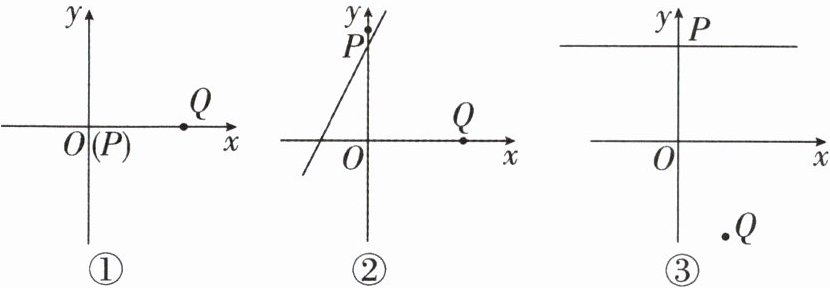
7. (2026·盐城期末)点$P$、点$P'$和点$Q$为平面直角坐标系中的三个点,给出如下定义:若$PQ=P'Q$,且$∠ PQP'=90°$,则称点$P'$为点$P$关于点$Q$的等垂点.
(1)已知点$Q$的坐标为$(4,0)$.
①如图①,若点$P$为原点,则点$P$关于点$Q$的等垂点$P'$的坐标为
②如图②,$P$为$y$轴上一点,且点$P$关于点$Q$的等垂点$P'$恰好在一次函数$y=2x+3$的图象上,求点$P'$的坐标.
(2)如图③,若点$Q$的坐标为$(1,-2)$,$P$为直线$y=2$上一点,$P$关于点$Q$的等垂点$P'$位于$y$轴右侧,连接$OP'$,$QP'$,请问$OP'+QP'$是否有最小值?若有,请求出最小值;若无,请说明理由.
视频讲题
(1)已知点$Q$的坐标为$(4,0)$.
①如图①,若点$P$为原点,则点$P$关于点$Q$的等垂点$P'$的坐标为
$(4,4)$或$(4,-4)$
;②如图②,$P$为$y$轴上一点,且点$P$关于点$Q$的等垂点$P'$恰好在一次函数$y=2x+3$的图象上,求点$P'$的坐标.
(2)如图③,若点$Q$的坐标为$(1,-2)$,$P$为直线$y=2$上一点,$P$关于点$Q$的等垂点$P'$位于$y$轴右侧,连接$OP'$,$QP'$,请问$OP'+QP'$是否有最小值?若有,请求出最小值;若无,请说明理由.
视频讲题
答案
(1) ①$(4,4)$或$(4,-4)$ 解析:作出点 P 关于点 Q 的等垂点,如图①,则$P'Q=PQ$.$\because$ 点 Q 的坐标为$(4,0)$,且点 P 为原点,$\therefore PQ=4$,$\therefore P'Q=PQ=4$.$\because P'Q ⊥ x$轴,$\therefore$ 点 P 关于点Q 的等垂点$P'$的坐标为$(4,4)$或$(4,-4).$
②Ⅰ. 当点 P 在 y 轴的正半轴上时,过点$P'$作$P'A ⊥ x$轴于点 A,如图②,$\because P'$恰好在一次函数$y=2x+3$的图象上,设$P'(m,2m+3)$,$\therefore P'A=-2m-3$.$\because$ 点 Q 的坐标为$(4,0)$,$\therefore OQ=4$.$\because PQ ⊥ P'Q$,$\therefore ∠ PQA+ ∠ AQP'=90^{ \circ }$.$\because ∠ AQP'+$$∠ AP'Q=90^{ \circ }$,$\therefore ∠ AP'Q= ∠ OQP$.
在$△ AP'Q$和$△ OQP$中,$\begin{cases} ∠ P'AQ= ∠ QOP=90^{ \circ },\\ ∠ AP'Q= ∠ OQP,\\ P'Q=QP,\\ \end{cases}$$\therefore △ AP'Q≌$$△ OQP(\mathrm{AAS})$,$\therefore AP'=OQ$,$\therefore -2m-3=4$,解得$m=-\dfrac{7}{2}$,$\therefore P'(-\dfrac{7}{2},-4).$
Ⅱ. 当点 P 在 y 轴的负半轴上时,过点$P'$作$P'B ⊥ x$轴于点 B,如图③,$\because P'$恰好在一次函数$y=2x+3$的图象上,设$P'(m,2m+3)$,$\therefore P'B=2m+3$. 同Ⅰ可得$△ P'BQ≌ △ QOP$,$\therefore P'B=OQ$,$\therefore 2m+3=4$,解得$m=\dfrac{1}{2}$,$\therefore P'(\dfrac{1}{2},4).$
综上,点$P'$的坐标为$(-\dfrac{7}{2},-4)$或$(\dfrac{1}{2},4).$
(2)$OP'+QP'$有最小值,最小值为$\sqrt{85}$. 过点 Q 作平行于 x轴的直线 a,交 y 轴于点 B,过点 P 作$PC ⊥$直线 a 于点 C,交x 轴于点 A,过点$P'$作$P'D ⊥$直线 a 于点 D,连接 PQ,如图④,则$OB=2$,$BQ=1$,$PA=2$,$AC=OB=2$,$\therefore PC=PA+AC=4$.$\because ∠ CPQ+ ∠ CQP=90^{ \circ }$,$∠ CQP+ ∠ P'QD=90^{ \circ }$,$\therefore ∠ CPQ=$$∠ DQP'$. 在$△ PCQ$和$△ QDP'$中,$\begin{cases} ∠ PCQ= ∠ QDP'=90^{ \circ },\\ ∠ CPQ= ∠ DQP',\\ PQ=QP',\\ \end{cases}$$\therefore △ PCQ≌ △ QDP'(\mathrm{AAS})$,$\therefore PC=QD=4$,$\therefore BD=BQ+QD=$$1+4=5$,$\therefore$ 点$P'$的横坐标为 5,即点$P'$在直线$x=5$上运动.作点 O 关于直线$x=5$的对称点$O'$,连接$O'Q$,交直线$x=5$于点$P''$,则$P''O=P''O'$.$\therefore$ 当点$P'$与点$P''$重合时,$OP'+QP'$的值最小,最小值为$O'Q$. 过点 Q 作$QE ⊥ OO'$于点 E,则$OE=$$1$,$QE=2$,$\therefore O'E=OO'-OE=10-1=9$,$\therefore O'Q=$$\sqrt{QE^{2}+O'E^{2}}=\sqrt{2^{2}+9^{2}}=\sqrt{85}$,$\therefore OP'+QP'$有最小值,最小值为$\sqrt{85}.$
②Ⅰ. 当点 P 在 y 轴的正半轴上时,过点$P'$作$P'A ⊥ x$轴于点 A,如图②,$\because P'$恰好在一次函数$y=2x+3$的图象上,设$P'(m,2m+3)$,$\therefore P'A=-2m-3$.$\because$ 点 Q 的坐标为$(4,0)$,$\therefore OQ=4$.$\because PQ ⊥ P'Q$,$\therefore ∠ PQA+ ∠ AQP'=90^{ \circ }$.$\because ∠ AQP'+$$∠ AP'Q=90^{ \circ }$,$\therefore ∠ AP'Q= ∠ OQP$.
在$△ AP'Q$和$△ OQP$中,$\begin{cases} ∠ P'AQ= ∠ QOP=90^{ \circ },\\ ∠ AP'Q= ∠ OQP,\\ P'Q=QP,\\ \end{cases}$$\therefore △ AP'Q≌$$△ OQP(\mathrm{AAS})$,$\therefore AP'=OQ$,$\therefore -2m-3=4$,解得$m=-\dfrac{7}{2}$,$\therefore P'(-\dfrac{7}{2},-4).$
Ⅱ. 当点 P 在 y 轴的负半轴上时,过点$P'$作$P'B ⊥ x$轴于点 B,如图③,$\because P'$恰好在一次函数$y=2x+3$的图象上,设$P'(m,2m+3)$,$\therefore P'B=2m+3$. 同Ⅰ可得$△ P'BQ≌ △ QOP$,$\therefore P'B=OQ$,$\therefore 2m+3=4$,解得$m=\dfrac{1}{2}$,$\therefore P'(\dfrac{1}{2},4).$
综上,点$P'$的坐标为$(-\dfrac{7}{2},-4)$或$(\dfrac{1}{2},4).$
(2)$OP'+QP'$有最小值,最小值为$\sqrt{85}$. 过点 Q 作平行于 x轴的直线 a,交 y 轴于点 B,过点 P 作$PC ⊥$直线 a 于点 C,交x 轴于点 A,过点$P'$作$P'D ⊥$直线 a 于点 D,连接 PQ,如图④,则$OB=2$,$BQ=1$,$PA=2$,$AC=OB=2$,$\therefore PC=PA+AC=4$.$\because ∠ CPQ+ ∠ CQP=90^{ \circ }$,$∠ CQP+ ∠ P'QD=90^{ \circ }$,$\therefore ∠ CPQ=$$∠ DQP'$. 在$△ PCQ$和$△ QDP'$中,$\begin{cases} ∠ PCQ= ∠ QDP'=90^{ \circ },\\ ∠ CPQ= ∠ DQP',\\ PQ=QP',\\ \end{cases}$$\therefore △ PCQ≌ △ QDP'(\mathrm{AAS})$,$\therefore PC=QD=4$,$\therefore BD=BQ+QD=$$1+4=5$,$\therefore$ 点$P'$的横坐标为 5,即点$P'$在直线$x=5$上运动.作点 O 关于直线$x=5$的对称点$O'$,连接$O'Q$,交直线$x=5$于点$P''$,则$P''O=P''O'$.$\therefore$ 当点$P'$与点$P''$重合时,$OP'+QP'$的值最小,最小值为$O'Q$. 过点 Q 作$QE ⊥ OO'$于点 E,则$OE=$$1$,$QE=2$,$\therefore O'E=OO'-OE=10-1=9$,$\therefore O'Q=$$\sqrt{QE^{2}+O'E^{2}}=\sqrt{2^{2}+9^{2}}=\sqrt{85}$,$\therefore OP'+QP'$有最小值,最小值为$\sqrt{85}.$
