

 登录
登录
A Listen and complete(听录音,根据对话内容补全表格,每空一词)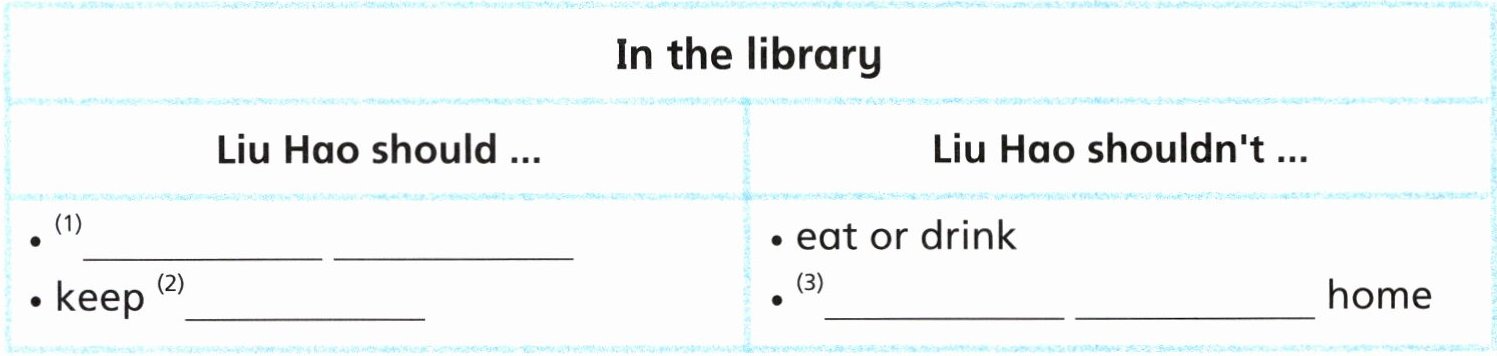
答案
1. walk slowly 2. quiet 3. take books
B
Judge and say(先判断人物行为是否安全,然后说一说)
参考句型:
In the park, we should/shouldn’t ...
Judge and say(先判断人物行为是否安全,然后说一说)
参考句型:
In the park, we should/shouldn’t ...
答案
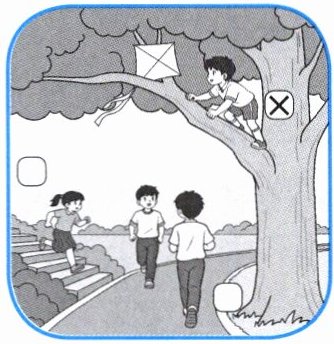
安全性判断:爬树行为打×,台阶上奔跑的行为打×,步道上平稳行走的行为打√。
参考描述:
1. In the park, we shouldn't climb the trees.
2. In the park, we shouldn't run on the steps.
3. In the park, we should walk carefully on the path.
参考描述:
1. In the park, we shouldn't climb the trees.
2. In the park, we shouldn't run on the steps.
3. In the park, we should walk carefully on the path.
解析
【分析】首先观察插图中的人物行为:①男孩爬树,属于危险行为;②女孩在台阶上奔跑,易摔倒,危险;③两名男孩在步道上平稳行走,安全。解题时需先判断每个行为的安全性,再结合参考句型“In the park, we should/shouldn’t ...”,分别描述不应该做的危险行为和应该做的安全行为。
【解析】1. 爬树是危险行为,不安全,对应表达:In the park, we shouldn't climb the trees.;2. 在台阶上奔跑易发生摔倒事故,不安全,对应表达:In the park, we shouldn't run on the steps.;3. 在步道上平稳行走是安全的,对应表达:In the park, we should walk carefully on the path.
【答案】安全性判断:爬树行为打×,台阶上奔跑的行为打×,步道上平稳行走的行为打√。参考描述:1. In the park, we shouldn't climb the trees. 2. In the park, we shouldn't run on the steps. 3. In the park, we should walk carefully on the path.
【知识点】安全行为判断、英语句型运用
【点评】本题结合公园生活场景,将安全常识与英语表达结合,既考查学生对安全行为的判断能力,又练习了指定句型,贴近生活,实用性强,有助于学生树立安全意识并提升英语运用能力。
【难度系数】0.8
【解析】1. 爬树是危险行为,不安全,对应表达:In the park, we shouldn't climb the trees.;2. 在台阶上奔跑易发生摔倒事故,不安全,对应表达:In the park, we shouldn't run on the steps.;3. 在步道上平稳行走是安全的,对应表达:In the park, we should walk carefully on the path.
【答案】安全性判断:爬树行为打×,台阶上奔跑的行为打×,步道上平稳行走的行为打√。参考描述:1. In the park, we shouldn't climb the trees. 2. In the park, we shouldn't run on the steps. 3. In the park, we should walk carefully on the path.
【知识点】安全行为判断、英语句型运用
【点评】本题结合公园生活场景,将安全常识与英语表达结合,既考查学生对安全行为的判断能力,又练习了指定句型,贴近生活,实用性强,有助于学生树立安全意识并提升英语运用能力。
【难度系数】0.8
C Read and choose(从方框中选出应答句,填序号,有一项多余)
A. Yes, we should.
B. We shouldn't sit down.
C. Because we may feel dizzy.
D. He shouldn't climb trees.
E. They should walk slowly and keep to the right.
F. She should go to a swimming pool.
(
(
(
(
(
A. Yes, we should.
B. We shouldn't sit down.
C. Because we may feel dizzy.
D. He shouldn't climb trees.
E. They should walk slowly and keep to the right.
F. She should go to a swimming pool.
(
C
) 1. Why shouldn't we sit down after running?(
A
) 2. Should we warm up before skipping?(
E
) 3. How should they walk on the wet floor?(
D
) 4. What shouldn't the boy do in the park?(
F
) 5. Where should Miss Lin swim?答案
1. C 2. A 3. E 4. D 5. F
解析
【分析】本题是英语情景匹配题,需根据每个问句的疑问词和内容,匹配对应的答句:第1题问原因,答句需说明理由;第2题是一般疑问句,答句用Yes/No回应;第3题问方式,答句需说明做法;第4题问某人不能做的事,答句对应该内容;第5题问地点,答句需说明地点。
【解析】1. 问句以Why开头,询问原因,C选项“Because we may feel dizzy.”(因为我们可能会头晕)是原因,符合,故1选C;2. 问句是Should开头的一般疑问句,A选项“Yes, we should.”是其肯定回答,符合,故2选A;3. 问句以How开头,询问方式,E选项“They should walk slowly and keep to the right.”说明行走方式,符合,故3选E;4. 问句问男孩不能做什么,D选项“He shouldn't climb trees.”说明男孩不能做的事,符合,故4选D;5. 问句以Where开头,询问地点,F选项“She should go to a swimming pool.”说明地点,符合,故5选F。
【答案】1.C 2.A 3.E 4.D 5.F
【知识点】英语情景交际、特殊疑问句应答、一般疑问句应答
【点评】本题考查英语情景对话中问句与答句的匹配,需掌握不同疑问词对应的答句类型,属于基础英语练习,难度不大。
【难度系数】0.7
【解析】1. 问句以Why开头,询问原因,C选项“Because we may feel dizzy.”(因为我们可能会头晕)是原因,符合,故1选C;2. 问句是Should开头的一般疑问句,A选项“Yes, we should.”是其肯定回答,符合,故2选A;3. 问句以How开头,询问方式,E选项“They should walk slowly and keep to the right.”说明行走方式,符合,故3选E;4. 问句问男孩不能做什么,D选项“He shouldn't climb trees.”说明男孩不能做的事,符合,故4选D;5. 问句以Where开头,询问地点,F选项“She should go to a swimming pool.”说明地点,符合,故5选F。
【答案】1.C 2.A 3.E 4.D 5.F
【知识点】英语情景交际、特殊疑问句应答、一般疑问句应答
【点评】本题考查英语情景对话中问句与答句的匹配,需掌握不同疑问词对应的答句类型,属于基础英语练习,难度不大。
【难度系数】0.7
D Read and write(用所给单词的适当形式填空)
1. Speak
2. Sam
3. Doing exercise in the morning is a
4. Look! The children are
5. Let's go to the new
1. Speak
slowly
(slow), please.2. Sam
is pushing
(push) Bobby on the swing now.3. Doing exercise in the morning is a
healthy
(health) habit.4. Look! The children are
warming
(warm) up on the sports ground.5. Let's go to the new
swimming
(swim) pool this afternoon.答案
1. slowly 2. is pushing 3. healthy 4. warming 5. swimming
解析
【分析】
本题考查英语中词性转换、时态及固定搭配的基础用法,需结合每个句子的语境和语法规则确定单词的适当形式:1. 修饰动词用副词;2. 由时间状语now判断用现在进行时;3. 修饰名词用形容词;4. 由句首Look判断用现在进行时;5. 固定搭配中用动名词作定语。
【解析】
1. 此处修饰动词speak,需用副词,slow的副词形式为slowly,故填slowly;
2. 根据时间状语now,句子用现在进行时,结构为“am/is/are + 现在分词”,主语Sam是第三人称单数,be动词用is,push的现在分词是pushing,故填is pushing;
3. 此处修饰名词habit,需用形容词,health的形容词形式为healthy,故填healthy;
4. 句首的Look提示句子用现在进行时,warm up的现在分词是warming,故填warming;
5. “游泳池”的固定表达为swimming pool,用动名词swimming作定语修饰pool,故填swimming。
【答案】
1. slowly 2. is pushing 3. healthy 4. warming 5. swimming
【知识点】
副词的使用、现在进行时、形容词转换
【点评】
本题考查小学英语基础的词性变化和时态运用,都是核心知识点,学生只要掌握基础规则即可解答,难度适中。
【难度系数】
0.6
本题考查英语中词性转换、时态及固定搭配的基础用法,需结合每个句子的语境和语法规则确定单词的适当形式:1. 修饰动词用副词;2. 由时间状语now判断用现在进行时;3. 修饰名词用形容词;4. 由句首Look判断用现在进行时;5. 固定搭配中用动名词作定语。
【解析】
1. 此处修饰动词speak,需用副词,slow的副词形式为slowly,故填slowly;
2. 根据时间状语now,句子用现在进行时,结构为“am/is/are + 现在分词”,主语Sam是第三人称单数,be动词用is,push的现在分词是pushing,故填is pushing;
3. 此处修饰名词habit,需用形容词,health的形容词形式为healthy,故填healthy;
4. 句首的Look提示句子用现在进行时,warm up的现在分词是warming,故填warming;
5. “游泳池”的固定表达为swimming pool,用动名词swimming作定语修饰pool,故填swimming。
【答案】
1. slowly 2. is pushing 3. healthy 4. warming 5. swimming
【知识点】
副词的使用、现在进行时、形容词转换
【点评】
本题考查小学英语基础的词性变化和时态运用,都是核心知识点,学生只要掌握基础规则即可解答,难度适中。
【难度系数】
0.6
