

 登录
登录
9. 如图15.1-14,点D,E在△ABC的边BC上,AD=AE,BD=CE,求证AB=AC. 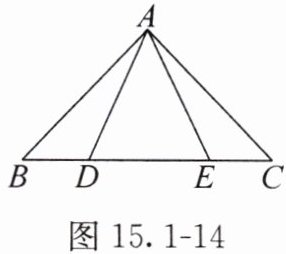
答案
9. 证明:过点$ A $作$ AF⊥ DE $,垂足为$ F $,如图。
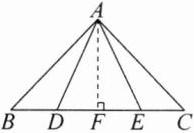
$\therefore∠ AFD=∠ AFE=90°.$
在$\mathrm{Rt}△ ADF$和$\mathrm{Rt}△ AEF$中,$\begin{cases} AD=AE,\\ AF=AF, \end{cases}$
$\therefore\mathrm{Rt}△ ADF≌\mathrm{Rt}△ AEF\ (\mathrm{HL}).$
$\therefore DF=EF.$
$\because BD=CE,$
$\therefore BD+DF=CE+EF$,即$BF=CF.$
$\because AF⊥ DE,$
$\therefore AF$垂直平分$BC.$ $\therefore AB=AC.$
解析
【分析】
要证明AB=AC,可证明点A在BC的垂直平分线上,即证AF垂直且平分BC。已知AD=AE,△ADE是等腰三角形,根据等腰三角形三线合一的性质,过A作AF⊥DE,可得DF=EF,再结合已知BD=CE,可推导出BF=CF,进而得到AF是BC的垂直平分线,最后利用垂直平分线的性质即可得出AB=AC。
【解析】
证明:过点$ A $作$ AF⊥ DE $,垂足为$ F $,如图。
$\therefore∠ AFD=∠ AFE=90°.$
在$\mathrm{Rt}△ ADF$和$\mathrm{Rt}△ AEF$中,$\begin{cases} AD=AE,\\ AF=AF, \end{cases}$
$\therefore\mathrm{Rt}△ ADF≌\mathrm{Rt}△ AEF\ (\mathrm{HL}).$
$\therefore DF=EF.$
$\because BD=CE,$
$\therefore BD+DF=CE+EF$,即$BF=CF.$
$\because AF⊥ DE,$
$\therefore AF$垂直平分$BC.$
$\therefore AB=AC.$
【答案】
证明:过点$ A $作$ AF⊥ DE $,垂足为$ F $,如图。
$\therefore∠ AFD=∠ AFE=90°.$
在$\mathrm{Rt}△ ADF$和$\mathrm{Rt}△ AEF$中,$\begin{cases} AD=AE,\\ AF=AF, \end{cases}$
$\therefore\mathrm{Rt}△ ADF≌\mathrm{Rt}△ AEF\ (\mathrm{HL}).$
$\therefore DF=EF.$
$\because BD=CE,$
$\therefore BD+DF=CE+EF$,即$BF=CF.$
$\because AF⊥ DE,$
$\therefore AF$垂直平分$BC.$ $\therefore AB=AC.$
【知识点】
等腰三角形性质,HL全等判定,线段垂直平分线性质
【点评】
本题是典型的几何证明题,通过作等腰三角形底边上的高这一常用辅助线,结合等腰三角形三线合一、全等三角形的性质推导线段关系,最终利用线段垂直平分线的性质得到结论,需要熟练掌握相关性质定理,学会构造合适的辅助线简化证明过程。
【难度系数】
0.7
要证明AB=AC,可证明点A在BC的垂直平分线上,即证AF垂直且平分BC。已知AD=AE,△ADE是等腰三角形,根据等腰三角形三线合一的性质,过A作AF⊥DE,可得DF=EF,再结合已知BD=CE,可推导出BF=CF,进而得到AF是BC的垂直平分线,最后利用垂直平分线的性质即可得出AB=AC。
【解析】
证明:过点$ A $作$ AF⊥ DE $,垂足为$ F $,如图。
$\therefore∠ AFD=∠ AFE=90°.$
在$\mathrm{Rt}△ ADF$和$\mathrm{Rt}△ AEF$中,$\begin{cases} AD=AE,\\ AF=AF, \end{cases}$
$\therefore\mathrm{Rt}△ ADF≌\mathrm{Rt}△ AEF\ (\mathrm{HL}).$
$\therefore DF=EF.$
$\because BD=CE,$
$\therefore BD+DF=CE+EF$,即$BF=CF.$
$\because AF⊥ DE,$
$\therefore AF$垂直平分$BC.$
$\therefore AB=AC.$
【答案】
证明:过点$ A $作$ AF⊥ DE $,垂足为$ F $,如图。
$\therefore∠ AFD=∠ AFE=90°.$
在$\mathrm{Rt}△ ADF$和$\mathrm{Rt}△ AEF$中,$\begin{cases} AD=AE,\\ AF=AF, \end{cases}$
$\therefore\mathrm{Rt}△ ADF≌\mathrm{Rt}△ AEF\ (\mathrm{HL}).$
$\therefore DF=EF.$
$\because BD=CE,$
$\therefore BD+DF=CE+EF$,即$BF=CF.$
$\because AF⊥ DE,$
$\therefore AF$垂直平分$BC.$ $\therefore AB=AC.$
【知识点】
等腰三角形性质,HL全等判定,线段垂直平分线性质
【点评】
本题是典型的几何证明题,通过作等腰三角形底边上的高这一常用辅助线,结合等腰三角形三线合一、全等三角形的性质推导线段关系,最终利用线段垂直平分线的性质得到结论,需要熟练掌握相关性质定理,学会构造合适的辅助线简化证明过程。
【难度系数】
0.7
10. 如图15.1-15,P是∠AOB内一点,OP=5 cm,点P与点C关于射线OA对称,点P与点D关于射线OB对称,连接CD,交OA于点E,交OB于点F,连接PE,PF,当△PEF的周长是5 cm时,∠AOB的度数是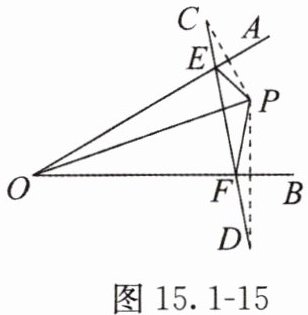
30°
。答案
10. $30°$
解析
【分析】
解题时先从轴对称的性质入手,首先明确对称轴是对应点连线的垂直平分线,可得对应线段相等、对应角相等,先将△PEF的周长转化为CD的长度;再结合OP的长度推出△OCD三边的长度关系,判定△OCD的形状得到∠COD的度数;最后根据对称得到的等角关系,推导得出∠AOB的度数。
【解析】
∵点P与点C关于射线OA对称
∴OA垂直平分线段PC,可得$PE=CE$,$OC=OP=5\mathrm{cm}$,$∠ AOC=∠ AOP$
同理,点P与点D关于射线OB对称
∴OB垂直平分线段PD,可得$PF=FD$,$OD=OP=5\mathrm{cm}$,$∠ BOD=∠ BOP$
$△ PEF$的周长$=PE+EF+PF=CE+EF+FD=CD$,已知$△ PEF$周长为$5\mathrm{cm}$,因此$CD=5\mathrm{cm}$
由此可得$OC=OD=CD=5\mathrm{cm}$,即$△ OCD$为等边三角形,$∠ COD=60°$
又$\because ∠ COD=∠ AOC+∠ AOP+∠ BOP+∠ BOD=2(∠ AOP+∠ BOP)=2∠ AOB$
$\therefore ∠ AOB=\frac{1}{2}∠ COD=\frac{1}{2}×60°=30°$
【答案】
$30°$
【知识点】
轴对称的性质,等边三角形的判定与性质,线段垂直平分线的性质
【点评】
本题核心是利用轴对称的性质实现线段和角度的转化,解题的关键是将△PEF的周长转化为CD的长度,再结合等边三角形的性质求解角度,体现了转化思想在几何题中的应用。
【难度系数】
0.6
解题时先从轴对称的性质入手,首先明确对称轴是对应点连线的垂直平分线,可得对应线段相等、对应角相等,先将△PEF的周长转化为CD的长度;再结合OP的长度推出△OCD三边的长度关系,判定△OCD的形状得到∠COD的度数;最后根据对称得到的等角关系,推导得出∠AOB的度数。
【解析】
∵点P与点C关于射线OA对称
∴OA垂直平分线段PC,可得$PE=CE$,$OC=OP=5\mathrm{cm}$,$∠ AOC=∠ AOP$
同理,点P与点D关于射线OB对称
∴OB垂直平分线段PD,可得$PF=FD$,$OD=OP=5\mathrm{cm}$,$∠ BOD=∠ BOP$
$△ PEF$的周长$=PE+EF+PF=CE+EF+FD=CD$,已知$△ PEF$周长为$5\mathrm{cm}$,因此$CD=5\mathrm{cm}$
由此可得$OC=OD=CD=5\mathrm{cm}$,即$△ OCD$为等边三角形,$∠ COD=60°$
又$\because ∠ COD=∠ AOC+∠ AOP+∠ BOP+∠ BOD=2(∠ AOP+∠ BOP)=2∠ AOB$
$\therefore ∠ AOB=\frac{1}{2}∠ COD=\frac{1}{2}×60°=30°$
【答案】
$30°$
【知识点】
轴对称的性质,等边三角形的判定与性质,线段垂直平分线的性质
【点评】
本题核心是利用轴对称的性质实现线段和角度的转化,解题的关键是将△PEF的周长转化为CD的长度,再结合等边三角形的性质求解角度,体现了转化思想在几何题中的应用。
【难度系数】
0.6
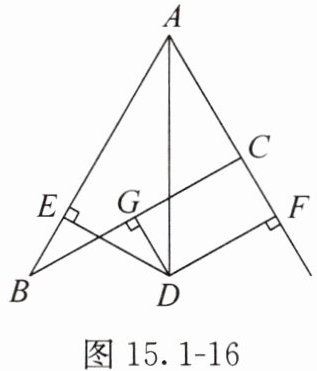
11. 如图15.1-16,在$△ ABC$中,$AB=8$,$AC=4$,$G$为$BC$的中点,$DG⊥ BC$交$∠ BAC$的平分线于点$D$,$DE⊥ AB$,垂足为$E$,$DF⊥ AC$交$AC$的延长线于点$F$。
(1)求证$BE=CF$;
(2)求$AE$的长。
(1)求证$BE=CF$;
(2)求$AE$的长。
答案
11. (1)证明:连接$DC$,$DB$(图略)。
$\because DG⊥ BC$,$G$为$BC$的中点,
$\therefore DB=DC.$
$\because AD$为$∠ BAC$的平分线,$DE⊥ AB$,$DF⊥ AC$,
$\therefore DE=DF$,$∠ AED=∠ BED=∠ AFD=90°.$
在$\mathrm{Rt}△ DBE$和$\mathrm{Rt}△ DCF$中,$\begin{cases} DB=DC,\\ DE=DF, \end{cases}$
$\therefore\mathrm{Rt}△ DBE≌\mathrm{Rt}△ DCF\ (\mathrm{HL}).$
$\therefore BE=CF.$
(2)解:在$\mathrm{Rt}△ ADE$和$\mathrm{Rt}△ ADF$中,
$\begin{cases} AD=AD,\\ DE=DF, \end{cases}$
$\therefore\mathrm{Rt}△ ADE≌\mathrm{Rt}△ ADF\ (\mathrm{HL}).$
$\therefore AE=AF.$
$\therefore AC+CF=AB-BE.$
$\because AB=8,\ AC=4,$
$\therefore 4+BE=8-BE.\ \therefore BE=2.$
$\therefore AE=AB-BE=8-2=6.$
$\because DG⊥ BC$,$G$为$BC$的中点,
$\therefore DB=DC.$
$\because AD$为$∠ BAC$的平分线,$DE⊥ AB$,$DF⊥ AC$,
$\therefore DE=DF$,$∠ AED=∠ BED=∠ AFD=90°.$
在$\mathrm{Rt}△ DBE$和$\mathrm{Rt}△ DCF$中,$\begin{cases} DB=DC,\\ DE=DF, \end{cases}$
$\therefore\mathrm{Rt}△ DBE≌\mathrm{Rt}△ DCF\ (\mathrm{HL}).$
$\therefore BE=CF.$
(2)解:在$\mathrm{Rt}△ ADE$和$\mathrm{Rt}△ ADF$中,
$\begin{cases} AD=AD,\\ DE=DF, \end{cases}$
$\therefore\mathrm{Rt}△ ADE≌\mathrm{Rt}△ ADF\ (\mathrm{HL}).$
$\therefore AE=AF.$
$\therefore AC+CF=AB-BE.$
$\because AB=8,\ AC=4,$
$\therefore 4+BE=8-BE.\ \therefore BE=2.$
$\therefore AE=AB-BE=8-2=6.$
解析
【分析】
(1)要证明$BE=CF$,可通过证明两条线段所在的直角三角形全等实现。首先连接$DB$、$DC$,根据线段垂直平分线的性质可得$DB=DC$;再根据角平分线的性质可得$DE=DF$,即可利用HL证明$\mathrm{Rt}△DBE≌\mathrm{Rt}△DCF$,从而得到$BE=CF$。
(2)要求$AE$的长,先利用HL证明$\mathrm{Rt}△ADE≌\mathrm{Rt}△ADF$,得到$AE=AF$,再结合$AF=AC+CF$、$AE=AB-BE$,且$BE=CF$,将已知的$AB$、$AC$长度代入,建立关于$BE$的方程求出$BE$,即可计算$AE$的长度。
【解析】
(1)证明:连接$DC$,$DB$。
$\because DG⊥ BC$,$G$为$BC$的中点,
$\therefore DG$是$BC$的垂直平分线,
$\therefore DB=DC$。
$\because AD$为$∠ BAC$的平分线,$DE⊥ AB$,$DF⊥ AC$,
$\therefore DE=DF$,$∠ BED=∠ CFD=90°$。
在$\mathrm{Rt}△ DBE$和$\mathrm{Rt}△ DCF$中,
$\begin{cases} DB=DC\\ DE=DF \end{cases}$
$\therefore\mathrm{Rt}△ DBE≌\mathrm{Rt}△ DCF\ (\mathrm{HL})$,
$\therefore BE=CF$。
(2)解:在$\mathrm{Rt}△ ADE$和$\mathrm{Rt}△ ADF$中,
$\begin{cases} AD=AD\\ DE=DF \end{cases}$
$\therefore\mathrm{Rt}△ ADE≌\mathrm{Rt}△ ADF\ (\mathrm{HL})$,
$\therefore AE=AF$。
$\because AF=AC+CF$,$AE=AB-BE$,且$BE=CF$,
$\therefore AC+BE=AB-BE$,
将$AB=8$,$AC=4$代入得:
$4+BE=8-BE$,
解得$BE=2$,
$\therefore AE=AB-BE=8-2=6$。
【答案】
(1)$BE=CF$得证;
(2)$AE$的长为$\boldsymbol{6}$。
【知识点】
角平分线的性质;线段垂直平分线的性质;全等三角形的判定与性质
【点评】
本题属于几何综合题,解题的关键是合理添加辅助线构造全等三角形,结合角平分线、线段垂直平分线的性质得到相等的边,再利用全等三角形的性质转化线段关系,通过建立方程求解线段长度。
【难度系数】
0.7
(1)要证明$BE=CF$,可通过证明两条线段所在的直角三角形全等实现。首先连接$DB$、$DC$,根据线段垂直平分线的性质可得$DB=DC$;再根据角平分线的性质可得$DE=DF$,即可利用HL证明$\mathrm{Rt}△DBE≌\mathrm{Rt}△DCF$,从而得到$BE=CF$。
(2)要求$AE$的长,先利用HL证明$\mathrm{Rt}△ADE≌\mathrm{Rt}△ADF$,得到$AE=AF$,再结合$AF=AC+CF$、$AE=AB-BE$,且$BE=CF$,将已知的$AB$、$AC$长度代入,建立关于$BE$的方程求出$BE$,即可计算$AE$的长度。
【解析】
(1)证明:连接$DC$,$DB$。
$\because DG⊥ BC$,$G$为$BC$的中点,
$\therefore DG$是$BC$的垂直平分线,
$\therefore DB=DC$。
$\because AD$为$∠ BAC$的平分线,$DE⊥ AB$,$DF⊥ AC$,
$\therefore DE=DF$,$∠ BED=∠ CFD=90°$。
在$\mathrm{Rt}△ DBE$和$\mathrm{Rt}△ DCF$中,
$\begin{cases} DB=DC\\ DE=DF \end{cases}$
$\therefore\mathrm{Rt}△ DBE≌\mathrm{Rt}△ DCF\ (\mathrm{HL})$,
$\therefore BE=CF$。
(2)解:在$\mathrm{Rt}△ ADE$和$\mathrm{Rt}△ ADF$中,
$\begin{cases} AD=AD\\ DE=DF \end{cases}$
$\therefore\mathrm{Rt}△ ADE≌\mathrm{Rt}△ ADF\ (\mathrm{HL})$,
$\therefore AE=AF$。
$\because AF=AC+CF$,$AE=AB-BE$,且$BE=CF$,
$\therefore AC+BE=AB-BE$,
将$AB=8$,$AC=4$代入得:
$4+BE=8-BE$,
解得$BE=2$,
$\therefore AE=AB-BE=8-2=6$。
【答案】
(1)$BE=CF$得证;
(2)$AE$的长为$\boldsymbol{6}$。
【知识点】
角平分线的性质;线段垂直平分线的性质;全等三角形的判定与性质
【点评】
本题属于几何综合题,解题的关键是合理添加辅助线构造全等三角形,结合角平分线、线段垂直平分线的性质得到相等的边,再利用全等三角形的性质转化线段关系,通过建立方程求解线段长度。
【难度系数】
0.7
