

 登录
登录
十三、阅读理解。(共17分)
(A)
There are lots of old things in Amy's home. She wants to make them useful. Recycling is a good idea. There are many other things she can do with them. There are many old clothes and old boxes in her bedroom. She wants to use them to make a bed for her cat. In her father's study, there are some old newspapers. She can use them to make cards. There are some old bottles in the living room. She wants to clean them and put some flowers in them. The old paper bags are on the floor. These bags look pretty. She thinks she can make book covers(封面) with them in the study. Many old things are useful. She can find a new home for them and make her home clean and beautiful.
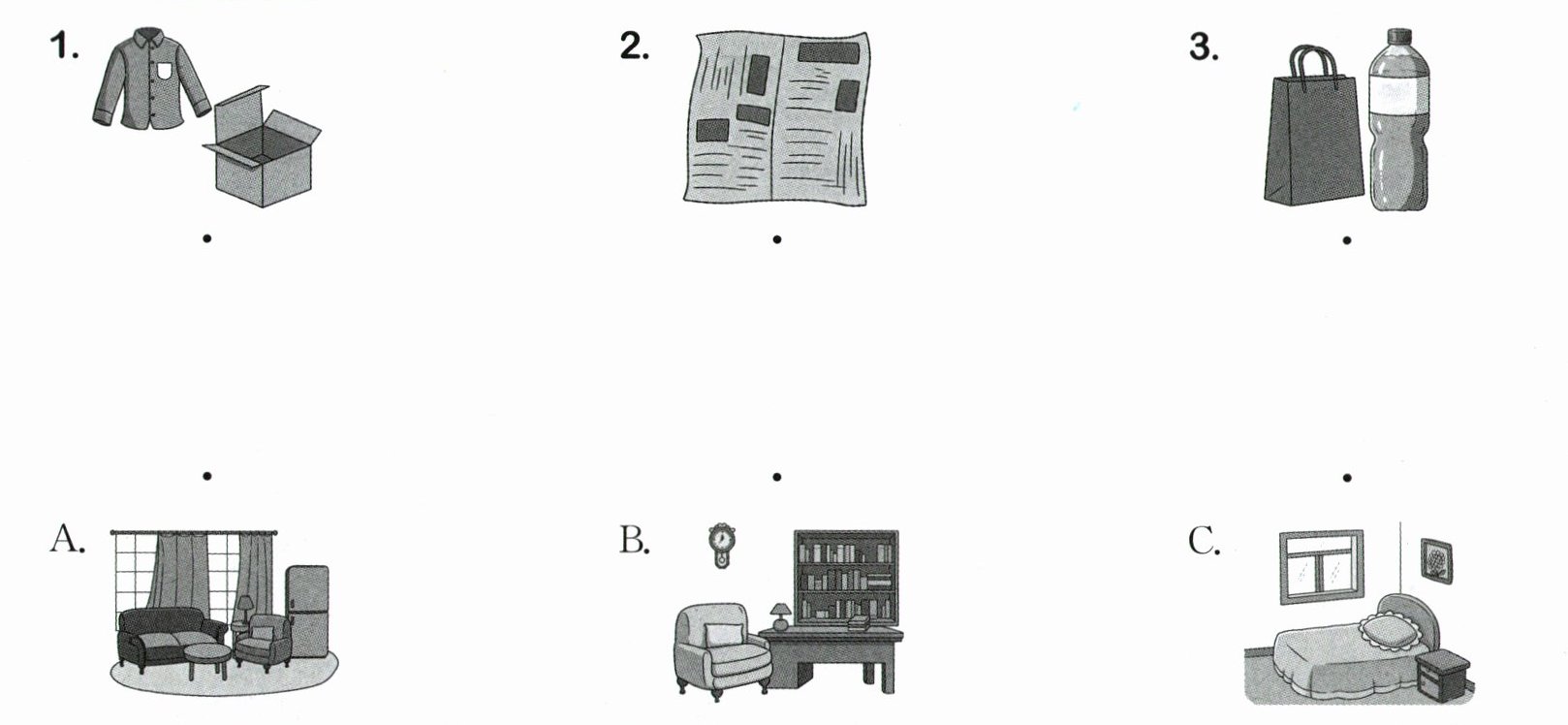
(一)信息匹配 阅读短文,将物品与所对应的房间连线。(每小题1分,共3分)
(二)阅读短文,回答问题。(每小题2分,共4分)
1. What can Amy use to make book covers?
2. Do you want to recycle the old things? Why?
(A)
There are lots of old things in Amy's home. She wants to make them useful. Recycling is a good idea. There are many other things she can do with them. There are many old clothes and old boxes in her bedroom. She wants to use them to make a bed for her cat. In her father's study, there are some old newspapers. She can use them to make cards. There are some old bottles in the living room. She wants to clean them and put some flowers in them. The old paper bags are on the floor. These bags look pretty. She thinks she can make book covers(封面) with them in the study. Many old things are useful. She can find a new home for them and make her home clean and beautiful.
(一)信息匹配 阅读短文,将物品与所对应的房间连线。(每小题1分,共3分)
(二)阅读短文,回答问题。(每小题2分,共4分)
1. What can Amy use to make book covers?
The old paper bags.
2. Do you want to recycle the old things? Why?
Yes. Because recycling is good for our life.(答案不唯一)
答案
(A)(一) 1~3. CBA
(二) 1. The old paper bags. 2. Yes. Because recycling is good for our life.(答案不唯一)
(二) 1. The old paper bags. 2. Yes. Because recycling is good for our life.(答案不唯一)
解析
【分析】
首先处理信息匹配题:先阅读短文,定位每个物品对应的房间:1. 旧衣服和旧盒子在Amy的卧室(bedroom),对应插图C(卧室场景);2. 旧报纸在父亲的书房(study),对应插图B(书房场景);3. 旧纸袋和旧瓶子,旧纸袋在客厅(living room),对应插图A(客厅场景),因此物品与房间的匹配为1-C、2-B、3-A,即1~3对应CBA。再处理回答问题:第1题需定位做书皮的材料,找到原文中关于book covers的描述;第2题是开放性问题,结合短文提到回收旧物有用,给出合理回答即可。
【解析】
(一)信息匹配:
1. 物品是旧衣服和旧盒子,短文提到“there are many old clothes and old boxes in her bedroom”,对应卧室插图C;
2. 物品是旧报纸,短文提到“there are some old newspapers in the father's study”,对应书房插图B;
3. 物品是旧纸袋和旧瓶子,短文提到“The old paper bags are on the floor... She thinks she can make book covers with them in the study”,旧瓶子在客厅,对应客厅插图A;因此匹配结果为1~3.CBA。
(二)回答问题:
1. 定位原文中“make book covers”的相关内容,可知Amy用旧纸袋做书皮,故答案为The old paper bags.
2. 开放性问题,结合短文提到回收旧物有用、能让家干净漂亮,可回答Yes. Because recycling is good for our life.(答案不唯一)
【答案】
(A)(一) 1~3. CBA
(二) 1. The old paper bags.
2. Yes. Because recycling is good for our life.(答案不唯一)
【知识点】
阅读理解(细节理解、信息匹配)
【点评】
本题通过短文考查学生的阅读理解能力,涵盖信息匹配、细节查找与开放性表达,难度适中,能有效检验学生对短文内容的理解与运用。
【难度系数】
0.6
首先处理信息匹配题:先阅读短文,定位每个物品对应的房间:1. 旧衣服和旧盒子在Amy的卧室(bedroom),对应插图C(卧室场景);2. 旧报纸在父亲的书房(study),对应插图B(书房场景);3. 旧纸袋和旧瓶子,旧纸袋在客厅(living room),对应插图A(客厅场景),因此物品与房间的匹配为1-C、2-B、3-A,即1~3对应CBA。再处理回答问题:第1题需定位做书皮的材料,找到原文中关于book covers的描述;第2题是开放性问题,结合短文提到回收旧物有用,给出合理回答即可。
【解析】
(一)信息匹配:
1. 物品是旧衣服和旧盒子,短文提到“there are many old clothes and old boxes in her bedroom”,对应卧室插图C;
2. 物品是旧报纸,短文提到“there are some old newspapers in the father's study”,对应书房插图B;
3. 物品是旧纸袋和旧瓶子,短文提到“The old paper bags are on the floor... She thinks she can make book covers with them in the study”,旧瓶子在客厅,对应客厅插图A;因此匹配结果为1~3.CBA。
(二)回答问题:
1. 定位原文中“make book covers”的相关内容,可知Amy用旧纸袋做书皮,故答案为The old paper bags.
2. 开放性问题,结合短文提到回收旧物有用、能让家干净漂亮,可回答Yes. Because recycling is good for our life.(答案不唯一)
【答案】
(A)(一) 1~3. CBA
(二) 1. The old paper bags.
2. Yes. Because recycling is good for our life.(答案不唯一)
【知识点】
阅读理解(细节理解、信息匹配)
【点评】
本题通过短文考查学生的阅读理解能力,涵盖信息匹配、细节查找与开放性表达,难度适中,能有效检验学生对短文内容的理解与运用。
【难度系数】
0.6
(B) 本土文化
Nanjing is a time-honoured city in Jiangsu. It has wonderful traditional arts and special local goods. People here are good at giving old things new meanings and new uses.
Nanjing paper-cutting is a well-known folk art. Long ago, families stuck red paper-cuts on windows only during the Spring Festival. Now creative artists put these lovely patterns on scarves, bags and tableware. They become popular gifts for tourists.
Yuhua stones are another symbol of Nanjing. People loved collecting these beautiful stones for fun hundreds of years ago. Today, designers make them into small decorations. They show the natural beauty of our city.
Even local food gets new looks. Famous salted duck is made into new-style snacks. More young people start to know and love our traditional food culture.
Old things connect us with history. Using them in new ways lets our local culture go on for a long time.
(一)阅读短文,选择正确的答案。(每小题1.5分,共6分)
(
A. Only at the Spring Festival. B. All year round.
C. Every holiday.
(
A. Red paper for writing. B. New scarves and bags only.
C. Things with paper-cut patterns.
(
A. Only for collecting. B. As small decorations.
C. As building materials.
(
A. To make the food cheaper.
B. To let young people learn local food culture.
C. To make the duck taste different.
(二)阅读短文,回答问题。(每小题2分,共4分)
1. Besides local food, what two local treasures does the passage talk about?
2. What is the main idea of the passage?
Nanjing is a time-honoured city in Jiangsu. It has wonderful traditional arts and special local goods. People here are good at giving old things new meanings and new uses.
Nanjing paper-cutting is a well-known folk art. Long ago, families stuck red paper-cuts on windows only during the Spring Festival. Now creative artists put these lovely patterns on scarves, bags and tableware. They become popular gifts for tourists.
Yuhua stones are another symbol of Nanjing. People loved collecting these beautiful stones for fun hundreds of years ago. Today, designers make them into small decorations. They show the natural beauty of our city.
Even local food gets new looks. Famous salted duck is made into new-style snacks. More young people start to know and love our traditional food culture.
Old things connect us with history. Using them in new ways lets our local culture go on for a long time.
(一)阅读短文,选择正确的答案。(每小题1.5分,共6分)
(
A
)1. In the past, when did people use paper-cuts?A. Only at the Spring Festival. B. All year round.
C. Every holiday.
(
C
)2. What do tourists like to buy now?A. Red paper for writing. B. New scarves and bags only.
C. Things with paper-cut patterns.
(
B
)3. What are Yuhua stones used today?A. Only for collecting. B. As small decorations.
C. As building materials.
(
B
)4. Why do people make new-style snacks from salted duck?A. To make the food cheaper.
B. To let young people learn local food culture.
C. To make the duck taste different.
(二)阅读短文,回答问题。(每小题2分,共4分)
1. Besides local food, what two local treasures does the passage talk about?
Nanjing paper-cutting and Yuhua stones.
2. What is the main idea of the passage?
The passage talks about how old things in Nanjing get new uses, and how this helps keep local culture alive.
答案
(B)(一) 1. A 解析:文中提到“Long ago, families stuck red paper-cuts on windows only during the Spring Festival.”,说明过去只在春节使用剪纸。 2. C 解析:文中提到“Now creative artists put these lovely patterns on scarves, bags and tableware. They become popular gifts for tourists.”,说明游客喜欢买带有剪纸图案的物品。 3. B 4. B 解析:文中提到“More young people start to know and love our traditional food culture.”,说明将盐水鸭做成新式零食是为了让年轻人了解本土饮食文化。
(二) 1. Nanjing paper-cutting and Yuhua stones. 2. The passage talks about how old things in Nanjing get new uses, and how this helps keep local culture alive.
(二) 1. Nanjing paper-cutting and Yuhua stones. 2. The passage talks about how old things in Nanjing get new uses, and how this helps keep local culture alive.
解析
【分析】
这是英语阅读理解题目,解题时需先通读全文把握主旨,再针对每个问题的关键词,回到原文定位对应语句,通过对比原文信息与选项或问题要求得出正确答案;回答类题目需准确提取原文相关信息,整理成规范答案。
【解析】
(一)1. 定位原文第二段“Long ago, families stuck red paper-cuts on windows only during the Spring Festival.”,可知过去人们仅在春节使用剪纸,故选A。2. 定位原文第二段“Now creative artists put these lovely patterns on scarves, bags and tableware. They become popular gifts for tourists.”,可知游客喜欢购买带有剪纸图案的物品,故选C。3. 定位原文第三段“Today, designers make them into small decorations.”,可知雨花石现在被用作小装饰品,故选B。4. 定位原文第四段“More young people start to know and love our traditional food culture.”,可知将盐水鸭制成新式零食是为了让年轻人了解本土饮食文化,故选B。(二)1. 原文介绍了南京剪纸、雨花石和本地食物,除本地食物外的两个本地珍宝是南京剪纸和雨花石,故答案为Nanjing paper-cutting and Yuhua stones。2. 原文围绕南京的旧事物被赋予新用途展开,最后点明这种方式能让本土文化延续,故主旨为The passage talks about how old things in Nanjing get new uses, and how this helps keep local culture alive。
【答案】(B)(一) 1. A 2. C 3. B 4. B (二) 1. Nanjing paper-cutting and Yuhua stones. 2. The passage talks about how old things in Nanjing get new uses, and how this helps keep local culture alive.
【知识点】英语阅读理解、细节理解、主旨大意
【点评】本题考查英语阅读理解的细节查找与主旨归纳能力,题目多为原文直接对应信息,难度较低,学生通过认真阅读原文即可完成解答。
【难度系数】0.8
这是英语阅读理解题目,解题时需先通读全文把握主旨,再针对每个问题的关键词,回到原文定位对应语句,通过对比原文信息与选项或问题要求得出正确答案;回答类题目需准确提取原文相关信息,整理成规范答案。
【解析】
(一)1. 定位原文第二段“Long ago, families stuck red paper-cuts on windows only during the Spring Festival.”,可知过去人们仅在春节使用剪纸,故选A。2. 定位原文第二段“Now creative artists put these lovely patterns on scarves, bags and tableware. They become popular gifts for tourists.”,可知游客喜欢购买带有剪纸图案的物品,故选C。3. 定位原文第三段“Today, designers make them into small decorations.”,可知雨花石现在被用作小装饰品,故选B。4. 定位原文第四段“More young people start to know and love our traditional food culture.”,可知将盐水鸭制成新式零食是为了让年轻人了解本土饮食文化,故选B。(二)1. 原文介绍了南京剪纸、雨花石和本地食物,除本地食物外的两个本地珍宝是南京剪纸和雨花石,故答案为Nanjing paper-cutting and Yuhua stones。2. 原文围绕南京的旧事物被赋予新用途展开,最后点明这种方式能让本土文化延续,故主旨为The passage talks about how old things in Nanjing get new uses, and how this helps keep local culture alive。
【答案】(B)(一) 1. A 2. C 3. B 4. B (二) 1. Nanjing paper-cutting and Yuhua stones. 2. The passage talks about how old things in Nanjing get new uses, and how this helps keep local culture alive.
【知识点】英语阅读理解、细节理解、主旨大意
【点评】本题考查英语阅读理解的细节查找与主旨归纳能力,题目多为原文直接对应信息,难度较低,学生通过认真阅读原文即可完成解答。
【难度系数】0.8
