

 登录
登录
八、阅读并回答问题
2025苏州吴中期中When I was a little kid, I thought my dad knew everything. I would ask him all kinds of questions, like how the moon worked or how to play a model plane. He always had the answer. During my teenage years, he taught me useful skills, like how to drive a car, and simple car care, such as checking the tire轮胎.
As I got older, I moved out on my own. I often called him when something in my flat went wrong, like the toilet, the light, the air-conditioner空调... However, after getting married, my husband knew a great deal about fixing household problems. At other times, the internet became a quick helper. So, I called my dad less and our calls were really short. I didn't know when it happened, but our phone calls became just six words. Me: "Hi, Dad." Him: "Hi, sweets. Here's Mum." because I still needed Mum for help, like asking for advice on looking after my sick children or cooking tastier chicken soup.
Last summer, when our house was being redecorated, we lived with my parents for a while. Dad asked me to help him rebuild the ceiling of the attic阁楼. As we worked, I was amazed by his skills. How could he be so skillful at this job? When I asked him, he said he'd done this during a college summer. I'd thought I knew all about him, but I was wrong.
I suddenly understood that I used to keep asking Mum and Dad wrong questions all along. Now, I talk to them because I truly want to, not just out of need.
1. During the teenage years, what did the writer's father teach her?
2. Why did the writer call her father less and less?
3. What question may the writer truly want to ask? Give your reasons.
2025苏州吴中期中When I was a little kid, I thought my dad knew everything. I would ask him all kinds of questions, like how the moon worked or how to play a model plane. He always had the answer. During my teenage years, he taught me useful skills, like how to drive a car, and simple car care, such as checking the tire轮胎.
As I got older, I moved out on my own. I often called him when something in my flat went wrong, like the toilet, the light, the air-conditioner空调... However, after getting married, my husband knew a great deal about fixing household problems. At other times, the internet became a quick helper. So, I called my dad less and our calls were really short. I didn't know when it happened, but our phone calls became just six words. Me: "Hi, Dad." Him: "Hi, sweets. Here's Mum." because I still needed Mum for help, like asking for advice on looking after my sick children or cooking tastier chicken soup.
Last summer, when our house was being redecorated, we lived with my parents for a while. Dad asked me to help him rebuild the ceiling of the attic阁楼. As we worked, I was amazed by his skills. How could he be so skillful at this job? When I asked him, he said he'd done this during a college summer. I'd thought I knew all about him, but I was wrong.
I suddenly understood that I used to keep asking Mum and Dad wrong questions all along. Now, I talk to them because I truly want to, not just out of need.
1. During the teenage years, what did the writer's father teach her?
2. Why did the writer call her father less and less?
3. What question may the writer truly want to ask? Give your reasons.
答案
八、【语篇导读】作者曾经认为自己非常了解
父亲,但与父母同住一段时间后发现父
亲还有很多自己不知道的技能。
1. Useful skills like how to drive a car and
simple car care.
2. Because her husband and the internet
could help with household problems and
she no longer needed her father's help
so much.
3. The writer may ask, "Dad, what other
skills did you learn in your youth that I
don't know about?", because she
realized she didn't know everything
about her father.
父亲,但与父母同住一段时间后发现父
亲还有很多自己不知道的技能。
1. Useful skills like how to drive a car and
simple car care.
2. Because her husband and the internet
could help with household problems and
she no longer needed her father's help
so much.
3. The writer may ask, "Dad, what other
skills did you learn in your youth that I
don't know about?", because she
realized she didn't know everything
about her father.
解析
【分析】
1. 第1题属于细节查找题,解题时先抓住题干关键词“During the teenage years”,回到原文第一段定位对应内容,直接提取父亲教授的技能信息即可。
2. 第2题是细节理解题,根据题干“call her father less and less”定位到第二段,梳理该段中提到的替代父亲帮忙的对象(丈夫、互联网),总结出作者不再频繁打电话的原因。
3. 第3题是推理判断题,结合第三段作者发现父亲有自己从未知晓的技能,以及第四段作者意识到自己之前只是因需求联系父母、现在想真正了解他们的心理变化,推测作者会提出的问题并阐述理由。
【解析】
1. 定位原文第一段:“During my teenage years, he taught me useful skills, like how to drive a car, and simple car care, such as checking the tire.”,提取核心信息得到答案。
2. 定位原文第二段:“However, after getting married, my husband knew a great deal about fixing household problems. At other times, the internet became a quick helper. So, I called my dad less...”,总结可知丈夫能解决家务问题,互联网也可提供帮助,作者不再那么需要父亲的帮助,这就是打电话变少的原因。
3. 根据第三段作者发现父亲有自己不了解的技能,以及第四段“Now, I talk to them because I truly want to, not just out of need.”的心理转变,可推测作者会询问父亲未被自己知晓的过往技能或经历,理由是她意识到自己并不完全了解父亲。
【答案】
1. Useful skills like how to drive a car and simple car care.
2. Because her husband and the internet could help with household problems and she no longer needed her father's help so much.
3. The writer may ask, "Dad, what other skills did you learn in your youth that I don't know about?", because she realized she didn't know everything about her father.
【知识点】
英语阅读理解细节查找、推理判断、情感主旨感悟
【点评】
本文围绕作者对父亲的认知转变展开,从依赖父亲解决问题到发现父亲不为人知的一面,最终转变为主动与父母交流。题目既考查细节提取能力,又引导学生理解作者的情感变化,体会亲情中主动了解家人的重要性。
【难度系数】
0.6
1. 第1题属于细节查找题,解题时先抓住题干关键词“During the teenage years”,回到原文第一段定位对应内容,直接提取父亲教授的技能信息即可。
2. 第2题是细节理解题,根据题干“call her father less and less”定位到第二段,梳理该段中提到的替代父亲帮忙的对象(丈夫、互联网),总结出作者不再频繁打电话的原因。
3. 第3题是推理判断题,结合第三段作者发现父亲有自己从未知晓的技能,以及第四段作者意识到自己之前只是因需求联系父母、现在想真正了解他们的心理变化,推测作者会提出的问题并阐述理由。
【解析】
1. 定位原文第一段:“During my teenage years, he taught me useful skills, like how to drive a car, and simple car care, such as checking the tire.”,提取核心信息得到答案。
2. 定位原文第二段:“However, after getting married, my husband knew a great deal about fixing household problems. At other times, the internet became a quick helper. So, I called my dad less...”,总结可知丈夫能解决家务问题,互联网也可提供帮助,作者不再那么需要父亲的帮助,这就是打电话变少的原因。
3. 根据第三段作者发现父亲有自己不了解的技能,以及第四段“Now, I talk to them because I truly want to, not just out of need.”的心理转变,可推测作者会询问父亲未被自己知晓的过往技能或经历,理由是她意识到自己并不完全了解父亲。
【答案】
1. Useful skills like how to drive a car and simple car care.
2. Because her husband and the internet could help with household problems and she no longer needed her father's help so much.
3. The writer may ask, "Dad, what other skills did you learn in your youth that I don't know about?", because she realized she didn't know everything about her father.
【知识点】
英语阅读理解细节查找、推理判断、情感主旨感悟
【点评】
本文围绕作者对父亲的认知转变展开,从依赖父亲解决问题到发现父亲不为人知的一面,最终转变为主动与父母交流。题目既考查细节提取能力,又引导学生理解作者的情感变化,体会亲情中主动了解家人的重要性。
【难度系数】
0.6
九、书面表达
2025南通海安期中我们的课本不仅能让我们学到知识,还会改善我们的生活习惯。只要我们有一颗上进心,就一定会发生很大的变化。请根据下面表格提供的信息,以“My changes”为题用英语写一篇短文,向同学介绍你的变化并简要说明理由。
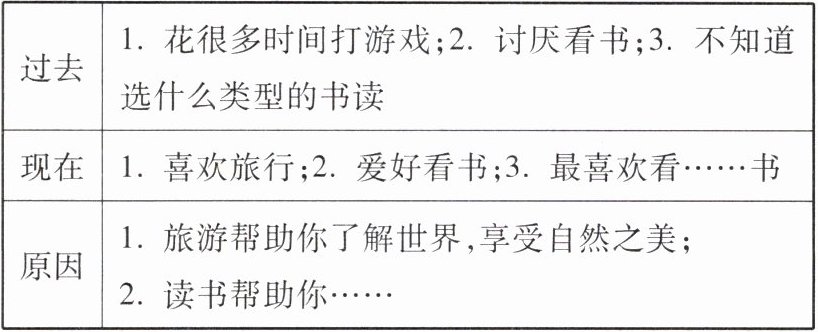
要求:
1. 语句通顺,条理清晰;
2. 词数90左右,必须包括表格中所有的信息,省略号部分适当发挥;
3. 文中不得出现真实姓名、校名和地名等。
My changes
2025南通海安期中我们的课本不仅能让我们学到知识,还会改善我们的生活习惯。只要我们有一颗上进心,就一定会发生很大的变化。请根据下面表格提供的信息,以“My changes”为题用英语写一篇短文,向同学介绍你的变化并简要说明理由。
要求:
1. 语句通顺,条理清晰;
2. 词数90左右,必须包括表格中所有的信息,省略号部分适当发挥;
3. 文中不得出现真实姓名、校名和地名等。
My changes
答案
九、One possible version:
My changes
In the past, I often spent a lot of time
playing computer games. I didn't like
reading at all. I didn't know what kind of
books to read, either.
But now I have changed a lot. I love
travelling. I have been to many places of
interest, such as Hong Kong Disneyland
and Sydney Opera House. I also like
reading. I think reading is an important
part of my life. So I spend more than seven
hours a week reading different types of
books. I am interested in history books,
but I like novels best.
I hope more and more students love
travelling and reading. Travelling can help us
understand the world and enjoy the beauty of
nature. And reading can not only make us get
knowledge but also open up a new world to
us. Good books are good friends.
My changes
In the past, I often spent a lot of time
playing computer games. I didn't like
reading at all. I didn't know what kind of
books to read, either.
But now I have changed a lot. I love
travelling. I have been to many places of
interest, such as Hong Kong Disneyland
and Sydney Opera House. I also like
reading. I think reading is an important
part of my life. So I spend more than seven
hours a week reading different types of
books. I am interested in history books,
but I like novels best.
I hope more and more students love
travelling and reading. Travelling can help us
understand the world and enjoy the beauty of
nature. And reading can not only make us get
knowledge but also open up a new world to
us. Good books are good friends.
解析
【分析】
首先要明确这是一篇以“My changes”为题的英语书面表达,需围绕表格中“过去、现在、原因”三个板块展开写作。解题思路如下:
1. 审题:确定写作主题为个人变化,必须涵盖表格所有要点,补充省略号部分,如确定最喜欢的书籍类型,词数控制在90左右,保证语言通顺、条理清晰。
2. 搭建结构:采用“过去状态-现在变化-变化原因”的三段式结构,开头引入主题,中间通过转折对比过去与现在的不同,结尾说明变化的原因并适当升华。
3. 内容填充:过去部分要覆盖“花大量时间打游戏、讨厌看书、不会选书”三个要点;现在部分补充旅行的具体例子,明确最喜欢的书籍类型,如小说,覆盖“喜欢旅行、爱好看书”的要点;原因部分结合表格内容,拓展读书的深层好处,如获取知识、开阔视野。
4. 语言润色:合理运用时态,用一般过去时描述过去,一般现在时、现在完成时描述现在,使用如not only...but also...这类经典句型,提升表达流畅度。
【解析】
1. 开篇引入:用一般过去时描述过去的自己,完整覆盖表格中过去的三个要点,清晰展现曾经的状态,如“I often spent a lot of time playing computer games. I didn't like reading at all. I didn't know what kind of books to read, either.”
2. 转折写变化:用“But now”过渡到现在的状态,结合现在完成时补充旅行的具体经历,如去过香港迪士尼等景点,明确最喜欢的书籍类型,如小说,清晰呈现现在的改变,覆盖表格中现在的所有要点。
3. 阐述原因:先发出倡议,再分别说明旅行和读书的好处,覆盖表格中原因的要点,同时拓展读书的价值,如“not only make us get knowledge but also open up a new world to us”,让内容更充实。
4. 结尾升华:用“Good books are good friends”收尾,增强文章感染力,让主题更突出。
【答案】
One possible version:
My changes
In the past, I often spent a lot of time
playing computer games. I didn't like
reading at all. I didn't know what kind of
books to read, either.
But now I have changed a lot. I love
travelling. I have been to many places of
interest, such as Hong Kong Disneyland
and Sydney Opera House. I also like
reading. I think reading is an important
part of my life. So I spend more than seven
hours a week reading different types of
books. I am interested in history books,
but I like novels best.
I hope more and more students love
travelling and reading. Travelling can help us
understand the world and enjoy the beauty of
nature. And reading can not only make us get
knowledge but also open up a new world to
us. Good books are good friends.
【知识点】
1. 变化类书面表达
2. 记叙文写作
3. 话题类英语作文
【点评】
这篇范文结构清晰,以“过去-现在-原因”的逻辑顺序展开,完整覆盖表格所有要点,还适当补充了旅行实例和书籍类型,内容充实。文中灵活运用多种时态和经典句型,语言流畅自然,符合词数要求,结尾的升华让文章更有深度,是一篇符合要求的优秀范文。
【难度系数】
0.6
首先要明确这是一篇以“My changes”为题的英语书面表达,需围绕表格中“过去、现在、原因”三个板块展开写作。解题思路如下:
1. 审题:确定写作主题为个人变化,必须涵盖表格所有要点,补充省略号部分,如确定最喜欢的书籍类型,词数控制在90左右,保证语言通顺、条理清晰。
2. 搭建结构:采用“过去状态-现在变化-变化原因”的三段式结构,开头引入主题,中间通过转折对比过去与现在的不同,结尾说明变化的原因并适当升华。
3. 内容填充:过去部分要覆盖“花大量时间打游戏、讨厌看书、不会选书”三个要点;现在部分补充旅行的具体例子,明确最喜欢的书籍类型,如小说,覆盖“喜欢旅行、爱好看书”的要点;原因部分结合表格内容,拓展读书的深层好处,如获取知识、开阔视野。
4. 语言润色:合理运用时态,用一般过去时描述过去,一般现在时、现在完成时描述现在,使用如not only...but also...这类经典句型,提升表达流畅度。
【解析】
1. 开篇引入:用一般过去时描述过去的自己,完整覆盖表格中过去的三个要点,清晰展现曾经的状态,如“I often spent a lot of time playing computer games. I didn't like reading at all. I didn't know what kind of books to read, either.”
2. 转折写变化:用“But now”过渡到现在的状态,结合现在完成时补充旅行的具体经历,如去过香港迪士尼等景点,明确最喜欢的书籍类型,如小说,清晰呈现现在的改变,覆盖表格中现在的所有要点。
3. 阐述原因:先发出倡议,再分别说明旅行和读书的好处,覆盖表格中原因的要点,同时拓展读书的价值,如“not only make us get knowledge but also open up a new world to us”,让内容更充实。
4. 结尾升华:用“Good books are good friends”收尾,增强文章感染力,让主题更突出。
【答案】
One possible version:
My changes
In the past, I often spent a lot of time
playing computer games. I didn't like
reading at all. I didn't know what kind of
books to read, either.
But now I have changed a lot. I love
travelling. I have been to many places of
interest, such as Hong Kong Disneyland
and Sydney Opera House. I also like
reading. I think reading is an important
part of my life. So I spend more than seven
hours a week reading different types of
books. I am interested in history books,
but I like novels best.
I hope more and more students love
travelling and reading. Travelling can help us
understand the world and enjoy the beauty of
nature. And reading can not only make us get
knowledge but also open up a new world to
us. Good books are good friends.
【知识点】
1. 变化类书面表达
2. 记叙文写作
3. 话题类英语作文
【点评】
这篇范文结构清晰,以“过去-现在-原因”的逻辑顺序展开,完整覆盖表格所有要点,还适当补充了旅行实例和书籍类型,内容充实。文中灵活运用多种时态和经典句型,语言流畅自然,符合词数要求,结尾的升华让文章更有深度,是一篇符合要求的优秀范文。
【难度系数】
0.6
一、完形填空
(2025 无锡江阴期中)Once in a physics
class, the teacher asked students, "Why do we
have brakes(刹车) in our cars?" Soon, students
gave different answers.
A student stood up and answered, "Sir, to
the
However,
as the teacher's. Then he said, "All of your
answers are right. But in my opinion, the brakes
in the cars make us able to drive much
"If the car has no brakes, how fast are we
ready to drive? It is the brakes in the cars that help
us drive fast and safely." Listening to this, the
whole class was silent
about this answer.
At the same time, there are many such "brakes"
in our life, which
parents may ask us about decisions in life. Their
questions or
stand in our way. But we can see them as our
supporters which can protect us. Sometimes, we
to stop, so that we can do better.
In fact, it is the "brakes" in life that help us
a lot.
direction or get into danger. So we need to
understand that "brakes" in our life do not mean
pushing us back
more quickly than before.
1. A. improve B. keep C. change D. stop
2. A. time B. direction
C. speed D. condition
3. A. all B. none C. some D. both
4. A. slow B. fast C. slower D. faster
5. A. because B. until C. if D. when
6. A. begin B. decide C. seem D. pick
7. A. advice B. presents
C. habits D. discussion
8. A. refuse B. have C. wait D. forget
9. A. From B. With C. Without D. On
10. A. and B. but C. or D. so
(2025 无锡江阴期中)Once in a physics
class, the teacher asked students, "Why do we
have brakes(刹车) in our cars?" Soon, students
gave different answers.
A student stood up and answered, "Sir, to
D
1 the car." Another one said, "To slow downthe
C
2 of the car."However,
B
3 of the answers was the sameas the teacher's. Then he said, "All of your
answers are right. But in my opinion, the brakes
in the cars make us able to drive much
D
4.""If the car has no brakes, how fast are we
ready to drive? It is the brakes in the cars that help
us drive fast and safely." Listening to this, the
whole class was silent
A
5 no one had thoughtabout this answer.
At the same time, there are many such "brakes"
in our life, which
C
6 to stop us. For example, ourparents may ask us about decisions in life. Their
questions or
A
7 may be seen as "brakes" whichstand in our way. But we can see them as our
supporters which can protect us. Sometimes, we
B
8to stop, so that we can do better.
In fact, it is the "brakes" in life that help us
a lot.
C
9 these "brakes", we could lose ourdirection or get into danger. So we need to
understand that "brakes" in our life do not mean
pushing us back
B
10 making us move forwardmore quickly than before.
1. A. improve B. keep C. change D. stop
2. A. time B. direction
C. speed D. condition
3. A. all B. none C. some D. both
4. A. slow B. fast C. slower D. faster
5. A. because B. until C. if D. when
6. A. begin B. decide C. seem D. pick
7. A. advice B. presents
C. habits D. discussion
8. A. refuse B. have C. wait D. forget
9. A. From B. With C. Without D. On
10. A. and B. but C. or D. so
答案
【语篇导读】本文通过刹车的例子告诉我
们生活中那些看似阻碍我们的力量其实
在帮助我们更快地前进。
1. D 提示:improve提高;keep保持;change改
变;stop停止。句意:一位学生站起来回答:
“老师,是为了让汽车停下。”
2. C 提示:time时间;direction方向;speed速
度;condition情况。句意:另一位学生说:“是
为了减慢汽车的速度。”
3. B 提示:all所有;none没有一个;some一
些;both两者都。句意:然而,没有一个答案
和老师的一样。
4. D 提示:slow慢;fast快;slower更慢;faster
更快。句意:但是在我看来,汽车里的刹车让
我们能更快地开车。
5. A 提示:because因为;until直到;if如果;
when当……时。句意:听到这番话,全班都
沉默了,因为没人想到这个答案。
6. C 提示:begin开始;decide决定;seem似乎;
pick挑选。句意:与此同时,生活中也存在许
多类似的“刹车”,这些“刹车”似乎在阻止
我们。
7. A 提示:advice建议;present礼物;habit习
惯;discussion讨论。句意:他们的问题或建议
可能被视为阻碍我们前进的“刹车”。
8. B 提示:句意:有时候,我们必须停下来,这
样我们才能做得更好。have to意为“不
得不”。
9. C 提示:from从;with有;without没有;on
在……之上。句意:没有这些“刹车”,我们
可能会迷失方向或陷入危险。
10. B 提示:not...but...意为“不是……而
是……”。句意:所以我们需要明白,生活中
的“刹车”不是在拖我们后腿,而是让我们
比以前更快地前进。
们生活中那些看似阻碍我们的力量其实
在帮助我们更快地前进。
1. D 提示:improve提高;keep保持;change改
变;stop停止。句意:一位学生站起来回答:
“老师,是为了让汽车停下。”
2. C 提示:time时间;direction方向;speed速
度;condition情况。句意:另一位学生说:“是
为了减慢汽车的速度。”
3. B 提示:all所有;none没有一个;some一
些;both两者都。句意:然而,没有一个答案
和老师的一样。
4. D 提示:slow慢;fast快;slower更慢;faster
更快。句意:但是在我看来,汽车里的刹车让
我们能更快地开车。
5. A 提示:because因为;until直到;if如果;
when当……时。句意:听到这番话,全班都
沉默了,因为没人想到这个答案。
6. C 提示:begin开始;decide决定;seem似乎;
pick挑选。句意:与此同时,生活中也存在许
多类似的“刹车”,这些“刹车”似乎在阻止
我们。
7. A 提示:advice建议;present礼物;habit习
惯;discussion讨论。句意:他们的问题或建议
可能被视为阻碍我们前进的“刹车”。
8. B 提示:句意:有时候,我们必须停下来,这
样我们才能做得更好。have to意为“不
得不”。
9. C 提示:from从;with有;without没有;on
在……之上。句意:没有这些“刹车”,我们
可能会迷失方向或陷入危险。
10. B 提示:not...but...意为“不是……而
是……”。句意:所以我们需要明白,生活中
的“刹车”不是在拖我们后腿,而是让我们
比以前更快地前进。
解析
【分析】
这是一篇夹叙夹议的完形填空,解题时需先通读全文,把握核心主旨:生活中看似阻碍我们的“刹车”,实则是助力我们更快前进的力量。随后逐个分析每个空:
1. 第1空结合刹车的基本功能,判断学生的回答是让汽车停下,需选对应含义的词汇;
2. 第2空根据“slow down”(减慢)的搭配,结合汽车相关属性,确定是减慢速度;
3. 第3空通过转折词“However”和后文老师的不同答案,可知没有学生的答案和老师一致;
4. 第4空依据后文“快速安全驾驶”的表述,且“much”修饰比较级,确定选“更快”;
5. 第5空分析前后句的因果关系,全班沉默是因为没人想到该答案;
6. 第6空结合语境,生活中的“刹车”表面上看似在阻止我们,需选表“似乎”的词汇;
7. 第7空根据前文父母询问人生决策的语境,对应“问题或建议”;
8. 第8空结合“停下来才能做得更好”的语境,用“have to”(不得不)的固定搭配;
9. 第9空根据后文“迷失方向或陷入危险”的后果,判断是假设没有这些“刹车”的情况;
10. 第10空运用“not...but...”的固定搭配,表达“不是……而是……”的逻辑关系。
【解析】
1. 第1空:A. improve提高;B. keep保持;C. change改变;D. stop停止。根据刹车的基本功能,学生回答刹车是为了让汽车停下,故选D。
2. 第2空:A. time时间;B. direction方向;C. speed速度;D. condition情况。“slow down”意为“减慢”,结合汽车属性,此处指减慢汽车的速度,故选C。
3. 第3空:A. all所有;B. none没有一个;C. some一些;D. both两者都。根据转折词“However”及后文老师的不同答案,可知没有一个学生的答案和老师一致,故选B。
4. 第4空:A. slow慢;B. fast快;C. slower更慢;D. faster更快。根据后文“刹车帮助我们快速安全驾驶”,且“much”修饰比较级,此处表示“更快地开车”,故选D。
5. 第5空:A. because因为;B. until直到;C. if如果;D. when当……时。全班沉默的原因是没人想到老师的答案,前后为因果关系,故选A。
6. 第6空:A. begin开始;B. decide决定;C. seem似乎;D. pick挑选。结合语境,生活中的“刹车”表面上似乎在阻止我们,故选C。
7. 第7空:A. advice建议;B. presents礼物;C. habits习惯;D. discussion讨论。前文提到父母询问人生决策,对应的是他们的问题或建议,这些被看作阻碍我们的“刹车”,故选A。
8. 第8空:A. refuse拒绝;B. have有;C. wait等待;D. forget忘记。“have to”是固定搭配,意为“不得不”,符合“有时候我们不得不停下来,才能做得更好”的语境,故选B。
9. 第9空:A. From从;B. With有;C. Without没有;D. On在……之上。根据后文“迷失方向或陷入危险”的后果,这是假设没有这些“刹车”的情况,故选C。
10. 第10空:A. and和;B. but但是;C. or或者;D. so所以。“not...but...”是固定搭配,意为“不是……而是……”,符合“生活中的‘刹车’不是拖我们后腿,而是让我们比以前更快地前进”的文意,故选B。
【答案】
1. D 2. C 3. B 4. D 5. A 6. C 7. A 8. B 9. C 10. B
【知识点】
1. 词义辨析
2. 固定搭配
3. 语境逻辑理解
【点评】
本文以汽车刹车为引子,引申到生活中类似“刹车”的人或事,传递了“阻碍实则是助力”的深层寓意。解题时需紧密结合上下文语境,准确辨析词汇含义,熟练运用固定搭配,同时理解文章的情感态度与核心思想,对学生的词汇运用和逻辑思维能力有一定考查。
【难度系数】
0.6
这是一篇夹叙夹议的完形填空,解题时需先通读全文,把握核心主旨:生活中看似阻碍我们的“刹车”,实则是助力我们更快前进的力量。随后逐个分析每个空:
1. 第1空结合刹车的基本功能,判断学生的回答是让汽车停下,需选对应含义的词汇;
2. 第2空根据“slow down”(减慢)的搭配,结合汽车相关属性,确定是减慢速度;
3. 第3空通过转折词“However”和后文老师的不同答案,可知没有学生的答案和老师一致;
4. 第4空依据后文“快速安全驾驶”的表述,且“much”修饰比较级,确定选“更快”;
5. 第5空分析前后句的因果关系,全班沉默是因为没人想到该答案;
6. 第6空结合语境,生活中的“刹车”表面上看似在阻止我们,需选表“似乎”的词汇;
7. 第7空根据前文父母询问人生决策的语境,对应“问题或建议”;
8. 第8空结合“停下来才能做得更好”的语境,用“have to”(不得不)的固定搭配;
9. 第9空根据后文“迷失方向或陷入危险”的后果,判断是假设没有这些“刹车”的情况;
10. 第10空运用“not...but...”的固定搭配,表达“不是……而是……”的逻辑关系。
【解析】
1. 第1空:A. improve提高;B. keep保持;C. change改变;D. stop停止。根据刹车的基本功能,学生回答刹车是为了让汽车停下,故选D。
2. 第2空:A. time时间;B. direction方向;C. speed速度;D. condition情况。“slow down”意为“减慢”,结合汽车属性,此处指减慢汽车的速度,故选C。
3. 第3空:A. all所有;B. none没有一个;C. some一些;D. both两者都。根据转折词“However”及后文老师的不同答案,可知没有一个学生的答案和老师一致,故选B。
4. 第4空:A. slow慢;B. fast快;C. slower更慢;D. faster更快。根据后文“刹车帮助我们快速安全驾驶”,且“much”修饰比较级,此处表示“更快地开车”,故选D。
5. 第5空:A. because因为;B. until直到;C. if如果;D. when当……时。全班沉默的原因是没人想到老师的答案,前后为因果关系,故选A。
6. 第6空:A. begin开始;B. decide决定;C. seem似乎;D. pick挑选。结合语境,生活中的“刹车”表面上似乎在阻止我们,故选C。
7. 第7空:A. advice建议;B. presents礼物;C. habits习惯;D. discussion讨论。前文提到父母询问人生决策,对应的是他们的问题或建议,这些被看作阻碍我们的“刹车”,故选A。
8. 第8空:A. refuse拒绝;B. have有;C. wait等待;D. forget忘记。“have to”是固定搭配,意为“不得不”,符合“有时候我们不得不停下来,才能做得更好”的语境,故选B。
9. 第9空:A. From从;B. With有;C. Without没有;D. On在……之上。根据后文“迷失方向或陷入危险”的后果,这是假设没有这些“刹车”的情况,故选C。
10. 第10空:A. and和;B. but但是;C. or或者;D. so所以。“not...but...”是固定搭配,意为“不是……而是……”,符合“生活中的‘刹车’不是拖我们后腿,而是让我们比以前更快地前进”的文意,故选B。
【答案】
1. D 2. C 3. B 4. D 5. A 6. C 7. A 8. B 9. C 10. B
【知识点】
1. 词义辨析
2. 固定搭配
3. 语境逻辑理解
【点评】
本文以汽车刹车为引子,引申到生活中类似“刹车”的人或事,传递了“阻碍实则是助力”的深层寓意。解题时需紧密结合上下文语境,准确辨析词汇含义,熟练运用固定搭配,同时理解文章的情感态度与核心思想,对学生的词汇运用和逻辑思维能力有一定考查。
【难度系数】
0.6
