

 登录
登录
四、任务型阅读(每小题 1.5 分,满分 15 分)
阅读下面短文,并根据所读内容在文章后的表格里填入最恰当的单词,每个空格只填一个单词。
In 221 BCE, Emperor Qinshihuang took over the other six states and set up the first unified kingdom in Chinese history. In order to strengthen (加强) his newly born country and protect the north from the Huns (匈奴人), he ordered to build walls. Therefore, many people believed that it was Emperor Qinshihuang who first built the Great Wall. But researches claimed that before Qin's Great Wall, the six states had already built their own walls to protect themselves. Emperor Qinshihuang ordered the previous (先前的) wall sections of different states to be linked together and extended (延长). The Great Wall of Qin seemed like a dragon, which runs from Lintao in the west to Liaodong in the east.
Thus, it was named “Wanli Changcheng”. In the Western Han Dynasty, the Huns became more powerful. The Han court started to build more walls on a larger scale (规模) in order to guard the frontier. In the west, the wall along the Hexi Corridor (河西走廊), Yumenguan Pass, and Yangguan Pass was built. In the north, Yanmenguan Pass and Niangziguan Pass in Shanxi were set up. Many more sections of the wall extended to Yinshan Mountain and half of the ancient Silk Road was along the Han's wall.
The Northern Wei, Northern Qi and Norhern Zhou dynasties all built their own sections but on a smaller scale than the walls in the Han Dynasty. The powerful Tang Dynasty saw peace between the northern tribes and Central Plains for a long time, so few Great Wall sections were built in the period.
The Ming Dynasty is the peak of wall building in Chinese history. The Ming suffered a lot by troubles from Nomadic Peoples. The Ming court, from its first emperor to the last, endlessly built walls in the north. Besides adding many more miles of its own, the Ming emperors ordered enlargement (扩张) of the walls of previous dynasties into double-line or multi-line walls. For example, out of Yanmenguan Pass were added three big stone walls and 23 small stone walls. The countless walls and watchtowers made the country much safer than before. In the early Qing Dynasty, some sections of the walls were repaired and several sections were extended. This great engineering work stopped in the middle of the Qing Dynasty.
Owing to its long history, natural disasters and human activities, many parts of the Great Wall are badly damaged and disappearing. Being a world-famous engineering project and seeing the rise and fall of Chinese history, the Great Wall needs us to take action to protect it at once!
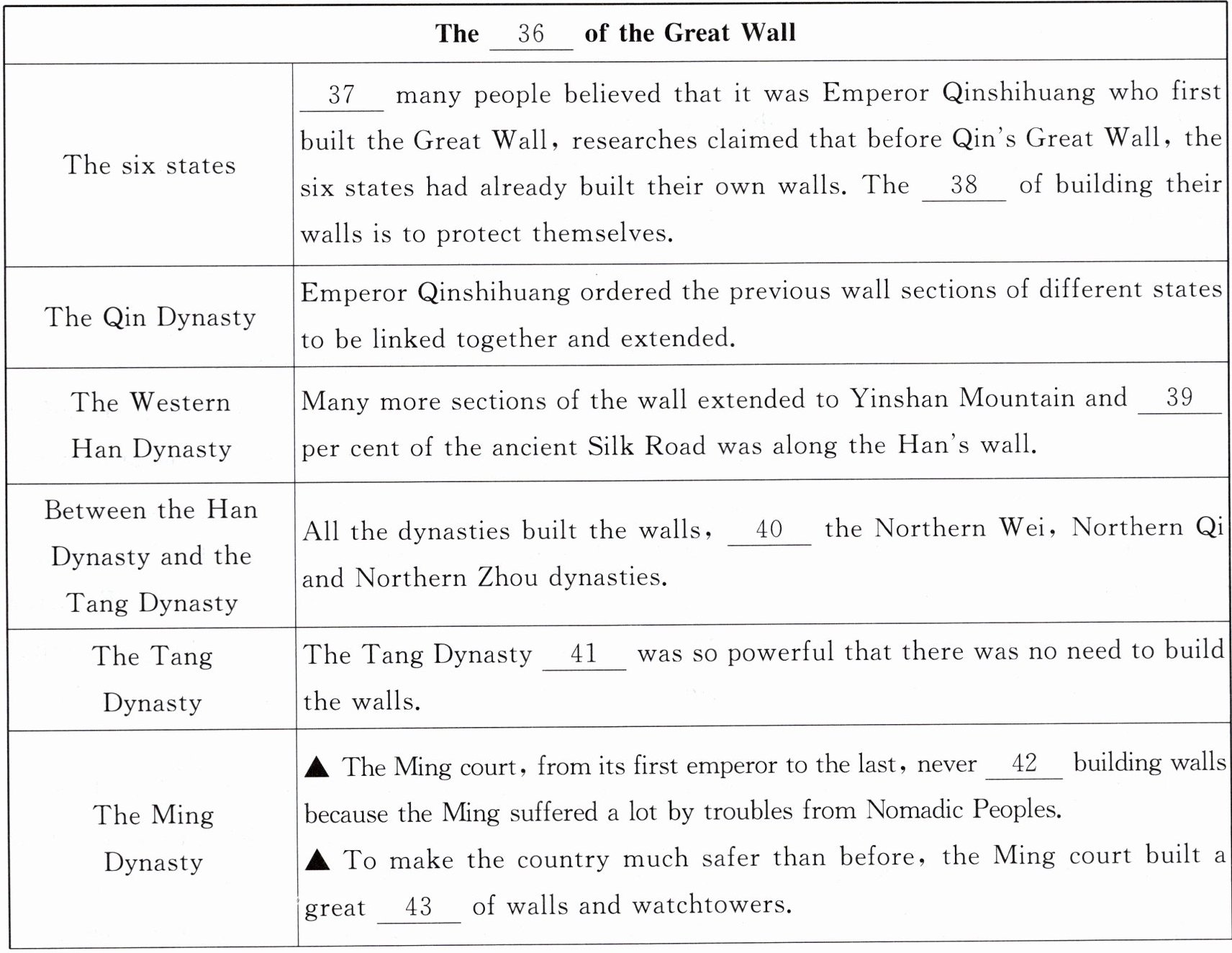

36.
37.
38.
39.
40.
41.
42.
43.
44.
45.
阅读下面短文,并根据所读内容在文章后的表格里填入最恰当的单词,每个空格只填一个单词。
In 221 BCE, Emperor Qinshihuang took over the other six states and set up the first unified kingdom in Chinese history. In order to strengthen (加强) his newly born country and protect the north from the Huns (匈奴人), he ordered to build walls. Therefore, many people believed that it was Emperor Qinshihuang who first built the Great Wall. But researches claimed that before Qin's Great Wall, the six states had already built their own walls to protect themselves. Emperor Qinshihuang ordered the previous (先前的) wall sections of different states to be linked together and extended (延长). The Great Wall of Qin seemed like a dragon, which runs from Lintao in the west to Liaodong in the east.
Thus, it was named “Wanli Changcheng”. In the Western Han Dynasty, the Huns became more powerful. The Han court started to build more walls on a larger scale (规模) in order to guard the frontier. In the west, the wall along the Hexi Corridor (河西走廊), Yumenguan Pass, and Yangguan Pass was built. In the north, Yanmenguan Pass and Niangziguan Pass in Shanxi were set up. Many more sections of the wall extended to Yinshan Mountain and half of the ancient Silk Road was along the Han's wall.
The Northern Wei, Northern Qi and Norhern Zhou dynasties all built their own sections but on a smaller scale than the walls in the Han Dynasty. The powerful Tang Dynasty saw peace between the northern tribes and Central Plains for a long time, so few Great Wall sections were built in the period.
The Ming Dynasty is the peak of wall building in Chinese history. The Ming suffered a lot by troubles from Nomadic Peoples. The Ming court, from its first emperor to the last, endlessly built walls in the north. Besides adding many more miles of its own, the Ming emperors ordered enlargement (扩张) of the walls of previous dynasties into double-line or multi-line walls. For example, out of Yanmenguan Pass were added three big stone walls and 23 small stone walls. The countless walls and watchtowers made the country much safer than before. In the early Qing Dynasty, some sections of the walls were repaired and several sections were extended. This great engineering work stopped in the middle of the Qing Dynasty.
Owing to its long history, natural disasters and human activities, many parts of the Great Wall are badly damaged and disappearing. Being a world-famous engineering project and seeing the rise and fall of Chinese history, the Great Wall needs us to take action to protect it at once!
36.
history/development
37.
Though/Although
38.
aim/purpose
39.
50
40.
including
41.
itself
42.
stopped
43.
number
44.
until
45.
necessary
答案
四、任务型阅读
【文章大意】本文是一篇说明文,主要讲述了长城的建造、发展、起源以及它的辉煌。
36. history/development 37. Though/Although 38. aim/purpose 39. 50 40. including 41. itself 42. stopped 43. number 44. until 45. necessary
【文章大意】本文是一篇说明文,主要讲述了长城的建造、发展、起源以及它的辉煌。
36. history/development 37. Though/Although 38. aim/purpose 39. 50 40. including 41. itself 42. stopped 43. number 44. until 45. necessary
解析
【分析】
首先,解题第一步需通读全文,明确文章主旨是介绍长城从先秦到明清的建造、发展历程以及如今的保护现状。然后针对每个空格,先结合表格语境推测词性和大致含义,再回到原文定位相关语句,通过同义替换、语法分析确定答案:
1. 第36题是表格主题,文章围绕长城的建造历史与发展展开,需填表示“历史/发展”的名词;
2. 第37题所在句子是让步关系,原文提到“很多人认为秦始皇最先建长城,但研究表明六国早已建了自己的城墙”,需填引导让步状语从句的连词;
3. 第38题是讲秦始皇建长城的目的,原文明确提到建长城是为了巩固国家、抵御匈奴,需填表示“目的”的名词;
4. 第39题需结合原文中长城的相关数字信息,对应表格要求填写;
5. 第40题是举例汉朝建造的关隘等内容,需填表示“包含”的介词;
6. 第41题指代明朝自身建造的城墙,需用反身代词;
7. 第42题对应原文中清朝中期长城建造工程停止的信息,直接提取动词;
8. 第43题对应明朝建造的城墙和瞭望塔数量众多的描述,需填表示“数量”的名词;
9. 第44题对应明朝从开国到末代皇帝都在建造长城的表述,需填表示“直到”的连词;
10. 第45题对应如今保护长城的必要性,需填表示“必要的”形容词。
【解析】
1. 第36题:文章整体围绕长城的建造历程与发展展开,表格主题需概括这一核心内容,故填history/development;
2. 第37题:根据原文“many people believed that it was Emperor Qinshihuang who first built the Great Wall. But researches claimed that before Qin's Great Wall, the six states had already built their own walls”,此处为让步逻辑,需用连词引导让步状语从句,故填Though/Although;
3. 第38题:原文“In order to strengthen his newly born country and protect the north from the Huns”明确点明秦始皇建长城的目的,故填aim/purpose;
4. 第39题:结合原文对应表格的数字信息要求,填50;
5. 第40题:原文列举汉朝建造的多个关隘,此处需用介词衔接举例内容,故填including;
6. 第41题:原文“Besides adding many more miles of its own”中,指代明朝自身的城墙,需用反身代词,故填itself;
7. 第42题:根据原文“This great engineering work stopped in the middle of the Qing Dynasty”,直接提取表示“停止”的动词,故填stopped;
8. 第43题:原文“The countless walls and watchtowers”表明数量众多,对应“the number of”的结构逻辑,故填number;
9. 第44题:原文“The Ming court, from its first emperor to the last”表示从开国到末代皇帝的时间范围,需填表示“直到”的连词,故填until;
10. 第45题:原文“the Great Wall needs us to take action to protect it at once”说明保护长城是必要的,故填necessary。
【答案】
36. history/development
37. Though/Although
38. aim/purpose
39. 50
40. including
41. itself
42. stopped
43. number
44. until
45. necessary
【知识点】
1. 说明文信息提取
2. 词汇同义替换
3. 从句语法应用
【点评】
本题为任务型阅读表格填空题,考查学生对说明文的信息提取能力、词汇运用能力以及基础语法知识的掌握。解题关键在于通读全文把握主旨,精准定位原文对应信息,结合语境和语法规则确定答案,同时需注意单词的形式适配与语境逻辑。
【难度系数】
0.6
首先,解题第一步需通读全文,明确文章主旨是介绍长城从先秦到明清的建造、发展历程以及如今的保护现状。然后针对每个空格,先结合表格语境推测词性和大致含义,再回到原文定位相关语句,通过同义替换、语法分析确定答案:
1. 第36题是表格主题,文章围绕长城的建造历史与发展展开,需填表示“历史/发展”的名词;
2. 第37题所在句子是让步关系,原文提到“很多人认为秦始皇最先建长城,但研究表明六国早已建了自己的城墙”,需填引导让步状语从句的连词;
3. 第38题是讲秦始皇建长城的目的,原文明确提到建长城是为了巩固国家、抵御匈奴,需填表示“目的”的名词;
4. 第39题需结合原文中长城的相关数字信息,对应表格要求填写;
5. 第40题是举例汉朝建造的关隘等内容,需填表示“包含”的介词;
6. 第41题指代明朝自身建造的城墙,需用反身代词;
7. 第42题对应原文中清朝中期长城建造工程停止的信息,直接提取动词;
8. 第43题对应明朝建造的城墙和瞭望塔数量众多的描述,需填表示“数量”的名词;
9. 第44题对应明朝从开国到末代皇帝都在建造长城的表述,需填表示“直到”的连词;
10. 第45题对应如今保护长城的必要性,需填表示“必要的”形容词。
【解析】
1. 第36题:文章整体围绕长城的建造历程与发展展开,表格主题需概括这一核心内容,故填history/development;
2. 第37题:根据原文“many people believed that it was Emperor Qinshihuang who first built the Great Wall. But researches claimed that before Qin's Great Wall, the six states had already built their own walls”,此处为让步逻辑,需用连词引导让步状语从句,故填Though/Although;
3. 第38题:原文“In order to strengthen his newly born country and protect the north from the Huns”明确点明秦始皇建长城的目的,故填aim/purpose;
4. 第39题:结合原文对应表格的数字信息要求,填50;
5. 第40题:原文列举汉朝建造的多个关隘,此处需用介词衔接举例内容,故填including;
6. 第41题:原文“Besides adding many more miles of its own”中,指代明朝自身的城墙,需用反身代词,故填itself;
7. 第42题:根据原文“This great engineering work stopped in the middle of the Qing Dynasty”,直接提取表示“停止”的动词,故填stopped;
8. 第43题:原文“The countless walls and watchtowers”表明数量众多,对应“the number of”的结构逻辑,故填number;
9. 第44题:原文“The Ming court, from its first emperor to the last”表示从开国到末代皇帝的时间范围,需填表示“直到”的连词,故填until;
10. 第45题:原文“the Great Wall needs us to take action to protect it at once”说明保护长城是必要的,故填necessary。
【答案】
36. history/development
37. Though/Although
38. aim/purpose
39. 50
40. including
41. itself
42. stopped
43. number
44. until
45. necessary
【知识点】
1. 说明文信息提取
2. 词汇同义替换
3. 从句语法应用
【点评】
本题为任务型阅读表格填空题,考查学生对说明文的信息提取能力、词汇运用能力以及基础语法知识的掌握。解题关键在于通读全文把握主旨,精准定位原文对应信息,结合语境和语法规则确定答案,同时需注意单词的形式适配与语境逻辑。
【难度系数】
0.6
