

 登录
登录
四、 核心素养 中华优秀传统文化 阅读理解。
主题群:自然生态 子主题:物候节气 语篇类型:说明文 难度:★★
The traditional Chinese lunar calendar divides(划分) the year into 24 solar terms(节气). It's very useful for people's life and work. Let's have a look.
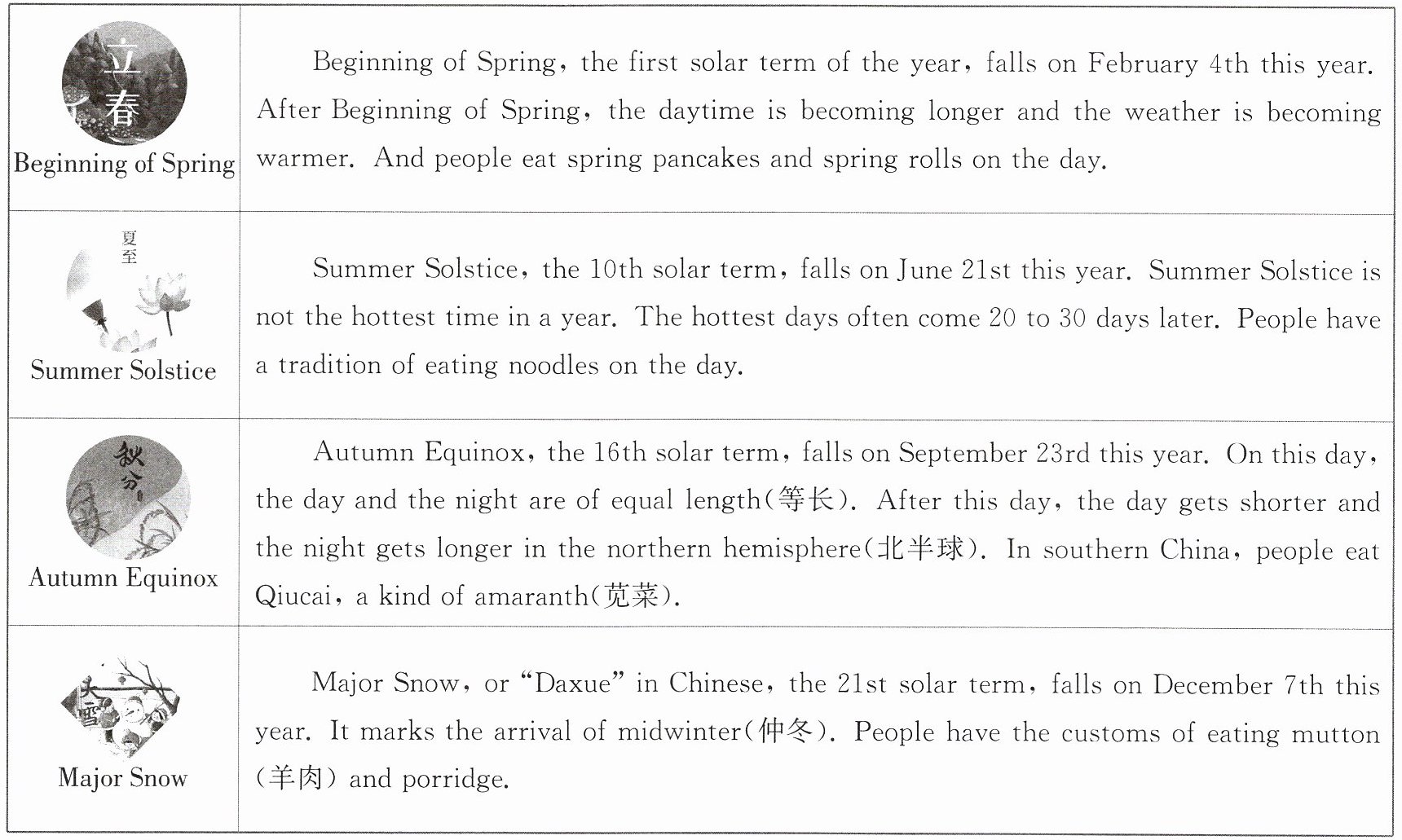
(
A. 20. B. 24. C. 12. D. 8.
(
A. May 15th. B. October 15th. C. September 15th. D. July 15th.
(
A. shorter than B. longer than C. as long as D. as warm as
(
A. Chinese famous people B. Chinese table manners
C. Chinese classical gardens D. Chinese culture and customs
主题群:自然生态 子主题:物候节气 语篇类型:说明文 难度:★★
The traditional Chinese lunar calendar divides(划分) the year into 24 solar terms(节气). It's very useful for people's life and work. Let's have a look.
(
B
)1. How many solar terms are there in the Chinese lunar calendar?A. 20. B. 24. C. 12. D. 8.
(
D
)2. According to the material, which of the following days may be the hottest?A. May 15th. B. October 15th. C. September 15th. D. July 15th.
(
A
)3. In October, the day is the night in Beijing.A. shorter than B. longer than C. as long as D. as warm as
(
D
)4. The material may come from a book about .A. Chinese famous people B. Chinese table manners
C. Chinese classical gardens D. Chinese culture and customs
答案
1~4. BDAD
解析
【分析】
本题是关于中国二十四节气的阅读理解题,需结合材料信息逐一分析各小题:第1题考查节气数量,需定位原文开头相关表述;第2题考查最热时间,需关联夏至的时间及最热时段的延后规律;第3题考查北半球秋分后的昼夜变化,需结合秋分的特点和时间推理;第4题考查材料主题,需归纳材料核心内容。
【解析】
1. 细节理解题:根据原文“The traditional Chinese lunar calendar divides the year into 24 solar terms”,可知中国农历一年有24个节气,故选B。
2. 细节理解题:根据原文“Summer Solstice... falls on June 21st this year. The hottest days often come 20 to 30 days later”,夏至为6月21日,最热时段在夏至后20-30天,即7月11日至7月21日之间,选项中July 15th(7月15日)在此区间,故选D。
3. 推理判断题:北京位于北半球,根据原文“Autumn Equinox... falls on September 23rd this year. After this day, the day gets shorter and the night gets longer in the northern hemisphere”,秋分(9月23日)后北半球白天变短、夜晚变长,10月在秋分之后,故白天比夜晚短,故选A。
4. 主旨大意题:材料介绍了四个节气的时间及对应习俗,核心围绕中国文化与习俗展开,故选D。
【答案】
1~4. BDAD
【知识点】
阅读理解(细节理解、推理判断、主旨大意),中国传统文化
【点评】
本题结合中华优秀传统文化,考查学生从材料中提取信息、推理判断和归纳主旨的能力,符合核心素养要求,难度适中。
【难度系数】
0.6
本题是关于中国二十四节气的阅读理解题,需结合材料信息逐一分析各小题:第1题考查节气数量,需定位原文开头相关表述;第2题考查最热时间,需关联夏至的时间及最热时段的延后规律;第3题考查北半球秋分后的昼夜变化,需结合秋分的特点和时间推理;第4题考查材料主题,需归纳材料核心内容。
【解析】
1. 细节理解题:根据原文“The traditional Chinese lunar calendar divides the year into 24 solar terms”,可知中国农历一年有24个节气,故选B。
2. 细节理解题:根据原文“Summer Solstice... falls on June 21st this year. The hottest days often come 20 to 30 days later”,夏至为6月21日,最热时段在夏至后20-30天,即7月11日至7月21日之间,选项中July 15th(7月15日)在此区间,故选D。
3. 推理判断题:北京位于北半球,根据原文“Autumn Equinox... falls on September 23rd this year. After this day, the day gets shorter and the night gets longer in the northern hemisphere”,秋分(9月23日)后北半球白天变短、夜晚变长,10月在秋分之后,故白天比夜晚短,故选A。
4. 主旨大意题:材料介绍了四个节气的时间及对应习俗,核心围绕中国文化与习俗展开,故选D。
【答案】
1~4. BDAD
【知识点】
阅读理解(细节理解、推理判断、主旨大意),中国传统文化
【点评】
本题结合中华优秀传统文化,考查学生从材料中提取信息、推理判断和归纳主旨的能力,符合核心素养要求,难度适中。
【难度系数】
0.6
