

 登录
登录
二、阅读理解
A
KEY→P23
范畴:人与社会 主题:传统故事 体裁:应用文 难度:★★★ 建议用时:7分钟 评价:/5
Here are three traditional Chinese stories. They are all interesting and educational.
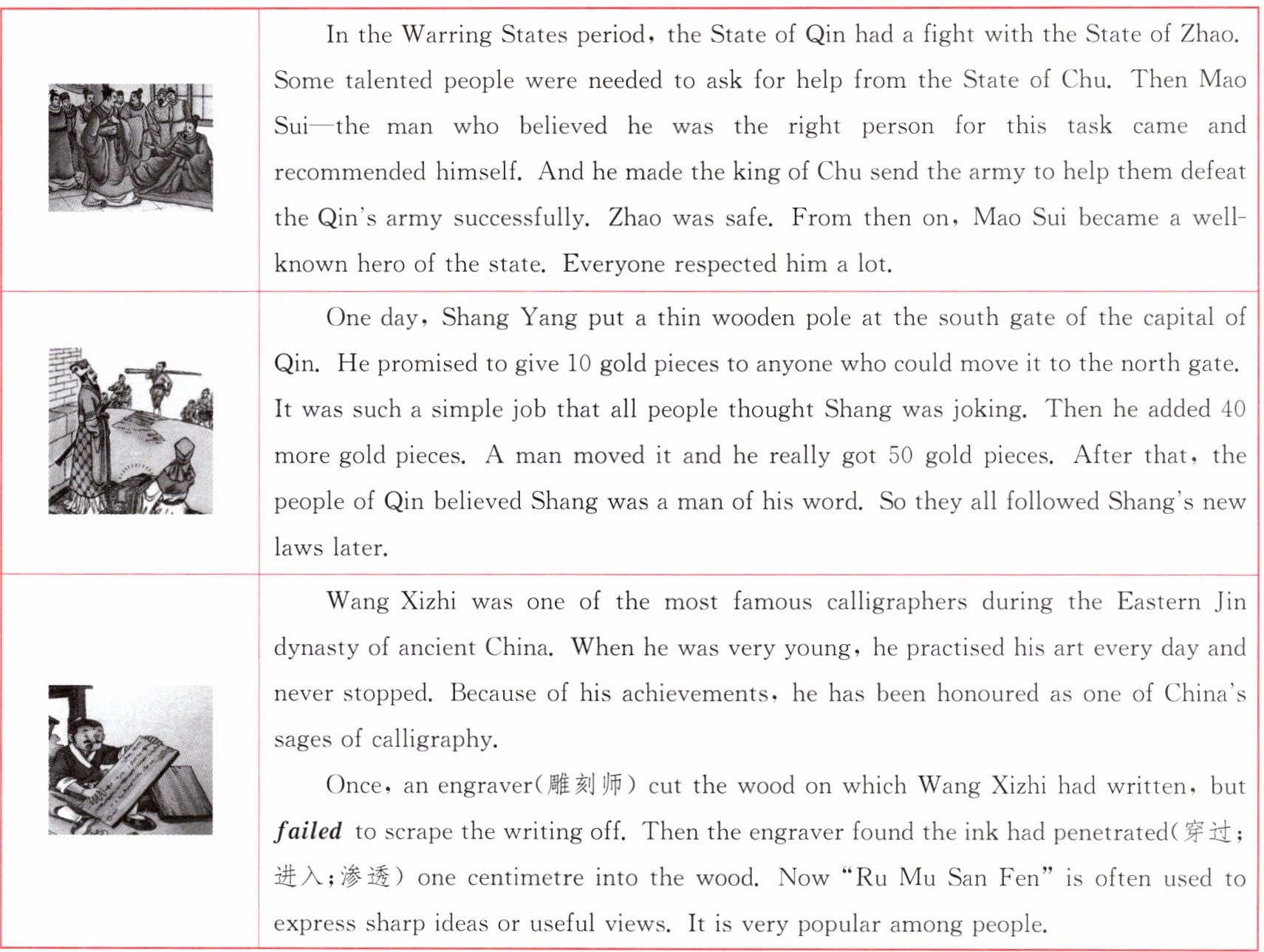
In the Warring States period, the State of Qin had a fight with the State of Zhao. Some talented people were needed to ask for help from the State of Chu. Then Mao Sui—the man who believed he was the right person for this task came and recommended himself. And he made the king of Chu send the army to help them defeat the Qin's army successfully. Zhao was safe. From then on, Mao Sui became a well-known hero of the state. Everyone respected him a lot.
One day, Shang Yang put a thin wooden pole at the south gate of the capital of Qin. He promised to give 10 gold pieces to anyone who could move it to the north gate. It was such a simple job that all people thought Shang was joking. Then he added 40 more gold pieces. A man moved it and he really got 50 gold pieces. After that, the people of Qin believed Shang was a man of his word. So they all followed Shang's new laws later.
Wang Xizhi was one of the most famous calligraphers during the Eastern Jin dynasty of ancient China. When he was very young, he practised his art every day and never stopped. Because of his achievements, he has been honoured as one of China's sages of calligraphy.
Once, an engraver(雕刻师) cut the wood on which Wang Xizhi had written, butfailed to scrape the writing off. Then the engraver found the ink had penetrated(穿过;进入;渗透) one centimetre into the wood. Now "Ru Mu San Fen" is often used to express sharp ideas or useful views. It is very popular among people.
(
A. Qin B. Zhao C. Yan D. Chu
(
A. protect his state B. get people's trust C. have new friends D. make more money
(
A. Mao Sui recommended himself B. Building trust by using a wooden pole
C. Ru Mu San Fen D. Zhuang Zhou dreamed of a butterfly
(
A. Mao Sui B. Shang Yang C. Wang Xizhi D. Yu Boya
(
A. online shopping website B. morning news report
C. food magazine D. storybook
A
KEY→P23
范畴:人与社会 主题:传统故事 体裁:应用文 难度:★★★ 建议用时:7分钟 评价:/5
Here are three traditional Chinese stories. They are all interesting and educational.
In the Warring States period, the State of Qin had a fight with the State of Zhao. Some talented people were needed to ask for help from the State of Chu. Then Mao Sui—the man who believed he was the right person for this task came and recommended himself. And he made the king of Chu send the army to help them defeat the Qin's army successfully. Zhao was safe. From then on, Mao Sui became a well-known hero of the state. Everyone respected him a lot.
One day, Shang Yang put a thin wooden pole at the south gate of the capital of Qin. He promised to give 10 gold pieces to anyone who could move it to the north gate. It was such a simple job that all people thought Shang was joking. Then he added 40 more gold pieces. A man moved it and he really got 50 gold pieces. After that, the people of Qin believed Shang was a man of his word. So they all followed Shang's new laws later.
Wang Xizhi was one of the most famous calligraphers during the Eastern Jin dynasty of ancient China. When he was very young, he practised his art every day and never stopped. Because of his achievements, he has been honoured as one of China's sages of calligraphy.
Once, an engraver(雕刻师) cut the wood on which Wang Xizhi had written, but
(
B
)1. From the material, we know Mao Sui was from B
.A. Qin B. Zhao C. Yan D. Chu
(
B
)2. Shang Yang's story tells us a man of his word can B
.A. protect his state B. get people's trust C. have new friends D. make more money
(
C
)3. We usually use "C
" to express sharp ideas or useful views.A. Mao Sui recommended himself B. Building trust by using a wooden pole
C. Ru Mu San Fen D. Zhuang Zhou dreamed of a butterfly
(
A
)4. People should learn from A
to catch each chance in front of challenges.A. Mao Sui B. Shang Yang C. Wang Xizhi D. Yu Boya
(
D
)5. 新考法·出处推断 The material may come from a(n) D
.A. online shopping website B. morning news report
C. food magazine D. storybook
答案
[A] B B C A D
本材料主要讲述了三则中国传统故事,即毛遂自荐、立木取信和入木三分。
1. B 推理判断题。由第一个故事可知,秦国攻打赵国,赵国需要楚国的帮助,毛遂去说服楚国帮助赵国,最终赵国平安了。因此可判断,毛遂来自赵国。
2. B 推理判断题。根据第二个故事中“After that, the people of Qin believed Shang was a man of his word.”可推知,言而有信的人可以得到人们的信任。
3. C 细节理解题。由第三个故事中“Now 'Ru Mu San Fen' is often used to express sharp ideas or useful views.”可知答案。
4. A 推理判断题。由第一个故事可知,面对挑战,我们要抓住每一次机会,因此我们要向毛遂学习。
5. D 出处推断题。根据材料内容可知,讲述的是三则中国传统故事,因此可推断,该材料来自一本故事书。
本材料主要讲述了三则中国传统故事,即毛遂自荐、立木取信和入木三分。
1. B 推理判断题。由第一个故事可知,秦国攻打赵国,赵国需要楚国的帮助,毛遂去说服楚国帮助赵国,最终赵国平安了。因此可判断,毛遂来自赵国。
2. B 推理判断题。根据第二个故事中“After that, the people of Qin believed Shang was a man of his word.”可推知,言而有信的人可以得到人们的信任。
3. C 细节理解题。由第三个故事中“Now 'Ru Mu San Fen' is often used to express sharp ideas or useful views.”可知答案。
4. A 推理判断题。由第一个故事可知,面对挑战,我们要抓住每一次机会,因此我们要向毛遂学习。
5. D 出处推断题。根据材料内容可知,讲述的是三则中国传统故事,因此可推断,该材料来自一本故事书。
解析
【分析】
本题是一篇介绍中国三个传统故事(毛遂自荐、立木取信、入木三分)的英语阅读理解题,包含5道不同类型的题目(推理判断、细节理解、出处推断)。解题时需先通读全文,把握每个故事的核心内容;再针对每道题,精准定位原文对应信息,结合题干要求逐一分析选项,排除干扰项,确定正确答案。
【解析】
1. 推理判断题:根据第一个故事内容,秦国攻打赵国,赵国需向楚国求助,毛遂成功说服楚国出兵助赵,最终赵国安全,由此可推断毛遂来自赵国,故选B。
2. 推理判断题:第二个故事中,商鞅兑现承诺给移木者50金后,秦国百姓相信他是言而有信的人,这说明言而有信的人能获得人们的信任,故选B。
3. 细节理解题:第三个故事明确提到“Now 'Ru Mu San Fen' is often used to express sharp ideas or useful views.”,直接对应选项C,故选C。
4. 推理判断题:第一个故事中毛遂主动推荐自己完成任务,体现了抓住挑战中的机会,因此应向毛遂学习,故选A。
5. 出处推断题:材料内容是三则中国传统故事,这类内容通常出自故事书,故选D。
【答案】
B B C A D
【知识点】
英语阅读理解、细节理解、推理判断
【点评】
本题以中国传统故事为载体,既考查学生的英语阅读能力,又融入了传统文化教育,题目类型全面,难度适中,能有效检验学生的阅读技巧和对文本的理解能力。
【难度系数】
0.6
本题是一篇介绍中国三个传统故事(毛遂自荐、立木取信、入木三分)的英语阅读理解题,包含5道不同类型的题目(推理判断、细节理解、出处推断)。解题时需先通读全文,把握每个故事的核心内容;再针对每道题,精准定位原文对应信息,结合题干要求逐一分析选项,排除干扰项,确定正确答案。
【解析】
1. 推理判断题:根据第一个故事内容,秦国攻打赵国,赵国需向楚国求助,毛遂成功说服楚国出兵助赵,最终赵国安全,由此可推断毛遂来自赵国,故选B。
2. 推理判断题:第二个故事中,商鞅兑现承诺给移木者50金后,秦国百姓相信他是言而有信的人,这说明言而有信的人能获得人们的信任,故选B。
3. 细节理解题:第三个故事明确提到“Now 'Ru Mu San Fen' is often used to express sharp ideas or useful views.”,直接对应选项C,故选C。
4. 推理判断题:第一个故事中毛遂主动推荐自己完成任务,体现了抓住挑战中的机会,因此应向毛遂学习,故选A。
5. 出处推断题:材料内容是三则中国传统故事,这类内容通常出自故事书,故选D。
【答案】
B B C A D
【知识点】
英语阅读理解、细节理解、推理判断
【点评】
本题以中国传统故事为载体,既考查学生的英语阅读能力,又融入了传统文化教育,题目类型全面,难度适中,能有效检验学生的阅读技巧和对文本的理解能力。
【难度系数】
0.6
