

 登录
登录
探究点1 everywhere 的用法
everywhere 意为“到处;所有地方”
副词
New factories are going up everywhere.
到处在兴建新工厂。
代词
We'll have to eat here—every-
where else is full. 我们只好在
这儿吃饭了——其他地方都
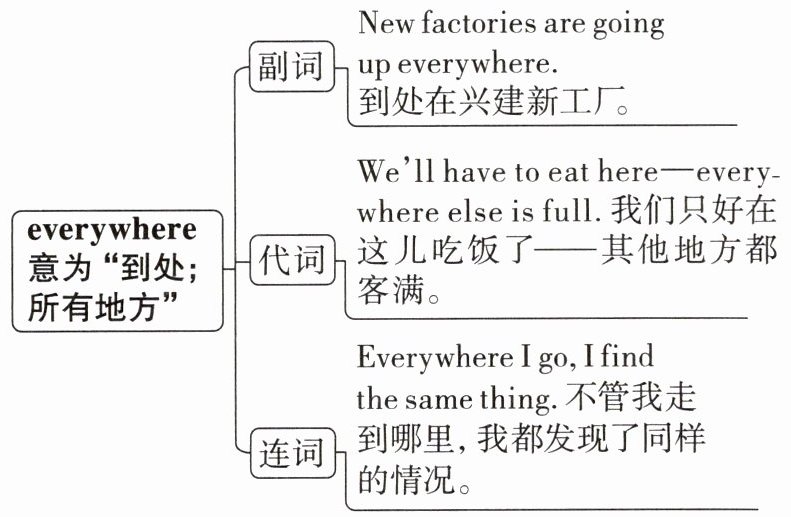 客满。
客满。
连词
Everywhere I go, I find
the same thing. 不管我走
到哪里, 我都发现了同样
的情况。
情境应用
1. The smell of fresh bread was in the house.(到处)
2. () You can see many beautiful flowers here and there in the garden.(选同义词)
A. somewhere B. anywhere
C. everywhere D. over there
everywhere 意为“到处;所有地方”
副词
New factories are going up everywhere.
到处在兴建新工厂。
代词
We'll have to eat here—every-
where else is full. 我们只好在
这儿吃饭了——其他地方都
客满。连词
Everywhere I go, I find
the same thing. 不管我走
到哪里, 我都发现了同样
的情况。
情境应用
1. The smell of fresh bread was in the house.(到处)
2. () You can see many beautiful flowers here and there in the garden.(选同义词)
A. somewhere B. anywhere
C. everywhere D. over there
答案
1. everywhere 2. C
解析
1. 本题考查everywhere的含义,根据括号内中文提示“到处”,此处填everywhere,在句中作地点状语,符合“新鲜面包的香气满屋子都是”的句意。
2. 本题考查词义辨析,划线短语here and there意为“到处、各处”:A选项somewhere意为“在某处”;B选项anywhere意为“任何地方”,多用于否定句或疑问句;C选项everywhere意为“到处、所有地方”,和here and there是同义表达;D选项over there意为“在那边”,因此选C。
2. 本题考查词义辨析,划线短语here and there意为“到处、各处”:A选项somewhere意为“在某处”;B选项anywhere意为“任何地方”,多用于否定句或疑问句;C选项everywhere意为“到处、所有地方”,和here and there是同义表达;D选项over there意为“在那边”,因此选C。
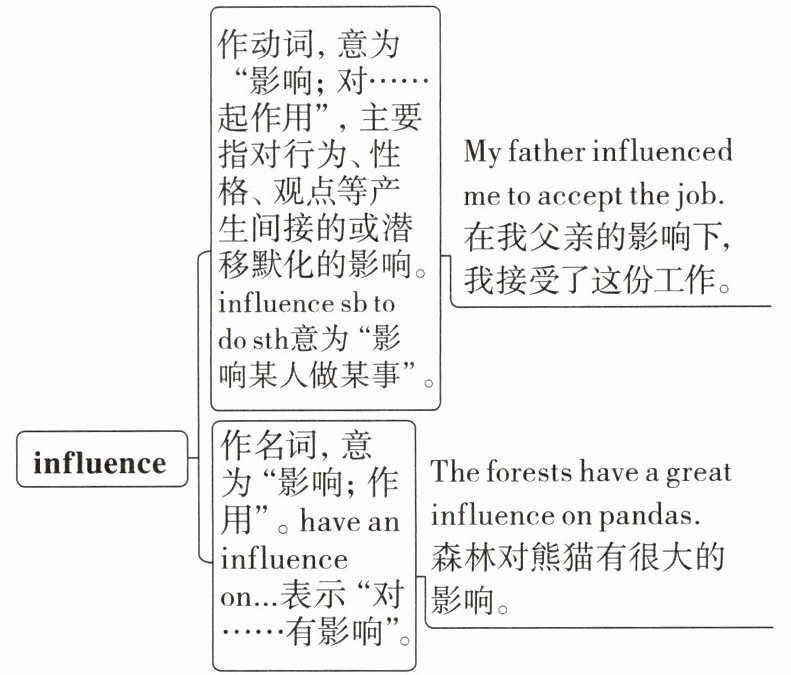
探究点2 influence 的用法
情境应用
1. Bob influenced me soft music.
(love)
2. School life a child. (有很大的影响)
情境应用
1. Bob influenced me soft music.
(love)
2. School life a child. (有很大的影响)
答案
1. to love
2. has a great influence on
2. has a great influence on
解析
1. 考查influence作动词的固定搭配influence sb to do sth,意为“影响某人做某事”,此处给出提示词love,因此填入love的不定式形式。
2. 考查influence作名词的固定搭配have a great influence on...,意为“对……有很大的影响”,主语School life是单数,句子描述客观事实用一般现在时,谓语动词用第三人称单数形式has。
2. 考查influence作名词的固定搭配have a great influence on...,意为“对……有很大的影响”,主语School life是单数,句子描述客观事实用一般现在时,谓语动词用第三人称单数形式has。
() 1. We had a party last night, and many came to join us.
A.guests
B.hosts
C.guides
D.hostesses
A.guests
B.hosts
C.guides
D.hostesses
答案
A
解析
辨析各选项词义:A. guests 客人;B. hosts 主人;C. guides 导游;D. hostesses 女主人。根据语境“我们昨晚举办了一场派对”,来加入派对的符合逻辑的身份是客人,只有A项符合句意。
() 2. Regular reading helps students good study habits.
A.happen
B.make
C.develop
D.describe
A.happen
B.make
C.develop
D.describe
答案
C
解析
辨析各选项词义:A. happen意为发生,不符合语境;B. make意为制作、使得,无make good habits的常用搭配;C. develop意为养成、发展,develop good study habits是固定搭配,表示养成良好的学习习惯,契合句意;D. describe意为描述,不符合语境。因此正确答案是C。
() 3. The snowman after the sun came out.
A.brought
B.added
C.disappeared
D.arrived
A.brought
B.added
C.disappeared
D.arrived
答案
C
解析
先理解句子含义:太阳出来后,雪人发生了某个动作。辨析各选项词义:A. brought 带来;B. added 添加;C. disappeared 消失;D. arrived 到达。结合生活常识,雪人在太阳出来后会融化消失,只有C符合语境逻辑。
()4. I am happy to your invitation to the party.
A.accept
B.communicate
C.share
D.answer
A.accept
B.communicate
C.share
D.answer
答案
A
解析
辨析各选项词义与用法:A. accept意为接受;B. communicate意为交流,常搭配介词with;C. share意为分享,常搭配介词with;D. answer意为回答,多用于回应问题等。句意为“我很高兴接受你的派对邀请”,只有A项符合语境。
() 5. After years of training, he became an musician, performing in famous concerts.
A.expert
B.outgoing
C.energetic
D.organized
A.expert
B.outgoing
C.energetic
D.organized
答案
A
解析
先明确各选项含义:A. expert专业的、熟练的;B. outgoing外向的;C. energetic精力充沛的;D. organized有条理的。根据语境“经过多年训练、能在知名音乐会演出”,只有“专业的”符合语义逻辑,同时空格前有不定冠词an,要求修饰的形容词以元音音素开头,A项符合所有要求。
