

 登录
登录
() 1. There isn't on TV. Let's go for a walk.
A.new something
B.new anything
C.something new
D.anything new
A.new something
B.new anything
C.something new
D.anything new
答案
D
解析
首先,形容词修饰不定代词时要放在不定代词的后面,可直接排除形容词前置的A、B选项。其次,本句为否定句,否定句中使用不定代词anything,something多用于肯定句,排除C选项,得到正确答案。
() 2. There isn't in the classroom.
All the students are having a PE lesson on the playground.
A.somebody
B.anybody
C.nobody
D.everybody
All the students are having a PE lesson on the playground.
A.somebody
B.anybody
C.nobody
D.everybody
答案
B
解析
本题考查不定代词用法。否定句中表示“任何人”需用anybody;somebody多用于肯定句,nobody自身表否定,和句中isn't构成双重否定逻辑矛盾,everybody不符合语境,由此确定答案。
() 3. —Look! is drawing under the tree.
—Oh, that’s my classmate Bob.
A.Someone
B.No one
—Oh, that’s my classmate Bob.
A.Someone
B.No one
答案
A
解析
根据答语“那是我的同学Bob”,可知此处要表达有人正在树下画画。Someone意为“某人、有人”,符合语境;No one意为“没有人”,和答语内容矛盾,因此选A。
() 4. —How is Helen in the new school?
—She is doing very well. There is to worry about.
A.something
B.anything
C.nothing
D.everything
—She is doing very well. There is to worry about.
A.something
B.anything
C.nothing
D.everything
答案
C
解析
先理解语境,答句前半部分表明Helen在新学校表现很好,由此可推知后半句表达“没有什么可担心的”。逐一辨析选项不定代词含义:A.something意为某事,多用于肯定句;B.anything意为任何事,多用于否定句或疑问句;C.nothing意为没有什么,表否定含义;D.everything意为所有事。结合语境符合的是nothing。
() 5. —Did you see in the museum today?
—Of course. I really liked some of the old things.
A.special anything
B.anything special
C.something interesting
D.interesting something
—Of course. I really liked some of the old things.
A.special anything
B.anything special
C.something interesting
D.interesting something
答案
B
解析
首先,这是一般疑问句,疑问句中要使用不定代词anything,不用something,据此排除C、D选项;其次,形容词修饰不定代词时,要放在不定代词的后面,因此正确结构为anything special,排除A选项。
探究点1 ready 的用法
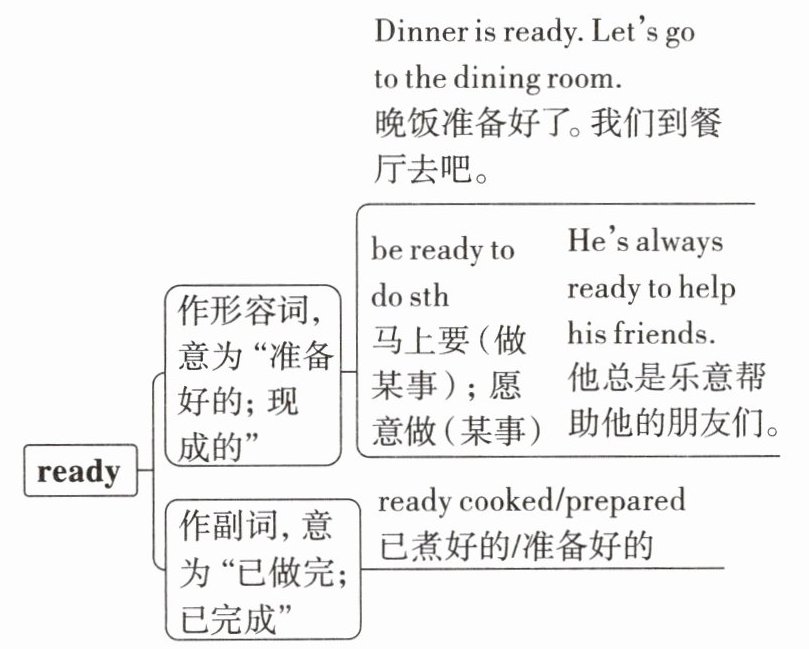
Dinner is ready. Let’s go
to the dining room.
晚饭准备好了。我们到餐
厅去吧。
ready
作形容词,
意为“准备
好的;现
成的”
be ready to
do sth 马上要(做
某事);愿
意做(某事)
He’s always
ready to help
his friends.
他总是乐意帮
助他的朋友们。
作副词,意
为“已做完;
已完成”
ready cooked/prepared
已煮好的/准备好的
情境应用
1. Can you help me for
the party?(准备好一切)
2. Two hours later, she was finally ready
. (leave)
3. I the meeting.(做好准备)
Dinner is ready. Let’s go
to the dining room.
晚饭准备好了。我们到餐
厅去吧。
ready
作形容词,
意为“准备
好的;现
成的”
be ready to
do sth 马上要(做
某事);愿
意做(某事)
He’s always
ready to help
his friends.
他总是乐意帮
助他的朋友们。
作副词,意
为“已做完;
已完成”
ready cooked/prepared
已煮好的/准备好的
情境应用
1. Can you help me for
the party?(准备好一切)
2. Two hours later, she was finally ready
. (leave)
3. I the meeting.(做好准备)
答案
1. (to) get everything ready
2. to leave
3. am ready for / get ready for
2. to leave
3. am ready for / get ready for
解析
本题考查形容词ready的常见固定搭配用法:
1. 第一空要表达“准备好一切”,对应短语get everything ready,同时help sb (to) do sth是固定结构,意为“帮助某人做某事”,符合句子语境。
2. 第二空考察核心搭配be ready to do sth,意为“准备好做某事”,括号给出提示动词leave,直接使用其不定式形式即可。
3. 第三空要表达“为会议做好准备”,对应固定搭配be ready for sth / get ready for sth,主语是I,一般现在时中be动词用am,符合语义和语法要求。
1. 第一空要表达“准备好一切”,对应短语get everything ready,同时help sb (to) do sth是固定结构,意为“帮助某人做某事”,符合句子语境。
2. 第二空考察核心搭配be ready to do sth,意为“准备好做某事”,括号给出提示动词leave,直接使用其不定式形式即可。
3. 第三空要表达“为会议做好准备”,对应固定搭配be ready for sth / get ready for sth,主语是I,一般现在时中be动词用am,符合语义和语法要求。
用bore的适当形式填空
1. I'm with watching the same show every evening.
2. Today is a day.
1. I'm with watching the same show every evening.
2. Today is a day.
答案
1. bored 2. boring
解析
我们需要区分bore的两个常见形容词变形:bored用来描述人的主观感受,意为“感到厌烦的”,有固定搭配be bored with,表示“对……感到厌烦”;boring用来修饰事物,意为“无聊的、令人厌烦的”,说明事物本身的属性。第1题主语是I,表达人的感受,符合be bored with的搭配用法;第2题修饰名词day,描述日子本身是无趣的,要用修饰事物的boring。
