

 登录
登录
三、按要求完成句子
1. Mr. Wang will put the result of the competition on the school notice board tomorrow.(改为被动语态)
The result of the competition
notice board by Mr. Wang tomorrow.
2. Her suggestions will be taken.(变为否定句)
Her suggestions
3. Chinese will be spoken by more people in the future.(改为主动句)
More people
4. Will this kind of technology be used to make cars?(做出否定回答)
No,
5. The new novel by this woman writer will be published next month.(就画线部分提问)
1. Mr. Wang will put the result of the competition on the school notice board tomorrow.(改为被动语态)
The result of the competition
will
be put
on the schoolnotice board by Mr. Wang tomorrow.
2. Her suggestions will be taken.(变为否定句)
Her suggestions
won't
be
taken
.3. Chinese will be spoken by more people in the future.(改为主动句)
More people
will
speak
Chinese in the future.4. Will this kind of technology be used to make cars?(做出否定回答)
No,
it
won't
.5. The new novel by this woman writer will be published next month.(就画线部分提问)
When
will
the new novel by this woman writer be
published
?答案
三、1. will be put 2. won't be taken
3. will speak 4. it won't
5. When will; be published
3. will speak 4. it won't
5. When will; be published
解析
【分析】
本题考查一般将来时被动语态相关的句型转换,解题思路如下:
1. 主动句改被动句:需将原主动句的宾语变为被动句主语,一般将来时被动结构为“will + be + 动词过去分词”,据此转换。
2. 被动句改否定句:一般将来时被动句的否定式在助动词will后加not(缩写为won't),后接be + 过去分词。
3. 被动句改主动句:将原被动句的动作执行者(by后的成分)变为主语,时态保持一般将来时,谓语用主动形式。
4. 一般将来时被动一般疑问句的否定回答:用it指代问句主语,否定回答为“No, 主语+won't”。
5. 对时间状语提问:用疑问词When,剩余部分将助动词will提前构成疑问句语序。
【解析】
1. 原句是一般将来时主动句,宾语the result of the competition作被动主语,被动结构为will be + put(put的过去分词),故填will be put。
2. 一般将来时被动句变否定,在will后加not,缩写为won't,后接be taken,故填won't be taken。
3. 原被动句的动作执行者more people作主动主语,时态为一般将来时,谓语用will + speak,故填will speak。
4. 问句主语this kind of technology用it指代,一般将来时否定回答为it won't,故填it won't。
5. 对时间状语next month提问用When,剩余部分将助动词will提前,构成When will; be published,故填When will; be published。
【答案】
1. will be put 2. won't be taken 3. will speak 4. it won't 5. When will; be published
【知识点】
一般将来时被动语态、句型转换
【点评】
本题围绕一般将来时被动语态设置句型转换题,涵盖主动变被动、否定句、主动句、一般疑问句回答、特殊疑问句等基础考点,是初中英语的核心基础题型,需熟练掌握被动语态的结构及各类句式转换规则。
【难度系数】
0.3
本题考查一般将来时被动语态相关的句型转换,解题思路如下:
1. 主动句改被动句:需将原主动句的宾语变为被动句主语,一般将来时被动结构为“will + be + 动词过去分词”,据此转换。
2. 被动句改否定句:一般将来时被动句的否定式在助动词will后加not(缩写为won't),后接be + 过去分词。
3. 被动句改主动句:将原被动句的动作执行者(by后的成分)变为主语,时态保持一般将来时,谓语用主动形式。
4. 一般将来时被动一般疑问句的否定回答:用it指代问句主语,否定回答为“No, 主语+won't”。
5. 对时间状语提问:用疑问词When,剩余部分将助动词will提前构成疑问句语序。
【解析】
1. 原句是一般将来时主动句,宾语the result of the competition作被动主语,被动结构为will be + put(put的过去分词),故填will be put。
2. 一般将来时被动句变否定,在will后加not,缩写为won't,后接be taken,故填won't be taken。
3. 原被动句的动作执行者more people作主动主语,时态为一般将来时,谓语用will + speak,故填will speak。
4. 问句主语this kind of technology用it指代,一般将来时否定回答为it won't,故填it won't。
5. 对时间状语next month提问用When,剩余部分将助动词will提前,构成When will; be published,故填When will; be published。
【答案】
1. will be put 2. won't be taken 3. will speak 4. it won't 5. When will; be published
【知识点】
一般将来时被动语态、句型转换
【点评】
本题围绕一般将来时被动语态设置句型转换题,涵盖主动变被动、否定句、主动句、一般疑问句回答、特殊疑问句等基础考点,是初中英语的核心基础题型,需熟练掌握被动语态的结构及各类句式转换规则。
【难度系数】
0.3
一、根据中文意思完成句子
1. 为了学好英语,王俊峰在这个学期初就设定了目标。
Wang Junfeng ______ ______ ______ to learn English well at the beginning of this term.
2. 我表妹每天都自学俄语。
My cousin Russian every day.
3. 你最好穿厚衣服,因为外边很冷。
your heavy coat, because it's very cold outside.
4. 我叔叔怀特先生去过哈尔滨两次了。
My uncle, Mr. White, Harbin twice.
5. 你进入大学后首先应该制订学习计划。
You should first when you enter university.
1. 为了学好英语,王俊峰在这个学期初就设定了目标。
Wang Junfeng ______ ______ ______ to learn English well at the beginning of this term.
2. 我表妹每天都自学俄语。
My cousin Russian every day.
3. 你最好穿厚衣服,因为外边很冷。
your heavy coat, because it's very cold outside.
4. 我叔叔怀特先生去过哈尔滨两次了。
My uncle, Mr. White, Harbin twice.
5. 你进入大学后首先应该制订学习计划。
You should first when you enter university.
答案
1. set a goal 2. teaches herself
3. You'd better wear 4. has been to
5. make a study plan
3. You'd better wear 4. has been to
5. make a study plan
解析
【分析】
本题为根据中文意思完成句子的基础题型,需结合句子的时间状语、中文含义,匹配对应的英语固定短语、句式及时态来填写正确内容。解题思路:1. 对应“设定目标”的固定搭配,结合时态确定动词形式;2. “自学”需用反身代词搭配teach,注意主语的单三形式;3. “最好做某事”是固定句式You'd better do sth;4. “去过某地(已返回)”用现在完成时的固定表达;5. “制订学习计划”是固定短语,should后接动词原形。
【解析】
1. “设定目标”的固定短语为set a goal,句子时间为过去的学期初,set的过去式仍为set,故填set a goal;
2. “自学”的固定搭配是teach oneself,主语my cousin是第三人称单数,一般现在时,teach变单三teaches,搭配反身代词herself,故填teaches herself;
3. “你最好做某事”的固定句式为You'd better + 动词原形,“穿”对应wear,故填You'd better wear;
4. “去过某地(已返回)”的现在完成时表达为have been to,主语是第三人称单数,故用has been to;
5. “制订学习计划”的固定短语是make a study plan,should后接动词原形,故填make a study plan。
【答案】
1. set a goal 2. teaches herself 3. You'd better wear 4. has been to 5. make a study plan
【知识点】
固定短语搭配、动词时态、固定句式
【点评】
本题考查英语基础的固定搭配、句式及时态的运用,题型简单,侧重基础知识的掌握,适合巩固英语基础。
【难度系数】
0.7
本题为根据中文意思完成句子的基础题型,需结合句子的时间状语、中文含义,匹配对应的英语固定短语、句式及时态来填写正确内容。解题思路:1. 对应“设定目标”的固定搭配,结合时态确定动词形式;2. “自学”需用反身代词搭配teach,注意主语的单三形式;3. “最好做某事”是固定句式You'd better do sth;4. “去过某地(已返回)”用现在完成时的固定表达;5. “制订学习计划”是固定短语,should后接动词原形。
【解析】
1. “设定目标”的固定短语为set a goal,句子时间为过去的学期初,set的过去式仍为set,故填set a goal;
2. “自学”的固定搭配是teach oneself,主语my cousin是第三人称单数,一般现在时,teach变单三teaches,搭配反身代词herself,故填teaches herself;
3. “你最好做某事”的固定句式为You'd better + 动词原形,“穿”对应wear,故填You'd better wear;
4. “去过某地(已返回)”的现在完成时表达为have been to,主语是第三人称单数,故用has been to;
5. “制订学习计划”的固定短语是make a study plan,should后接动词原形,故填make a study plan。
【答案】
1. set a goal 2. teaches herself 3. You'd better wear 4. has been to 5. make a study plan
【知识点】
固定短语搭配、动词时态、固定句式
【点评】
本题考查英语基础的固定搭配、句式及时态的运用,题型简单,侧重基础知识的掌握,适合巩固英语基础。
【难度系数】
0.7
二、阅读理解
根据短文内容,从短文后所给的选项中选出能填入空白处的最佳选项。
With the rapid development of China, more and more foreign friends are interested in Chinese now, and my pen pal Mike is one of them. He is from Canada and has learned Chinese for one year. 1.
asks me for some advice about how to learn Chinese well.
At first, Mike, like many other foreigners, thought Chinese was the most difficult language in the world. Its pronunciation and writing style are very different from other languages such as English and French. He couldn't speak Chinese correctly, and he mixed up similar words like mum and horse in Chinese. He also found it hard to write Chinese words neatly. 2.
In my reply, I encouraged him to stick to learning Chinese because it's meaningful for him. I gave him some suggestions. I told him to listen to Chinese children's songs and watch Chinese cartoons for kids. They are helpful for imitating Chinese pronunciation. I also asked him to write a few Chinese words every day and send them to me for checking. 3.
Now, he can write simple sentences like “Ni hao” and “Xie xie” correctly. He can even read short Chinese stories for kids.
Mike says learning Chinese helps him know more about China. It's an amazing experience. 4.
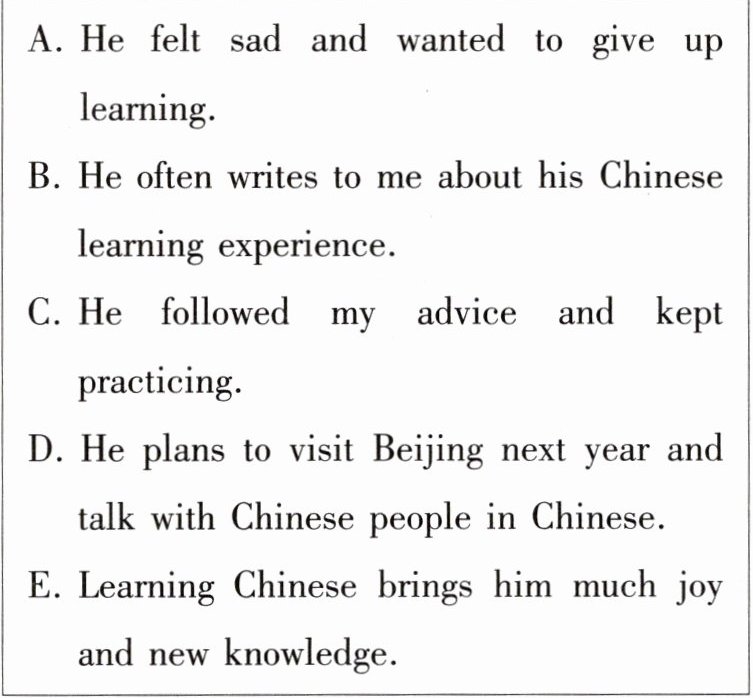
根据短文内容,从短文后所给的选项中选出能填入空白处的最佳选项。
With the rapid development of China, more and more foreign friends are interested in Chinese now, and my pen pal Mike is one of them. He is from Canada and has learned Chinese for one year. 1.
B
And he alsoasks me for some advice about how to learn Chinese well.
At first, Mike, like many other foreigners, thought Chinese was the most difficult language in the world. Its pronunciation and writing style are very different from other languages such as English and French. He couldn't speak Chinese correctly, and he mixed up similar words like mum and horse in Chinese. He also found it hard to write Chinese words neatly. 2.
A
So he emailed me and wanted to get some help.In my reply, I encouraged him to stick to learning Chinese because it's meaningful for him. I gave him some suggestions. I told him to listen to Chinese children's songs and watch Chinese cartoons for kids. They are helpful for imitating Chinese pronunciation. I also asked him to write a few Chinese words every day and send them to me for checking. 3.
C
Now, he can write simple sentences like “Ni hao” and “Xie xie” correctly. He can even read short Chinese stories for kids.
Mike says learning Chinese helps him know more about China. It's an amazing experience. 4.
D
He thinks Chinese is a beautiful language, and he will never stop learning it. 5. E
He wishes that Chinese would be taught in more Canadian schools so that more Canadian students can know about the uniqueness of Chinese.答案
1. B 2. A 3. C 4. D 5. E
解析
【分析】
本题为英语阅读理解句子填空题,需结合上下文语境选择合适句子。解题思路:先通读全文理解主旨(外国朋友Mike学习中文的经历),再逐个分析空格前后内容,匹配符合逻辑的选项。1. 第1空:前文提Mike学中文一年,后文说他请教建议,选项B衔接学习交流的语境;2. 第2空:前文说Mike遇学习困难,后文说他求助,选项A体现困难后的负面反应;3. 第3空:前文是“我”给的学习建议,选项C说明Mike的行动;4. 第4空:前文说学习中文的好处,选项D是他的具体计划;5. 第5空:后文说他希望中文推广,选项E说明他坚持学习的原因。
【解析】
1. 第1空:根据前文“has learned Chinese for one year”和后文“asks me for some advice”,选项B“他经常写信给我讲中文学习经历”符合交流语境,故选B;
2. 第2空:前文描述Mike学习中文的诸多困难,后文“wanted to get some help”说明他有负面情绪,选项A“他感到难过想放弃学习”衔接合理,故选A;
3. 第3空:前文是“我”给出的学习建议,选项C“他听从我的建议坚持练习”承接上文建议,说明Mike的行动,故选C;
4. 第4空:前文说学习中文让Mike更了解中国,选项D“他计划明年去北京用中文和中国人交流”是他学习后的具体计划,符合逻辑,故选D;
5. 第5空:后文说他希望中文在加拿大更多学校开设,选项E“学习中文带给他很多快乐和新知识”是他坚持学习的原因,衔接自然,故选E。
【答案】
1.B 2.A 3.C 4.D 5.E
【知识点】
英语阅读理解、语境理解
【点评】
本题考查英语阅读理解句子填空,重点考查学生对上下文逻辑关系的分析能力,需结合文章细节和句子间的关联选择,难度适中。
【难度系数】
0.6
本题为英语阅读理解句子填空题,需结合上下文语境选择合适句子。解题思路:先通读全文理解主旨(外国朋友Mike学习中文的经历),再逐个分析空格前后内容,匹配符合逻辑的选项。1. 第1空:前文提Mike学中文一年,后文说他请教建议,选项B衔接学习交流的语境;2. 第2空:前文说Mike遇学习困难,后文说他求助,选项A体现困难后的负面反应;3. 第3空:前文是“我”给的学习建议,选项C说明Mike的行动;4. 第4空:前文说学习中文的好处,选项D是他的具体计划;5. 第5空:后文说他希望中文推广,选项E说明他坚持学习的原因。
【解析】
1. 第1空:根据前文“has learned Chinese for one year”和后文“asks me for some advice”,选项B“他经常写信给我讲中文学习经历”符合交流语境,故选B;
2. 第2空:前文描述Mike学习中文的诸多困难,后文“wanted to get some help”说明他有负面情绪,选项A“他感到难过想放弃学习”衔接合理,故选A;
3. 第3空:前文是“我”给出的学习建议,选项C“他听从我的建议坚持练习”承接上文建议,说明Mike的行动,故选C;
4. 第4空:前文说学习中文让Mike更了解中国,选项D“他计划明年去北京用中文和中国人交流”是他学习后的具体计划,符合逻辑,故选D;
5. 第5空:后文说他希望中文在加拿大更多学校开设,选项E“学习中文带给他很多快乐和新知识”是他坚持学习的原因,衔接自然,故选E。
【答案】
1.B 2.A 3.C 4.D 5.E
【知识点】
英语阅读理解、语境理解
【点评】
本题考查英语阅读理解句子填空,重点考查学生对上下文逻辑关系的分析能力,需结合文章细节和句子间的关联选择,难度适中。
【难度系数】
0.6
