

 登录
登录
Ⅶ.阅读水的来源和使用,将下列信息排序。
A. Water goes into our homes. It comes out of the tap.
B. Water isn't clean in the seas and rivers. We cannot drink it. It goes to a water factory.
C. Now we can use water to wash our hands and clothes at home.
D. Water comes from the rain. It falls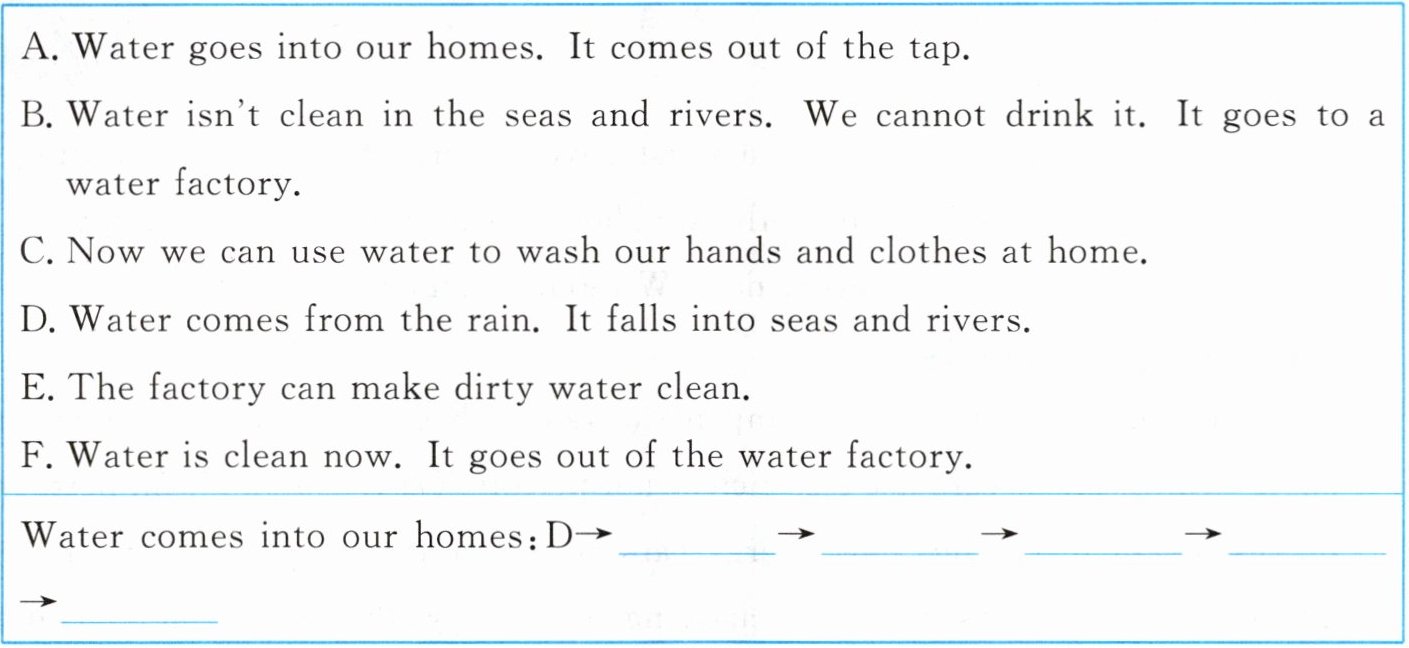 into seas and rivers.
E. The factory can make dirty water clean.
F. Water is clean now. It goes out of the water factory.
Water comes into our homes:D→→→→→
A. Water goes into our homes. It comes out of the tap.
B. Water isn't clean in the seas and rivers. We cannot drink it. It goes to a water factory.
C. Now we can use water to wash our hands and clothes at home.
D. Water comes from the rain. It falls
into seas and rivers.E. The factory can make dirty water clean.
F. Water is clean now. It goes out of the water factory.
Water comes into our homes:D→→→→→
答案
B→E→F→A→C
解析
【分析】本题需梳理水从自然来源到家庭使用的完整流程,先确定起点D(水来自雨水,流入江河),再按逻辑推导后续步骤:江河的水不干净需送往水厂、水厂净化脏水、净化后水流出水厂、水进入家庭从水龙头出来、最后家庭使用水,以此完成排序。
【解析】首先,水的自然来源是D:雨水形成后流入江河;接着B说明江河的水不干净,无法直接饮用,需送往水厂;然后E指出水厂能将脏水净化;净化后的干净水从水厂流出对应F;之后水进入家庭,从水龙头出来是A;最后在家中使用水对应C,因此排序为D→B→E→F→A→C。
【答案】B→E→F→A→C
【知识点】英语阅读理解、语篇逻辑排序、水的净化常识
【点评】本题通过梳理水的来源、净化、输送及使用的流程,考查学生对语篇逻辑的理解能力,需理清事件的先后顺序。
【难度系数】0.5
【解析】首先,水的自然来源是D:雨水形成后流入江河;接着B说明江河的水不干净,无法直接饮用,需送往水厂;然后E指出水厂能将脏水净化;净化后的干净水从水厂流出对应F;之后水进入家庭,从水龙头出来是A;最后在家中使用水对应C,因此排序为D→B→E→F→A→C。
【答案】B→E→F→A→C
【知识点】英语阅读理解、语篇逻辑排序、水的净化常识
【点评】本题通过梳理水的来源、净化、输送及使用的流程,考查学生对语篇逻辑的理解能力,需理清事件的先后顺序。
【难度系数】0.5
Ⅷ. 从方框中选择合适的选项补全对话。
Ms Guo: Hi, everybody. Let's talk about water. 1.
Alice: It comes from the sea, the lake and the river.
Kitty: It also comes from the rain, the snow and the tap.
Ms Guo: You are right. 2.
Alice: Firemen use water to put out fires.
Kitty: 3. And we use water to drink, cook and do some cleaning.
Ms Guo: Yes. 4. But now there is not enough water for people. What should we do?
Kitty: 5.
Alice: And we should not waste water.
Ms Guo: Very good.
A. Farmers use water to grow crops.
B. Where does water come from?
C. We should save water.
D. Water is very useful.
E. How do people use water?
Ms Guo: Hi, everybody. Let's talk about water. 1.
Alice: It comes from the sea, the lake and the river.
Kitty: It also comes from the rain, the snow and the tap.
Ms Guo: You are right. 2.
Alice: Firemen use water to put out fires.
Kitty: 3. And we use water to drink, cook and do some cleaning.
Ms Guo: Yes. 4. But now there is not enough water for people. What should we do?
Kitty: 5.
Alice: And we should not waste water.
Ms Guo: Very good.
A. Farmers use water to grow crops.
B. Where does water come from?
C. We should save water.
D. Water is very useful.
E. How do people use water?
答案
1. B 2. E 3. A 4. D 5. C
解析
【分析】
解答本题需结合对话上下文的问答逻辑,先通读对话明确话题为“水的来源、用途及节水”,再根据每空的答句反推问句,或根据问句匹配答句:1. 答句说明水的来源,故问句问“水来自哪里”;2. 答句说明水的用途(消防员灭火),故问句问“人们如何用水”;3. 此处需补充水的另一用途,结合前后语境选农民的用途;4. 后文提到水不足,前文需说明水的重要性;5. 前文问该做什么,需给出节水的做法。
【解析】
1. 由答句“It comes from the sea, the lake and the river.”可知,问句询问水的来源,对应选项B;
2. 由答句“Firemen use water to put out fires.”可知,问句询问水的用途,对应选项E;
3. 此处需补充水的用途,结合前后语境(列举不同群体用水),对应选项A;
4. 后文提到“现在没有足够的水”,前文需说明水的重要性,对应选项D;
5. 前文问“我们应该做什么”,需给出节水的做法,对应选项C。
【答案】
1. B 2. E 3. A 4. D 5. C
【知识点】
补全对话、情景交际
【点评】
本题为英语情景补全对话题,围绕“水”的话题展开,考查学生对日常对话语境的理解能力,属于基础题型,难度较低。
【难度系数】
0.8
解答本题需结合对话上下文的问答逻辑,先通读对话明确话题为“水的来源、用途及节水”,再根据每空的答句反推问句,或根据问句匹配答句:1. 答句说明水的来源,故问句问“水来自哪里”;2. 答句说明水的用途(消防员灭火),故问句问“人们如何用水”;3. 此处需补充水的另一用途,结合前后语境选农民的用途;4. 后文提到水不足,前文需说明水的重要性;5. 前文问该做什么,需给出节水的做法。
【解析】
1. 由答句“It comes from the sea, the lake and the river.”可知,问句询问水的来源,对应选项B;
2. 由答句“Firemen use water to put out fires.”可知,问句询问水的用途,对应选项E;
3. 此处需补充水的用途,结合前后语境(列举不同群体用水),对应选项A;
4. 后文提到“现在没有足够的水”,前文需说明水的重要性,对应选项D;
5. 前文问“我们应该做什么”,需给出节水的做法,对应选项C。
【答案】
1. B 2. E 3. A 4. D 5. C
【知识点】
补全对话、情景交际
【点评】
本题为英语情景补全对话题,围绕“水”的话题展开,考查学生对日常对话语境的理解能力,属于基础题型,难度较低。
【难度系数】
0.8
