

 登录
登录
一、根据句意及汉语提示填写单词
1. It's traditional Chinese virtue to
2. We can't eat
3. I hope
4. If you get the right answer, you can get a
5. There is a
1. It's traditional Chinese virtue to
respect
(尊敬) the old in China.2. We can't eat
snacks
(点心) in class in our school.3. I hope
everything
(一切) goes well with you.4. If you get the right answer, you can get a
sweet
(糖果).5. There is a
mobile
(移动的) library in our city.答案
一、1. respect 2. snacks 3. everything 4. sweet 5. mobile
解析
【分析】
解题思路:先通读每个句子,明确句子结构和所需单词的词性(如动词原形、名词单复数、形容词、不定代词等),再结合括号内的汉语提示,写出对应的正确单词,同时注意单词的形式变化(如名词复数、动词原形等),确保填入的单词符合句子语境和语法要求。
【解析】
1. 句中不定式符号to后需接动词原形,“尊敬”对应的动词是respect,故填respect;
2. 此处泛指课堂上不能吃的点心,需用名词复数形式,“点心”对应的名词是snack,复数为snacks,故填snacks;
3. “一切”对应的不定代词是everything,符合句意,故填everything;
4. 不定冠词a后接可数名词单数,“糖果”对应的名词是sweet,故填sweet;
5. 需用形容词修饰名词library,“移动的”对应的形容词是mobile,故填mobile。
【答案】
1. respect 2. snacks 3. everything 4. sweet 5. mobile
【知识点】
词汇运用、单词拼写、词性判断
【点评】
本题为基础词汇考查题,聚焦核心词汇的识记与运用,难度较低,只要学生平时积累常见词汇,掌握基本词性和词形变化,即可轻松作答,适合巩固基础词汇知识。
【难度系数】
0.8
解题思路:先通读每个句子,明确句子结构和所需单词的词性(如动词原形、名词单复数、形容词、不定代词等),再结合括号内的汉语提示,写出对应的正确单词,同时注意单词的形式变化(如名词复数、动词原形等),确保填入的单词符合句子语境和语法要求。
【解析】
1. 句中不定式符号to后需接动词原形,“尊敬”对应的动词是respect,故填respect;
2. 此处泛指课堂上不能吃的点心,需用名词复数形式,“点心”对应的名词是snack,复数为snacks,故填snacks;
3. “一切”对应的不定代词是everything,符合句意,故填everything;
4. 不定冠词a后接可数名词单数,“糖果”对应的名词是sweet,故填sweet;
5. 需用形容词修饰名词library,“移动的”对应的形容词是mobile,故填mobile。
【答案】
1. respect 2. snacks 3. everything 4. sweet 5. mobile
【知识点】
词汇运用、单词拼写、词性判断
【点评】
本题为基础词汇考查题,聚焦核心词汇的识记与运用,难度较低,只要学生平时积累常见词汇,掌握基本词性和词形变化,即可轻松作答,适合巩固基础词汇知识。
【难度系数】
0.8
二、在空白处填入适当的词或用括号中所给单词的适当形式填空
1. John
2. Thank you for
3. Please
4. —Would you like
—Tea, please.
5. There is a
6. When you leave the room, please turn them
1. John
has
(have) to leave home before 7:00.2. Thank you for
lending
(lend) me your new bike.3. Please
bring
(bring) two small boxes to class next week.4. —Would you like
to drink
(drink) tea or coffee?—Tea, please.
5. There is a
locker
(lock) for every student in our school.6. When you leave the room, please turn them
off
.答案
二、1. has 2. lending 3. bring 4. to drink 5. locker 6. off
解析
【分析】
本题为英语适当形式填空题,需结合语法规则、固定搭配及词性变形解题:1. 第1题根据主语人称和时态确定动词形式;2. 第2、4题依据介词、固定搭配判断非谓语形式;3. 第3题根据祈使句结构确定动词原形;4. 第5题进行词性转换,将动词变为名词;5. 第6题考查固定短语搭配。
【解析】
1. 主语John为第三人称单数,句子为一般现在时,故have用第三人称单数形式has;
2. 介词for后接动名词作宾语,lend的动名词形式为lending;
3. 祈使句以动词原形开头,故填bring;
4. 固定搭配would like to do sth.(想要做某事),故填to drink;
5. 此处需表示“储物柜”,将动词lock转换为名词locker;
6. 固定短语turn off(关闭),故填off。
【答案】
1. has 2. lending 3. bring 4. to drink 5. locker 6. off
【知识点】
一般现在时、非谓语动词、固定短语搭配
【点评】
本题考查初中英语基础语法,涵盖动词形式变化、非谓语用法、词性转换及固定搭配,题型常见,难度适中,需掌握基础语法规则即可解答。
【难度系数】
0.6
本题为英语适当形式填空题,需结合语法规则、固定搭配及词性变形解题:1. 第1题根据主语人称和时态确定动词形式;2. 第2、4题依据介词、固定搭配判断非谓语形式;3. 第3题根据祈使句结构确定动词原形;4. 第5题进行词性转换,将动词变为名词;5. 第6题考查固定短语搭配。
【解析】
1. 主语John为第三人称单数,句子为一般现在时,故have用第三人称单数形式has;
2. 介词for后接动名词作宾语,lend的动名词形式为lending;
3. 祈使句以动词原形开头,故填bring;
4. 固定搭配would like to do sth.(想要做某事),故填to drink;
5. 此处需表示“储物柜”,将动词lock转换为名词locker;
6. 固定短语turn off(关闭),故填off。
【答案】
1. has 2. lending 3. bring 4. to drink 5. locker 6. off
【知识点】
一般现在时、非谓语动词、固定短语搭配
【点评】
本题考查初中英语基础语法,涵盖动词形式变化、非谓语用法、词性转换及固定搭配,题型常见,难度适中,需掌握基础语法规则即可解答。
【难度系数】
0.6
三、句子翻译
1. —你愿意把你的钢笔借给我吗? —当然。
2. 我们不能把手机带到学校来。
3. 让我们遵守规则并过得开心。
4. 吃太多糖果对我们的牙齿没有好处。
5. 我们必须把手机关机并放在储物柜里。
1. —你愿意把你的钢笔借给我吗? —当然。
—Would you like to lend your pen to me? —Of course.
2. 我们不能把手机带到学校来。
We can't bring our mobile phones to school.
3. 让我们遵守规则并过得开心。
Let's follow the rules and have fun.
4. 吃太多糖果对我们的牙齿没有好处。
Eating too many sweets isn't good for our teeth.
5. 我们必须把手机关机并放在储物柜里。
We must turn off the mobile phones and put them in the lockers.
答案
三、1. —Would you like to lend your pen to me? —Of course.
2. We can't bring our mobile phones to school.
3. Let's follow the rules and have fun.
4. Eating too many sweets isn't good for our teeth.
5. We must turn off the mobile phones and put them in the lockers.
2. We can't bring our mobile phones to school.
3. Let's follow the rules and have fun.
4. Eating too many sweets isn't good for our teeth.
5. We must turn off the mobile phones and put them in the lockers.
解析
【分析】
本题为英语句子翻译题,解题思路为:先分析每句中文的句式类型(如疑问句、陈述句、祈使句等),再匹配对应的英语固定表达与语法结构:1. 第1题是委婉请求的日常疑问句,用Would you like to...结构,“借给某人”对应lend sth to sb;2. 第2题是含否定情态动词can't的陈述句,“把某物带到某地”用bring sth to sp;3. 第3题是Let's引导的提议类祈使句,“遵守规则”为follow the rules,“过得开心”为have fun;4. 第4题是动名词作主语的陈述句,“对……有好处”对应be good for;5. 第5题是含情态动词must的陈述句,“关机”为turn off,“把某物放在某处”用put sth in...,注意代词指代的正确性。
【解析】
1. —Would you like to lend your pen to me? —Of course.
2. We can't bring our mobile phones to school.
3. Let's follow the rules and have fun.
4. Eating too many sweets isn't good for our teeth.
5. We must turn off the mobile phones and put them in the lockers.
【答案】
三、1. —Would you like to lend your pen to me? —Of course.
2. We can't bring our mobile phones to school.
3. Let's follow the rules and have fun.
4. Eating too many sweets isn't good for our teeth.
5. We must turn off the mobile phones and put them in the lockers.
【知识点】
固定短语搭配、情态动词用法、动名词作主语
【点评】
本题考查日常英语表达的翻译,涵盖常用短语、情态动词及特殊句式,属于英语基础题型,需学生掌握核心词汇与固定搭配,难度适中,适合巩固日常交际用语基础。
【难度系数】
0.8
本题为英语句子翻译题,解题思路为:先分析每句中文的句式类型(如疑问句、陈述句、祈使句等),再匹配对应的英语固定表达与语法结构:1. 第1题是委婉请求的日常疑问句,用Would you like to...结构,“借给某人”对应lend sth to sb;2. 第2题是含否定情态动词can't的陈述句,“把某物带到某地”用bring sth to sp;3. 第3题是Let's引导的提议类祈使句,“遵守规则”为follow the rules,“过得开心”为have fun;4. 第4题是动名词作主语的陈述句,“对……有好处”对应be good for;5. 第5题是含情态动词must的陈述句,“关机”为turn off,“把某物放在某处”用put sth in...,注意代词指代的正确性。
【解析】
1. —Would you like to lend your pen to me? —Of course.
2. We can't bring our mobile phones to school.
3. Let's follow the rules and have fun.
4. Eating too many sweets isn't good for our teeth.
5. We must turn off the mobile phones and put them in the lockers.
【答案】
三、1. —Would you like to lend your pen to me? —Of course.
2. We can't bring our mobile phones to school.
3. Let's follow the rules and have fun.
4. Eating too many sweets isn't good for our teeth.
5. We must turn off the mobile phones and put them in the lockers.
【知识点】
固定短语搭配、情态动词用法、动名词作主语
【点评】
本题考查日常英语表达的翻译,涵盖常用短语、情态动词及特殊句式,属于英语基础题型,需学生掌握核心词汇与固定搭配,难度适中,适合巩固日常交际用语基础。
【难度系数】
0.8
一、阅读短文,从方框内所给选项中选出可以填入空白处的最佳选项,其中有一个多余的选项
After students study in a middle school, they may know that there are many rules at school. 1.
Maybe they don't have to wear school uniforms every day at the primary school. But many middle schools will ask students to wear uniforms, and they can't go into the classroom if they don't wear them. 2.
3.
Some of them are easy to follow. 4.
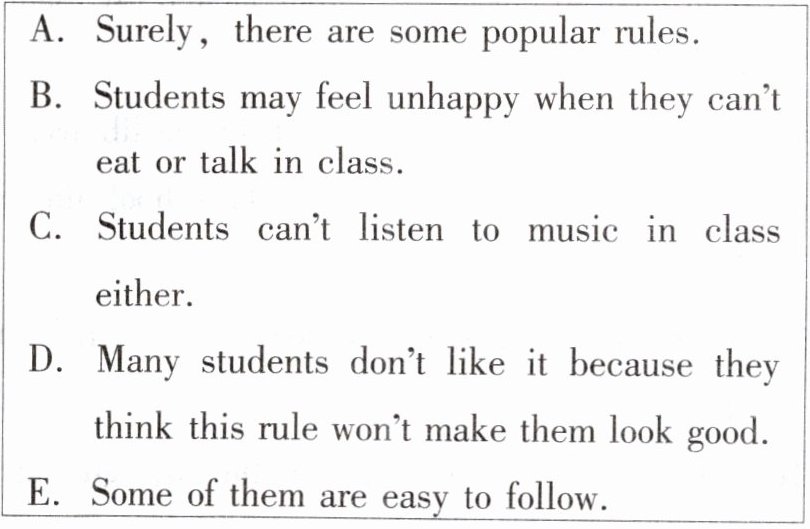
After students study in a middle school, they may know that there are many rules at school. 1.
E
But others aren't so popular and students don't like them.Maybe they don't have to wear school uniforms every day at the primary school. But many middle schools will ask students to wear uniforms, and they can't go into the classroom if they don't wear them. 2.
D
But they don't see the real reason for wearing uniforms. Wearing uniforms will let them know team spirit and help each other. If they don't know the rules, it's hard for them to live and work alone when students grow up.3.
B
When they're thinking about this, they may forget they're having classes with other students. If all of them eat or talk when they want to do it, what will the class be like?Some of them are easy to follow. 4.
A
For example, some schools ask students to sleep for some time after lunch so that they can study well in the afternoon. Some schools also give students some time to play sports in the afternoon, so they can be healthy.答案
一、1—4 EDBA
解析
【分析】
本题为英语阅读补全题,需结合上下文的逻辑关系(如固定搭配、话题一致性、指代关系等)匹配选项。解题时先通读全文,明确每段主旨,再根据空格前后的语句提示,逐一筛选符合语境的选项:第1空后有“But others...”,对应“some...others...”结构;第2空承接校服规定的话题,需匹配学生对该规则的态度;第3空对应“eat or talk”的课堂规则;第4空承接“容易遵守的规则”,引出举例说明。
【解析】
1. 第1空:空格后出现“But others aren't so popular...”,“some...others...”是常用对应结构,选项E“Some of them are easy to follow.”符合该逻辑,故选E。
2. 第2空:前文提及中学要求穿校服的规则,后文说明学生不理解穿校服的原因,选项D“Many students don't like it because they think this rule won't make them look good.”匹配学生对校服规定的态度,故选D。
3. 第3空:后文提到“eat or talk when they want to do it”,选项B“Students may feel unhappy when they can't eat or talk in class.”对应课堂上禁止吃、说的规则,符合语境,故选B。
4. 第4空:前文指出“Some of them are easy to follow.”,后文举例说明受欢迎的规则,选项A“Surely, there are some popular rules.”承接上文,引出举例,故选A。
【答案】
1—4 EDBA
【知识点】
英语阅读补全;语境推理;固定搭配
【点评】
本题考查英语阅读中的句子还原能力,需学生结合上下文逻辑(如对应结构、话题衔接)进行判断,难度适中,适合初中阶段学生巩固阅读技巧。
【难度系数】
0.5
本题为英语阅读补全题,需结合上下文的逻辑关系(如固定搭配、话题一致性、指代关系等)匹配选项。解题时先通读全文,明确每段主旨,再根据空格前后的语句提示,逐一筛选符合语境的选项:第1空后有“But others...”,对应“some...others...”结构;第2空承接校服规定的话题,需匹配学生对该规则的态度;第3空对应“eat or talk”的课堂规则;第4空承接“容易遵守的规则”,引出举例说明。
【解析】
1. 第1空:空格后出现“But others aren't so popular...”,“some...others...”是常用对应结构,选项E“Some of them are easy to follow.”符合该逻辑,故选E。
2. 第2空:前文提及中学要求穿校服的规则,后文说明学生不理解穿校服的原因,选项D“Many students don't like it because they think this rule won't make them look good.”匹配学生对校服规定的态度,故选D。
3. 第3空:后文提到“eat or talk when they want to do it”,选项B“Students may feel unhappy when they can't eat or talk in class.”对应课堂上禁止吃、说的规则,符合语境,故选B。
4. 第4空:前文指出“Some of them are easy to follow.”,后文举例说明受欢迎的规则,选项A“Surely, there are some popular rules.”承接上文,引出举例,故选A。
【答案】
1—4 EDBA
【知识点】
英语阅读补全;语境推理;固定搭配
【点评】
本题考查英语阅读中的句子还原能力,需学生结合上下文逻辑(如对应结构、话题衔接)进行判断,难度适中,适合初中阶段学生巩固阅读技巧。
【难度系数】
0.5
