

 登录
登录
一、阅读下列材料,从每题所给的 A、B、C 三个选项中选出最佳选项。
Suchita Mahajan came to Shanghai from India with her family and has lived here for 13 years. At first, she was worried about moving to China. She thought it would be hard to find vegetarian food she often had in India. But soon she found many Indian shops and vegetarian dishes in restaurants in Shanghai.
However, the family's move was not their original plan. In 2011, Mahajan's husband came to work in Shanghai for a short time. They enjoyed the life here so much that they decided to settle down. Now they have two children. The younger son, born in Shanghai, is almost more Chinese than Indian. Like most kids his age, he loves using Chinese apps. He can speak Chinese well and he often helps his mum learn the language.
Mahajan now works as a mosaic artist. At first, she learned mosaic art from an Indian friend just as a hobby. But later she found she was good at it and then she turned it into a job. Her works sell well. In 2021, she even started teaching mosaic classes at a community centre.
Mahajan enjoys her life in Shanghai. She has picked up many Chinese habits, like drinking hot water. She shops online, but her favourite shopping place is the market at Yuyuan Garden. She also gets along well with her Chinese neighbours. She often invites them to celebrate Indian festivals like Diwali and Holi. "I love Shanghai,"said Mahajan. "It's my second home. "
(
A. Language problems. B. Cultural differences. C. Different eating habits.
(
A. He is good at Chinese. B. He shops online. C. He wants to move back to India.
(
A. Mahajan's love for Indian festivals. B. Mahajan's enjoyable life in Shanghai.
C. Mahajan's favourite dish in Shanghai.
(
A. Short Stay in Shanghai B. An Artist's Trip in India
C. Home Away from Home in China
Suchita Mahajan came to Shanghai from India with her family and has lived here for 13 years. At first, she was worried about moving to China. She thought it would be hard to find vegetarian food she often had in India. But soon she found many Indian shops and vegetarian dishes in restaurants in Shanghai.
However, the family's move was not their original plan. In 2011, Mahajan's husband came to work in Shanghai for a short time. They enjoyed the life here so much that they decided to settle down. Now they have two children. The younger son, born in Shanghai, is almost more Chinese than Indian. Like most kids his age, he loves using Chinese apps. He can speak Chinese well and he often helps his mum learn the language.
Mahajan now works as a mosaic artist. At first, she learned mosaic art from an Indian friend just as a hobby. But later she found she was good at it and then she turned it into a job. Her works sell well. In 2021, she even started teaching mosaic classes at a community centre.
Mahajan enjoys her life in Shanghai. She has picked up many Chinese habits, like drinking hot water. She shops online, but her favourite shopping place is the market at Yuyuan Garden. She also gets along well with her Chinese neighbours. She often invites them to celebrate Indian festivals like Diwali and Holi. "I love Shanghai,"said Mahajan. "It's my second home. "
(
C
)1. What was Mahajan worried about before she moved to China?A. Language problems. B. Cultural differences. C. Different eating habits.
(
A
)2. What can we learn about Mahajan's younger son?A. He is good at Chinese. B. He shops online. C. He wants to move back to India.
(
B
)3. What is Paragraph 4 mainly about?A. Mahajan's love for Indian festivals. B. Mahajan's enjoyable life in Shanghai.
C. Mahajan's favourite dish in Shanghai.
(
C
)4. Which of the following is the best title for the passage?A. Short Stay in Shanghai B. An Artist's Trip in India
C. Home Away from Home in China
答案
一、1.C 2.A 3.B 4.C
解析
【分析】
做这类人物故事类阅读理解题,首先可以先快速通读全文,梳理文章核心内容:本文讲述了来自印度的Suchita Mahajan在上海定居13年,逐步适应并爱上当地生活、将上海视作第二故乡的经历。之后针对每道题干,提取关键词回到原文精准定位,对比选项和原文内容,排除明显错误的干扰项,就能选出正确答案。比如第一题找搬家前的担忧,直接定位第一段相关内容;第二题找小儿子的信息定位第二段后半部分,第三题归纳第四段主旨,第四题结合全文核心选最贴合的标题。
【解析】
1. 细节题:根据第一段内容"She thought it would be hard to find vegetarian food she often had in India.",可知Mahajan最初担心到中国后找不到自己常吃的素食,对应的是不同的饮食习惯,A选项语言问题、B选项宽泛的文化差异都不是她最初担心的内容,因此选C。
2. 细节题:根据第二段内容"He can speak Chinese well and he often helps his mum learn the language.",可知她的小儿子中文说得很好,擅长中文,A选项表述正确;B选项网上购物是Mahajan本人的习惯,文中没有提到儿子相关内容;C选项“想要搬回印度”在文中完全没有提及,因此选A。
3. 主旨题:第四段首句"Mahajan enjoys her life in Shanghai."是该段的主题句,后续内容分别介绍了她养成喝热水的中国习惯、喜欢逛豫园的集市、和中国邻居友好相处等内容,整体都是在讲述Mahajan在上海的愉快生活,A选项的印度节日只是段落里的局部细节,C选项内容完全没有在该段出现,因此选B。
4. 主旨题:全文讲述了Mahajan从印度来到上海定居13年,适应当地生活、把上海当成自己第二个家的经历,A选项“在上海短暂停留”和文中定居多年的事实不符,B选项“艺术家的印度之旅”完全偏离文章内容,只有C选项“在中国的第二故乡”最贴合全文核心主旨,因此选C。
【答案】
1.C 2.A 3.B 4.C
【知识点】
细节信息定位,段落主旨归纳,文章标题判断
【点评】
本题属于难度偏低的人物故事类阅读理解,绝大多数正确答案都可以直接在原文中找到对应依据,主要考察学生快速定位文本关键信息的能力,做题时注意区分不同人物的行为描述,不要把局部细节误判为段落/全文的核心主旨即可轻松得分。
【难度系数】
0.8
做这类人物故事类阅读理解题,首先可以先快速通读全文,梳理文章核心内容:本文讲述了来自印度的Suchita Mahajan在上海定居13年,逐步适应并爱上当地生活、将上海视作第二故乡的经历。之后针对每道题干,提取关键词回到原文精准定位,对比选项和原文内容,排除明显错误的干扰项,就能选出正确答案。比如第一题找搬家前的担忧,直接定位第一段相关内容;第二题找小儿子的信息定位第二段后半部分,第三题归纳第四段主旨,第四题结合全文核心选最贴合的标题。
【解析】
1. 细节题:根据第一段内容"She thought it would be hard to find vegetarian food she often had in India.",可知Mahajan最初担心到中国后找不到自己常吃的素食,对应的是不同的饮食习惯,A选项语言问题、B选项宽泛的文化差异都不是她最初担心的内容,因此选C。
2. 细节题:根据第二段内容"He can speak Chinese well and he often helps his mum learn the language.",可知她的小儿子中文说得很好,擅长中文,A选项表述正确;B选项网上购物是Mahajan本人的习惯,文中没有提到儿子相关内容;C选项“想要搬回印度”在文中完全没有提及,因此选A。
3. 主旨题:第四段首句"Mahajan enjoys her life in Shanghai."是该段的主题句,后续内容分别介绍了她养成喝热水的中国习惯、喜欢逛豫园的集市、和中国邻居友好相处等内容,整体都是在讲述Mahajan在上海的愉快生活,A选项的印度节日只是段落里的局部细节,C选项内容完全没有在该段出现,因此选B。
4. 主旨题:全文讲述了Mahajan从印度来到上海定居13年,适应当地生活、把上海当成自己第二个家的经历,A选项“在上海短暂停留”和文中定居多年的事实不符,B选项“艺术家的印度之旅”完全偏离文章内容,只有C选项“在中国的第二故乡”最贴合全文核心主旨,因此选C。
【答案】
1.C 2.A 3.B 4.C
【知识点】
细节信息定位,段落主旨归纳,文章标题判断
【点评】
本题属于难度偏低的人物故事类阅读理解,绝大多数正确答案都可以直接在原文中找到对应依据,主要考察学生快速定位文本关键信息的能力,做题时注意区分不同人物的行为描述,不要把局部细节误判为段落/全文的核心主旨即可轻松得分。
【难度系数】
0.8
二、阅读下面短文,从短文后的选项中选出可以填入空白处的最佳选项。
During the Spring Festival,Chinese people usually visit their relatives and send blessings to them. Now with the development of technology, a lot of people choose not to visit others in person during the Spring Festival anymore. 5.
Actually, the recent research shows that only about 30 percent of people choose to visit others in person during the Spring Festival. There was once a hot online discussion about this situation. 6.
"I'm very shy. I don't want to visit anyone during the holiday, especially those relatives who are only interested in my studies or my private matters. I don't feel good every time I visit them," a young girl said. 7.
In fact, the tradition is not simply sending wishes to others. 9.
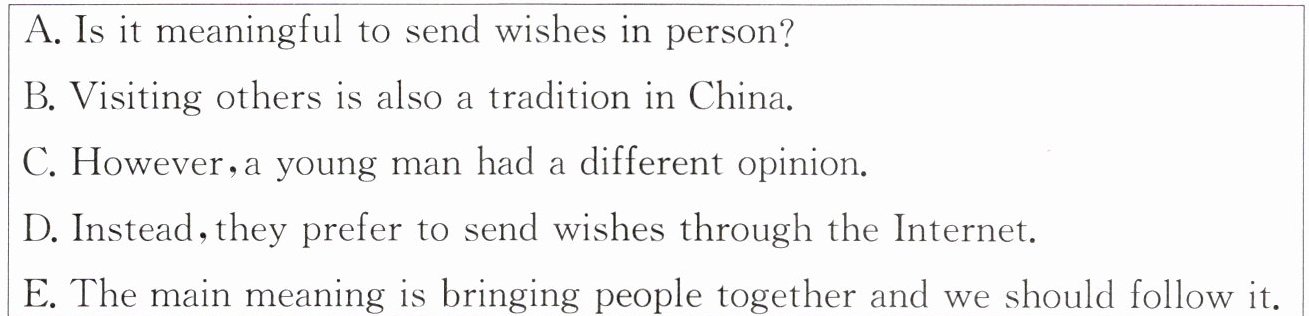
A. Is it meaningful to send wishes in person?
B. Visiting others is also a tradition in China.
C. However,a young man had a different opinion.
D. Instead,they prefer to send wishes through the Internet.
E. The main meaning is bringing people together and we should follow it.
During the Spring Festival,Chinese people usually visit their relatives and send blessings to them. Now with the development of technology, a lot of people choose not to visit others in person during the Spring Festival anymore. 5.
D
Actually, the recent research shows that only about 30 percent of people choose to visit others in person during the Spring Festival. There was once a hot online discussion about this situation. 6.
A
Different people have different opinions."I'm very shy. I don't want to visit anyone during the holiday, especially those relatives who are only interested in my studies or my private matters. I don't feel good every time I visit them," a young girl said. 7.
C
He said, "Many of my friends have left our hometown to work in different cities. We only see each other during the Spring Festival. The holiday is a great time to reunite with our family members and friends. 8. B
In fact, the tradition is not simply sending wishes to others. 9.
E
Whether or not we visit others in person during the Spring Festival, we should value our family members and friends and truly care about them.A. Is it meaningful to send wishes in person?
B. Visiting others is also a tradition in China.
C. However,a young man had a different opinion.
D. Instead,they prefer to send wishes through the Internet.
E. The main meaning is bringing people together and we should follow it.
答案
二、5.D 6.A 7.C 8.B 9.E
解析
【分析】
这是一道英语语篇还原类五选五题型,解题思路是先通读全文,明确本文围绕春节拜年方式变化、不同人对线上/线下送祝福的不同看法的核心主题,再逐空分析前后文的逻辑关联:先看空前的内容铺垫,再看空后内容的指向,匹配选项的逻辑属性(顺承、转折、抛出问题、阐释内涵等),逐一排除匹配出最合适的答案。
1. 第5空:前文提到很多人不再亲自登门拜年,需要承接“不亲自登门”的后续行为;
2. 第6空:前文提到有相关网络热议,后文说不同人有不同观点,需要填入热议的核心问题引出后文讨论;
3. 第7空:前文是年轻女孩反对线下拜年的观点,后文是支持线下相聚的男性观点,需要填入转折过渡句衔接两个相反立场;
4. 第8空:前文男子提到春节是和亲友团聚的好时机,需要填入符合他立场的支撑表述;
5. 第9空:前文提到传统不只是简单送祝福,需要填入进一步阐释传统真正内涵的内容。
【解析】
5. 空前句说明“随着科技发展,很多人春节不再亲自登门拜访他人”,D选项“相反,他们更愿意通过互联网传递祝福”直接承接前文“不再亲自登门”的行为,逻辑连贯,因此选D。
6. 空前句提到“曾经有一场关于该现象的网络热议”,空后句说明“不同的人有不同的观点”,A选项“亲自送祝福是有意义的吗?”正是这场热议的核心问题,自然引出后文不同观点的阐述,因此选A。
7. 空前是年轻女孩表达不想走亲访友的想法,空后是男子完全相反的立场表述,C选项“然而,一位年轻男子有着不同的看法”起到转折过渡的作用,完美衔接前后两个不同立场的发言,因此选C。
8. 空前男子提到“春节是和家人朋友团聚的好时机”,B选项“登门拜访在中国同样是一项传统”承接男子支持线下相聚的立场,符合语境逻辑,因此选B。
9. 空前句指出“实际上,这项传统并不只是简单地给他人送祝福”,E选项“它的核心意义是将人们凝聚在一起,我们应当传承它”对应前文否定的“不只是简单送祝福”,进一步阐释传统的真正内涵,逻辑通顺,因此选E。
【答案】
5.D 6.A 7.C 8.B 9.E
【知识点】
阅读还原,语篇逻辑衔接,语境理解
【点评】
本题围绕春节拜年的生活化主题展开,整体难度适中,重点考察学生对语篇顺承、转折等逻辑关系的把握,不需要过高的词汇基础,学生只要抓住前后句的指代和内容关联就可以顺利解题,容易出错的点是混淆讨论的引入句和观点支撑句,需要注意区分上下文的内容指向。
【难度系数】
0.7
这是一道英语语篇还原类五选五题型,解题思路是先通读全文,明确本文围绕春节拜年方式变化、不同人对线上/线下送祝福的不同看法的核心主题,再逐空分析前后文的逻辑关联:先看空前的内容铺垫,再看空后内容的指向,匹配选项的逻辑属性(顺承、转折、抛出问题、阐释内涵等),逐一排除匹配出最合适的答案。
1. 第5空:前文提到很多人不再亲自登门拜年,需要承接“不亲自登门”的后续行为;
2. 第6空:前文提到有相关网络热议,后文说不同人有不同观点,需要填入热议的核心问题引出后文讨论;
3. 第7空:前文是年轻女孩反对线下拜年的观点,后文是支持线下相聚的男性观点,需要填入转折过渡句衔接两个相反立场;
4. 第8空:前文男子提到春节是和亲友团聚的好时机,需要填入符合他立场的支撑表述;
5. 第9空:前文提到传统不只是简单送祝福,需要填入进一步阐释传统真正内涵的内容。
【解析】
5. 空前句说明“随着科技发展,很多人春节不再亲自登门拜访他人”,D选项“相反,他们更愿意通过互联网传递祝福”直接承接前文“不再亲自登门”的行为,逻辑连贯,因此选D。
6. 空前句提到“曾经有一场关于该现象的网络热议”,空后句说明“不同的人有不同的观点”,A选项“亲自送祝福是有意义的吗?”正是这场热议的核心问题,自然引出后文不同观点的阐述,因此选A。
7. 空前是年轻女孩表达不想走亲访友的想法,空后是男子完全相反的立场表述,C选项“然而,一位年轻男子有着不同的看法”起到转折过渡的作用,完美衔接前后两个不同立场的发言,因此选C。
8. 空前男子提到“春节是和家人朋友团聚的好时机”,B选项“登门拜访在中国同样是一项传统”承接男子支持线下相聚的立场,符合语境逻辑,因此选B。
9. 空前句指出“实际上,这项传统并不只是简单地给他人送祝福”,E选项“它的核心意义是将人们凝聚在一起,我们应当传承它”对应前文否定的“不只是简单送祝福”,进一步阐释传统的真正内涵,逻辑通顺,因此选E。
【答案】
5.D 6.A 7.C 8.B 9.E
【知识点】
阅读还原,语篇逻辑衔接,语境理解
【点评】
本题围绕春节拜年的生活化主题展开,整体难度适中,重点考察学生对语篇顺承、转折等逻辑关系的把握,不需要过高的词汇基础,学生只要抓住前后句的指代和内容关联就可以顺利解题,容易出错的点是混淆讨论的引入句和观点支撑句,需要注意区分上下文的内容指向。
【难度系数】
0.7
