

 登录
登录
训练1
体裁:说明文 主题:学习策略 难度:★★★★★ 建议用时:8 min 正确率: /10
新素养·学习能力 “Five-Hour Rule”,one hour a day on every weekday,dates back to Benjamin Franklin,one of America's greatest inventors and leaders. However busy he was,he spared at least one hour every weekday to learn and improve himself. How can you use the five-hour rule in daily life? Here are practical ways to make learning part of life.
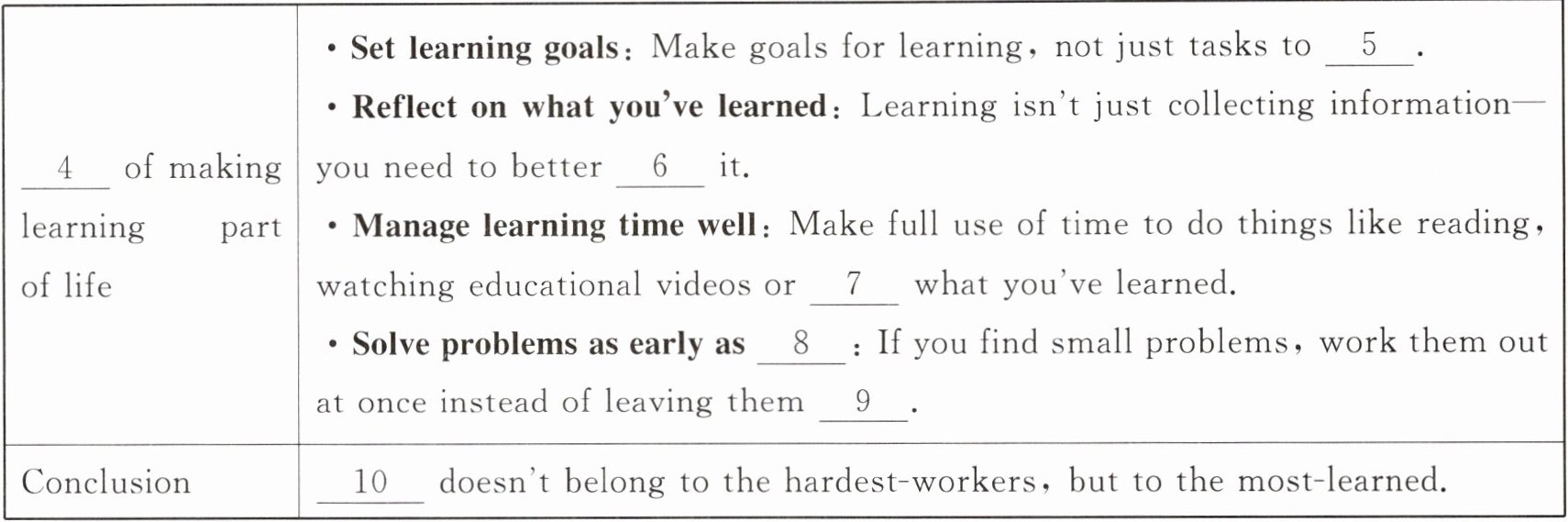
Set learning goals
Instead of just making to-do lists (“finish homework”,“clean my room”),also make “learn lists”. For example,“This week I'll memorize 20 new English words”,“I'll practise giving talks to improve my speaking skills”.
Reflect on(反思) what you've learned
Learning isn't just collecting information—you need to have a better understanding of it. Try these methods to reflect on what you've learned. Keep a learning note to write down new ideas. Discuss what you've learned with friends or family. Take short walks to think about new ideas.
Manage learning time well
Make learning a regular habit by reading for 30 minutes every morning,watching educational videos during meals and using spare moments like bus rides to have a revision(复习).
Solve problems as early as you can
When you notice small problems in your work or studies,pay much attention to them on purpose. If you keep making the same math mistake,try to practise the same type until you master it completely.
Benjamin Franklin wasn't born a genius—he became one through daily learning. Remember that successful people aren't those who work the most,but those who learn the most.


体裁:说明文 主题:学习策略 难度:★★★★★ 建议用时:8 min 正确率: /10
新素养·学习能力 “Five-Hour Rule”,one hour a day on every weekday,dates back to Benjamin Franklin,one of America's greatest inventors and leaders. However busy he was,he spared at least one hour every weekday to learn and improve himself. How can you use the five-hour rule in daily life? Here are practical ways to make learning part of life.
Set learning goals
Instead of just making to-do lists (“finish homework”,“clean my room”),also make “learn lists”. For example,“This week I'll memorize 20 new English words”,“I'll practise giving talks to improve my speaking skills”.
Reflect on(反思) what you've learned
Learning isn't just collecting information—you need to have a better understanding of it. Try these methods to reflect on what you've learned. Keep a learning note to write down new ideas. Discuss what you've learned with friends or family. Take short walks to think about new ideas.
Manage learning time well
Make learning a regular habit by reading for 30 minutes every morning,watching educational videos during meals and using spare moments like bus rides to have a revision(复习).
Solve problems as early as you can
When you notice small problems in your work or studies,pay much attention to them on purpose. If you keep making the same math mistake,try to practise the same type until you master it completely.
Benjamin Franklin wasn't born a genius—he became one through daily learning. Remember that successful people aren't those who work the most,but those who learn the most.
答案
训练 1 【语篇解读】本文是一篇说明文。文章主要介绍了“5小时原则”及其在学习中的应用方法。
1. Introduction 根据表格右侧的内容可知,此处介绍5小时原则的起源。故填 Introduction。
2. how 根据第一段“However busy he was, he spared at least one hour every weekday to learn and improve himself.”可知无论富兰克林多忙,他都坚持学习;no matter how 表示“无论多么”。故填 how。
3. progress 根据第一段“he spared at least one hour every weekday to learn and improve himself”可知富兰克林花费时间学习并提升自己;make progress 表示“取得进步”。故填 progress。
4. Ways 根据第一段“Here are practical ways to make learning part of life.”和表格右侧的内容可知,此处介绍将学习融入生活的方法。故填 Ways。
5. do/complete/finish 根据第二段“Instead of just making to-do lists (‘finish homework’, ‘clean my room’), also make ‘learn lists’.”可知要制定学习目标,而不仅仅是要做/完成的任务;此处用动词原形和 to 构成不定式结构。故填 do/complete/finish。
6. understand 根据第三段“Learning isn't just collecting information—you need to have a better understanding of it.”可知学习要更好地理解信息;此处用动词原形和 to 构成不定式结构。故填 understand。
7. reviewing 根据第四段“using spare moments like bus rides to have a revision”可知利用空闲时间复习;此处与“reading”“watching”并列,应用动名词形式。故填 reviewing。
8. possible 根据第五段“·Solve problems as early as you can”可知要尽早解决问题;as...as sb. can = as...as possible “尽可能”。故填 possible。
9. alone 根据第五段“When you notice small problems in your work or studies, pay much attention to them on purpose.”可知发现小问题要刻意关注,而不是留下它们不管;leave...alone 表示“不管;不理”。故填 alone。
10. Success 根据最后一段“Remember that successful people aren't those who work the most, but those who learn the most.”可知成功不属于工作最努力的人,而是学习最多的人;此处应用名词作主语,句首首字母需大写。故填 Success。
1. Introduction 根据表格右侧的内容可知,此处介绍5小时原则的起源。故填 Introduction。
2. how 根据第一段“However busy he was, he spared at least one hour every weekday to learn and improve himself.”可知无论富兰克林多忙,他都坚持学习;no matter how 表示“无论多么”。故填 how。
3. progress 根据第一段“he spared at least one hour every weekday to learn and improve himself”可知富兰克林花费时间学习并提升自己;make progress 表示“取得进步”。故填 progress。
4. Ways 根据第一段“Here are practical ways to make learning part of life.”和表格右侧的内容可知,此处介绍将学习融入生活的方法。故填 Ways。
5. do/complete/finish 根据第二段“Instead of just making to-do lists (‘finish homework’, ‘clean my room’), also make ‘learn lists’.”可知要制定学习目标,而不仅仅是要做/完成的任务;此处用动词原形和 to 构成不定式结构。故填 do/complete/finish。
6. understand 根据第三段“Learning isn't just collecting information—you need to have a better understanding of it.”可知学习要更好地理解信息;此处用动词原形和 to 构成不定式结构。故填 understand。
7. reviewing 根据第四段“using spare moments like bus rides to have a revision”可知利用空闲时间复习;此处与“reading”“watching”并列,应用动名词形式。故填 reviewing。
8. possible 根据第五段“·Solve problems as early as you can”可知要尽早解决问题;as...as sb. can = as...as possible “尽可能”。故填 possible。
9. alone 根据第五段“When you notice small problems in your work or studies, pay much attention to them on purpose.”可知发现小问题要刻意关注,而不是留下它们不管;leave...alone 表示“不管;不理”。故填 alone。
10. Success 根据最后一段“Remember that successful people aren't those who work the most, but those who learn the most.”可知成功不属于工作最努力的人,而是学习最多的人;此处应用名词作主语,句首首字母需大写。故填 Success。
解析
【分析】
本题为任务型阅读理解,需结合文章主旨、段落细节及语法知识完成填空。解题思路为:1. 通读全文把握“5小时原则”的核心内容;2. 定位每个空格所在段落,分析空格处的词性、语法结构(如不定式、动名词、固定搭配等);3. 结合原文对应语句匹配符合语境的词汇,注意词形变化(如动名词、名词单复数等)。
【解析】
1. 空格位于表格开头,对应介绍“5小时原则”的起源,结合第一段内容,此处需填名词表“介绍”,故为Introduction。
2. 空格所在结构为“no matter ______”,对应第一段“However busy he was”,no matter how是固定结构表“无论多么”,故填how。
3. 空格需与make构成固定搭配,结合第一段“learn and improve himself”,make progress意为“取得进步”,符合语境,故填progress。
4. 空格对应表格中介绍学习方法的部分,结合第一段“Here are practical ways”,此处需填名词表“方法”,故为Ways。
5. 空格位于不定式符号to后,结合第二段“instead of just making to-do lists (‘finish homework’...)”,此处需填动词原形表“完成”,故为do/complete/finish。
6. 空格位于不定式符号to后,结合第三段“you need to have a better understanding of it”,此处需填动词原形表“理解”,故填understand。
7. 空格与reading、watching并列,结合第四段“using spare moments like bus rides to have a revision”,此处需填动名词表“复习”,故为reviewing。
8. 空格所在结构为“as...as sb. can”,对应第五段“Solve problems as early as you can”,as...as possible是固定结构表“尽可能”,故填possible。
9. 空格所在结构为“leave...________”,结合第五段“pay much attention to them on purpose”,leave alone意为“不管;不理”,符合语境,故填alone。
10. 空格需作主语,结合最后一段“successful people aren't those...”,此处需填名词表“成功”,句首首字母大写,故为Success。
【答案】
1. Introduction 2. how 3. progress 4. Ways 5. do/complete/finish 6. understand 7. reviewing 8. possible 9. alone 10. Success
【知识点】
说明文阅读;词汇运用;固定搭配
【点评】
本题为任务型阅读,考查学生对文章细节的理解及词汇在语境中的运用能力,需结合原文信息与语法规则解题,难度适中。
【难度系数】
0.4
本题为任务型阅读理解,需结合文章主旨、段落细节及语法知识完成填空。解题思路为:1. 通读全文把握“5小时原则”的核心内容;2. 定位每个空格所在段落,分析空格处的词性、语法结构(如不定式、动名词、固定搭配等);3. 结合原文对应语句匹配符合语境的词汇,注意词形变化(如动名词、名词单复数等)。
【解析】
1. 空格位于表格开头,对应介绍“5小时原则”的起源,结合第一段内容,此处需填名词表“介绍”,故为Introduction。
2. 空格所在结构为“no matter ______”,对应第一段“However busy he was”,no matter how是固定结构表“无论多么”,故填how。
3. 空格需与make构成固定搭配,结合第一段“learn and improve himself”,make progress意为“取得进步”,符合语境,故填progress。
4. 空格对应表格中介绍学习方法的部分,结合第一段“Here are practical ways”,此处需填名词表“方法”,故为Ways。
5. 空格位于不定式符号to后,结合第二段“instead of just making to-do lists (‘finish homework’...)”,此处需填动词原形表“完成”,故为do/complete/finish。
6. 空格位于不定式符号to后,结合第三段“you need to have a better understanding of it”,此处需填动词原形表“理解”,故填understand。
7. 空格与reading、watching并列,结合第四段“using spare moments like bus rides to have a revision”,此处需填动名词表“复习”,故为reviewing。
8. 空格所在结构为“as...as sb. can”,对应第五段“Solve problems as early as you can”,as...as possible是固定结构表“尽可能”,故填possible。
9. 空格所在结构为“leave...________”,结合第五段“pay much attention to them on purpose”,leave alone意为“不管;不理”,符合语境,故填alone。
10. 空格需作主语,结合最后一段“successful people aren't those...”,此处需填名词表“成功”,句首首字母大写,故为Success。
【答案】
1. Introduction 2. how 3. progress 4. Ways 5. do/complete/finish 6. understand 7. reviewing 8. possible 9. alone 10. Success
【知识点】
说明文阅读;词汇运用;固定搭配
【点评】
本题为任务型阅读,考查学生对文章细节的理解及词汇在语境中的运用能力,需结合原文信息与语法规则解题,难度适中。
【难度系数】
0.4
