

 登录
登录
1. Read and choose
1) What can the children learn in the museum? ()
A. How the forms(形式) of money change.
B. How the ways of money management change.
2) Why did people start to use money? ()
A. Money was easy to carry.
B. It was difficult to exchange things.
3) Why do we use mobile phones to pay? ()
A. It's quick and easy.
B. It's cheap to use.
1) What can the children learn in the museum? ()
A. How the forms(形式) of money change.
B. How the ways of money management change.
2) Why did people start to use money? ()
A. Money was easy to carry.
B. It was difficult to exchange things.
3) Why do we use mobile phones to pay? ()
A. It's quick and easy.
B. It's cheap to use.
答案
1) A 2) B 3) A
解析
本题结合人教版六年级上册Unit4《Managing money well》的单元核心知识点解答:
1) 本单元相关内容介绍钱币主题博物馆的核心展示内容是货币从古代到现代的形式演变,孩子们可以在博物馆了解钱的形式是如何变化的,A选项表述符合单元内容。
2) 货币诞生的背景是早期物物交换的模式下,人们交换物品十分不便,为了解决这个问题人们才开始使用货币,B选项表述符合单元内容。
3) 移动支付成为主流支付方式的核心原因是它操作快捷、使用方便,不需要携带现金,A选项表述符合单元内容。
1) 本单元相关内容介绍钱币主题博物馆的核心展示内容是货币从古代到现代的形式演变,孩子们可以在博物馆了解钱的形式是如何变化的,A选项表述符合单元内容。
2) 货币诞生的背景是早期物物交换的模式下,人们交换物品十分不便,为了解决这个问题人们才开始使用货币,B选项表述符合单元内容。
3) 移动支付成为主流支付方式的核心原因是它操作快捷、使用方便,不需要携带现金,A选项表述符合单元内容。
2. Read and choose

A. knife money
B. paper money
C. bankbook
D. copper coin
E. card
F. shell money
G. mobile phone
A. knife money
B. paper money
C. bankbook
D. copper coin
E. card
F. shell money
G. mobile phone
答案
从左到右依次为F、A、D、B、C、E、G
解析
我们逐图匹配对应的词汇:
1. 第一幅图是贝壳制成的古钱币,对应F选项shell money(贝币)
2. 第二幅图是刀形的古钱币,对应A选项knife money(刀币)
3. 第三幅图是圆形方孔的古铜钱,对应D选项copper coin(铜币)
4. 第四幅图是早期的纸质钱币,对应B选项paper money(纸币)
5. 第五幅图是银行存折,对应C选项bankbook(银行存折)
6. 第六幅图是银行卡,对应E选项card(银行卡)
7. 第七幅图是手机扫码移动支付,对应G选项mobile phone(手机移动支付)
1. 第一幅图是贝壳制成的古钱币,对应F选项shell money(贝币)
2. 第二幅图是刀形的古钱币,对应A选项knife money(刀币)
3. 第三幅图是圆形方孔的古铜钱,对应D选项copper coin(铜币)
4. 第四幅图是早期的纸质钱币,对应B选项paper money(纸币)
5. 第五幅图是银行存折,对应C选项bankbook(银行存折)
6. 第六幅图是银行卡,对应E选项card(银行卡)
7. 第七幅图是手机扫码移动支付,对应G选项mobile phone(手机移动支付)
3. Read and match 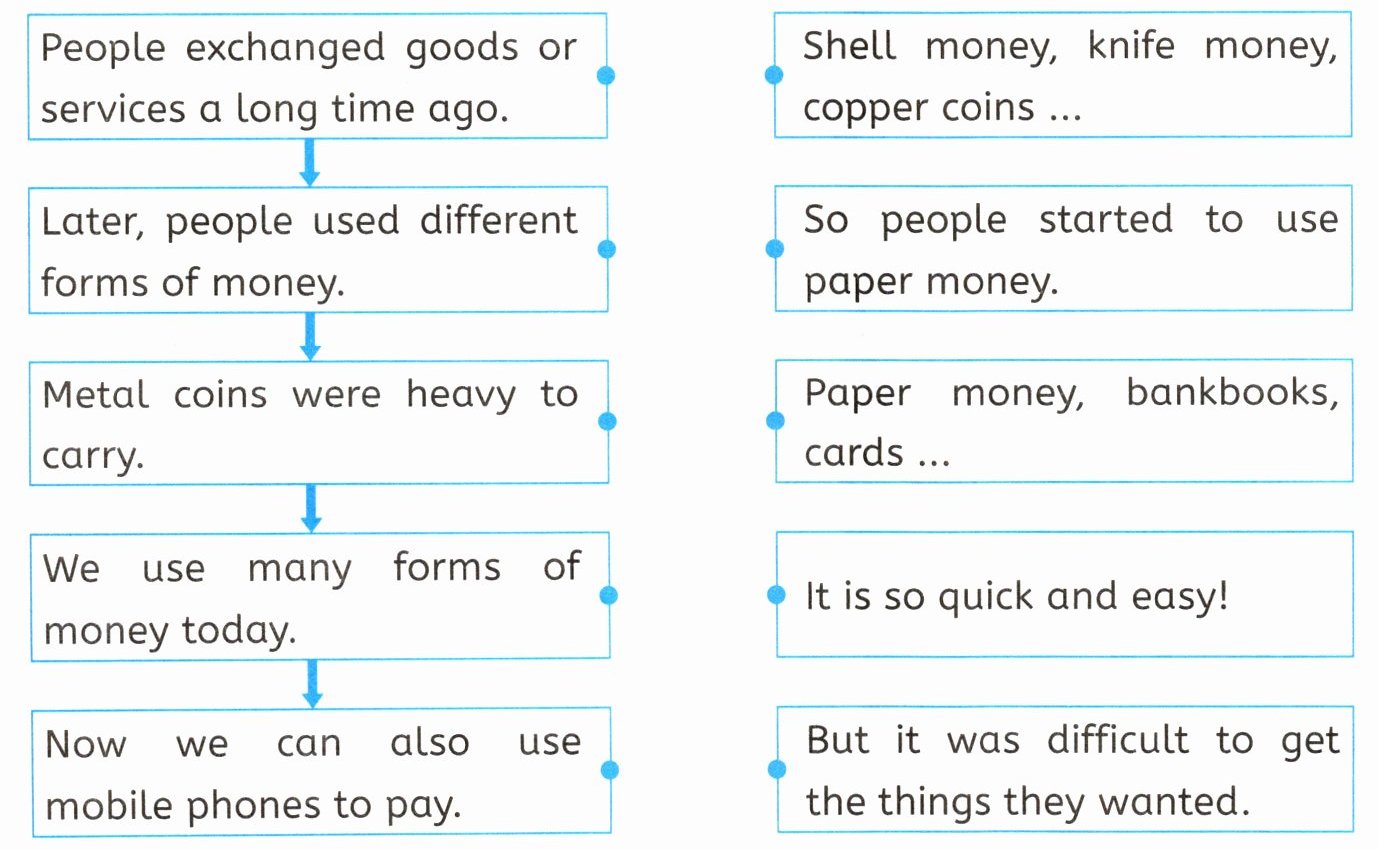
答案
1. People exchanged goods or services a long time ago. —— But it was difficult to get the things they wanted.
2. Later, people used different forms of money. —— Shell money, knife money, copper coins ...
3. Metal coins were heavy to carry. —— So people started to use paper money.
4. We use many forms of money today. —— Paper money, bankbooks, cards ...
5. Now we can also use mobile phones to pay. —— It is so quick and easy!
2. Later, people used different forms of money. —— Shell money, knife money, copper coins ...
3. Metal coins were heavy to carry. —— So people started to use paper money.
4. We use many forms of money today. —— Paper money, bankbooks, cards ...
5. Now we can also use mobile phones to pay. —— It is so quick and easy!
解析
本题按照货币发展的历史逻辑进行匹配,梳理每句的对应关系:
1. 第一句描述远古时期人们以物换物的交易模式,对应的是该模式的弊端:人们很难换到自己想要的物品。
2. 第二句描述后续人们开始使用各类货币,对应的是早期诞生的特殊材质货币:贝币、刀币、铜币等。
3. 第三句描述金属硬币的缺点是携带很重,对应的是该问题催生的结果:人们开始使用纸币。
4. 第四句描述当下我们使用多种货币形式,对应的是当代主流的各类支付载体:纸币、存折、银行卡等。
5. 第五句描述现在可以用手机支付,对应的是对移动支付的评价:这种支付方式又快又便捷。
1. 第一句描述远古时期人们以物换物的交易模式,对应的是该模式的弊端:人们很难换到自己想要的物品。
2. 第二句描述后续人们开始使用各类货币,对应的是早期诞生的特殊材质货币:贝币、刀币、铜币等。
3. 第三句描述金属硬币的缺点是携带很重,对应的是该问题催生的结果:人们开始使用纸币。
4. 第四句描述当下我们使用多种货币形式,对应的是当代主流的各类支付载体:纸币、存折、银行卡等。
5. 第五句描述现在可以用手机支付,对应的是对移动支付的评价:这种支付方式又快又便捷。
