

 登录
登录
2. Read and choose
Many students have pocket money, but some don't know how to use it well. My friend Sam has a good way to manage his pocket money. He always asks himself some important questions before buying things.
First, he asks, "Do I need it now?" If he really needs it right now, he will buy it. If not, he will wait. Second, he asks, "Do I already have one?" If he has one, he will not buy again. Third, he asks, "What is it for?" He knows clearly why he wants to buy it. Then, he asks, "Is it expensive?" If it is expensive, he will wait for a sale. Last, he asks, "Do I have enough money?" If he doesn't have enough money, he will save up first.
These questions help Sam use his pocket money wisely.
1) Which can be the title for the passage? ()
A. Why is money useful?
B. How does Sam use his money well?
2) What does Sam do before buying things? ()
A. He asks himself some questions.
B. He buys things quickly.
3) What will Sam do if he doesn't have enough money? ()
A. He will save up first.
B. He will wait for a sale.
Many students have pocket money, but some don't know how to use it well. My friend Sam has a good way to manage his pocket money. He always asks himself some important questions before buying things.
First, he asks, "Do I need it now?" If he really needs it right now, he will buy it. If not, he will wait. Second, he asks, "Do I already have one?" If he has one, he will not buy again. Third, he asks, "What is it for?" He knows clearly why he wants to buy it. Then, he asks, "Is it expensive?" If it is expensive, he will wait for a sale. Last, he asks, "Do I have enough money?" If he doesn't have enough money, he will save up first.
These questions help Sam use his pocket money wisely.
1) Which can be the title for the passage? ()
A. Why is money useful?
B. How does Sam use his money well?
2) What does Sam do before buying things? ()
A. He asks himself some questions.
B. He buys things quickly.
3) What will Sam do if he doesn't have enough money? ()
A. He will save up first.
B. He will wait for a sale.
答案
1) B 2) A 3) A
解析
1) 通读全文可知,文章主要介绍了Sam合理规划使用零花钱的方法,并没有讨论金钱的用处,B选项“Sam是如何好好使用他的钱的?”是最贴合全文内容的标题。
2) 根据文章第一段最后一句“He always asks himself some important questions before buying things.”可知,Sam买东西前会问自己一些重要的问题,A选项符合原文描述。
3) 根据文章第二段最后一句“If he doesn't have enough money, he will save up first.”可知,当Sam没有足够的钱时,他会先存钱,对应A选项。
2) 根据文章第一段最后一句“He always asks himself some important questions before buying things.”可知,Sam买东西前会问自己一些重要的问题,A选项符合原文描述。
3) 根据文章第二段最后一句“If he doesn't have enough money, he will save up first.”可知,当Sam没有足够的钱时,他会先存钱,对应A选项。
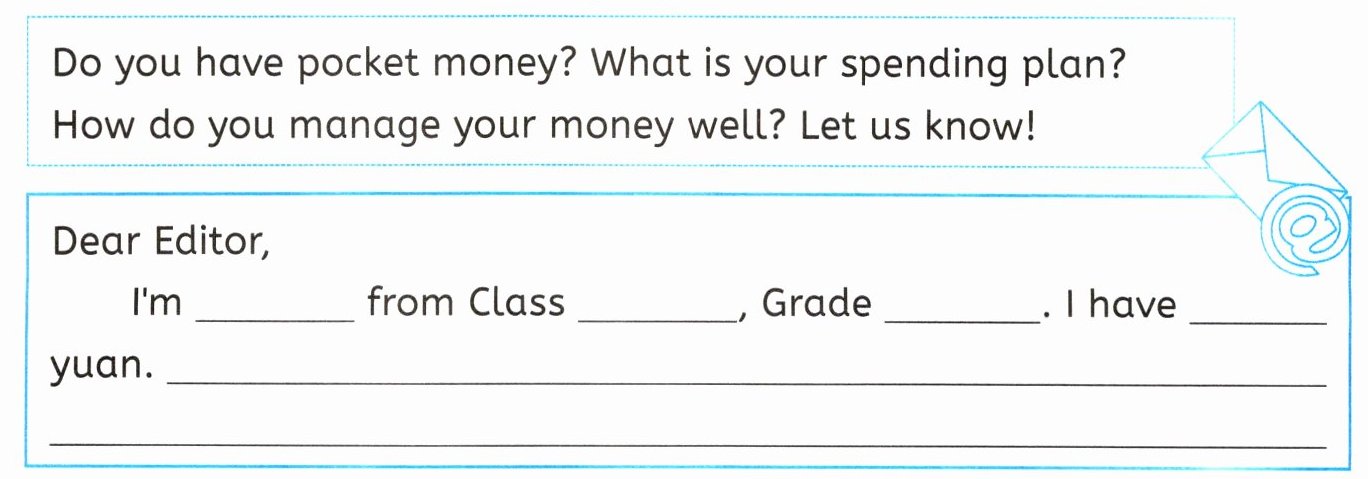
3. Write to the school newspaper
答案
Dear Editor,
I'm Li Hua from Class 2, Grade 6. I have 200 yuan.
My spending plan is simple: I will use 40 yuan to buy my favourite storybooks and stationery each month, 30 yuan will go to the poor pupils in the mountain village to help them buy learning things, and I will put the rest 130 yuan into my piggy bank for future use.
To manage my money well, I always write down every coin I spend, and I never waste money on useless snacks or toys.
I'm Li Hua from Class 2, Grade 6. I have 200 yuan.
My spending plan is simple: I will use 40 yuan to buy my favourite storybooks and stationery each month, 30 yuan will go to the poor pupils in the mountain village to help them buy learning things, and I will put the rest 130 yuan into my piggy bank for future use.
To manage my money well, I always write down every coin I spend, and I never waste money on useless snacks or toys.
解析
这是本单元"合理管理零花钱"主题相关的开放性写作练习,要求先填写基础个人信息,再围绕自身零花钱的使用计划、合理理财的方法展开表述,内容贴合小学生日常即可,使用已学的简单英语表达,无需复杂句式。
