

 登录
登录
一、单词辨音,选出画线部分与其他单词发音不同的选项。(每小题 1 分,共 10 分)
() 1. A. bea
B. hear
C. dear
D. year
() 2. A. hair
B. fair
C. air
D. earth
() 3. A. yellow
B. how
C. follow
D. slow
() 4. A. come
B. love
C. London
D. welcome
() 5. A. kangaroo
B. football
C. soon
D. food
() 6. A. bus
B. ruler
C. rubber
D. but
() 7. A. house
B. outing
C. touch
D. cloudy
() 8. A. students
B. friends
C. birds
D. cards
() 9. A. short
B. for
C. work
D. morning
() 10. A. weather
B. sweater
C. breakfast
D. teacher
() 1. A. bea
B. hear
C. dear
D. year
() 2. A. hair
B. fair
C. air
D. earth
() 3. A. yellow
B. how
C. follow
D. slow
() 4. A. come
B. love
C. London
D. welcome
() 5. A. kangaroo
B. football
C. soon
D. food
() 6. A. bus
B. ruler
C. rubber
D. but
() 7. A. house
B. outing
C. touch
D. cloudy
() 8. A. students
B. friends
C. birds
D. cards
() 9. A. short
B. for
C. work
D. morning
() 10. A. weather
B. sweater
C. breakfast
D. teacher
答案
1. A
2. D
3. B
4. C
5. B
6. B
7. C
8. A
9. C
10. D
解析
1. 画线部分为 "ea" 或 "ear",需要找出与其他不同的发音。
A. bea [i:]
B. hear [ɪə]
C. dear [ɪə]
D. year [ɪə]
答案为 A。
2. 画线部分为 "ai" 或 "air",需要找出不同的发音。
A. hair [eə]
B. fair [eə]
C. air [eə]
D. earth [ɜ:]
答案为 D。
3. 画线部分为 "ow" 或 "o",需要找出不同的发音。
A. yellow [əʊ]
B. how [aʊ]
C. follow [əʊ]
D. slow [əʊ]
答案为 B。
4. 画线部分为 "o",需要找出不同的发音。
A. come [ʌ]
B. love [ʌ]
C. London [ʌ]
D. welcome [ɔ]
答案为 C。
5. 画线部分为 "oo" 或 "oo",需要找出不同的发音。
A. kangaroo [u:]
B. football [ʊ]
C. soon [u:]
D. food [u:]
答案为 B。
6. 画线部分为 "u",需要找出不同的发音。
A. bus [ʌ]
B. ruler [u:]
C. rubber [ʌ]
D. but [ʌ]
答案为 B。
7. 画线部分为 "ou" 或 "ou",需要找出不同的发音。
A. house [aʊ]
B. outing [aʊ]
C. touch [ʌ]
D. cloudy [aʊ]
答案为 C。
8. 画线部分为 "ts" 或 "ds",需要找出不同的发音。
A. students [ts]
B. friends [dz]
C. birds [dz]
D. cards [dz]
答案为 A。
9. 画线部分为 "or" 或 "o",需要找出不同的发音。
A. short [ɔ:]
B. for [ɔ:]
C. work [ɜ:]
D. morning [ɔ:]
答案为 C。
10. 画线部分为 "ea" 或 "ea",需要找出不同的发音。
A. weather [e]
B. sweater [e]
C. breakfast [e]
D. teacher [i:]
答案为 D。
二、英汉互译。(每小题 0.5 分,共 5 分)
1. 在儿童节
2. 查阅一些书
3. 许多有趣的城市
4. 欢迎到我们学校
5. 学习关于烹饪的知识
6. arrive too late
7. have some fun
8. find some lovely things
9. the Great Barrier Reef
10. a Western party
1. 在儿童节
2. 查阅一些书
3. 许多有趣的城市
4. 欢迎到我们学校
5. 学习关于烹饪的知识
6. arrive too late
7. have some fun
8. find some lovely things
9. the Great Barrier Reef
10. a Western party
答案
1. on Children's Day
2. look up some books
3. many interesting cities
4. welcome to our school
5. learn about cooking
6. 到达(某处)太晚
7. 玩得开心
8. 发现一些可爱的东西
9. 大堡礁
10. 一个西式派对
2. look up some books
3. many interesting cities
4. welcome to our school
5. learn about cooking
6. 到达(某处)太晚
7. 玩得开心
8. 发现一些可爱的东西
9. 大堡礁
10. 一个西式派对
三、按要求写词。(每小题 0.5 分,共 5 分)
1. cook(名词)
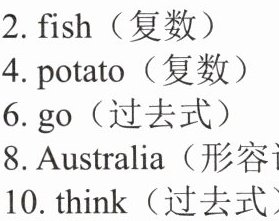
2. fish(复数)
3. Mike(所有格)
4. potato(复数)
5. city(复数)
6. go(过去式)
7. want(过去式)
8. Australia(形容词)
9. America(形容词)
10. think(过去式)
1. cook(名词)
2. fish(复数)
3. Mike(所有格)
4. potato(复数)
5. city(复数)
6. go(过去式)
7. want(过去式)
8. Australia(形容词)
9. America(形容词)
10. think(过去式)
答案
1. cook
2. fish/fishes
3. Mike's
4. potatoes
5. cities
6. went
7. wanted
8. Australian
9. American
10. thought
2. fish/fishes
3. Mike's
4. potatoes
5. cities
6. went
7. wanted
8. Australian
9. American
10. thought
四、单项选择。(每小题 1 分,共 10 分)
() 1.We will a film and a picnic tonight.
A. watch, have
B. watched, had
C. watch, had
D. watched, have
() 1.We will a film and a picnic tonight.
A. watch, have
B. watched, had
C. watch, had
D. watched, have
答案
A
解析
will后接动词原形,and连接并列成分,前后动词形式一致,均用原形。watch a film和have a picnic为固定搭配。
() 2.— Where she from? — She China.
A.is, come, comes from
B.is, /, is from
C.does, /, is from
D.does, come, is come from
A.is, come, comes from
B.is, /, is from
C.does, /, is from
D.does, come, is come from
答案
B
解析
本题可根据“来自某地”的英语表达以及一般现在时的特殊疑问句结构来进行解答。“来自某地”可以用“be from”或“come from”表达。在一般现在时中,当主语是第三人称单数时,若用“be from”结构,其疑问句形式是“Where is + 主语 + from?”,答语是“主语 + is from + 地点”;若用“come from”结构,其疑问句形式需要借助助动词 does,即“Where does + 主语 + come from?”,答语是“主语 + comes from + 地点”。本题中问句只有一个空,所以只能用“be from”结构,即“Where is she from?”;答语也用“be from”结构,“She is from China.” 。
() 3.Yesterday my father a book about America.
A.readed
B.read
C.reads
D.is going to read
A.readed
B.read
C.reads
D.is going to read
答案
B
解析
由题中的时间状语“Yesterday”可知,本句应为一般过去时态,谓语动词应为动词过去式,“read”的过去式和原形同形,为“read”,而选项A是错误形式,选项C是第三人称单数形式一般现在时,选项D是一般将来时结构,所以选择B。
() 4.— What Helen ? — She's writing an email.
A.is, going to do
B.will, do
C.are, doing
D.is, doing
A.is, going to do
B.will, do
C.are, doing
D.is, doing
答案
D
解析
根据答句"She's writing an email."(她正在写邮件)可知,问句应询问Helen正在做什么,用现在进行时,结构为“be动词+动词现在分词”。主语Helen是第三人称单数,be动词用is,“做”用doing。选项A、B是一般将来时,不符合;选项C中are与第三人称单数主语不搭配。
() 5.The basketball match is very . All the children are very .
A.excited, excited
B.excited, exciting
C.exciting, excited
D.exciting, exciting
A.excited, excited
B.excited, exciting
C.exciting, excited
D.exciting, exciting
答案
C
解析
本题考查形容词-ed和-ing的用法区别。-ed形式的形容词通常用于描述人的感受,而-ing形式的形容词用于描述事物的性质。第一个空描述的是篮球比赛的性质,所以用exciting;第二个空描述的是孩子们的感受,所以用excited。
() 6. is famous in the UK.
A.Yellowstone National Park
B.the Great Barrier Reef
C.Sydney Opera House
D.Stonehenge
A.Yellowstone National Park
B.the Great Barrier Reef
C.Sydney Opera House
D.Stonehenge
答案
D
解析
本题可根据各个选项所涉及的景点所在国家来进行判断。选项A,Yellowstone National Park(黄石国家公园)位于美国。选项B,the Great Barrier Reef(大堡礁)位于澳大利亚。选项C,Sydney Opera House(悉尼歌剧院)位于澳大利亚。选项D,Stonehenge(巨石阵)位于英国,在英国很有名。
