

 登录
登录
五、阅读短文,选择正确的答案。(6分)
Do you have a garden? Do you help your parents or grandparents in the garden? If the answers are yes, then why not grow your own vegetables? We should eat lots of vegetables to be healthy and growing vegetables is a lot of fun.
You should always plant vegetables in a sunny place and in good soil. You shouldn't plant vegetables outside when the weather is cold because they won't grow.
What is your favourite vegetable? What vegetables do you and your family like to eat? Choose the vegetables you want to grow. Tomatoes, onions and cabbages are all easy to grow. Plant different ones, and then you can see which you and your family like best! Some of them will grow better than other vegetables in your garden. You should draw a picture of your vegetable garden so that you can remember where you planted your different vegetables. Then you will know what they are. And you will also know when they start to grow.
You should rake(用耙子耙)and water the soil and dig(挖)some small holes. Then plant your seeds or vegetable plants in the holes. You should water your vegetable plants every day. It's best to water them in the morning. Ask a friend or someone in your family to water them when you can't do it.
( )1. 新趋势写作手法 How does the writer introduce the topic in paragraph 1?
A. By telling some stories. B. By giving different ideas.
C. By asking some questions.
( )2. Which of the following is the writer's idea?
A. Tomatoes and onions are difficult to grow.
B. It's best to water vegetables in the morning.
C. You should plant vegetables when it is cold.
( )3. What does the writer think of growing vegetables according to the passage?
A. It's interesting but expensive. B. It's great fun.
C. It is easy but takes you much time.
Do you have a garden? Do you help your parents or grandparents in the garden? If the answers are yes, then why not grow your own vegetables? We should eat lots of vegetables to be healthy and growing vegetables is a lot of fun.
You should always plant vegetables in a sunny place and in good soil. You shouldn't plant vegetables outside when the weather is cold because they won't grow.
What is your favourite vegetable? What vegetables do you and your family like to eat? Choose the vegetables you want to grow. Tomatoes, onions and cabbages are all easy to grow. Plant different ones, and then you can see which you and your family like best! Some of them will grow better than other vegetables in your garden. You should draw a picture of your vegetable garden so that you can remember where you planted your different vegetables. Then you will know what they are. And you will also know when they start to grow.
You should rake(用耙子耙)and water the soil and dig(挖)some small holes. Then plant your seeds or vegetable plants in the holes. You should water your vegetable plants every day. It's best to water them in the morning. Ask a friend or someone in your family to water them when you can't do it.
( )1. 新趋势写作手法 How does the writer introduce the topic in paragraph 1?
A. By telling some stories. B. By giving different ideas.
C. By asking some questions.
( )2. Which of the following is the writer's idea?
A. Tomatoes and onions are difficult to grow.
B. It's best to water vegetables in the morning.
C. You should plant vegetables when it is cold.
( )3. What does the writer think of growing vegetables according to the passage?
A. It's interesting but expensive. B. It's great fun.
C. It is easy but takes you much time.
答案
1. C 2. B 3. B
解析
【分析】
1. 第1题:先观察第一段的开篇形式,作者连续抛出两个疑问句,通过提问引发读者的兴趣与思考,自然引出“自己种植蔬菜”的话题,因此可判断引入话题的方式是提问,对应选项C。
2. 第2题:需将每个选项与原文内容逐一比对:A选项与文中“Tomatoes, onions and cabbages are all easy to grow.”表述矛盾;B选项和第四段“It's best to water them in the morning.”内容一致;C选项与第二段“You shouldn't plant vegetables outside when the weather is cold”相悖,所以正确选项为B。
3. 第3题:定位到第一段末尾句“We should eat lots of vegetables to be healthy and growing vegetables is a lot of fun.”,直接能找到作者对种植蔬菜的看法,对应选项B。
【解析】
1. 第1题:根据第一段开头的“Do you have a garden? Do you help your parents or grandparents in the garden?”可知,作者通过提出问题的方式引入话题,故选C。
2. 第2题:
A选项:文中明确提到“Tomatoes, onions and cabbages are all easy to grow.”,说明这类蔬菜容易种植,A错误;
B选项:由第四段“It's best to water them in the morning.”可知,早上给蔬菜浇水是最佳选择,B正确;
C选项:根据第二段“You shouldn't plant vegetables outside when the weather is cold because they won't grow.”可知,寒冷天气不适合种植蔬菜,C错误。
综上,选B。
3. 第3题:从第一段最后一句“growing vegetables is a lot of fun.”可得出,作者认为种植蔬菜十分有趣,故选B。
【答案】
1. C 2. B 3. B
【知识点】
1. 细节信息定位
2. 话题引入方式判断
3. 作者观点提取
【点评】
本文围绕“家庭种植蔬菜”展开介绍,题目均为基础阅读理解题型,重点考查学生对文章细节的抓取能力和对作者观点的理解能力。解题时需紧扣原文,逐一核对选项,避免因粗心导致错误。
【难度系数】
0.7
1. 第1题:先观察第一段的开篇形式,作者连续抛出两个疑问句,通过提问引发读者的兴趣与思考,自然引出“自己种植蔬菜”的话题,因此可判断引入话题的方式是提问,对应选项C。
2. 第2题:需将每个选项与原文内容逐一比对:A选项与文中“Tomatoes, onions and cabbages are all easy to grow.”表述矛盾;B选项和第四段“It's best to water them in the morning.”内容一致;C选项与第二段“You shouldn't plant vegetables outside when the weather is cold”相悖,所以正确选项为B。
3. 第3题:定位到第一段末尾句“We should eat lots of vegetables to be healthy and growing vegetables is a lot of fun.”,直接能找到作者对种植蔬菜的看法,对应选项B。
【解析】
1. 第1题:根据第一段开头的“Do you have a garden? Do you help your parents or grandparents in the garden?”可知,作者通过提出问题的方式引入话题,故选C。
2. 第2题:
A选项:文中明确提到“Tomatoes, onions and cabbages are all easy to grow.”,说明这类蔬菜容易种植,A错误;
B选项:由第四段“It's best to water them in the morning.”可知,早上给蔬菜浇水是最佳选择,B正确;
C选项:根据第二段“You shouldn't plant vegetables outside when the weather is cold because they won't grow.”可知,寒冷天气不适合种植蔬菜,C错误。
综上,选B。
3. 第3题:从第一段最后一句“growing vegetables is a lot of fun.”可得出,作者认为种植蔬菜十分有趣,故选B。
【答案】
1. C 2. B 3. B
【知识点】
1. 细节信息定位
2. 话题引入方式判断
3. 作者观点提取
【点评】
本文围绕“家庭种植蔬菜”展开介绍,题目均为基础阅读理解题型,重点考查学生对文章细节的抓取能力和对作者观点的理解能力。解题时需紧扣原文,逐一核对选项,避免因粗心导致错误。
【难度系数】
0.7
六、新素养 技术运用 Smart devices(智能家居设备)让我们的生活更加便利。阅读城市科学中心的海报,完成下列任务。(11分)

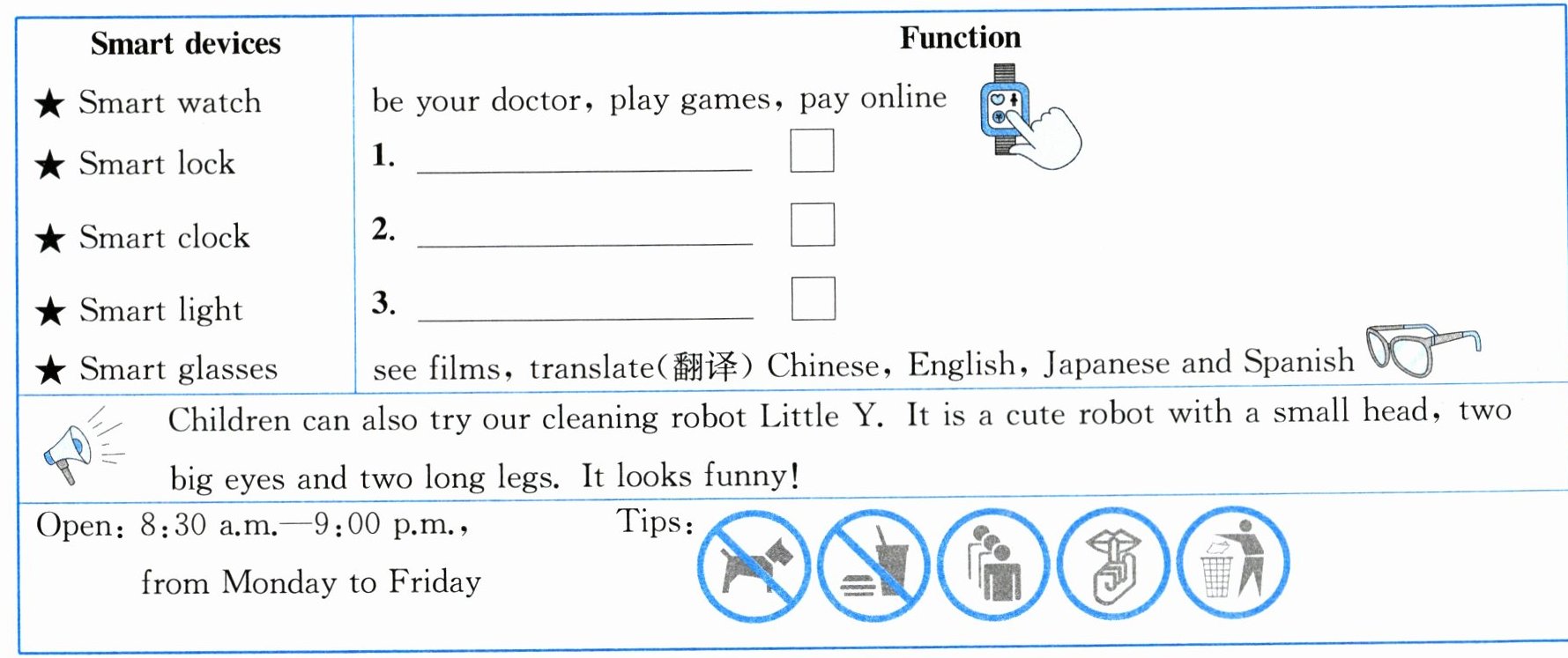
(一) 根据海报内容及生活常识,从方框中选择与智能设备相对应的功能填在横线上,并匹配相应的图片。(6分)
A. tell time, the weather and what to wear
B. turn on or turn off by your sound
C. open by your sound, fingers and keys a. b. C.
(二)根据海报内容,选择正确的答案。(2分)
( )What does Little Y look like?

(三)根据海报内容,回答下列问题。(3分)
1. Sherry can only speak Chinese. If she's going to Japan for travel, what smart device can she try? ___
2. What can't we do in the City Science Centre? ___
(一) 根据海报内容及生活常识,从方框中选择与智能设备相对应的功能填在横线上,并匹配相应的图片。(6分)
A. tell time, the weather and what to wear
B. turn on or turn off by your sound
C. open by your sound, fingers and keys a. b. C.
(二)根据海报内容,选择正确的答案。(2分)
( )What does Little Y look like?
(三)根据海报内容,回答下列问题。(3分)
1. Sherry can only speak Chinese. If she's going to Japan for travel, what smart device can she try? ___
2. What can't we do in the City Science Centre? ___
答案
(一) 1. C, b 2. A, c 3. B, a
(二)C
(三)1. She can try the smart glasses. 2. We can't take dogs to the centre or eat in the centre.(第2小题答案不唯一,与海报内容相符即可)
(二)C
(三)1. She can try the smart glasses. 2. We can't take dogs to the centre or eat in the centre.(第2小题答案不唯一,与海报内容相符即可)
解析
【分析】
这道题围绕智能家居设备海报展开,解题需分模块梳理思路:
1. 亮点原创题:先逐一解读功能选项的含义,再结合生活常识判断对应的智能设备,进而匹配对应图片。比如选项C是通过声音、指纹、钥匙开启,对应智能门锁,匹配图片b;选项A是播报时间、天气和穿搭建议,对应智能语音助手,匹配图片c;选项B是声控开关设备,匹配图片a。
2. 选择题:需依据海报中Little Y的形象描述,从选项里选出对应外观。
3. 回答问题:第一问要找到具备翻译功能的智能设备,满足只会中文去日本的需求;第二问需从海报的参观规则中提取禁止的行为,结合内容合理作答即可。
【解析】
(一) 亮点原创:
1. 选项C描述“通过声音、指纹和钥匙开启”,符合智能门锁的功能,对应图片b,故填C, b。
2. 选项A描述“播报时间、天气和穿搭建议”,是智能语音助手的典型功能,对应图片c,故填A, c。
3. 选项B描述“通过声音控制开关”,对应声控类智能设备,匹配图片a,故填B, a。
(二) 根据海报中Little Y的外观相关信息,选择正确选项C。
(三) 回答问题:
1. Sherry只会中文去日本,需要具备翻译功能的智能设备,海报中的智能眼镜(smart glasses)可满足该需求,所以回答She can try the smart glasses.
2. 根据海报的参观规定,不能在城市科学中心做的事包括带狗进入、在中心内进食等,所以回答We can't take dogs to the centre or eat in the centre.(答案不唯一,符合海报内容即可)
【答案】
(一) 1. C, b 2. A, c 3. B, a
(二)C
(三)1. She can try the smart glasses. 2. We can't take dogs to the centre or eat in the centre.(第2小题答案不唯一,与海报内容相符即可)
【知识点】
信息匹配、细节理解、常识运用
【点评】
本题结合智能家居的生活化场景,考查学生的信息提取、匹配能力及常识运用。解题时需仔细研读海报内容,将选项描述与设备功能、图片准确对应,同时紧扣题目要求提取细节作答,既贴近生活又锻炼了实用英语能力。
【难度系数】
0.6
这道题围绕智能家居设备海报展开,解题需分模块梳理思路:
1. 亮点原创题:先逐一解读功能选项的含义,再结合生活常识判断对应的智能设备,进而匹配对应图片。比如选项C是通过声音、指纹、钥匙开启,对应智能门锁,匹配图片b;选项A是播报时间、天气和穿搭建议,对应智能语音助手,匹配图片c;选项B是声控开关设备,匹配图片a。
2. 选择题:需依据海报中Little Y的形象描述,从选项里选出对应外观。
3. 回答问题:第一问要找到具备翻译功能的智能设备,满足只会中文去日本的需求;第二问需从海报的参观规则中提取禁止的行为,结合内容合理作答即可。
【解析】
(一) 亮点原创:
1. 选项C描述“通过声音、指纹和钥匙开启”,符合智能门锁的功能,对应图片b,故填C, b。
2. 选项A描述“播报时间、天气和穿搭建议”,是智能语音助手的典型功能,对应图片c,故填A, c。
3. 选项B描述“通过声音控制开关”,对应声控类智能设备,匹配图片a,故填B, a。
(二) 根据海报中Little Y的外观相关信息,选择正确选项C。
(三) 回答问题:
1. Sherry只会中文去日本,需要具备翻译功能的智能设备,海报中的智能眼镜(smart glasses)可满足该需求,所以回答She can try the smart glasses.
2. 根据海报的参观规定,不能在城市科学中心做的事包括带狗进入、在中心内进食等,所以回答We can't take dogs to the centre or eat in the centre.(答案不唯一,符合海报内容即可)
【答案】
(一) 1. C, b 2. A, c 3. B, a
(二)C
(三)1. She can try the smart glasses. 2. We can't take dogs to the centre or eat in the centre.(第2小题答案不唯一,与海报内容相符即可)
【知识点】
信息匹配、细节理解、常识运用
【点评】
本题结合智能家居的生活化场景,考查学生的信息提取、匹配能力及常识运用。解题时需仔细研读海报内容,将选项描述与设备功能、图片准确对应,同时紧扣题目要求提取细节作答,既贴近生活又锻炼了实用英语能力。
【难度系数】
0.6
