

 登录
登录
五、新情境 时文热点 阅读短文,选择正确的答案并完成句子。(5分)
Some of China's high-speed trains roll out(推出)“quiet carriages". The carriages close doors at both ends to keep away from the noise outside and ask people in them to keep quiet. People can choose such a carriage when they buy the tickets. I The new carriages can create(营造)a quiet and comfortable ambience for people. Many people welcome them. "I make one trip a week between Chengdu and Chongqing for work. I sometimes do my work or get some sleep during the trip. The quiet carriage is good for me," says a 34-year-old man in Chengdu.
( )1. What makes the quiet carriages quiet?
A. Doors on both ends of the carriages. B. People outside the carriages.
C. The doors on both ends of the carriages and people in the carriages.
( )2. Which of the following is NOT allowed in a quiet carriage?
A. Having a sleep. B. Using a computer to do some work.
C. Answering the phone without turning off the speaker.
( )3. The underlined word "ambience" means“___”in Chinese.
A. 气味 B. 氛围 C. 情景
( )4. What does the part with “~” mainly talk about?
A. Some rules(规则)of the quiet carriages.
B. How people feel about the quiet carriages.
C. Why China rolls out such quiet carriages.
5. The underlined word “them” refers to “the ___ ___” in the passage.
Some of China's high-speed trains roll out(推出)“quiet carriages". The carriages close doors at both ends to keep away from the noise outside and ask people in them to keep quiet. People can choose such a carriage when they buy the tickets. I
n
t
h
e
c
a
r
r
i
a
g
e
s
,
p
e
o
p
l
e
m
u
s
t
k
e
e
p
t
h
e
i
r
v
o
i
c
e
l
o
w
a
n
d
w
e
a
r
h
e
a
d
p
h
o
n
e
s
o
r
t
u
r
n
o
f
f
s
p
e
a
k
e
r
s
w
h
e
n
t
h
e
y
u
s
e
e
l
e
c
t
r
o
n
i
c
d
e
v
i
c
e
s
(
电
子
设
备
)
.
T
h
e
y
n
e
e
d
t
o
l
e
a
v
e
t
h
e
c
a
r
r
i
a
g
e
s
t
o
m
a
k
e
o
r
a
n
s
w
e
r
c
a
l
l
s
.
( )1. What makes the quiet carriages quiet?
A. Doors on both ends of the carriages. B. People outside the carriages.
C. The doors on both ends of the carriages and people in the carriages.
( )2. Which of the following is NOT allowed in a quiet carriage?
A. Having a sleep. B. Using a computer to do some work.
C. Answering the phone without turning off the speaker.
( )3. The underlined word "ambience" means“___”in Chinese.
A. 气味 B. 氛围 C. 情景
( )4. What does the part with “~” mainly talk about?
A. Some rules(规则)of the quiet carriages.
B. How people feel about the quiet carriages.
C. Why China rolls out such quiet carriages.
5. The underlined word “them” refers to “the ___ ___” in the passage.
答案
1. C 2. C 3. B 4. A 5. new carriages
解析
【分析】
这是一篇聚焦高铁静音车厢的时文阅读题,解题核心思路是“定位原文,匹配对应信息”:
1. 第1题:需从原文中找到静音车厢实现安静的全部原因,原文同时提到了车厢两端关门隔绝外界噪音和要求车内乘客保持安静两个条件,需综合判断。
2. 第2题:要对照原文里的静音车厢规则,找出不符合要求的行为,重点关注电子设备使用、接打电话的相关规定。
3. 第3题:结合前文“营造安静舒适的”这一语境,推测划线单词的中文含义。
4. 第4题:分析划线段落的内容,该段落全是对车厢内乘客行为的要求,据此判断段落主旨。
5. 第5题:根据指代关系的就近原则,找到前文提到的被欢迎的对象,确定“them”的指代内容。
【解析】
1. 第1题:根据原文“The carriages close doors at both ends to keep away from the noise outside and ask people in them to keep quiet.”可知,静音车厢安静的原因是两端的门隔绝外界噪音,同时车内乘客保持安静,两者共同作用,故选C。
2. 第2题:根据原文“They need to leave the carriages to make or answer calls.”以及“wear headphones or turn off speakers when they use electronic devices”可知,在静音车厢内不允许不离开车厢接电话,也不允许使用电子设备时不关闭扬声器,选项C的行为违反规定,故选C。
3. 第3题:根据前文“The new carriages can create(营造)a quiet and comfortable ambience”的语境,“营造安静舒适的______”,结合选项可知“ambience”意为“氛围”,故选B。
4. 第4题:原文划线部分(“In the carriages, people must keep their voice low...make or answer calls.”)均为静音车厢内的行为规则,所以该部分主要讲述静音车厢的规则,故选A。
5. 第5题:根据前文“The new carriages can create(营造)a quiet and comfortable ambience for people. Many people welcome them.”,可知“them”指代前文提到的“new carriages”。
【答案】
1. C 2. C 3. B 4. A 5. new carriages
【知识点】
细节理解、词义猜测、指代辨析
【点评】
本文取材于高铁静音车厢的社会热点,贴近日常生活,考查学生的信息定位、语境推理及主旨归纳能力,在完成习题的同时能让学生了解民生热点,提升英语实用阅读能力。
【难度系数】
0.7
这是一篇聚焦高铁静音车厢的时文阅读题,解题核心思路是“定位原文,匹配对应信息”:
1. 第1题:需从原文中找到静音车厢实现安静的全部原因,原文同时提到了车厢两端关门隔绝外界噪音和要求车内乘客保持安静两个条件,需综合判断。
2. 第2题:要对照原文里的静音车厢规则,找出不符合要求的行为,重点关注电子设备使用、接打电话的相关规定。
3. 第3题:结合前文“营造安静舒适的”这一语境,推测划线单词的中文含义。
4. 第4题:分析划线段落的内容,该段落全是对车厢内乘客行为的要求,据此判断段落主旨。
5. 第5题:根据指代关系的就近原则,找到前文提到的被欢迎的对象,确定“them”的指代内容。
【解析】
1. 第1题:根据原文“The carriages close doors at both ends to keep away from the noise outside and ask people in them to keep quiet.”可知,静音车厢安静的原因是两端的门隔绝外界噪音,同时车内乘客保持安静,两者共同作用,故选C。
2. 第2题:根据原文“They need to leave the carriages to make or answer calls.”以及“wear headphones or turn off speakers when they use electronic devices”可知,在静音车厢内不允许不离开车厢接电话,也不允许使用电子设备时不关闭扬声器,选项C的行为违反规定,故选C。
3. 第3题:根据前文“The new carriages can create(营造)a quiet and comfortable ambience”的语境,“营造安静舒适的______”,结合选项可知“ambience”意为“氛围”,故选B。
4. 第4题:原文划线部分(“In the carriages, people must keep their voice low...make or answer calls.”)均为静音车厢内的行为规则,所以该部分主要讲述静音车厢的规则,故选A。
5. 第5题:根据前文“The new carriages can create(营造)a quiet and comfortable ambience for people. Many people welcome them.”,可知“them”指代前文提到的“new carriages”。
【答案】
1. C 2. C 3. B 4. A 5. new carriages
【知识点】
细节理解、词义猜测、指代辨析
【点评】
本文取材于高铁静音车厢的社会热点,贴近日常生活,考查学生的信息定位、语境推理及主旨归纳能力,在完成习题的同时能让学生了解民生热点,提升英语实用阅读能力。
【难度系数】
0.7
六、新情境生活运用 任务型阅读。(12分)
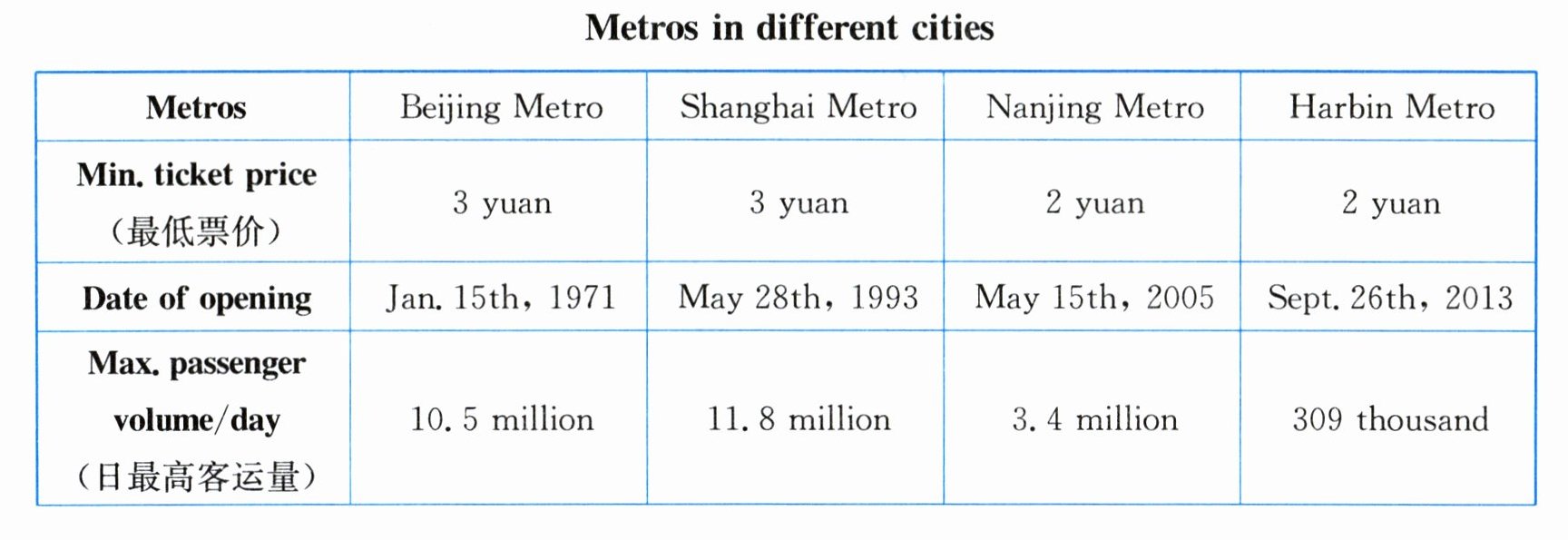


(续表)
(一)根据材料内容,选择正确的答案。(6分)
( )1. The metros in ___ have the most passengers every day.
A. Beijing B. Shanghai C. Nanjing
( )2. Which of the following is TRUE according to the form?
A. People in Beijing can go everywhere in the city by metro.
B. It's easy to go from the south to the north in Shanghai.
C. You should spend at least(至少)3 yuan taking the metro in Har ( )3. You're at Zhenru Station. You want to go swimming. How many stops should you take?
A. Five. B. Seven. C. Nine.
(二)根据材料内容,判断正(T)误(F)。(6分)
( )1. In the diagram, we can see five interchange stations.
( )2. We can change Line 3 at Caoyang Road Station.
( )3. There are three lines at Xujiahui Station.
(续表)
(一)根据材料内容,选择正确的答案。(6分)
( )1. The metros in ___ have the most passengers every day.
A. Beijing B. Shanghai C. Nanjing
( )2. Which of the following is TRUE according to the form?
A. People in Beijing can go everywhere in the city by metro.
B. It's easy to go from the south to the north in Shanghai.
C. You should spend at least(至少)3 yuan taking the metro in Har ( )3. You're at Zhenru Station. You want to go swimming. How many stops should you take?
A. Five. B. Seven. C. Nine.
(二)根据材料内容,判断正(T)误(F)。(6分)
( )1. In the diagram, we can see five interchange stations.
( )2. We can change Line 3 at Caoyang Road Station.
( )3. There are three lines at Xujiahui Station.
答案
(一)1. B 2. A 3. B
(二)1. F 2. T 3. T
(二)1. F 2. T 3. T
解析
【分析】
这是一道结合地铁图文材料的任务型阅读题,以选择题和判断题的形式考查细节信息提取能力。解题思路如下:
1. 先通读所有题目,明确每个问题的考查点:选择题侧重各城市地铁的客流、服务范围、票价及站点计数;判断题侧重地铁线路图中的换乘站数量、线路换乘点等细节。
2. 带着问题回归材料(文字信息+线路图),精准定位对应内容,逐一核对选项或题目描述与材料是否匹配,避免主观猜测。
3. 对于站点计数类题目,需在线路图中找到起点与目标站点,按线路顺序准确统计经过的站数。
【解析】
(一) 选择题
1. 对比材料中各城市地铁的日均客流量数据,可知上海地铁的日均乘客量最多,因此选B。
2. 逐一分析选项:
A选项:根据材料中北京地铁的相关表述,可知其覆盖范围广,可到达城市各处,表述正确;
B选项:材料未提及上海南北区域出行便捷的相关内容,表述错误;
C选项:材料中哈尔滨地铁的最低票价并非3元,表述错误;
综上选A。
3. 在地铁线路图中定位Zhenru(真如)站,找到可抵达游泳场所的站点,按线路顺序数出经过的站点为7个,因此选B。
(二) 判断题
1. 查看地铁线路图中的换乘站数量,可知其数量并非5个,表述错误,填F。
2. 根据线路图信息,Caoyang Road(曹杨路)站可换乘Line 3(3号线),表述正确,填T。
3. 从线路图可知Xujiahui(徐家汇)站有三条线路交汇,表述正确,填T。
【答案】
(一)1. B 2. A 3. B
(二)1. F 2. T 3. T
【知识点】
细节信息提取,任务型阅读,图文信息匹配
【点评】
本题贴合生活中的地铁出行场景,考查学生从图文材料中精准提取细节的能力,既锻炼了审题能力,也提升了学生运用英语解决生活实际问题的能力。
【难度系数】
0.6
这是一道结合地铁图文材料的任务型阅读题,以选择题和判断题的形式考查细节信息提取能力。解题思路如下:
1. 先通读所有题目,明确每个问题的考查点:选择题侧重各城市地铁的客流、服务范围、票价及站点计数;判断题侧重地铁线路图中的换乘站数量、线路换乘点等细节。
2. 带着问题回归材料(文字信息+线路图),精准定位对应内容,逐一核对选项或题目描述与材料是否匹配,避免主观猜测。
3. 对于站点计数类题目,需在线路图中找到起点与目标站点,按线路顺序准确统计经过的站数。
【解析】
(一) 选择题
1. 对比材料中各城市地铁的日均客流量数据,可知上海地铁的日均乘客量最多,因此选B。
2. 逐一分析选项:
A选项:根据材料中北京地铁的相关表述,可知其覆盖范围广,可到达城市各处,表述正确;
B选项:材料未提及上海南北区域出行便捷的相关内容,表述错误;
C选项:材料中哈尔滨地铁的最低票价并非3元,表述错误;
综上选A。
3. 在地铁线路图中定位Zhenru(真如)站,找到可抵达游泳场所的站点,按线路顺序数出经过的站点为7个,因此选B。
(二) 判断题
1. 查看地铁线路图中的换乘站数量,可知其数量并非5个,表述错误,填F。
2. 根据线路图信息,Caoyang Road(曹杨路)站可换乘Line 3(3号线),表述正确,填T。
3. 从线路图可知Xujiahui(徐家汇)站有三条线路交汇,表述正确,填T。
【答案】
(一)1. B 2. A 3. B
(二)1. F 2. T 3. T
【知识点】
细节信息提取,任务型阅读,图文信息匹配
【点评】
本题贴合生活中的地铁出行场景,考查学生从图文材料中精准提取细节的能力,既锻炼了审题能力,也提升了学生运用英语解决生活实际问题的能力。
【难度系数】
0.6
