

 登录
登录
Ⅰ. Complete the sentences with proper words according to the Chinese given.
Lily wants to make a report on how to be positive (积极的). Here are the steps.
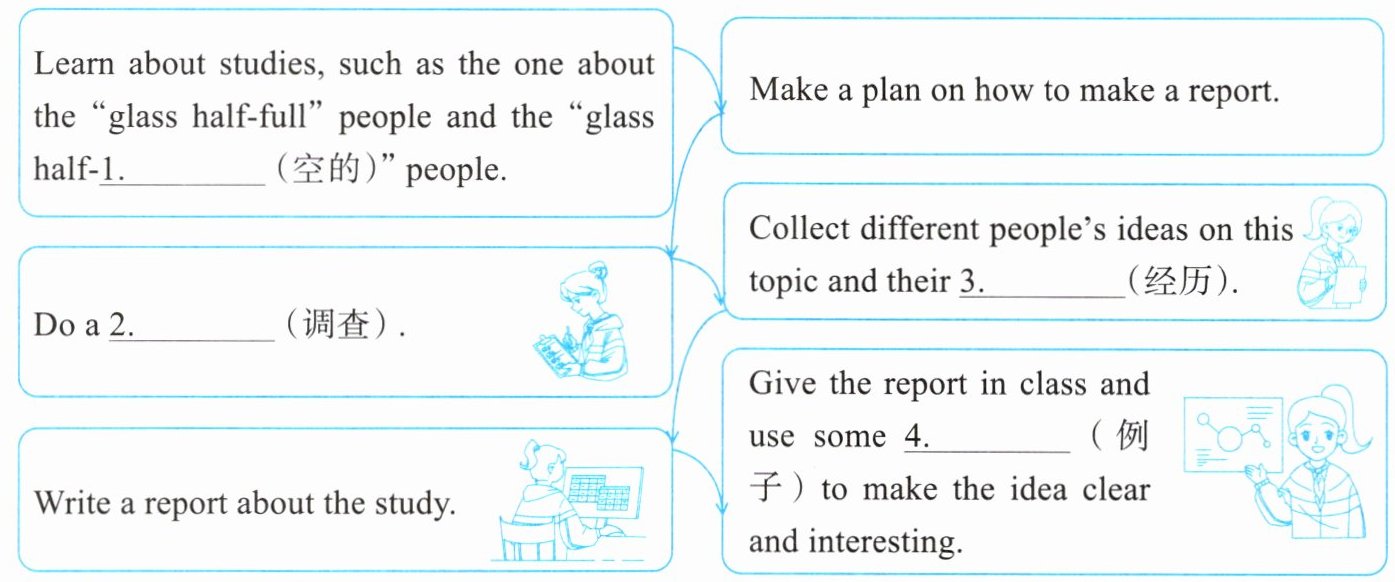
Learn about studies, such as the one about the “glass half - full” people and the “glass half - 1.
Do a 2.
Make a plan on how to make a report.
Collect different people’s ideas on this topic and their 3.
Write a report about the study.
Give the report in class and use some 4.
Lily wants to make a report on how to be positive (积极的). Here are the steps.
Learn about studies, such as the one about the “glass half - full” people and the “glass half - 1.
empty
(空的)” people.Do a 2.
survey
(调查).Make a plan on how to make a report.
Collect different people’s ideas on this topic and their 3.
experiences
(经历).Write a report about the study.
Give the report in class and use some 4.
examples
(例子) to make the idea clear and interesting.答案
Ⅰ. 1. empty 2. survey 3. experiences 4. examples
解析
【分析】
这是一道根据中文提示补全单词的题目,解题时需要结合语境、固定搭配和语法规则来思考:
1. 先根据中文提示回忆对应的英文单词;
2. 关注名词的单复数变化,当表示多个同类事物时要使用复数形式;
3. 结合固定表达和常用短语,确保填写的单词符合语境和语法要求。
【解析】
1. 第一空:中文提示“空的”,对应的英文形容词是empty,“glass half-empty”是固定表达,用来指代心态悲观的人,符合语境,故填empty。
2. 第二空:中文提示“调查”,对应的英文名词是survey,“do a survey”是固定短语,意为“做调查”,符合题意,故填survey。
3. 第三空:中文提示“经历”,对应的英文名词是experience,此处指不同人的具体经历,是可数名词,前面有“different people's”(不同人的)修饰,所以要用复数形式experiences。
4. 第四空:中文提示“例子”,对应的英文名词是example,前面有some(一些)修饰,可数名词要使用复数形式,故填examples。
【答案】
1. empty
2. survey
3. experiences
4. examples
【知识点】
1. 基础形容词拼写
2. 名词单复数变形
3. 固定短语搭配
【点评】
本题结合学习场景考查词汇的拼写、语境运用和名词单复数的语法规则,既需要掌握基础词汇,也需要结合语境判断名词的数,注重词汇在实际场景中的运用,整体难度适中。
【难度系数】
0.7
这是一道根据中文提示补全单词的题目,解题时需要结合语境、固定搭配和语法规则来思考:
1. 先根据中文提示回忆对应的英文单词;
2. 关注名词的单复数变化,当表示多个同类事物时要使用复数形式;
3. 结合固定表达和常用短语,确保填写的单词符合语境和语法要求。
【解析】
1. 第一空:中文提示“空的”,对应的英文形容词是empty,“glass half-empty”是固定表达,用来指代心态悲观的人,符合语境,故填empty。
2. 第二空:中文提示“调查”,对应的英文名词是survey,“do a survey”是固定短语,意为“做调查”,符合题意,故填survey。
3. 第三空:中文提示“经历”,对应的英文名词是experience,此处指不同人的具体经历,是可数名词,前面有“different people's”(不同人的)修饰,所以要用复数形式experiences。
4. 第四空:中文提示“例子”,对应的英文名词是example,前面有some(一些)修饰,可数名词要使用复数形式,故填examples。
【答案】
1. empty
2. survey
3. experiences
4. examples
【知识点】
1. 基础形容词拼写
2. 名词单复数变形
3. 固定短语搭配
【点评】
本题结合学习场景考查词汇的拼写、语境运用和名词单复数的语法规则,既需要掌握基础词汇,也需要结合语境判断名词的数,注重词汇在实际场景中的运用,整体难度适中。
【难度系数】
0.7
Ⅱ. Choose the proper sentences to complete the conversations.
1. Rita: School life is so boring. We have classes and do homework every day.
Ben:
Rita: I guess you’re right. We do have fun together.
A. But think about our happy moments of learning and playing together.
B. But do we really have any other choices? Just do it.
2. Rita: I made a mistake in my report. Our classmates laughed at me.
Ben:
Rita: OK!
A. It is really funny. We still laugh when we think of the mistake.
B. But we learnt a lot from your report. It’s lunchtime. Come and have lunch.
3. Rita: I joined the school football team. I’m afraid I can’t play well.
Ben: But you are the best football player in our class. You can do it.
Rita:
A. Thank you, Ben. You’re right. I can do it.
B. But I’m still not good enough.
1. Rita: School life is so boring. We have classes and do homework every day.
Ben:
A
Rita: I guess you’re right. We do have fun together.
A. But think about our happy moments of learning and playing together.
B. But do we really have any other choices? Just do it.
2. Rita: I made a mistake in my report. Our classmates laughed at me.
Ben:
B
Rita: OK!
A. It is really funny. We still laugh when we think of the mistake.
B. But we learnt a lot from your report. It’s lunchtime. Come and have lunch.
3. Rita: I joined the school football team. I’m afraid I can’t play well.
Ben: But you are the best football player in our class. You can do it.
Rita:
A
A. Thank you, Ben. You’re right. I can do it.
B. But I’m still not good enough.
答案
Ⅱ. 1. A 2. B 3. A
解析
【分析】
这是一道情景交际补全对话题,解题关键是结合上下文语境,分析说话者的情绪和意图,选择最贴合语境的应答:
1. 第一题中,Rita抱怨校园生活无聊,后文她认同Ben的话并提到“在一起确实很开心”,所以Ben的回答需要引导Rita关注校园里的快乐时刻,A选项符合这一逻辑;B选项语气消极,不符合后文的积极回应。
2. 第二题中,Rita因报告出错被同学嘲笑,情绪低落,Ben的回答需要给予安慰或转移注意力,B选项既肯定了报告的价值,又邀请Rita吃午饭,能缓解她的情绪;A选项附和嘲笑,会加重Rita的负面情绪,不合适。
3. 第三题中,Ben在鼓励Rita,Rita的回应应该是接受鼓励并建立信心,A选项表达感谢并肯定自己,符合积极的交际逻辑;B选项继续自我否定,不符合鼓励后的正常回应。
【解析】
1. 对话1:Rita抱怨校园生活无聊,Ben需要引导她看到校园生活的快乐面,A选项“但想想我们一起学习和玩耍的快乐时刻”与后文Rita说“我们在一起确实很开心”呼应,故选A。
2. 对话2:Rita因被嘲笑心情不佳,B选项“但我们从你的报告中学到了很多。现在是午饭时间,来吃午饭吧”既给予了正面肯定,又转移了话题,能安抚Rita的情绪,符合语境,故选B。
3. 对话3:Ben鼓励Rita,A选项“谢谢你,Ben。你说得对,我能做到”是对鼓励的积极回应,符合交际逻辑,故选A。
【答案】
Ⅱ. 1. A 2. B 3. A
【知识点】
情景交际、语境匹配、口语应答
【点评】
本题围绕校园日常场景展开,考查学生在真实交际语境中选择合适应答的能力,要求学生结合上下文判断说话者的情绪和意图,注重语言的得体性与逻辑性,有助于提升学生的英语口语交际能力。
【难度系数】
0.8
这是一道情景交际补全对话题,解题关键是结合上下文语境,分析说话者的情绪和意图,选择最贴合语境的应答:
1. 第一题中,Rita抱怨校园生活无聊,后文她认同Ben的话并提到“在一起确实很开心”,所以Ben的回答需要引导Rita关注校园里的快乐时刻,A选项符合这一逻辑;B选项语气消极,不符合后文的积极回应。
2. 第二题中,Rita因报告出错被同学嘲笑,情绪低落,Ben的回答需要给予安慰或转移注意力,B选项既肯定了报告的价值,又邀请Rita吃午饭,能缓解她的情绪;A选项附和嘲笑,会加重Rita的负面情绪,不合适。
3. 第三题中,Ben在鼓励Rita,Rita的回应应该是接受鼓励并建立信心,A选项表达感谢并肯定自己,符合积极的交际逻辑;B选项继续自我否定,不符合鼓励后的正常回应。
【解析】
1. 对话1:Rita抱怨校园生活无聊,Ben需要引导她看到校园生活的快乐面,A选项“但想想我们一起学习和玩耍的快乐时刻”与后文Rita说“我们在一起确实很开心”呼应,故选A。
2. 对话2:Rita因被嘲笑心情不佳,B选项“但我们从你的报告中学到了很多。现在是午饭时间,来吃午饭吧”既给予了正面肯定,又转移了话题,能安抚Rita的情绪,符合语境,故选B。
3. 对话3:Ben鼓励Rita,A选项“谢谢你,Ben。你说得对,我能做到”是对鼓励的积极回应,符合交际逻辑,故选A。
【答案】
Ⅱ. 1. A 2. B 3. A
【知识点】
情景交际、语境匹配、口语应答
【点评】
本题围绕校园日常场景展开,考查学生在真实交际语境中选择合适应答的能力,要求学生结合上下文判断说话者的情绪和意图,注重语言的得体性与逻辑性,有助于提升学生的英语口语交际能力。
【难度系数】
0.8
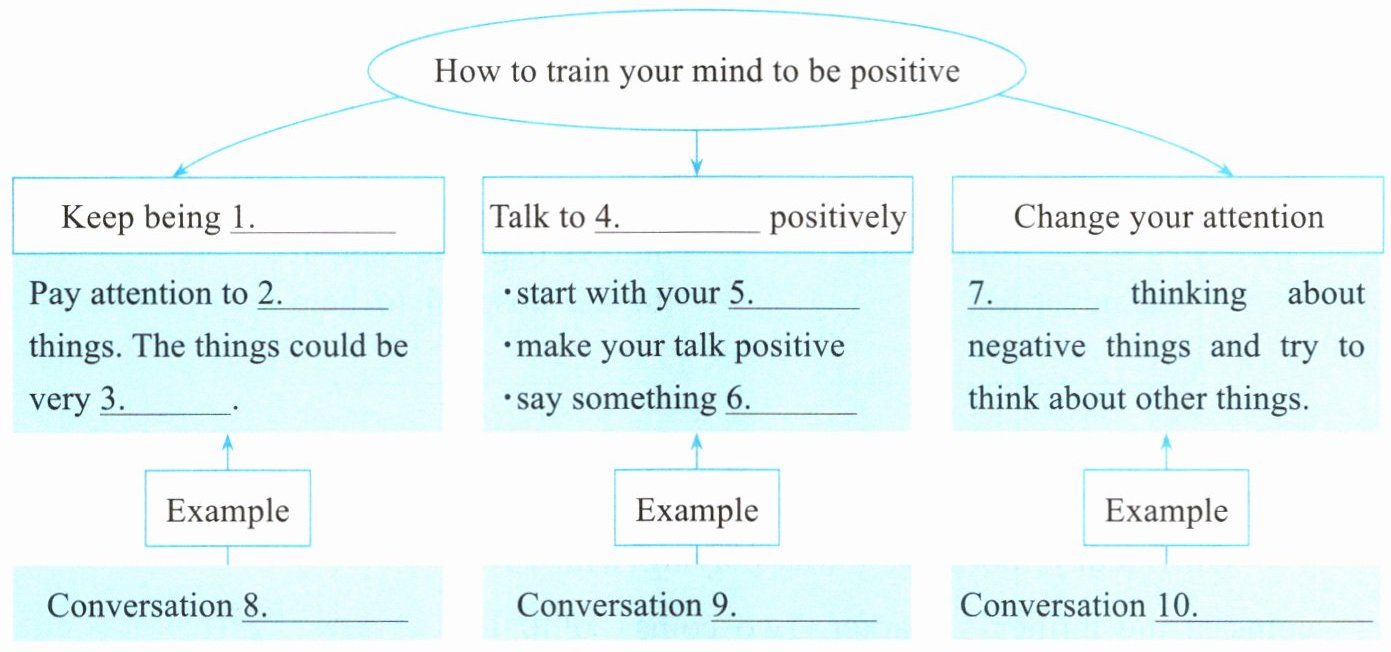
Ⅲ. Read Lily’s report and complete the mind map. One word for each blank. Then match the conversations in Exercise Ⅱ with the ways to be positive.
If you want to make your mind positive, all you need is some practice. Try out our plan and you’ll stay positive all day.
Always be thankful. When good things happen, you’ll find the world is wonderful. Always pay attention to happy things or what you are thankful for. It can be as small as a sunny day or your cat sitting by your hand.
Use positive self - talk. If you feel bad, try to encourage yourself. First, start with your name. For example, say: “Jamie …” Then, change your words into positive ones. Don’t tell yourself, “You’ll be nervous at the party.” You can say, “You’ll meet many nice people there.” Finally, you can say something nice like, “People will like you.”
Change your attention. People sometimes keep thinking about negative (消极的) things. Try to move your mind away from them. If you can’t stop thinking about them, try to go for a run, take a bath or think about some happy things.
If you want to make your mind positive, all you need is some practice. Try out our plan and you’ll stay positive all day.
Always be thankful. When good things happen, you’ll find the world is wonderful. Always pay attention to happy things or what you are thankful for. It can be as small as a sunny day or your cat sitting by your hand.
Use positive self - talk. If you feel bad, try to encourage yourself. First, start with your name. For example, say: “Jamie …” Then, change your words into positive ones. Don’t tell yourself, “You’ll be nervous at the party.” You can say, “You’ll meet many nice people there.” Finally, you can say something nice like, “People will like you.”
Change your attention. People sometimes keep thinking about negative (消极的) things. Try to move your mind away from them. If you can’t stop thinking about them, try to go for a run, take a bath or think about some happy things.
It’s easy for some people to look on thebright side, but for others it may be difficult. Keep practising. You will have a bright life.
答案
Ⅲ. 1. thankful 2. happy/good 3. small 4. yourself 5. name 6. nice 7. Stop 8. 1 9. 3 10. 2
解析
【分析】
这是一道任务型阅读题,需结合短文内容完成思维导图的填空与对话匹配。解题思路如下:
1. 先通读全文,明确培养积极心态的三个核心方法;
2. 针对思维导图的每个模块,回到原文对应段落定位细节,提取符合“每空一词”要求的关键词;
3. 最后根据每个方法对应的示例,匹配对应的对话编号。
【解析】
1. 根据短文第二段开头“Always be thankful.”,可知第一个核心方法是保持感恩,故填thankful。
2. 由第二段“Always pay attention to happy things or what you are thankful for.”,可知要关注开心/美好的事,故填happy/good。
3. 从第二段“It can be as small as a sunny day or your cat sitting by your hand.”可知,这些事可以非常微小,故填small。
4. 短文第三段介绍“Use positive self - talk.”,即和自己进行积极对话,故填yourself。
5. 根据第三段“First, start with your name.”,可知对话要从自己的名字开始,故填name。
6. 由第三段“Finally, you can say something nice like, ‘People will like you.’”,可知要讲美好的内容,故填nice。
7. 第四段提到“People sometimes keep thinking about negative (消极的) things. Try to move your mind away from them.”,也就是停止想消极的事,故填Stop。
8. 第一个方法(感恩)对应的示例对话是Conversation 1,故填1。
9. 第二个方法(自我积极对话)对应的示例对话是Conversation 3,故填3。
10. 第三个方法(转移注意力)对应的示例对话是Conversation 2,故填2。
【答案】
1. thankful
2. happy/good
3. small
4. yourself
5. name
6. nice
7. Stop
8. 1
9. 3
10. 2
【知识点】
语篇细节定位、关键词提取、任务型匹配
【点评】
本题围绕“培养积极心态”的语篇展开,重点考查学生在语篇中定位细节、提取关键信息的能力,同时要求学生完成对话与方法的匹配,对学生的信息整合能力有一定要求。题目设置贴合语篇内容,难度适中,有助于提升学生的阅读信息处理能力。
【难度系数】
0.7
这是一道任务型阅读题,需结合短文内容完成思维导图的填空与对话匹配。解题思路如下:
1. 先通读全文,明确培养积极心态的三个核心方法;
2. 针对思维导图的每个模块,回到原文对应段落定位细节,提取符合“每空一词”要求的关键词;
3. 最后根据每个方法对应的示例,匹配对应的对话编号。
【解析】
1. 根据短文第二段开头“Always be thankful.”,可知第一个核心方法是保持感恩,故填thankful。
2. 由第二段“Always pay attention to happy things or what you are thankful for.”,可知要关注开心/美好的事,故填happy/good。
3. 从第二段“It can be as small as a sunny day or your cat sitting by your hand.”可知,这些事可以非常微小,故填small。
4. 短文第三段介绍“Use positive self - talk.”,即和自己进行积极对话,故填yourself。
5. 根据第三段“First, start with your name.”,可知对话要从自己的名字开始,故填name。
6. 由第三段“Finally, you can say something nice like, ‘People will like you.’”,可知要讲美好的内容,故填nice。
7. 第四段提到“People sometimes keep thinking about negative (消极的) things. Try to move your mind away from them.”,也就是停止想消极的事,故填Stop。
8. 第一个方法(感恩)对应的示例对话是Conversation 1,故填1。
9. 第二个方法(自我积极对话)对应的示例对话是Conversation 3,故填3。
10. 第三个方法(转移注意力)对应的示例对话是Conversation 2,故填2。
【答案】
1. thankful
2. happy/good
3. small
4. yourself
5. name
6. nice
7. Stop
8. 1
9. 3
10. 2
【知识点】
语篇细节定位、关键词提取、任务型匹配
【点评】
本题围绕“培养积极心态”的语篇展开,重点考查学生在语篇中定位细节、提取关键信息的能力,同时要求学生完成对话与方法的匹配,对学生的信息整合能力有一定要求。题目设置贴合语篇内容,难度适中,有助于提升学生的阅读信息处理能力。
【难度系数】
0.7
