

 登录
登录
Ⅳ. 阅读理解
David Gill might be the richest man in Sebastopol, California. The semi-retired health care officer is banking the most valuable currency(货币) in the world—TIME. Gill has 480 hours saved at the local time bank.
In short, a time bank does with time while other banks do with money: It stores and trades it. “Time banking means that for every hour you give to your community, you receive an hour credit(积分),” explains Krista Wyatt, a director of the nonprofit TimeBanks Org., which helps volunteers set up local time banks all over the world.
Nobody knows the exact number, but thousands of time banks with several hundred thousand members have been set up in at least 37 countries and regions, including China, Malaysia, Japan, Senegal, Argentina, Brazil and Europe, with over 3.2 million exchanges. There are probably more than 40,000 members in over 500 time banks in the US.
In Sebastopol, 250 local people have time bank accounts(账户) where they save and withdraw hours as needed. For example, Gill likes to offer his advice and help with computer programming, editing and financial(经济的) planning. In return, he asks for help when he needs a ride to the airport or someone to transport heavy furniture. The time banks are building social capital(社会资本). “I’ve made wonderful friends I wouldn’t have met otherwise and we now invite each other to our garden parties,” says Gill. “It’s about making community and being a part of the community. You can’t put a price on that.”
David Gill came to the time bank like most of his neighbours. He doesn’t remember where he first heard about it a few years ago, but he immediately thought it was a great idea. He signed up, started using it, and when the founders asked for help, he stepped up. He gets paid in the currency he values most: hours.
Time banks are a valuable resource for building social capital and supporting aging populations(人群). They allow people to help with their community and receive help in return, creating a stronger, more connected society.
1. 语言能力 推断能力 Why does the writer mention David Gill in Paragraph 1?
A. To show his wealth.
B. To announce the news.
C. To present his new job.
D. To introduce the time bank.
2. 语言能力 归纳能力 What does Paragraph 3 mainly talk about?
A. The popularity of time banks.
B. The safety of bank accounts.
C. The importance of bank members.
D. The rules of time exchanges.
3. How does David Gill get credits from the time bank?
A. By giving free rides to the airport.
B. By transporting heavy furniture.
C. By offering financial planning advice.
D. By keeping the old people company.
4. What is probably the best title for the passage?
A. Enjoying the Best Time: Old Age
B. Living in the Greatest City: Sebastopol
C. Working with the Richest Man: David Gill
D. Banking the Most Valuable Currency: Time
Ⅴ. 阅读还原
从方框中选出能填入空白处的最佳选项。选项中有一项多余。
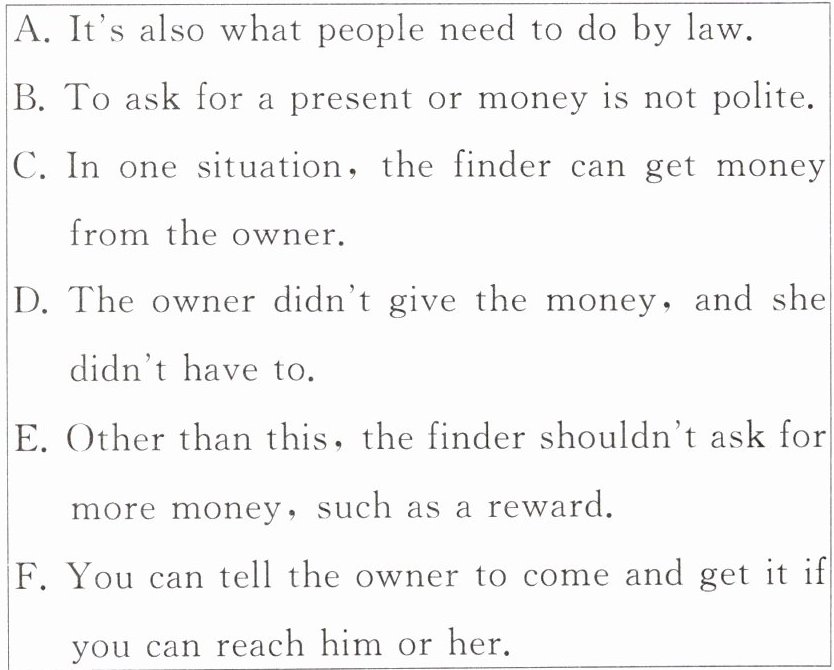
It’s nice for someone to return the thing he or she found to the owner. 1 Recently, a university student left her smartphone in a restaurant. A man later picked it up. When the phone owner found the man, he asked for 2,000 yuan from the owner. He even said that he would delete all the information on the phone if the owner wouldn’t give him the money.
2 The police suggested that the owner should file a lawsuit(起诉) against the man.
According to the Civil Code(《中华人民共和国民法典》), when you find something by accident, you must not keep it as your own.
3 Or you can hand it over to the police.
4 By law, the owner should give back any money the finder had to spend for safekeeping. The owner should also cover the travelling expenses of the finder when he or she returns the lost thing.
5 If the finder keeps the lost things on purpose, he or she may face up to two years in prison if the lost things are very valuable.
1. 2. 3. 4. 5.
David Gill might be the richest man in Sebastopol, California. The semi-retired health care officer is banking the most valuable currency(货币) in the world—TIME. Gill has 480 hours saved at the local time bank.
In short, a time bank does with time while other banks do with money: It stores and trades it. “Time banking means that for every hour you give to your community, you receive an hour credit(积分),” explains Krista Wyatt, a director of the nonprofit TimeBanks Org., which helps volunteers set up local time banks all over the world.
Nobody knows the exact number, but thousands of time banks with several hundred thousand members have been set up in at least 37 countries and regions, including China, Malaysia, Japan, Senegal, Argentina, Brazil and Europe, with over 3.2 million exchanges. There are probably more than 40,000 members in over 500 time banks in the US.
In Sebastopol, 250 local people have time bank accounts(账户) where they save and withdraw hours as needed. For example, Gill likes to offer his advice and help with computer programming, editing and financial(经济的) planning. In return, he asks for help when he needs a ride to the airport or someone to transport heavy furniture. The time banks are building social capital(社会资本). “I’ve made wonderful friends I wouldn’t have met otherwise and we now invite each other to our garden parties,” says Gill. “It’s about making community and being a part of the community. You can’t put a price on that.”
David Gill came to the time bank like most of his neighbours. He doesn’t remember where he first heard about it a few years ago, but he immediately thought it was a great idea. He signed up, started using it, and when the founders asked for help, he stepped up. He gets paid in the currency he values most: hours.
Time banks are a valuable resource for building social capital and supporting aging populations(人群). They allow people to help with their community and receive help in return, creating a stronger, more connected society.
1. 语言能力 推断能力 Why does the writer mention David Gill in Paragraph 1?
A. To show his wealth.
B. To announce the news.
C. To present his new job.
D. To introduce the time bank.
2. 语言能力 归纳能力 What does Paragraph 3 mainly talk about?
A. The popularity of time banks.
B. The safety of bank accounts.
C. The importance of bank members.
D. The rules of time exchanges.
3. How does David Gill get credits from the time bank?
A. By giving free rides to the airport.
B. By transporting heavy furniture.
C. By offering financial planning advice.
D. By keeping the old people company.
4. What is probably the best title for the passage?
A. Enjoying the Best Time: Old Age
B. Living in the Greatest City: Sebastopol
C. Working with the Richest Man: David Gill
D. Banking the Most Valuable Currency: Time
Ⅴ. 阅读还原
从方框中选出能填入空白处的最佳选项。选项中有一项多余。
It’s nice for someone to return the thing he or she found to the owner. 1 Recently, a university student left her smartphone in a restaurant. A man later picked it up. When the phone owner found the man, he asked for 2,000 yuan from the owner. He even said that he would delete all the information on the phone if the owner wouldn’t give him the money.
2 The police suggested that the owner should file a lawsuit(起诉) against the man.
According to the Civil Code(《中华人民共和国民法典》), when you find something by accident, you must not keep it as your own.
3 Or you can hand it over to the police.
4 By law, the owner should give back any money the finder had to spend for safekeeping. The owner should also cover the travelling expenses of the finder when he or she returns the lost thing.
5 If the finder keeps the lost things on purpose, he or she may face up to two years in prison if the lost things are very valuable.
1. 2. 3. 4. 5.
答案
Ⅳ. 1.D 2.A 3.C 4.D
【语篇解读】本文是一篇说明文,主要介绍了时间银行。
Ⅴ. 1.A 2.D 3.F 4.C 5.E
【语篇解读】本文是一篇说明文,介绍了当我们捡到东西时,要还给失主,拒不归还的可能会触犯法律。
1. A 解析:根据“It's nice for someone to return the thing he or she found to the owner.”以及下文可知,此处是说返还捡到的东西于情于理都是应该的,选项 A“这也是法律要求人们需要做的。”符合语境。故选 A。
2. D 解析:根据“The police suggested that the owner should file a lawsuit against the man.”可知,此处是说失主不需要给捡到者钱,选项 D“失主不用给钱,并且她也不需要。”符合语境。故选 D。
3. F 解析:根据“you must not keep it as your own”以及“Or you can hand it over to the police.”可知,此处是说捡到东西应该怎么做,选项 F“你可以通知失主过来取,如果你能联系到他或者她。”符合语境。故选 F。
4. C 解析:根据“By law, the owner should give back any money the finder had to spend for safekeeping. The owner should also cover the travelling expenses of the finder when he or she returns the lost thing.”可知,此处是说失主需要给捡到者钱的情形,选项 C“在一种情境下,捡到者可以从失主那里得到钱。”符合语境。故选 C。
5. E 解析:根据“If the finder keeps the lost things on purpose, he or she may face up to two years in prison if the lost things are very valuable.”可知,此处是说只有前面那一种情境可以,选项 E“除此之外,捡到者不应该要更多的钱,比如说回报。”符合语境。故选 E。
【语篇解读】本文是一篇说明文,主要介绍了时间银行。
Ⅴ. 1.A 2.D 3.F 4.C 5.E
【语篇解读】本文是一篇说明文,介绍了当我们捡到东西时,要还给失主,拒不归还的可能会触犯法律。
1. A 解析:根据“It's nice for someone to return the thing he or she found to the owner.”以及下文可知,此处是说返还捡到的东西于情于理都是应该的,选项 A“这也是法律要求人们需要做的。”符合语境。故选 A。
2. D 解析:根据“The police suggested that the owner should file a lawsuit against the man.”可知,此处是说失主不需要给捡到者钱,选项 D“失主不用给钱,并且她也不需要。”符合语境。故选 D。
3. F 解析:根据“you must not keep it as your own”以及“Or you can hand it over to the police.”可知,此处是说捡到东西应该怎么做,选项 F“你可以通知失主过来取,如果你能联系到他或者她。”符合语境。故选 F。
4. C 解析:根据“By law, the owner should give back any money the finder had to spend for safekeeping. The owner should also cover the travelling expenses of the finder when he or she returns the lost thing.”可知,此处是说失主需要给捡到者钱的情形,选项 C“在一种情境下,捡到者可以从失主那里得到钱。”符合语境。故选 C。
5. E 解析:根据“If the finder keeps the lost things on purpose, he or she may face up to two years in prison if the lost things are very valuable.”可知,此处是说只有前面那一种情境可以,选项 E“除此之外,捡到者不应该要更多的钱,比如说回报。”符合语境。故选 E。
解析
【分析】
做阅读还原题时,首先通读全文和方框内选项,明确文章围绕“拾得遗失物的道德要求与法律规定”展开;接着逐空分析,结合空格前后的语境(如逻辑承接、语义关联、法律条文表述)匹配选项,同时注意有一个多余选项,需排除干扰项。
【解析】
1. 空格前提到归还捡到的东西是好事,空格后引出具体事例,选项A“这也是法律要求人们需要做的”承接上文,说明归还不仅是道德要求也是法律义务,符合语境,故选A。
2. 空格前讲捡到者索要2000元,空格后警察建议失主起诉,选项D“失主不用给钱,并且她也不需要”对应警察的建议,说明失主无义务支付该费用,符合语境,故选D。
3. 空格前说不能将遗失物据为己有,空格后提到可交给警察,选项F“你可以通知失主过来取,如果你能联系到他或者她”是归还遗失物的具体可行做法,符合语境,故选F。
4. 空格后阐述失主需支付捡到者保管费、交通费的情形,选项C“在一种情境下,捡到者可以从失主那里得到钱”引出该特定情形,符合语境,故选C。
5. 空格后说明捡到者故意不还遗失物的法律后果,选项E“除此之外,捡到者不应该要更多的钱,比如说回报”明确除前述情形外不能索要额外费用,符合语境,故选E。
【答案】
1.A 2.D 3.F 4.C 5.E
【知识点】
阅读还原、拾得遗失物法律常识
【点评】
本题为阅读还原题,围绕拾得遗失物的道德与法律规定展开,考查学生的语篇逻辑衔接能力,需结合上下文语境匹配选项,难度适中。
【难度系数】
0.6
做阅读还原题时,首先通读全文和方框内选项,明确文章围绕“拾得遗失物的道德要求与法律规定”展开;接着逐空分析,结合空格前后的语境(如逻辑承接、语义关联、法律条文表述)匹配选项,同时注意有一个多余选项,需排除干扰项。
【解析】
1. 空格前提到归还捡到的东西是好事,空格后引出具体事例,选项A“这也是法律要求人们需要做的”承接上文,说明归还不仅是道德要求也是法律义务,符合语境,故选A。
2. 空格前讲捡到者索要2000元,空格后警察建议失主起诉,选项D“失主不用给钱,并且她也不需要”对应警察的建议,说明失主无义务支付该费用,符合语境,故选D。
3. 空格前说不能将遗失物据为己有,空格后提到可交给警察,选项F“你可以通知失主过来取,如果你能联系到他或者她”是归还遗失物的具体可行做法,符合语境,故选F。
4. 空格后阐述失主需支付捡到者保管费、交通费的情形,选项C“在一种情境下,捡到者可以从失主那里得到钱”引出该特定情形,符合语境,故选C。
5. 空格后说明捡到者故意不还遗失物的法律后果,选项E“除此之外,捡到者不应该要更多的钱,比如说回报”明确除前述情形外不能索要额外费用,符合语境,故选E。
【答案】
1.A 2.D 3.F 4.C 5.E
【知识点】
阅读还原、拾得遗失物法律常识
【点评】
本题为阅读还原题,围绕拾得遗失物的道德与法律规定展开,考查学生的语篇逻辑衔接能力,需结合上下文语境匹配选项,难度适中。
【难度系数】
0.6
