

 登录
登录
三、阅读七选五
阅读下面短文,从短文后的选项中选出可以填入空白处的最佳选项。选项中有两项为多余选项。
体裁:说明文
主题:科普知识
难度:★★★★
建议用时:7 min
正确率: /5
Sometimes, when turning the pages of our textbooks, we get a paper cut. 1 >> 词汇衔接
Three scientists from the Technical University of Denmark found that 65-micrometre-thick paper is most likely to cut our skin. They won the Physics Prize for this finding at the 2024 Pineapple of Science Award in Hangzhou, Zhejiang, on Nov 23.
2 >> 结构衔接
They used different kinds of paper from 30 to 220 micrometres and tested them on man-made fingers made from ballistic gel. Made with animal protein, ballistic gel has the toughness of human skin.
For thin paper, the scientists found it couldn't cut the "fingers"—it just bent(弯曲). 3
When they tried the 65-micrometre-thick paper, the scientists found it cut the fingers the most, about once every five tries. The paper used for magazines such as *Nature* and *Science* is of a thickness close to this. Common A4 printer paper is about 100 micrometers thick, which is much safer.
4 >> 结构衔接
Pushing the paper straight down onto the fingers didn't often result in a cut. Pushing the paper at a slanted angle(倾斜角度) resulted in more cuts.
According to the scientists, their findings could lead to safer paper products. 5 >> 词汇衔接
It can cut through apples and chicken.
A. Ouch! That paper is sharp.
B. The cutting angle also made a difference.
C. The scientists tested papers with different thicknesses.
D. They also created a cheap paper knife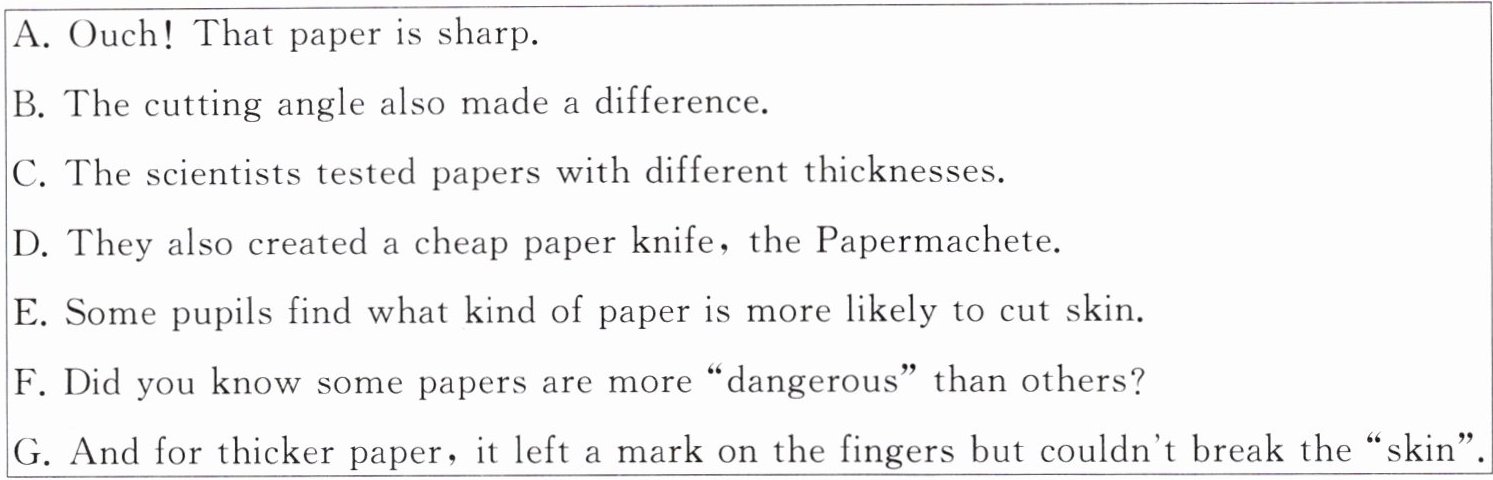 the Papermachete.
E. Some pupils find what kind of paper is more likely to cut skin.
F. Did you know some papers are more "dangerous" than others?
G. And for thicker paper, it left a mark on the fingers but couldn't break the "skin".
1.
2.
3.
4.
5.
阅读下面短文,从短文后的选项中选出可以填入空白处的最佳选项。选项中有两项为多余选项。
体裁:说明文
主题:科普知识
难度:★★★★
建议用时:7 min
正确率: /5
Sometimes, when turning the pages of our textbooks, we get a paper cut. 1 >> 词汇衔接
Three scientists from the Technical University of Denmark found that 65-micrometre-thick paper is most likely to cut our skin. They won the Physics Prize for this finding at the 2024 Pineapple of Science Award in Hangzhou, Zhejiang, on Nov 23.
2 >> 结构衔接
They used different kinds of paper from 30 to 220 micrometres and tested them on man-made fingers made from ballistic gel. Made with animal protein, ballistic gel has the toughness of human skin.
For thin paper, the scientists found it couldn't cut the "fingers"—it just bent(弯曲). 3
When they tried the 65-micrometre-thick paper, the scientists found it cut the fingers the most, about once every five tries. The paper used for magazines such as *Nature* and *Science* is of a thickness close to this. Common A4 printer paper is about 100 micrometers thick, which is much safer.
4 >> 结构衔接
Pushing the paper straight down onto the fingers didn't often result in a cut. Pushing the paper at a slanted angle(倾斜角度) resulted in more cuts.
According to the scientists, their findings could lead to safer paper products. 5 >> 词汇衔接
It can cut through apples and chicken.
A. Ouch! That paper is sharp.
B. The cutting angle also made a difference.
C. The scientists tested papers with different thicknesses.
D. They also created a cheap paper knife
the Papermachete.E. Some pupils find what kind of paper is more likely to cut skin.
F. Did you know some papers are more "dangerous" than others?
G. And for thicker paper, it left a mark on the fingers but couldn't break the "skin".
1.
2.
3.
4.
5.
答案
1. F 根据上文“Sometimes,when turning the pages of our textbooks,we get a paper cut.”和下文“65-micrometre-thick paper is most likely to cut our skin”可知纸张能割伤人,不同厚度的纸张割伤程度不同;F项“你知道有些纸张比其他纸张更‘危险’吗?”符合语境。故选F。
2. C 根据下文“They used different kinds of paper from 30 to 220 micrometres and tested them on man-made fingers made from ballistic gel.”可知科学家用不同厚度的纸张进行实验。故选C。
3. G 根据上文“For thin paper,the scientists found it couldn't cut the ‘fingers’—it just bent.”可知此处进一步介绍上文关于纸张厚度的实验结果;G项“而对于较厚的纸张,在手指上留下了印记却破不了‘皮’。”符合语境。故选G。
4. B 根据下文“Pushing the paper straight down onto the fingers didn't often result in a cut. Pushing the paper at a slanted angle resulted in more cuts.”可知不同的切割角度会有不同的结果。故选B。
5. D 根据下文“It can cut through apples and chicken.”可知科学家运用这一发现进行新的创造;D项“他们还发明了一种便宜的裁纸刀——Papermachete。”符合语境。故选D。
2. C 根据下文“They used different kinds of paper from 30 to 220 micrometres and tested them on man-made fingers made from ballistic gel.”可知科学家用不同厚度的纸张进行实验。故选C。
3. G 根据上文“For thin paper,the scientists found it couldn't cut the ‘fingers’—it just bent.”可知此处进一步介绍上文关于纸张厚度的实验结果;G项“而对于较厚的纸张,在手指上留下了印记却破不了‘皮’。”符合语境。故选G。
4. B 根据下文“Pushing the paper straight down onto the fingers didn't often result in a cut. Pushing the paper at a slanted angle resulted in more cuts.”可知不同的切割角度会有不同的结果。故选B。
5. D 根据下文“It can cut through apples and chicken.”可知科学家运用这一发现进行新的创造;D项“他们还发明了一种便宜的裁纸刀——Papermachete。”符合语境。故选D。
解析
【分析】
本题为英语七选五题型,需结合上下文的语境、词汇衔接及结构逻辑来选择合适的句子。第1空承接上文“被纸割伤”的话题,引出“纸张危险性”的内容;第2空总述科学家的实验内容,对应下文的实验操作;第3空与上文“薄纸的实验结果”形成对比,介绍厚纸的情况;第4空引出“切割角度影响”的话题,对应下文的角度实验;第5空衔接下文“新工具的功能”,说明科学家的发明成果。
【解析】
1. 第1空:上文“Sometimes, when turning the pages of our textbooks, we get a paper cut.”提到被纸割伤,下文“65-micrometre-thick paper is most likely to cut our skin”说明不同纸张的危险性,F项“Did you know some papers are more 'dangerous' than others?”能承接上文并引出下文,符合语境,故选F。
2. 第2空:下文“They used different kinds of paper from 30 to 220 micrometres and tested them on man-made fingers...”说明科学家用不同厚度的纸做实验,C项“The scientists tested papers with different thicknesses.”总述实验内容,符合语境,故选C。
3. 第3空:上文“For thin paper, the scientists found it couldn't cut the 'fingers'—it just bent.”介绍薄纸的实验结果,G项“And for thicker paper, it left a mark on the fingers but couldn't break the 'skin'.”对应介绍厚纸的结果,与上文形成对比,符合语境,故选G。
4. 第4空:下文“Pushing the paper straight down onto the fingers didn't often result in a cut. Pushing the paper at a slanted angle resulted in more cuts.”说明切割角度对割伤的影响,B项“The cutting angle also made a difference.”引出角度话题,符合语境,故选B。
5. 第5空:下文“It can cut through apples and chicken.”介绍新工具的功能,D项“They also created a cheap paper knife, the Papermachete.”说明科学家的发明,与下文功能衔接,符合语境,故选D。
【答案】
1. F 2. C 3. G 4. B 5. D
【知识点】
英语阅读理解;七选五题型;语篇衔接
【点评】
本题考查学生对英语语篇逻辑的理解能力,需结合上下文的语境、词汇及结构衔接来选择合适的句子,能有效考查学生的阅读理解水平,属于中等难度的语篇理解类题目。
【难度系数】
0.6
本题为英语七选五题型,需结合上下文的语境、词汇衔接及结构逻辑来选择合适的句子。第1空承接上文“被纸割伤”的话题,引出“纸张危险性”的内容;第2空总述科学家的实验内容,对应下文的实验操作;第3空与上文“薄纸的实验结果”形成对比,介绍厚纸的情况;第4空引出“切割角度影响”的话题,对应下文的角度实验;第5空衔接下文“新工具的功能”,说明科学家的发明成果。
【解析】
1. 第1空:上文“Sometimes, when turning the pages of our textbooks, we get a paper cut.”提到被纸割伤,下文“65-micrometre-thick paper is most likely to cut our skin”说明不同纸张的危险性,F项“Did you know some papers are more 'dangerous' than others?”能承接上文并引出下文,符合语境,故选F。
2. 第2空:下文“They used different kinds of paper from 30 to 220 micrometres and tested them on man-made fingers...”说明科学家用不同厚度的纸做实验,C项“The scientists tested papers with different thicknesses.”总述实验内容,符合语境,故选C。
3. 第3空:上文“For thin paper, the scientists found it couldn't cut the 'fingers'—it just bent.”介绍薄纸的实验结果,G项“And for thicker paper, it left a mark on the fingers but couldn't break the 'skin'.”对应介绍厚纸的结果,与上文形成对比,符合语境,故选G。
4. 第4空:下文“Pushing the paper straight down onto the fingers didn't often result in a cut. Pushing the paper at a slanted angle resulted in more cuts.”说明切割角度对割伤的影响,B项“The cutting angle also made a difference.”引出角度话题,符合语境,故选B。
5. 第5空:下文“It can cut through apples and chicken.”介绍新工具的功能,D项“They also created a cheap paper knife, the Papermachete.”说明科学家的发明,与下文功能衔接,符合语境,故选D。
【答案】
1. F 2. C 3. G 4. B 5. D
【知识点】
英语阅读理解;七选五题型;语篇衔接
【点评】
本题考查学生对英语语篇逻辑的理解能力,需结合上下文的语境、词汇及结构衔接来选择合适的句子,能有效考查学生的阅读理解水平,属于中等难度的语篇理解类题目。
【难度系数】
0.6
