

 登录
登录
B
体裁: 议论文
主题: 科普知识
难度: ★★★★★
新素养·思维品质 ①If you lie awake at night, thinking over a decision you made earlier that day or worrying about tomorrow's to-do list, you might be overthinking. Overthinking means thinking about the same thing again and again, and analyzing(分析) the simplest of situations or events too much.
②According to a research, overthinking comes from one of our primitive instincts(原始本能). The primitive mind will always see things in the worst possible way. Our brains are always looking for dangers, and then make a plan to deal with those dangers and keep us safe. Those dangers in mind may be based on past experiences or the “what ifs” we imagine could happen in the future.
③Some people believe that overthinking may be helpful because it helps us look at a problem from every possible direction and get ready for what might happen. However, the research suggests that overthinking can lead to more stress, anxiety, and depression.
④What's more, overthinking can hurt relationships. Thinking the worst and making wrong guesses can lead to conflicts(冲突) with other people. Worrying about every little thing other people do and say can also mean that you misunderstand what they mean.
⑤So, instead of sitting and thinking about a problem endlessly, you can distract(转移注意力) yourself for a bit. For example, when you have trouble in working out a problem, you can try something else, like gardening, or even sleeping.
⑥When you find yourself overthinking, challenge these thoughts. Ask yourself if they make sense and think about other possibilities. It can be difficult at first, but learning to recognize your overthinking can help you change negative(消极的) thoughts into more positive ones.
⑦“Thinking is a two-way street. While the brain may create many thoughts, in the end, it's up to us to decide if we accept them,” Natalie Dattilo, a professor at Harvard Medical School, said.
1. If you don't pass an exam, what might you think based on the primitive instincts according to the passage?
A. Parents will say nothing about my exam.
B. I should never do homework and copy others'.
C. I believe I can get higher scores in the next exam.
D. Teachers won't like me and students will laugh at me.
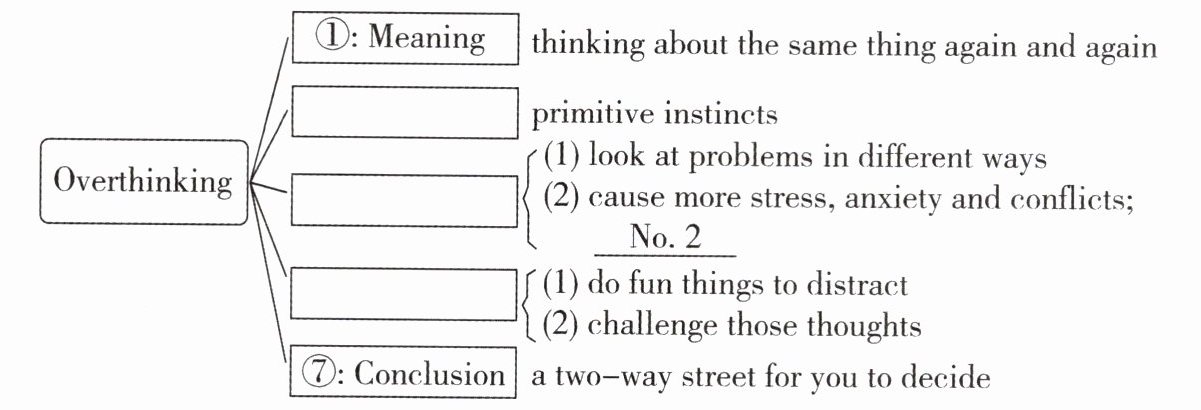
2. 新趋势·创新设问 Which of the following can be put into No. 2 in the mind map in the end?
A. make relations worse
B. get on well with others
C. distract yourself from studies
D. understand what people mean
3. 新趋势·写作手法 How does the writer develop his ideas in Paragraph 5?
A. By listing numbers.
B. By raising questions.
C. By giving examples.
D. By showing pictures.
4. 新趋势·篇章结构 Which of the following can best fit in the blanks of the structure?
A. ②: Advice; ③—④: Effects; ⑤—⑥: Reasons
B. ②: Reasons; ③—④: Effects; ⑤—⑥: Advice
C. ②: Advice; ③—⑤: Effects; ⑥: Reasons
D. ②: Reasons; ③—⑤: Effects; ⑥: Advice
体裁: 议论文
主题: 科普知识
难度: ★★★★★
新素养·思维品质 ①If you lie awake at night, thinking over a decision you made earlier that day or worrying about tomorrow's to-do list, you might be overthinking. Overthinking means thinking about the same thing again and again, and analyzing(分析) the simplest of situations or events too much.
②According to a research, overthinking comes from one of our primitive instincts(原始本能). The primitive mind will always see things in the worst possible way. Our brains are always looking for dangers, and then make a plan to deal with those dangers and keep us safe. Those dangers in mind may be based on past experiences or the “what ifs” we imagine could happen in the future.
③Some people believe that overthinking may be helpful because it helps us look at a problem from every possible direction and get ready for what might happen. However, the research suggests that overthinking can lead to more stress, anxiety, and depression.
④What's more, overthinking can hurt relationships. Thinking the worst and making wrong guesses can lead to conflicts(冲突) with other people. Worrying about every little thing other people do and say can also mean that you misunderstand what they mean.
⑤So, instead of sitting and thinking about a problem endlessly, you can distract(转移注意力) yourself for a bit. For example, when you have trouble in working out a problem, you can try something else, like gardening, or even sleeping.
⑥When you find yourself overthinking, challenge these thoughts. Ask yourself if they make sense and think about other possibilities. It can be difficult at first, but learning to recognize your overthinking can help you change negative(消极的) thoughts into more positive ones.
⑦“Thinking is a two-way street. While the brain may create many thoughts, in the end, it's up to us to decide if we accept them,” Natalie Dattilo, a professor at Harvard Medical School, said.
1. If you don't pass an exam, what might you think based on the primitive instincts according to the passage?
A. Parents will say nothing about my exam.
B. I should never do homework and copy others'.
C. I believe I can get higher scores in the next exam.
D. Teachers won't like me and students will laugh at me.
2. 新趋势·创新设问 Which of the following can be put into No. 2 in the mind map in the end?
A. make relations worse
B. get on well with others
C. distract yourself from studies
D. understand what people mean
3. 新趋势·写作手法 How does the writer develop his ideas in Paragraph 5?
A. By listing numbers.
B. By raising questions.
C. By giving examples.
D. By showing pictures.
4. 新趋势·篇章结构 Which of the following can best fit in the blanks of the structure?
A. ②: Advice; ③—④: Effects; ⑤—⑥: Reasons
B. ②: Reasons; ③—④: Effects; ⑤—⑥: Advice
C. ②: Advice; ③—⑤: Effects; ⑥: Reasons
D. ②: Reasons; ③—⑤: Effects; ⑥: Advice
答案
1. D 推理判断题。根据第二段“The primitive mind will always see things in the worst possible way.”可知原始思维总是以最坏的方式看待事物。因此没有通过考试时觉得老师会不喜欢“我”,同学会嘲笑“我”。故选 D。
2. A 细节理解题。根据第四段“What's more, overthinking can hurt relationships.”可知过度思考会损害人际关系。故选 A。
3. C 写作手法题。根据第五段“For example, when you have trouble in working out a problem, you can try something else, like gardening, or even sleeping.”可知作者举例子说明可以通过转移注意力来应对过度思考。故选 C。
4. B 篇章结构题。结合文章内容可知,第二段介绍了过度思考的原因;第三、四段介绍了过度思考的影响;第五、六段介绍了应对过度思考的建议。故选 B。
2. A 细节理解题。根据第四段“What's more, overthinking can hurt relationships.”可知过度思考会损害人际关系。故选 A。
3. C 写作手法题。根据第五段“For example, when you have trouble in working out a problem, you can try something else, like gardening, or even sleeping.”可知作者举例子说明可以通过转移注意力来应对过度思考。故选 C。
4. B 篇章结构题。结合文章内容可知,第二段介绍了过度思考的原因;第三、四段介绍了过度思考的影响;第五、六段介绍了应对过度思考的建议。故选 B。
解析
【分析】
这是一篇关于“过度思考”的科普议论文,包含4道不同类型的阅读理解题,解题思路如下:
1. 第1题(推理判断题):先定位原文第二段关于“原始本能”的描述,明确原始本能的特点是“以最坏的方式看待事物”,再分析选项选出符合该特点的答案。
2. 第2题(细节理解题):结合思维导图结构,No.2对应过度思考的负面影响,定位原文相关表述匹配选项得出答案。
3. 第3题(写作手法题):定位第五段,发现段中出现举例标志词,明确该段通过举例说明应对方法,对应选项。
4. 第4题(篇章结构题):梳理各段落内容,划分出原因、影响、建议的结构,匹配选项得出结论。
【解析】
1. 第1题:根据原文第二段“The primitive mind will always see things in the worst possible way.”可知,原始本能会以最坏的方式看待事物。选项D“老师不会喜欢我,同学会嘲笑我”是最坏的情况,符合原始本能的思维特点,故选D。
2. 第2题:根据原文第四段“What's more, overthinking can hurt relationships.”可知,过度思考会损害人际关系,对应思维导图中No.2的内容,A项“使关系更糟”符合,故选A。
3. 第3题:第五段中“For example, when you have trouble in working out a problem, you can try something else, like gardening, or even sleeping.”明确通过举例说明应对过度思考的方法,属于举例子的写作手法,故选C。
4. 第4题:梳理段落结构:第二段介绍过度思考的来源(原因);第三、四段说明过度思考带来的压力、焦虑、冲突等影响;第五、六段给出转移注意力、挑战消极想法等应对建议,对应B选项的结构划分,故选B。
【答案】
1. D 2. A 3. C 4. B
【知识点】
英语阅读理解、细节理解、推理判断
【点评】
本文为科普类议论文,围绕“过度思考”展开,题型涵盖推理判断、细节理解、写作手法、篇章结构,考查学生定位原文信息、梳理文章逻辑的综合阅读能力。
【难度系数】
0.4
这是一篇关于“过度思考”的科普议论文,包含4道不同类型的阅读理解题,解题思路如下:
1. 第1题(推理判断题):先定位原文第二段关于“原始本能”的描述,明确原始本能的特点是“以最坏的方式看待事物”,再分析选项选出符合该特点的答案。
2. 第2题(细节理解题):结合思维导图结构,No.2对应过度思考的负面影响,定位原文相关表述匹配选项得出答案。
3. 第3题(写作手法题):定位第五段,发现段中出现举例标志词,明确该段通过举例说明应对方法,对应选项。
4. 第4题(篇章结构题):梳理各段落内容,划分出原因、影响、建议的结构,匹配选项得出结论。
【解析】
1. 第1题:根据原文第二段“The primitive mind will always see things in the worst possible way.”可知,原始本能会以最坏的方式看待事物。选项D“老师不会喜欢我,同学会嘲笑我”是最坏的情况,符合原始本能的思维特点,故选D。
2. 第2题:根据原文第四段“What's more, overthinking can hurt relationships.”可知,过度思考会损害人际关系,对应思维导图中No.2的内容,A项“使关系更糟”符合,故选A。
3. 第3题:第五段中“For example, when you have trouble in working out a problem, you can try something else, like gardening, or even sleeping.”明确通过举例说明应对过度思考的方法,属于举例子的写作手法,故选C。
4. 第4题:梳理段落结构:第二段介绍过度思考的来源(原因);第三、四段说明过度思考带来的压力、焦虑、冲突等影响;第五、六段给出转移注意力、挑战消极想法等应对建议,对应B选项的结构划分,故选B。
【答案】
1. D 2. A 3. C 4. B
【知识点】
英语阅读理解、细节理解、推理判断
【点评】
本文为科普类议论文,围绕“过度思考”展开,题型涵盖推理判断、细节理解、写作手法、篇章结构,考查学生定位原文信息、梳理文章逻辑的综合阅读能力。
【难度系数】
0.4
