登录
8. (2025·南通中考)在平面直角坐标系$xOy$中,五个点的坐标分别为$A(-1,5)$,$B(1,2)$,$C(2,1)$,$D(3,-1)$,$E(5,5)$.若抛物线$y=a(x-2)^2 +k(a>0)$经过上述五个点中的三个点,则满足题意的$a$的值不可能为 (
A.$\frac{3}{8}$
B.$\frac{4}{9}$
C.$\frac{2}{3}$
D.$\frac{3}{4}$
C
)A.$\frac{3}{8}$
B.$\frac{4}{9}$
C.$\frac{2}{3}$
D.$\frac{3}{4}$
答案
8. C 解析:抛物线 $y=a(x-2)^2+k(a>0)$ 的对称轴为直线 $x=2$,$\because A(-1,5)$,$E(5,5)$,$\therefore A,E$ 关于对称轴直线 $x=2$ 对称,$\therefore A,E$ 两点同时在抛物线上或同时不在抛物线上.
①当 $A,D,E$ 三点在抛物线上时,将 $A(-1,5)$,$D(3,-1)$ 代入,得 $\begin{cases}5=a(-1-2)^2+k,\\-1=a(3-2)^2+k,\end{cases}$ 解得 $a=\dfrac{3}{4}$;
②当 $A,C,E$ 三点在抛物线上时,把 $A(-1,5)$,$C(2,1)$ 代入,得 $\begin{cases}5=a(-1-2)^2+k,\\1=a(2-2)^2+k,\end{cases}$ 解得 $a=\dfrac{4}{9}$;
③当 $A,B,E$ 三点在抛物线上时,把 $A(-1,5)$,$B(1,2)$ 代入,得 $\begin{cases}5=a(-1-2)^2+k,\\2=a(1-2)^2+k,\end{cases}$ 解得 $a=\dfrac{3}{8}$;
④当 $B,C,D$ 三点在抛物线上时,将 $C(2,1)$ 代入,得 $k=1$,再将 $B(1,2)$ 代入,得 $a=1$,即表达式为 $y=(x-2)^2+1$. 但此时将 $D(3,-1)$ 代入表达式可得等式不成立,故 $B,C,D$ 三点无法同时在抛物线上.
综上所述,$a$ 可取的值分别是 $\dfrac{3}{4}$,$\dfrac{4}{9}$,$\dfrac{3}{8}$.$\therefore a$ 的值不可能为 $\dfrac{2}{3}$.故选 C.
9. “科教兴国,强国有我”.某中学在科技实验活动中,设计制作了“水火箭”升空实验,已知“水火箭”的升空高度$h$(m)与飞行时间$t$(s)满足函数表达式$h=at^2+bt+1$.已知“水火箭”飞行3 s和飞行9 s时的升空高度相同,飞行8 s时的升空高度为33 m,则$a+b$的值为
11
.答案
9. 11 解析:根据题意得 $\begin{cases}a×3^2+3b+1=a×9^2+9b+1,\\a×8^2+8b+1=33,\end{cases}$ 解得 $\begin{cases}a=-1,\\b=12,\end{cases}$ 所以 $a+b=11$.
10. 一题多解(苏州中考)二次函数$y=ax^2+bx+c$($a≠0$)的图象过点$A(0,m)$,$B(1,-m)$,$C(2,n)$,$D(3,-m)$,其中$m,n$为常数,则$\dfrac{m}{n}$的值为
$-\dfrac{3}{5}$
。答案
10. $-\dfrac{3}{5}$ 解析:把 $A(0,m)$,$B(1,-m)$,$D(3,-m)$ 代入 $y=ax^2+bx+c$($a≠0$),得 $\begin{cases}c=m,\\a+b+c=-m,\\9a+3b+c=-m,\end{cases}$ 解得 $\begin{cases}a=\dfrac{2}{3}m,\\b=-\dfrac{8}{3}m,\\c=m,\end{cases}$$\therefore y=\dfrac{2}{3}mx^2-\dfrac{8}{3}mx+m$. 把 $C(2,n)$ 代入 $y=\dfrac{2}{3}mx^2-\dfrac{8}{3}mx+m$,得 $n=\dfrac{2}{3}m×2^2-\dfrac{8}{3}m×2+m$,$\therefore n=-\dfrac{5}{3}m$,$\therefore \dfrac{m}{n}=\dfrac{m}{-\dfrac{5}{3}m}=-\dfrac{3}{5}$.
一题多解 解法二:利用本课时第3题归纳总结中设二次函数表达式的方法.$\because$ 二次函数图象过 $B(1,-m)$,$D(3,-m)$ 两点,可设表达式为 $y=a(x-1)(x-3)-m(a≠0)$,将 $A(0,m)$ 代入,得 $a=\dfrac{2}{3}m$,即 $y=\dfrac{2}{3}m(x-1)(x-3)-m$. 将 $C(2,n)$ 代入,得 $n=-\dfrac{2}{3}m-m=-\dfrac{5}{3}m$,即 $\dfrac{m}{n}=-\dfrac{3}{5}$.
解法三:$\because$ 二次函数图象过点 $B(1,-m)$,$D(3,-m)$,根据对称性可得该二次函数图象对称轴为直线 $x=2$,$\therefore C(2,n)$ 为二次函数图象顶点.$\because$ 二次函数图象过点 $A(0,m)$,$B(1,-m)$ 与 $C(2,n)$,$A,B$ 在对称轴同一侧,利用本题下方技法点拨中的思路可得 $m-n=2^2(-m-n)$,得 $\dfrac{m}{n}=-\dfrac{3}{5}$.
11. (2026·泸州中考节选)已知二次函数$y=ax^2+bx+1$.
(1)若该二次函数的图象经过点$(3,4)$,且关于直线$x=1$对称,求二次函数的表达式;
(2)当$b=1$时,点$D(1,y_1),E(2,y_2)$在该二次函数的图象上,若$y_1>y_2$,求二次函数在$0≤x≤1$上的最大值$m$的取值范围.
(1)若该二次函数的图象经过点$(3,4)$,且关于直线$x=1$对称,求二次函数的表达式;
(2)当$b=1$时,点$D(1,y_1),E(2,y_2)$在该二次函数的图象上,若$y_1>y_2$,求二次函数在$0≤x≤1$上的最大值$m$的取值范围.
答案
11. (1) $\because$ 该二次函数 $y=ax^2+bx+1$ 图象的对称轴为直线 $x=1$,$\therefore x=-\dfrac{b}{2a}=1$,即 $b=-2a$.$\because$ 该二次函数的图象经过点 $(3,4)$,$\therefore 9a+3b+1=4$,把 $b=-2a$ 代入,得 $9a+3×(-2a)+1=4$,解得 $a=1$,$\therefore b=-2$,$\therefore$ 该二次函数的表达式为 $y=x^2-2x+1$.
(2)当 $b=1$ 时,则有 $y=ax^2+x+1$,$\because$ 点 $D(1,y_1)$,$E(2,y_2)$ 在该二次函数的图象上,$\therefore y_1=a+2$,$y_2=4a+3$.$\because y_1>y_2$,$\therefore a+2>4a+3$,解得 $a<-\dfrac{1}{3}$,$\therefore$ 该二次函数的图象开口向下,对称轴为直线 $x=-\dfrac{1}{2a}$.$\because a<-\dfrac{1}{3}$,$\therefore -2a>\dfrac{2}{3}$,即 $0<-\dfrac{1}{2a}<\dfrac{3}{2}$,$\therefore$ 当 $1≤-\dfrac{1}{2a}<\dfrac{3}{2}$,即 $-\dfrac{1}{2}≤ a<-\dfrac{1}{3}$ 时,此时二次函数在 $0≤ x≤1$ 上,$y$ 随 $x$ 的增大而增大,二次函数在 $0≤ x≤1$ 上的最大值为 $m=a+2$.$\because -\dfrac{1}{2}≤ a<-\dfrac{1}{3}$,$\therefore \dfrac{3}{2}≤ m<\dfrac{5}{3}$.当 $0<-\dfrac{1}{2a}<1$,即 $a<-\dfrac{1}{2}$ 时,二次函数在 $0≤ x≤1$ 上的最大值为 $m=a(-\dfrac{1}{2a})^2+(-\dfrac{1}{2a})+1=\dfrac{1}{4a}-\dfrac{1}{2a}+1=1-\dfrac{1}{4a}$,$\because a<-\dfrac{1}{2}$,$\therefore -4a>2$,即 $0<-\dfrac{1}{4a}<\dfrac{1}{2}$,$\therefore 1<m<\dfrac{3}{2}$.
综上所述,最大值 $m$ 的取值范围为 $1<m<\dfrac{5}{3}$.
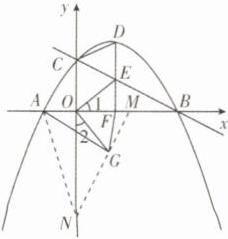
12. (2025·烟台中考)如图,抛物线$y=ax^2+bx+3$与x轴交于A,B两点(点A在点B左侧),与y轴交于点C,$OA=2,OB=6$,D是直线BC上方抛物线上一动点,作$DF⊥AB$交BC于点E,垂足为点F,连接CD.
(1)求抛物线的表达式.
(2)设点D的横坐标为t.
①用含有t的代数式表示线段DE的长度.
②是否存在点D,使得$△ CDE$是等腰三角形?若存在,请求出所有满足条件的点D的坐标;若不存在,请说明理由.
(3)连接OE,将线段OE绕点O按顺时针方向旋转$90°$得到线段OG,连接AG,请直接写出线段AG长度的最小值.
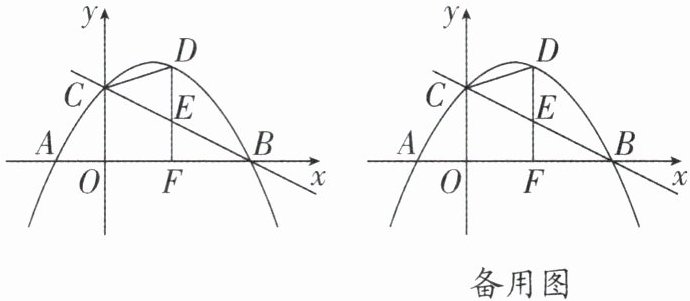
备用图
(1)求抛物线的表达式.
(2)设点D的横坐标为t.
①用含有t的代数式表示线段DE的长度.
②是否存在点D,使得$△ CDE$是等腰三角形?若存在,请求出所有满足条件的点D的坐标;若不存在,请说明理由.
(3)连接OE,将线段OE绕点O按顺时针方向旋转$90°$得到线段OG,连接AG,请直接写出线段AG长度的最小值.
备用图
答案
12. (1) $\because$ 抛物线 $y=ax^2+bx+3$ 与 $x$ 轴交于 $A,B$ 两点(点 $A$ 在点 $B$ 左侧),与 $y$ 轴交于点 $C$,$OA=2$,$OB=6$,$\therefore A(-2,0)$,$B(6,0)$,$\therefore \begin{cases}4a-2b+3=0,\\36a+6b+3=0,\end{cases}$ 解得 $\begin{cases}a=-\dfrac{1}{4},\\b=1,\end{cases}$$\therefore$ 抛物线的表达式为 $y=-\dfrac{1}{4}x^2+x+3$.
(2)①对于抛物线 $y=-\dfrac{1}{4}x^2+x+3$,当 $x=0$ 时,$y=3$,$\therefore C(0,3)$. 设直线 $BC$ 的表达式为 $y=kx+b_1$,则 $\begin{cases}6k+b_1=0,\\b_1=3,\end{cases}$ 解得 $\begin{cases}k=-\dfrac{1}{2},\\b_1=3,\end{cases}$$\therefore$ 直线 $BC$:$y=-\dfrac{1}{2}x+3$.$\because DE⊥ AB$,$\therefore D(t,-\dfrac{1}{4}t^2+t+3)$,$E(t,-\dfrac{1}{2}t+3)$,$\therefore DE=-\dfrac{1}{4}t^2+t+3-(-\dfrac{1}{2}t+3)=-\dfrac{1}{4}t^2+\dfrac{3}{2}t(0<t<6)$.
②存在,由题意得 $CD=\sqrt{t^2+(-\dfrac{1}{4}t^2+t+3-3)^2}=\sqrt{t^2+(-\dfrac{1}{4}t^2+t)^2}$,$CE=\sqrt{t^2+(-\dfrac{1}{2}t+3-3)^2}=\dfrac{\sqrt{5}}{2}t$.
当 $DE=CE$ 时,$-\dfrac{1}{4}t^2+\dfrac{3}{2}t=\dfrac{\sqrt{5}}{2}t$,解得 $t=6-2\sqrt{5}$ 或 $t=0$(舍),$\therefore -\dfrac{1}{4}t^2+t+3=-\dfrac{1}{4}×(6-2\sqrt{5})^2+6-2\sqrt{5}+3=4\sqrt{5}-5$,$\therefore D(6-2\sqrt{5},4\sqrt{5}-5)$;
当 $CD=DE$ 时,$t^2+(-\dfrac{1}{4}t^2+t)^2=(-\dfrac{1}{4}t^2+\dfrac{3}{2}t)^2$,整理得 $t^2(-t+1)=0$,解得 $t=1$ 或 $t=0$(舍),$\therefore -\dfrac{1}{4}t^2+t+3=-\dfrac{1}{4}×1^2+1+3=\dfrac{15}{4}$,$\therefore D(1,\dfrac{15}{4})$;
当 $CD=CE$ 时,$t^2+(-\dfrac{1}{4}t^2+t)^2=(\dfrac{\sqrt{5}}{2}t)^2$,整理得 $t^2(\dfrac{1}{16}t^2-\dfrac{1}{2}t+\dfrac{3}{4})=0$,解得 $t=2$ 或 $t=6$(舍)或 $t=0$(舍),$\therefore -\dfrac{1}{4}t^2+t+3=-\dfrac{1}{4}×2^2+2+3=4$,$\therefore D(2,4)$.
综上所述,$△ CDE$ 是等腰三角形时,$D(2,4)$ 或 $D(1,\dfrac{15}{4})$ 或 $D(6-2\sqrt{5},4\sqrt{5}-5)$.
(3)在 $y$ 轴负半轴取点 $N(0,-6)$,连接 $NG$ 并延长,交 $x$ 轴于点 $M$,连接 $AN$,由旋转得 $OE=OG$,$∠ EOG=90°$,$\because B(6,0)$,$\therefore OB=ON$.$\because ∠ BON=90°$,$\therefore ∠1=∠2=90°-∠ MOG$,$\therefore △ BOE≌△ NOG(\mathrm{SAS})$,$\therefore ∠ CBO=∠ MNO$,$\therefore$ 点 $G$ 在线段 $MN$ 上运动(不包括端点),$\therefore$ 当 $AG⊥ MN$ 时,$AG$ 最小.$\because ∠ CBO=∠ MNO$,$OB=ON$,$∠ COB=∠ MON$,$\therefore △ COB≌△ MON(\mathrm{ASA})$,$\therefore OM=OC=3$,$\therefore MN=\sqrt{OM^2+ON^2}=3\sqrt{5}$,$\therefore$ 当 $AG⊥ MN$ 时,$S_{△ AMN}=\dfrac{1}{2}AM· ON=\dfrac{1}{2}MN· AG$,$\therefore \dfrac{1}{2}×5×6=\dfrac{1}{2}×3\sqrt{5}× AG$,$\therefore AG=2\sqrt{5}$,$\therefore$ 线段 $AG$ 长度的最小值为 $2\sqrt{5}$.