

 登录
登录
Ⅰ. Add a prefix (re-, un-) or suffix (-ive, -or, -ful, -able, -ness, -ous, -less) to the given words.
1. use→(adj.)
2. write→(v.)
3. kind→(n.)
4. care→(n.)
5. danger→(adj.)
6. effect→(adj.)
7. act→(n.)
8. forget→(adj.)
1. use→(adj.)
useful
(help a lot)2. write→(v.)
rewrite
(write again)3. kind→(n.)
kindness
(in a kind way)4. care→(n.)
careless
(without care)5. danger→(adj.)
dangerous
(full of danger)6. effect→(adj.)
effective
(having a strong effect)7. act→(n.)
actor
(a man who acts)8. forget→(adj.)
unforgettable
(never to be forgotten)答案
1. useful 2. rewrite 3. kindness 4. careless 5. dangerous 6. effective
7. actor 8. unforgettable
7. actor 8. unforgettable
解析
【分析】
本题为英语构词题,需结合括号内的释义,从给定的前缀(re-、un-)和后缀(-ive、-or、-ful、-able、-ness、-ous、-less)中选择合适的词缀,将给定单词转换为对应词性的单词。解题时先明确每个单词目标词性,再根据释义匹配正确词缀,注意拼写规则即可。
【解析】
1. 需将use变为形容词,释义为“帮助很多”,后缀-ful表“充满…的”,故加-ful得useful;
2. 需将write变为动词,释义为“再写”,前缀re-表“再、重新”,故加re-得rewrite;
3. 需将kind变为名词,释义为“以友善的方式”,后缀-ness表“性质、状态”,故加-ness得kindness;
4. 需将care变为名词,释义为“没有小心”,后缀-less表“无、没有”,故加-less得careless;
5. 需将danger变为形容词,释义为“充满危险的”,后缀-ous表“充满…的”,故加-ous得dangerous;
6. 需将effect变为形容词,释义为“有强烈效果的”,后缀-ive表“有…性质的”,故加-ive得effective;
7. 需将act变为表人的名词,释义为“表演的人”,后缀-or表“人”,故加-or得actor;
8. 需将forget变为形容词,释义为“永远不会被忘记的”,前缀un-表“不”,故加un-得unforgettable。
【答案】
1. useful 2. rewrite 3. kindness 4. careless 5. dangerous 6. effective 7. actor 8. unforgettable
【知识点】
英语构词法、前缀后缀用法、词性转换
【点评】
本题考查基础的英语构词规则,是英语词汇学习的核心题型之一,要求学生掌握常见前缀和后缀的含义及用法,结合释义即可完成,难度较低。
【难度系数】
0.3
本题为英语构词题,需结合括号内的释义,从给定的前缀(re-、un-)和后缀(-ive、-or、-ful、-able、-ness、-ous、-less)中选择合适的词缀,将给定单词转换为对应词性的单词。解题时先明确每个单词目标词性,再根据释义匹配正确词缀,注意拼写规则即可。
【解析】
1. 需将use变为形容词,释义为“帮助很多”,后缀-ful表“充满…的”,故加-ful得useful;
2. 需将write变为动词,释义为“再写”,前缀re-表“再、重新”,故加re-得rewrite;
3. 需将kind变为名词,释义为“以友善的方式”,后缀-ness表“性质、状态”,故加-ness得kindness;
4. 需将care变为名词,释义为“没有小心”,后缀-less表“无、没有”,故加-less得careless;
5. 需将danger变为形容词,释义为“充满危险的”,后缀-ous表“充满…的”,故加-ous得dangerous;
6. 需将effect变为形容词,释义为“有强烈效果的”,后缀-ive表“有…性质的”,故加-ive得effective;
7. 需将act变为表人的名词,释义为“表演的人”,后缀-or表“人”,故加-or得actor;
8. 需将forget变为形容词,释义为“永远不会被忘记的”,前缀un-表“不”,故加un-得unforgettable。
【答案】
1. useful 2. rewrite 3. kindness 4. careless 5. dangerous 6. effective 7. actor 8. unforgettable
【知识点】
英语构词法、前缀后缀用法、词性转换
【点评】
本题考查基础的英语构词规则,是英语词汇学习的核心题型之一,要求学生掌握常见前缀和后缀的含义及用法,结合释义即可完成,难度较低。
【难度系数】
0.3
Ⅱ. Complete the sentences with the words from Exercise Ⅰ.
1. It is
2. He lost his wallet because he was
3. The young
4. The trip to the beach was an
5. I remember the
6. Taking notes is a very
7. Mr Li asked me to
8. Studying for 30 minutes and then taking a short break is an
1. It is
dangerous
to text on your phone while riding a bike.2. He lost his wallet because he was
careless
and left it on the bus.3. The young
actor
was nervous before his first performance on stage.4. The trip to the beach was an
unforgettable
experience for my whole family.5. I remember the
kindness
of the stranger who helped me find my way home.6. Taking notes is a very
useful
habit for remembering important information.7. Mr Li asked me to
rewrite
my composition because I made many mistakes.8. Studying for 30 minutes and then taking a short break is an
effective
way to improve memory.答案
1. dangerous 2. careless 3. actor 4. unforgettable 5. kindness
6. useful 7. rewrite 8. effective
6. useful 7. rewrite 8. effective
解析
【分析】本题为语境填词题,需结合句子的语义逻辑和语法结构,判断空格处所需单词的词性,再匹配词义恰当的单词,确保填入后句子通顺合理。
【解析】1. 句意为“骑车时玩手机是危险的”,空格处需形容词作表语,故填dangerous;2. 句意为“他丢了钱包因为他粗心,把钱包落在公交车上”,空格处需形容词作表语,故填careless;3. 句意为“这位年轻演员第一次登台表演前很紧张”,空格处需名词作主语,故填actor;4. 句意为“这次海滩旅行对我们全家来说是难忘的经历”,空格处需形容词修饰名词experience,故填unforgettable;5. 句意为“我记得那个帮我找到回家路的陌生人的善意”,空格处需名词作宾语,故填kindness;6. 句意为“记笔记是记住重要信息的非常有用的习惯”,空格处需形容词修饰名词habit,故填useful;7. 句意为“李老师让我重写我的作文因为我犯了很多错误”,ask sb to do sth结构要求空格处为动词原形,故填rewrite;8. 句意为“学习30分钟然后短暂休息是提高记忆力的有效方法”,空格处需形容词修饰名词way,故填effective。
【答案】1. dangerous 2. careless 3. actor 4. unforgettable 5. kindness 6. useful 7. rewrite 8. effective
【知识点】语境填词、词汇运用、词性辨析
【点评】本题考查词汇在具体语境中的灵活运用,要求学生掌握单词的词义、词性及常用搭配,属于基础题型,能有效检验学生的词汇掌握情况。
【难度系数】0.6
【解析】1. 句意为“骑车时玩手机是危险的”,空格处需形容词作表语,故填dangerous;2. 句意为“他丢了钱包因为他粗心,把钱包落在公交车上”,空格处需形容词作表语,故填careless;3. 句意为“这位年轻演员第一次登台表演前很紧张”,空格处需名词作主语,故填actor;4. 句意为“这次海滩旅行对我们全家来说是难忘的经历”,空格处需形容词修饰名词experience,故填unforgettable;5. 句意为“我记得那个帮我找到回家路的陌生人的善意”,空格处需名词作宾语,故填kindness;6. 句意为“记笔记是记住重要信息的非常有用的习惯”,空格处需形容词修饰名词habit,故填useful;7. 句意为“李老师让我重写我的作文因为我犯了很多错误”,ask sb to do sth结构要求空格处为动词原形,故填rewrite;8. 句意为“学习30分钟然后短暂休息是提高记忆力的有效方法”,空格处需形容词修饰名词way,故填effective。
【答案】1. dangerous 2. careless 3. actor 4. unforgettable 5. kindness 6. useful 7. rewrite 8. effective
【知识点】语境填词、词汇运用、词性辨析
【点评】本题考查词汇在具体语境中的灵活运用,要求学生掌握单词的词义、词性及常用搭配,属于基础题型,能有效检验学生的词汇掌握情况。
【难度系数】0.6
Ⅲ. Read and complete the tasks.
A. Complete the passage with correct sentences. There is one extra option.
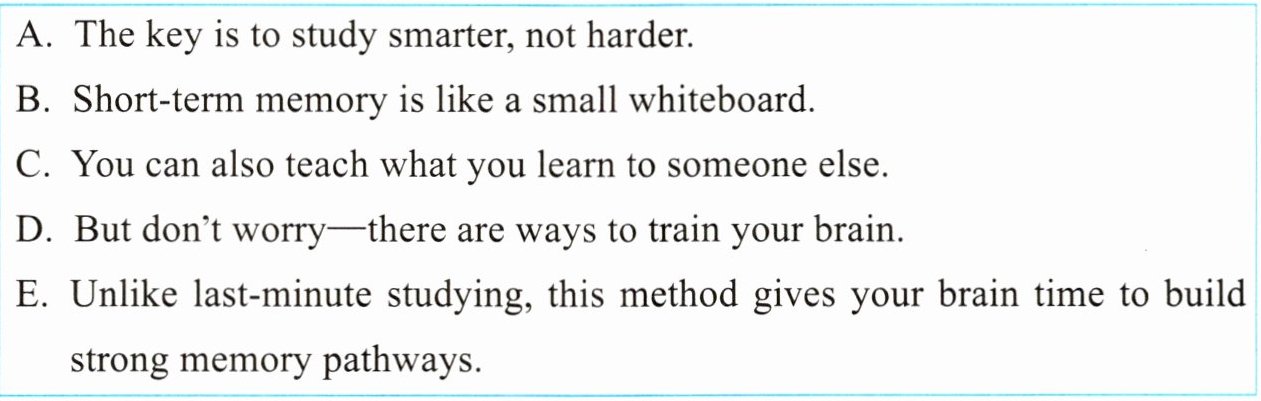
Have you ever studied for hours only to forget everything the next day? You’re not alone—this happens to almost everyone. 1.
Our brain has two main types of memory: short-term and long-term. When you learn something new, it first goes into your short-term memory. 2.
The first is spaced practice. Instead of studying everything in a long period of time, spread your study out over several days. 3.
The second is retrieval practice. Stop simply re-reading your notes. Close
the book and try to remember what you have just learnt.
The third is creating connections. Try different ways to memorize information. Draw pictures. Make up stories. Connect new ideas to things you already know.
These techniques don’t require special equipment—just a little planning. 4.
B. Answer the questions.
(
A. Reading your notes again and again.
B. Drawing pictures to help you remember.
C. Closing the book and trying to remember.
D. Teaching what you learn to someone else.
2. Why does the writer compare short-term memory to a small whiteboard?
A. Complete the passage with correct sentences. There is one extra option.
Have you ever studied for hours only to forget everything the next day? You’re not alone—this happens to almost everyone. 1.
D
Our brain has two main types of memory: short-term and long-term. When you learn something new, it first goes into your short-term memory. 2.
B
It can only hold a few things at once, and information fades away quickly. Scientists have found three learning principles that are truly effective.The first is spaced practice. Instead of studying everything in a long period of time, spread your study out over several days. 3.
E
The second is retrieval practice. Stop simply re-reading your notes. Close
the book and try to remember what you have just learnt.
The third is creating connections. Try different ways to memorize information. Draw pictures. Make up stories. Connect new ideas to things you already know.
These techniques don’t require special equipment—just a little planning. 4.
A
Try just one of these methods for your next test and see what happens!B. Answer the questions.
(
C
)1. What does “retrieval practice” mean according to the passage?A. Reading your notes again and again.
B. Drawing pictures to help you remember.
C. Closing the book and trying to remember.
D. Teaching what you learn to someone else.
2. Why does the writer compare short-term memory to a small whiteboard?
One possible version: Because short-term memory can only hold a few things at once, and information quickly fades away—just like a small whiteboard that has limited space and gets erased easily.
答案
A. 1. D 2. B 3. E 4. A
B. 1. C
2. One possible version: Because short-term memory can only hold a few things at once, and information quickly fades away—just like a small whiteboard that has limited space and gets erased easily.
B. 1. C
2. One possible version: Because short-term memory can only hold a few things at once, and information quickly fades away—just like a small whiteboard that has limited space and gets erased easily.
解析
【分析】
本题分为两部分,A部分为补全段落,需结合上下文逻辑选择合适句子;B部分为细节理解题,需定位原文信息作答。A部分解题思路:先分析第1空,前文提到学习后遗忘的问题,后文介绍解决方法,需选引出方法的句子;第2空前文讲短期记忆,后文说明其特点,需选引出比喻的句子;第3空前文讲间隔练习,需选解释该方法作用的句子;第4空前文介绍学习技巧,需选总结核心的句子。B部分第1题定位“retrieval practice”的定义,第2题找短期记忆特点的原文信息。
【解析】
A. 补全段落:
1. 第1空:前文提出学习遗忘的问题,后文介绍解决方法,D选项“But don’t worry—there are ways to train your brain.”承接问题引出方法,故选D;
2. 第2空:前文提到短期记忆,后文说明其特点,B选项“Short-term memory is like a small whiteboard.”用比喻引出短期记忆的特点,故选B;
3. 第3空:前文讲间隔练习的方法,E选项“Unlike last-minute studying, this method gives your brain time to build strong memory pathways.”对比临时学习说明间隔练习的作用,故选E;
4. 第4空:前文介绍学习技巧,后文建议尝试方法,A选项“The key is to study smarter, not harder.”总结学习的核心,故选A;
B. 回答问题:
1. 第1题:原文明确“retrieval practice”是“Stop simply re-reading your notes. Close the book and try to remember what you have just learnt.”,对应选项C;
2. 第2题:原文提到短期记忆的特点是“It can only hold a few things at once, and information fades away quickly.”,因此比作小白板的原因是该特点。
【答案】
A.1.D 2.B 3.E 4.A;B.1.C;2. Because short-term memory can only hold a few things at once, and information fades away quickly, just like a small whiteboard with limited space that is easy to erase.
【知识点】
英语阅读理解(段落衔接)、英语阅读理解(细节理解)、英语原因表达
【点评】
本题考查英语阅读理解的综合应用,涵盖段落逻辑衔接和细节信息提取,要求学生结合上下文语境分析句子连贯性,准确定位原文细节并整理答案,是初中英语常见题型。
【难度系数】
0.5
本题分为两部分,A部分为补全段落,需结合上下文逻辑选择合适句子;B部分为细节理解题,需定位原文信息作答。A部分解题思路:先分析第1空,前文提到学习后遗忘的问题,后文介绍解决方法,需选引出方法的句子;第2空前文讲短期记忆,后文说明其特点,需选引出比喻的句子;第3空前文讲间隔练习,需选解释该方法作用的句子;第4空前文介绍学习技巧,需选总结核心的句子。B部分第1题定位“retrieval practice”的定义,第2题找短期记忆特点的原文信息。
【解析】
A. 补全段落:
1. 第1空:前文提出学习遗忘的问题,后文介绍解决方法,D选项“But don’t worry—there are ways to train your brain.”承接问题引出方法,故选D;
2. 第2空:前文提到短期记忆,后文说明其特点,B选项“Short-term memory is like a small whiteboard.”用比喻引出短期记忆的特点,故选B;
3. 第3空:前文讲间隔练习的方法,E选项“Unlike last-minute studying, this method gives your brain time to build strong memory pathways.”对比临时学习说明间隔练习的作用,故选E;
4. 第4空:前文介绍学习技巧,后文建议尝试方法,A选项“The key is to study smarter, not harder.”总结学习的核心,故选A;
B. 回答问题:
1. 第1题:原文明确“retrieval practice”是“Stop simply re-reading your notes. Close the book and try to remember what you have just learnt.”,对应选项C;
2. 第2题:原文提到短期记忆的特点是“It can only hold a few things at once, and information fades away quickly.”,因此比作小白板的原因是该特点。
【答案】
A.1.D 2.B 3.E 4.A;B.1.C;2. Because short-term memory can only hold a few things at once, and information fades away quickly, just like a small whiteboard with limited space that is easy to erase.
【知识点】
英语阅读理解(段落衔接)、英语阅读理解(细节理解)、英语原因表达
【点评】
本题考查英语阅读理解的综合应用,涵盖段落逻辑衔接和细节信息提取,要求学生结合上下文语境分析句子连贯性,准确定位原文细节并整理答案,是初中英语常见题型。
【难度系数】
0.5
